
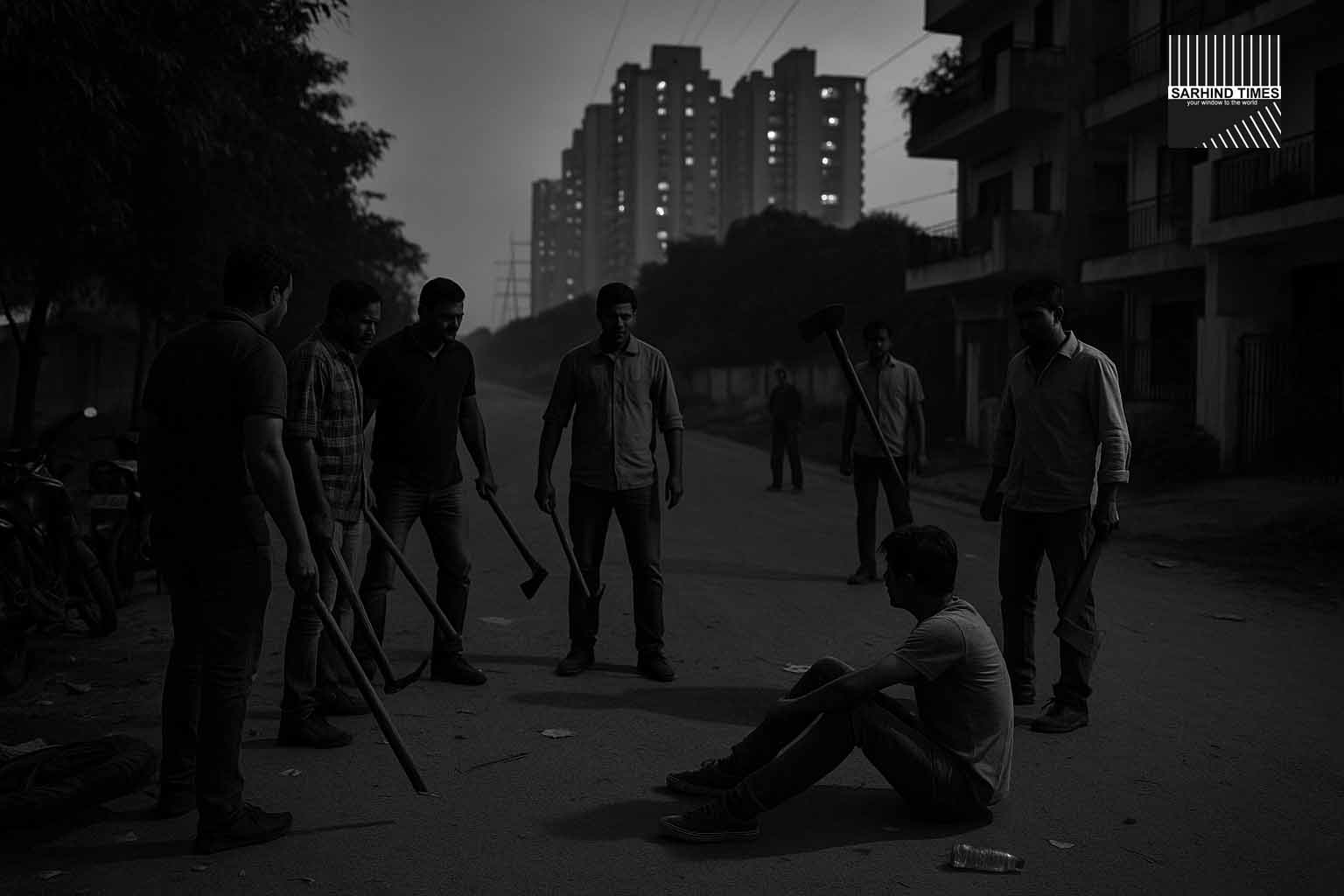
Half-dozen attackers descend on youth after minor dispute, raise fresh concerns over vigilante violence in NCR
Dateline: Gurugram | 25 November 2025
Summary: In a chilling incident in Gurugram’s Sector 10, a young man was subjected to an organised, weapon-rich assault by six attackers wielding axes and sticks following a trivial argument. The victim remains in critical condition, while the police have launched a manhunt and raised grave questions about neighbourhood safety and law enforcement response.
1. The Incident Unfolds
In the early afternoon of 24 November, residents of Sector 10 in Gurugram were startled by the sight of a young man lying severely wounded on the pavement, near the green belt adjacent to the KMP Expressway. He had been attacked by a group of more than half-a-dozen men, wielding axes, lathis (sticks) and other sharp implements. The assault, which reportedly followed a minor dispute, quickly escalated into a brutal, pre-planned rampage.
According to eyewitnesses, the victim, identified as “Abhishek” (name changed), had been involved in a verbal exchange a day earlier with one member of what has now been characterised as a local gang. The next day, the assailants, fully armed, surrounded him and carried out the attack in broad daylight. One neighbour recalled hearing the thud of a metal strike, followed by shouts and the victim screaming for help.
The attackers escaped before the police could arrive, leaving in their wake a scene of carnage—blood-soaked pavement, broken sticks and axes scattered around, and a crowd of shocked bystanders. The victim was rushed to hospital by local residents. His condition remains critical.
2. Police Response & Initial Investigation
The case was registered at the Sector 50 police station in Gurugram. The police spokesperson confirmed that an FIR has been lodged for attempted murder and illegal weapons, and multiple teams have been deployed to track down the suspects. CCTV footage from nearby streets and the KMP Expressway green belt is being examined, and the bodies of two suspected attackers are reportedly seen on camera exiting the area on scooters shortly after the attack.
According to senior officers, the planned nature of the assault—use of axes, coding of the meeting location, coordinated arrival of attackers—points to a deliberate “go-for-blood” exercise rather than a spontaneous fight. Investigators say they are exploring whether this was a settled personal grievance or linked to a larger criminal network exploiting territorial control in Gurugram’s outskirts.
3. A Minor Dispute with Major Consequences
The genesis of this incident appears to be a minor dispute. One report indicates that the victim and a close friend had inadvertently offended a group of local youths by refusing to join a late-night rumble, or intervention in a neighbourhood fracas. What started as an insult reportedly escalated into a revenge attack—with the assailants returning the next day with weapons in hand.
Often in urban fringe zones like Gurugram’s Sector 10, disputes that may seem trivial morph into violent episodes because of the proximity to expressways, poor lighting, and semi-industrial neighbourhoods. In this case, the attackers exploited the green belt and access routes near the KMP Expressway to execute the assault and escape swiftly.
4. Weapons, Tactics and Fear Factor
That a group of six or more men could collectively carry axes and sticks into a neighbourhood lane, commit a violent assault and leave before reinforcements arrived signals a troubling combination of audacity and impunity. Locals interviewed later described a “planned ambush” scenario in which the attackers timed their arrival when few people were around and struck while the victim was alone.
One neighbour, speaking on condition of anonymity, said: “We heard an argument, then a crash. When we came out, he was sprawled. They had axes. We only dared to help after they left. It was terrifying.” The use of traditional weapons like axes and sticks suggests access to crude but effective instruments of violence, rather than firearms—words that may mislead to thinking this is less serious; in fact, such tools often cause severe injury and signal low-tech but high-damage organised attacks.
5. Medical Condition & Victim Profile
The victim, a 22-year-old local resident engaged in a private job, was admitted to a nearby hospital in critical condition with multiple head and limb injuries. The medical team reports life-threatening trauma, including fractures, deep lacerations consistent with axe blows and haemorrhaging. He remains under monitoring in the ICU, with surgery underway.
No motive has yet been publicly confirmed by the police. The victim’s family is cooperating with the investigation, and investigators are also analysing mobile phone call logs and messages to trace the preparatory steps taken by the accused. Police say that the gravity of injuries suggests the attackers intended serious harm or death, not just intimidation.
6. Background: Rising Violence in Gurugram’s Fringe Zones
Gurugram has long been an emblem of rapid urban growth in Haryana — but with growth has come socio-economic pressure. Between high-end sectors and industrial belts lie areas where civic amenities are thin, street lighting is sporadic, and policing is stretched. These zones often become theatres of violent crime, especially late-night spats, drunken brawls and gang-style vengeance attacks.
According to local crime trackers, there has been a growing trend of group assaults where axes, knives and sticks are used rather than guns—possibly because they are easier to conceal and attract less immediate attention. This incident fits that pattern. The green-belt access alongside the expressway adds to the vulnerability: isolated stretches, fewer witnesses, easy escape.
7. Local Residents and Mobilisation of Fear
In the immediate aftermath, residents of Sector 10 were shaken. Some temporarily avoided venturing outside after dark, and apartment security guards reported heightened alertness. WhatsApp groups and resident welfare associations have demanded increased patrolling and CCTV coverage. A meeting of the residents was convened the same evening, calling for street-level lighting upgrades and urgent police presence.
One local businessman interviewed said: “We thought Gurugram meant security, big-city perks. But when a group strikes with axes at noon, it reminds you that lawlessness lurks at the edges.” The community also expressed frustration at what they described as delayed police arrival; though the attack was reported quickly, the actual scene-of-crime team arrived only 30 minutes later.
8. Police Strategy & Preliminary Leads
Gurugram Police have formed a dedicated six-officer team led by ACP Patoudi Sector, along with forensic and technical support teams. CCTV footage near the KMP Expressway green belt and Sector 10 lanes is being analysed for license-plate numbers. Data from telecom towers has been requisitioned to track mobile hand-overs during the time of attack.
Furthermore, police have appealed to the public for information and anonymous tips, offering rewards in accordance with standard policy. They are treating the case as a planned attempted murder rather than rash assault, and have invoked relevant sections under the  new Bhartiya Nyaya Sanhita 2023 that address gang-style violence, organised crime and possession of weapons.
Given the use of axes and the coordination involved, investigators are probing whether the suspects belong to any local criminal formation or hail from neighbouring villages with prior dispute connections. The quick escape route via the expressway’s green belt is also being treated as part of the premeditation.
9. Policy Implications & Enforcement Gaps
What makes this incident significant beyond its brutality is that it highlights enforcement gaps. How did six men mobilise weapons in a residential area during daylight without triggering immediate community alarm? How did they coordinate escape routes? And how effectively are early-warning systems, such as block-level patrols and CCTV monitoring, working in fringe residential zones?
Urban planners and policing experts say that fast-growing city outskirts like Gurugram’s Sector 10 often fall into policing blind-spots: moth-balling of formal neighbourhood watch, inadequate lighting, mixed zoning of industrial/residential use and rapid in-migration. These patterns create fertile ground for rackets, local strong-man culture and quick violence. Without systematic street-level policing, such incidents can proliferate.
10. Community Response and Preventive Measures
In the wake of the attack, community leaders and Resident Welfare Associations (RWAs) have demanded several immediate measures: enhanced policing presence especially during evening hours, reconstruction of old CCTV installations, installation of motion-activated lighting along the green belt, stronger liaison between police and neighbourhood security, and awareness drives for local youth about consequences of violence.
A resident-organised patrol group has also been formed in Sector 10, operating on a volunteer basis (with residents rotating shifts between 9 pm–4 am) to act as mobile observers, report suspicious movement and coordinate with the local police station. While private security firms operate within major apartment complexes, the green belt and public lane zones remain outside their jurisdiction—a gap that local residents hope to plug through collective vigilance.
11. Legal Trajectory and What to Watch For
From a legal standpoint, the case has several key markers to monitor: whether the police identify and arrest the six named attackers, mode of evidence collection (video, mobile logs, weapon recovery), and how the prosecution frames the case under BNS provisions for organised assault. Given the gravity of injuries, the victim’s family may pursue additional civil actions or request enhanced compensation from the state under corporate nuisance or collective security failure.
Another crucial question is whether this incident will trigger deeper investigations into local gang influence in Gurugram’s outskirts. If the attack links to a larger rhyming of weapon-ready groups exploiting expressway corridors, it may prompt focused state-level directives on dismantling such networks.
12. Looking Ahead: Building Resilience in Urban Perimeters
This incident is a stark reminder that rapid urbanisation brings not just height and glass facades, but also hidden shadow zones. For Gurugram to sustain its image as a smart-city and safe metropolis, the challenge lies in securing its peripheral areas—green belts, expressway corridors, mixed-use zones—where formal policing often lags.
For residents, the lesson is clear: collective vigilance matters. Street-level lighting, active RWA-police coordination, and transparent incident reporting go beyond CCTV installation. For the administration, this is a prompt to intensify patrolling, upgrade surveillance to real time and deploy mobile strike units for fringe zones.
If the Gurugram police succeed in arresting the attackers and mapping the underlying network, this case could become a model for swift justice and deterrence. If not, the chilling nature of the attack and the ease of escape may embolden similar crimes.
13. Victim Support and Rehabilitation
As the investigation progresses, the injured victim’s road to recovery is expected to be long. Multiple surgeries, physiotherapy and psychological counselling await. The family, deeply traumatised, is in discussions with legal advisors about compensation and long-term care support. Local voluntary groups have also stepped in to provide meals and transport assistance for hospital visits.
Separately, Gurugram’s security agencies are coordinating to ensure the victim’s family is relocated if needed to reduce ongoing threat perception, and that their housing complex’s security is enhanced, given the potential for retributive violence until suspects are apprehended.
14. Societal Angle: Youth, Escalation and Urban Stress
This incident raises deeper questions about youth aggression, informal justice and the proliferation of violence in modern city-spaces. A casual argument became a fully-armed mob attack in a matter of hours—a transformation that suggests elevated triggers, ready weapons, and latent grievances milling beneath the surface of urban life.
The stress of migration, job insecurity, hierarchy battles, territorial assertions and easy escape routes contribute to the volatile mix. Gurugram, once a promise of urban opportunity, now must contend with the shadow-side of growth: anonymity, weak community bonds and heightened risk of collective violence.
15. Final Word: A Wake-Up Call for the City
For Gurugram’s residents, especially in the fringe sectors, yesterday’s daylight brick-lane attack should not be dismissed as isolated. It symbolises a fault-line in city security. Urbanisation cannot be claimed without urban safety. The speed with which six men armed with axes carried out a brutal attack and vanished is a wake-up call.
As police chase leads and residents re-organise for vigilance, the real test will not be simply arrests—but prevention. Because the next attack may not wait for daylight, and the next weapon might be far more lethal.


+ There are no comments
Add yours