
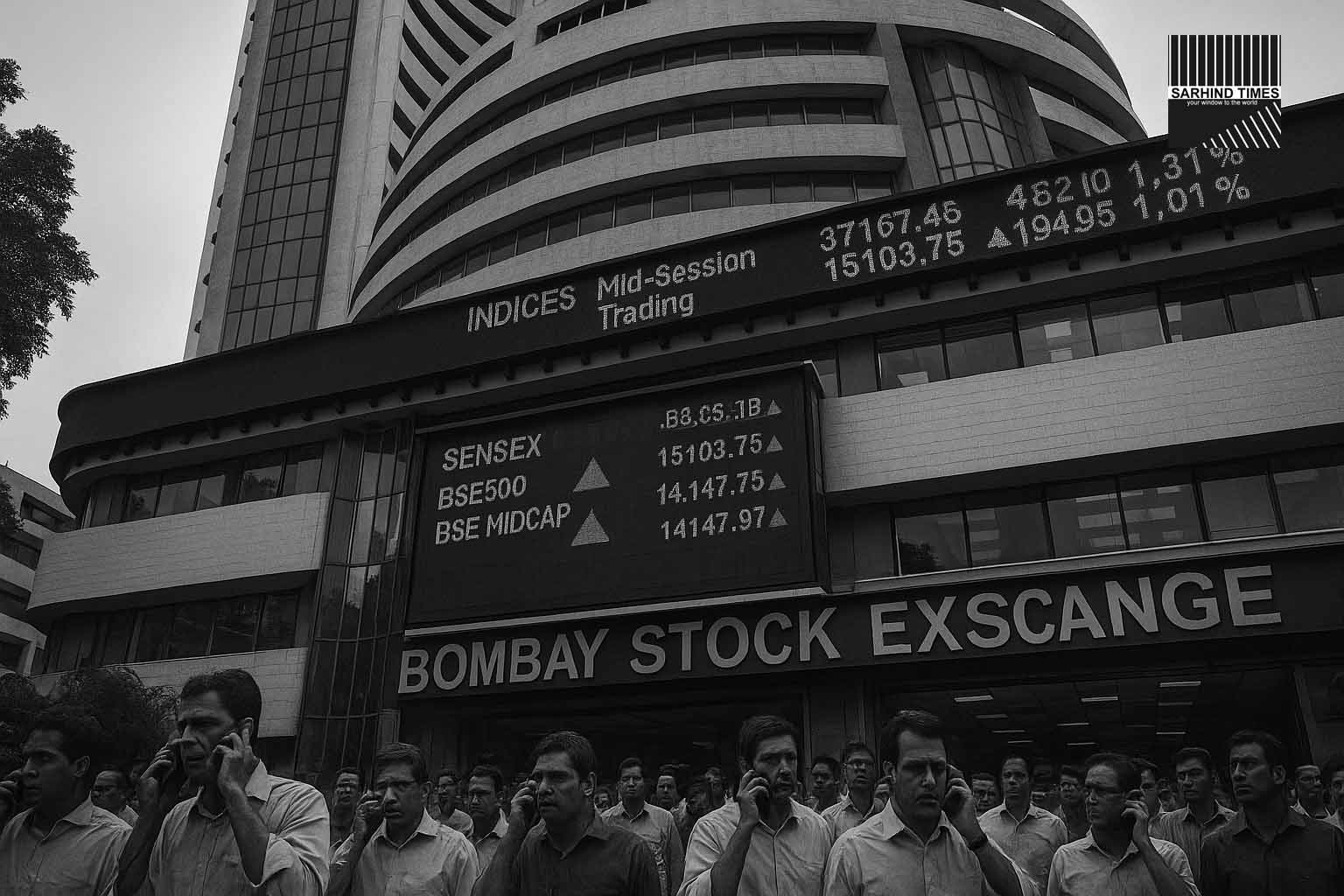
Major broker upgrades and fresh inflows hint at recovery—but key risks remain for Dalal Street
Dateline: Mumbai | 25 November 2025
Summary: Indian equity markets are showing signs of revival, with global brokerages like HSBC forecasting stronger numbers ahead and domestic benchmarks hovering near record highs. Yet with foreign outflows, currency vulnerability and global headwinds still in play, the road from momentum to sustained breakout is paved with questions.
Market at a Glance: Where Things Stand
Meanwhile, the BSE Sensex has also been inching closer to all-time highs, though inward foreign investor flows have remained cautious. (Times of India data)
One of the major global voices raising its India equity target is HSBC Global Investment Research, which expects the Sensex to reach 94,000 by end-2026 — roughly a 10 % upside from current levels. Their thesis: earnings recovery, margin expansion in banking, and tail-winds for consumer/auto names as GST cuts and interest rate easing kick in. (Reuters data)
So, on the surface, the story is positive: valuations are not frothy relative to some peers, domestic trends are supportive, and the base case looks constructive. But a closer look reveals a complex mix of opportunities and vulnerabilities.
What’s Driving the Optimism?
There are three clear thrusts behind the bullish increment in sentiment.
1. Earnings Ahead of Cycle Low — Analysts believe corporate earnings in India may have bottomed out and are set for recovery. Banking margins, in particular, are expected to expand with softening rates, while consumer names may benefit from demand bounce once GST cuts and monetary policy axis turn favourable.
2. Valuations Have Cooled. Even though Indian equities have not lagged massively, the gap of foreign flows and performance relative to other emerging markets has created a catch-up potential. HSBC explicitly notes that India is well-positioned to attract emerging-market capital seeking growth beyond just AI themes.
3. Technicals and Breadth Improving. Domestic trading behaviour suggests dips are being bought, the support around the 25,800–26,000 level has held, and key stocks in banking and infrastructure are being referenced as fresh picks. (Economic Times / IndiaInfoline commentary)
The Risks That Remain Under The Hood
Despite the positive backdrop, there are several red flags and areas of concern that could derail momentum.
A. Foreign Portfolio Investor (FPI) flows remain volatile. While domestic buying has held up, foreign portfolios pulled US$16.8 billion so far in 2025. Although selling pressure eased recently, sustained inflows are not yet guaranteed. If global risk appetite turns, India could again see outflows.
B. Currency and Macro Sensitivities. The rupee has weakened, with some commentary pointing to the exchange rate near ₹89-90 per US$ in prior weeks. A sharp currency correction could spook markets, especially those heavy in external debt or earnings in dollars. (IndiaInfoline data)
C. Global Headwinds & Tech-Exposure Vulnerability. Large parts of emerging market flows are still linked to global growth and tech risk. India’s IT and service exporters could face headwinds if global demand softens. For example, when US data disappointed recently, Indian IT stocks and metal/commodity segments saw pressure.
D. Domestic Growth and Inflation Uncertainties. While earnings may recover, they are not guaranteed. Consumer demand could remain muted if inflation, job insecurity, or interest rates stay elevated. Growth disappointments would weigh heavily on market expectations.
Key Themes to Watch: Which Stocks and Sectors Lead?
Delving deeper, certain sectors are being positioned as likely outperformers, and these will serve as useful gauges for the market’s next leg.
1. Banking & Financials. With interest rates potentially nearing a peak or moving sideways, the scope for margin expansion in banks exists. HSBC emphasises this as a key driver. Domestic strategy notes highlight broader participation and strength in the PSU banking index.
2. Auto & Consumer Good Firms. As GST rationalisation and rate cuts feed into disposable incomes, auto makers and consumer guzzlers may reclaim some growth. Analysts mention names like major auto manufacturers and consumer staples as structural plays.
3. Infrastructure & Capital Goods. With government push on CAPEX and infrastructure spending under the ’Make-in-India / Green-India’ umbrella, stocks in this theme are in focus. This could also support earnings for suppliers and ancillary industries.
4. Select IT/Export Plays With Global Arbitrage. Even though the export environment remains uncertain, well-placed IT stocks with diversified delivery centres and cost advantages may benefit if global demand rebounds.
Technical Watch-Points & Market Mechanics
From a chart/flow perspective, several technical levels are worth attention:
- Support around Nifty 50 at ~25,800–26,000. A breakdown below could trigger negative sentiment. (LiveMint commentary)
- Resistance around 26,200–26,700 region. A sustained break-above could open the door to 27,000+ territory in the near term.
- Monthly expiry weeks, liquidity roll-over, derivative flows—these mechanics matter more given how quickly sentiment can flip. (Economic Times insight)
Trailing volatility remains elevated relative to typical levels, meaning sharp intra-day swings and sector rotation are likely. Investors are advised to “buy on dips” rather than chase breakouts at current juncture.
Implications for Investors & Wider Economy
For investors, the message is cautiously positive: the market appears set for incremental gains, but large-scale breakout will need broader catalyst confirmation. From an economy perspective, stronger equity markets could feed into greater consumer confidence and wealth effects, reinforcing domestic demand—which in turn helps growth and tax collections.
Yet one must ask: are we already pricing in the easy wins? With many analysts predicting double-digit upside by end-2026, the time-value for investors becomes critical. Waiting for confirmation may be wise rather than jumping in aggressively.
Scenario Analysis: What Could Change the Narrative?
Let’s run through three plausible scenarios.
Scenario 1: Smooth Ride – Base Case. Earnings recover broadly, rupee stabilises, global risk appetite improves. Market tracks slowly higher, reaches 94,000-level Sensex by end-2026 as HSBC estimates.
Scenario 2: Headwinds Persist – Mid Case. Growth remains patchy, inflation hovers, global headwinds linger, but no crash. Market drifts sideways between 25,500-27,500 Nifty zones, occasional sharp corrections but no breakout.
Scenario 3: Negative Tilt – Worst Case. FPI outflows re-intensify, rupee weakens sharply, global slowdown bites exports and earnings. Market breaks support, possibly retracing to 24,000-25,000 Nifty territory or worse.
Policy and Regulatory Watch-List
To make sure you are aligned with the big drivers, here are key policy/regulatory factors to track:
- Any cut in official interest rates by the Reserve Bank of India (RBI) or signals thereof.
- Progress on GST rate rationalisation (as flagged by brokers) which could impact consumption demand.
- Foreign capital flows: any reversal or increase of FPI inflows into Indian equities.
- Government infrastructure or CAPEX announcements, public sector spending plans—especially in marquee sectors.
- Currency movement, especially how the rupee behaves and whether intervention occurs.
Market Sentiment & Retail Behaviour
Interestingly, domestic investors appear more confident than foreign investors at this moment. Dips are being bought, and there is some broadening of participation beyond large-cap names. That said, there remains a risk of “buying sentiment” overshooting if no anchor of earnings or economic growth materialises.
One behavioural insight: analysts warn that if one invests purely on momentum and narrative (e.g., “India story”), without checking fundamentals or downside risks, the risk of disappointment increases. The question remains whether market participants are entering the late phase of the cycle or still early.
Why This Matters Beyond the Trading Desk
When Indian equity markets improve in a sustained way, there are real economy implications: higher wealth for households, improved consumption, better corporate investment, and greater tax revenue for the government. That in turn supports infrastructure and social spending.
From a global investor perspective, India is increasingly being seen as one of the few large-market growth stories—especially as China’s momentum slows. The HSBC upgrade to overweight is a clear recognition of that. If India succeeds, it could attract meaningful emerging-market capital in the coming years.
Key Indicators to Track Moving Forward
Here are five crucial indicators investors and commentators should monitor:
- Quarterly corporate earnings growth, especially banking, auto, consumer goods.
- Foreign portfolio investor (FPI) net flows into Indian equities.
- Movement of the rupee against major currencies and any central bank-intervention signals.
- Break-out above resistance levels in key indices—Nifty above 26,700, Sensex above 94,000-target confidence zone.
- Policy signals on GST, rates and infrastructure spending.
Conclusion: The Indian Market’s Crossroads
The Indian equity market today finds itself at a crossroads. On one hand, the structural story is intact: demographic tailwinds, consumption potential, growing domestic investor base, and global attention. On the other hand, the near-term path is not smooth: earnings must deliver, macro vulnerabilities remain, and global shocks could reverse the narrative.
For the serious investor or commentator, this is a time to be selective, patient and alert. The story is not about missing the move but about making the right move at the right time. If this cycle is the beginning of something long-term, strong entry points will give compounding advantage. If it is nearer the end of the easy gains, caution and risk-management should dominate.
Will this be the breakout year for Indian equities or just another temporary up-leg before consolidation? The answer will shape investment and economic narratives far beyond the trading desks.



+ There are no comments
Add yours