
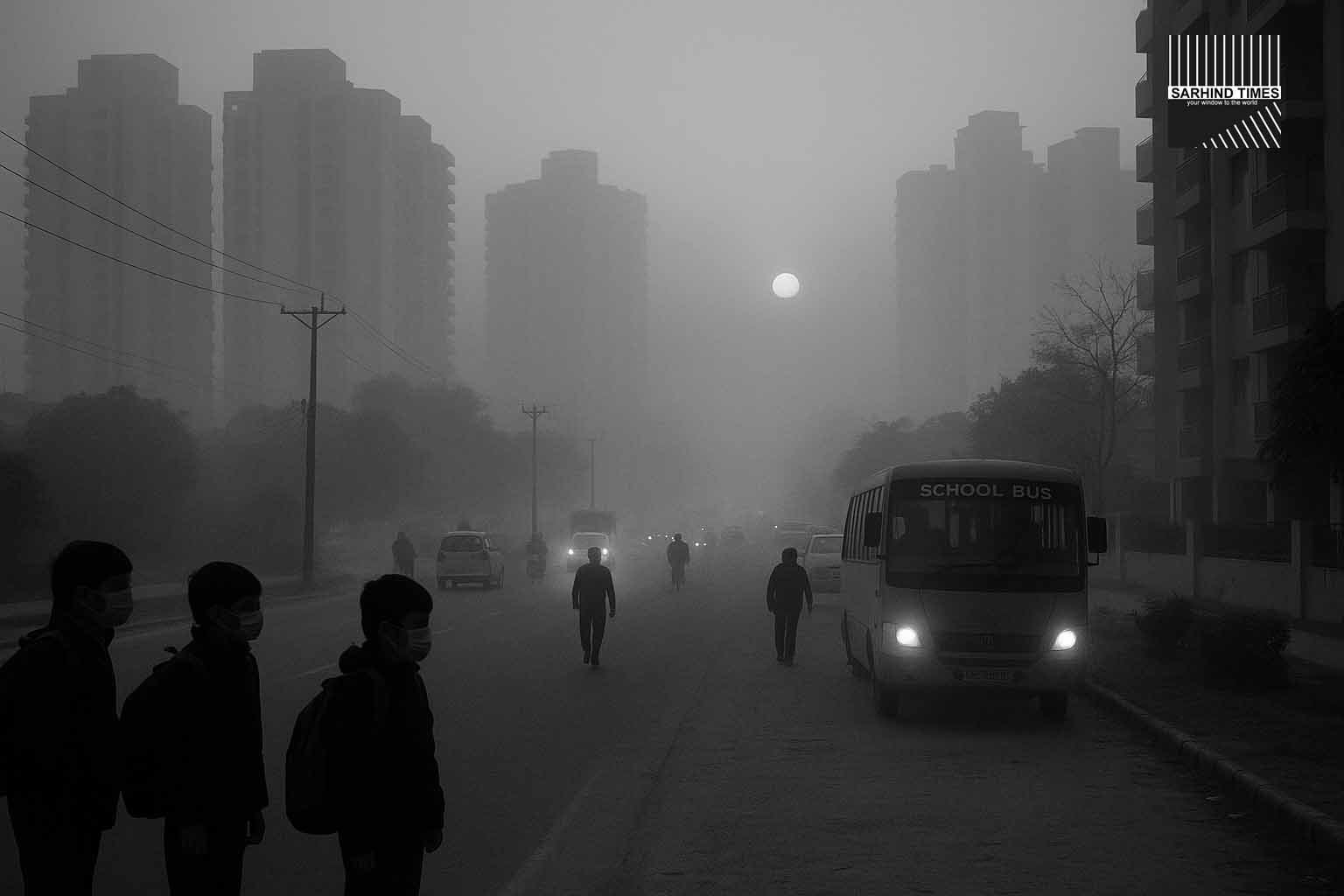
Delhi-NCR, including Gurugram, grapples with record pollution as residents protest and authorities scramble for response
Dateline: Gurugram & Delhi | 11 November 2025
Summary: The annual smog season has arrived early for the National Capital Region, with dangerously poor air quality readings and even public protests. In neighbouring Gurugram, families face a fresh environmental and health challenge as schools and homes are bathed in a haze of PM2.5 and PM10. The crisis is forcing a reckoning on policy, enforcement and citizen action.
Smog returns early, and with a vengeance
As northern India moves into November, the region is seeing a sharper and earlier onset of smog than usual. In the capital city of Delhi, the air quality index (AQI) hovered in the “very poor” range — above 300 on Monday — and residents reported headaches, burning eyes and difficulty breathing. One visitor described the landing in Delhi as akin to stepping into a chemical haze. The protest at India Gate, where dozens were detained, was a rare public display of frustration with the status-quo. This development reverberates for the broader Delhi-NCR region, including Gurugram, which shares the geography, meteorology and pollution sources of the capital.
In Gurugram, the implications are clear. Though aggregated data for Gurugram alone are not yet publicly released in full, localisation of smog and stagnant air is leading to visible haze, reduced visibility, and concern among parents, school-authorities and local businesses. Many families reported school-drop times where children emerge coughing and clutching masks. Residents of high-rise apartments along sectors close to expressways say the haze is thick enough to make distant buildings fade into background greys. This is not business-as-usual; the early onset indicates the usual “waiting until December” posture may no longer suffice.
What’s driving the surge this season?
The causes are a complex mix of perennial and emergent factors:
- Vehicle emissions and congestion: With Gurugram still expanding rapidly, more vehicles, more congestion, more idling on expressways and arterial roads contribute to fine-particle load.
- Construction dust and building activity: High-rise construction continues apace in sectors across Gurugram, often without full enforcement of dust-control norms. These dust particles readily become part of the smog load.
- Regional meteorology: Cooler nights and early stagnation of air mean pollutants hover instead of dispersing. When the mixing layer drops, pollutants accumulate quickly.
- Crop-residue burning in adjacent states: Though Gurugram is urban and not in the paddy-belt itself, regional wind flows carry smog components from nearby states, exacerbating the local situation.
- Indoor-outdoor interplay: Families spending more time inside high-rise buildings may face poorer indoor-air quality if filtration is weak; for children, this can become a serious health hazard.
Experts point out that the early smog season suggests climate-shifts may be altering patterns of dispersion and mixing. The confinement of pollutants is now occurring earlier in the calendar, meaning cities need to begin mitigation well ahead of traditional timelines.
Health impacts: children, schools and vulnerable populations
Of particular concern is the impact on children and those with respiratory vulnerabilities. In Gurugram, many school-administrators are already evaluating whether to postpone early-morning sports, adjust bus routes, and advise mask usage even in well-sealed indoor spaces. Parents express alarm. “We thought October was the tough period, but we’re already in full smog,” said a parent in Sector 44 whose 10-year-old has begun coughing again.
The health risks are not limited to irritation and cough: consistent exposure to elevated PM2.5 levels is associated with impaired lung development in children, increased asthma incidence, and elevated long-term risks of cardiovascular disease. For families in high-rise apartments near major roads, indoor filtration often makes a difference—but many rentals and older homes lack that feature.
Schools under pressure
Schools in Gurugram now face difficult choices. Early-morning assembly outside may expose children to hazardous air even before classroom doors open. Parents and administrators are debating whether to shift to hybrid or indoor-only early-morning sessions. Several institutions have already activated their air-purifier systems, reduced outdoor-activity time and sent notices to parents about mask-use and hydration. The issue no longer seems remote; many school-users query whether this is now a year-round concern, not just the winter months.
Public reaction and protest rise
The protest in Delhi at the India Gate monument—and subsequent detentions of demonstrators chanting “Our right: clear air” — illustrates rising frustration with repeated inaction. When authorities failed to designate the protest site, the police response drew criticism from opposition leaders who questioned why citizens demanding basic environmental rights were treated as law-breakers.
In the wider region including Gurugram, neighbourhood groups are organising more actively. WhatsApp groups, resident-welfare associations (RWAs) and neighbourhood social-media pages are posting real-time AQI alerts, sharing temporary mitigation steps and lobbying local councillors. There is a growing sense among residents: “We cannot remain passive.”
Governance and policy: what’s being done, what’s not
The state and urban authorities are under pressure. Some visible steps have been taken: water-sprinkler trucks on major roads, random monitoring of dust at construction sites, mobile AQI screens across expressways, and cloud-seeding in adjacent areas. However, critics say these are mostly reactive and short-term rather than systemic. The lack of a comprehensive, real-time, enforceable action-plan remains the gap.
For Gurugram, additional complexities arise: the city spans multiple jurisdictions (urban local body, national-capital region authority, state pollution board), making coordinated enforcement challenging. The booming rental apartment population, heavy-vehicle transit and large commercial developments complicate enforcement of dust and emission norms.
Corporate and business implications
For businesses headquartered or operating in Gurugram, the poor air quality adds to the practical costs of operations: employee health, productivity losses, absenteeism, facility-management costs (filters, air-conditioning loads). Some firms are reconsidering transportation schedules (shifting start times), improving indoor-air filtration, and increasing remote-work flexibility during poor-AQI days. Real-estate developers who market premium apartments are now emphasising air-filtration and green-build certifications more vocally, which may shift cost-structures in housing.
Infrastructure and urban planning: longer-term fixes
Mitigating the smog cycle demands long-term infrastructure solutions: more green cover, buffer-zones between highways and residences, better public transport so fewer cars, low-dust roads, advanced construction-site control, tighter fuel-emission norms, and indoor-air filtration standards for high-rise buildings. For Gurugram, each of these is within reach but will require cross-departmental planning and investment.
What residents can do now
While systemic solutions roll out slowly, residents and neighbourhood groups can protect themselves and advocate for change:
- Monitor AQI daily: Apps and public-dashboards show local readings. If it enters “very poor” or “severe”, reduce outdoor exposure especially for children, elderly, pregnant women.
- Home filtration and sealing: Use HEPA-grade air purifiers, ensure windows remain closed during peak pollution hours, clean filters regularly, reduce indoor combustion (candles, incense) during smog spells.
- Mask usage outdoors: Use proper N95/N99 masks when commuting or outdoors in smog; simple cloth masks are insufficient for fine particulates.
- Indoor scheduling: Avoid heavy outdoor physical activity early morning or late evening when the mixing layer is shallow and pollution accumulates.
- Community action: Push for dust-control at nearby sites, report excessive tanker/dust emissions, join RWA efforts, contact local councillors for enforcement of dust suppression and deployment of sprinklers/vegetation.
Looking ahead: a winter of risk and opportunity
This year’s early smog appears to signal a shifting pattern, one that may extend the high-pollution season or deepen its severity. But that also presents opportunity: a more proactive, prepared city can shift from crisis-management to preventive action. For Gurugram, the place to watch is whether administrative agencies, urban planners and residents treat this as a trigger for systemic change or simply another bad winter.
If real change happens—in coordinated monitoring, infrastructure investment, behavioural adaptation and community-base action—then this smog season could mark the pivot point for better air-quality governance in the region. If not, it may be remembered as yet another year where urban‐growth outpaced the capacity to secure breathable air.
Conclusion
The smog that now blankets northern India is a stark reminder that rapid urban growth, infrastructural pressure and meteorological shifts make air-quality management one of the most pressing challenges of our time. Whether in Delhi or Gurugram or the wider region, the risk is real: for health, for productivity, for urban liveability.
For the residents of Gurugram, this is not about waiting for better days—it is about demanding better air today. The hour for accountability, technology, and civic engagement is now.


+ There are no comments
Add yours