
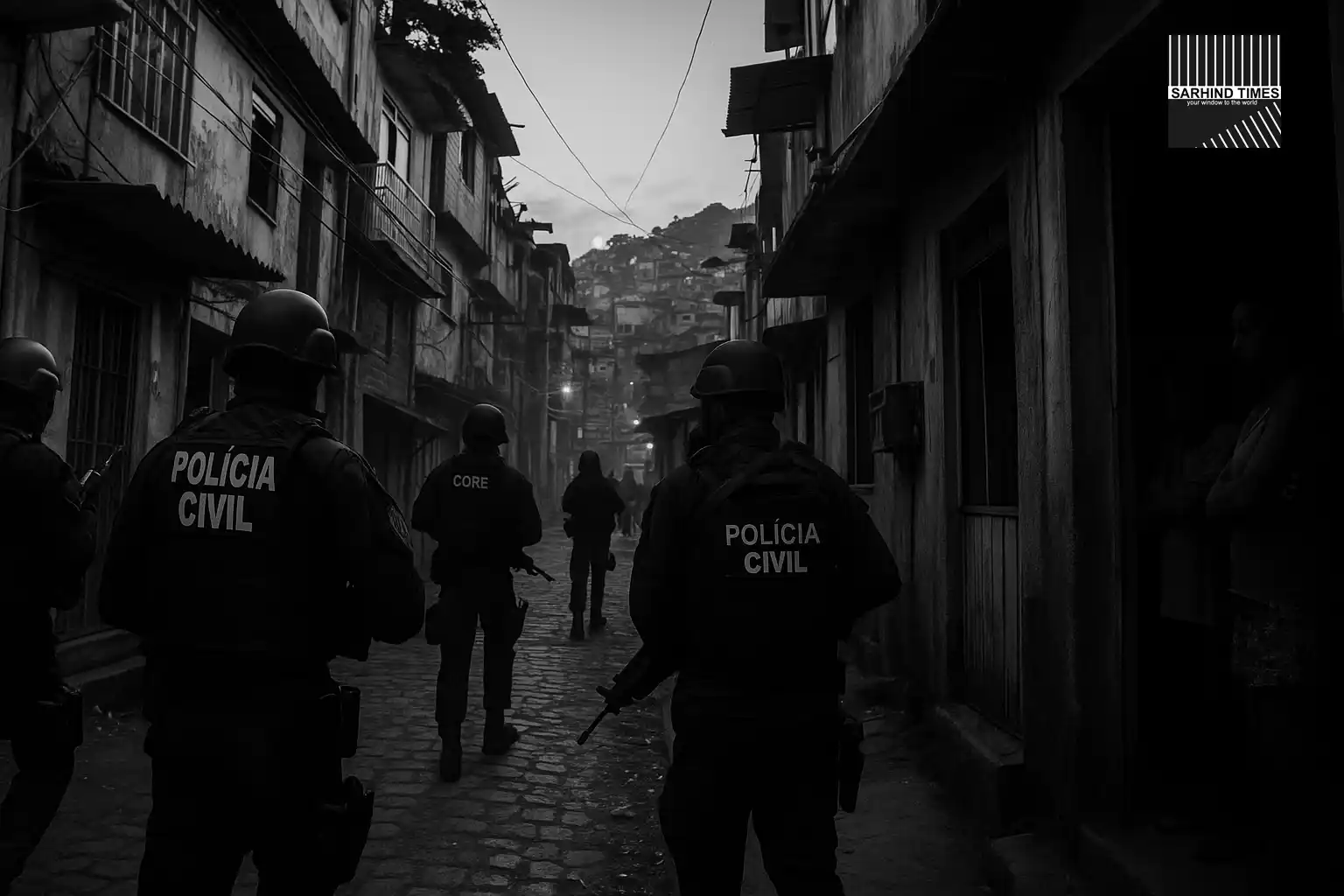
Brazil records its deadliest operation as concerns deepen over policing tactics and human-rights implications
Dateline: Rio de Janeiro | October 30, 2025
Summary: At least **119 people** were killed in a massive police operation targeting a powerful narco-gang in a Rio de Janeiro favela on Wednesday, marking the deadliest such raid in Brazil’s history. The heavy-handed tactics used by Brazilian security forces have triggered international scrutiny of policing standards, gang-control policies and the societal cost of Brazil’s ongoing war against drug traffickers.
Operation Overview: What We Know
Brazilian authorities mounted a sweeping raid early Wednesday morning in a densely populated slum (favela) in Rio de Janeiro, targeting a long-standing narcotics gang that controlled the area. Local residents reportedly heard helicopter gunships, heavy gunfire and saw armoured vehicles rolling in. Reports from news agencies say the death toll has climbed to at least **119**, with dozens more injured.
The raid was touted by police as necessary to dismantle the gang’s operations — involving drug-trafficking, extortion of local residents and illegal arms flows. However, human-rights groups immediately raised alarms, citing the scale of the casualties, the presence of civilian bystanders and the military style of the operation.
Historical Context: Brazil’s Long-Running Favela Policing Challenge
For decades, Rio’s favelas have been contested territories between the state and criminal networks. Gang-controlled slums often feature limited state presence, poor infrastructure, and residents who live under the sway of armed groups. Past operations have brought both dramatic successes (temporary reduction in violence) and tragic blow-backs (civilian casualties, rights violations).
This latest raid appears to be the most lethal to date, putting a spotlight on the escalation of violence in efforts to re-assert state control. Critics argue that the law-enforcement approach in favelas has increasingly resembled wartime operations rather than community policing, with high risks to non-combatants.
Victims, Residents and Local Impact
Eyewitnesses told reporters they saw masked officers moving through maze-like alleys, exchange of gunfire lasting hours, and residents fleeing with children in their arms. Several impacted families said they couldn’t access the scene for hours due to cordons and risk of stray bullets.
Local clinics reported they were overwhelmed by wounded victims. There are unconfirmed reports that some of the dead were teenagers or young residents suspected of no direct involvement in the gang.
The human cost is not just measured in deaths—but in trauma, property damage, refusal of residents to cooperate and displacement of several thousand people temporarily uprooted by the heavy-security presence.
Policy & Rights Debate: Crackdown or Collateral Damage?
Security officials defend the operation as overdue and necessary in the face of gang power that had challenged state sovereignty. The gang reportedly controlled roads, organised armed convoys, built fortifications and used local civilians as human shields.
Yet rights-watchers raise serious concerns:
- Proportionality: Was the level of force justified given the population density and civilian presence?
- Accountability: Will investigations follow? Will officers be subject to oversight?
- Collateral damage: How many non-combatants were killed or injured? What compensation or support will be offered families?
- Long-term effect: Does such a high-casualty operation improve community trust or erode it further?
Regional and Global Implications
The raid in Rio has echoes far beyond Brazil’s borders. Latin America remains a hotspot for state-vs-organised-crime battles, and the outcomes often influence how other nations structure their policies on urban gang violence, narcotics, arms trafficking and community policing.
For India and other democracies, the incident underscores the challenge of balancing firm action with rights protection. While India’s security approach differs in scale and context, parallels in urban-gang risk, narcotics control and policing tactics are worth noting.
Internationally, Brazil’s image as a large democracy grappling with security crises is reinforced — but so is concern among human-rights bodies over law-enforcement excesses.
What Happens Next: Investigations and Oversight
Immediately after the raid, the Brazilian federal prosecutors announced an independent inquiry. Media reports indicate that forensic teams are being dispatched to collect evidence, tally civilian casualties, and assess whether any police units deviated from international legal norms.
The government has pledged to review post-operation outcomes within 30 days and hold officers accountable if misconduct is found. Whether that promise becomes tangible remains to be seen.
Meanwhile, local authorities must manage the aftermath: clearing debris, restoring basic services, compensating displaced families, and ensuring that the gang vacuum does not lead to further instability—either from rival groups or armed revenge cycles.
Analysis: Will Such Heavy-Handed Operations Work?
Security analysts caution that while blow-up operations may disrupt criminal infrastructure temporarily, sustainable change requires long-term investment in community policing, socio-economic uplift of favela residents, exit routes for gang youth and integration of state presence.
There is a risk that the raid may become a singular event, followed by a return to status-quo. Without follow-through reforms and residents’ buy-in, the under-belly of gang control may simply shift deeper underground or resurface under new leadership.
In that sense, the raid is both a statement of power and a test of policy — whether Brazil can convert shock-operations into structural change, or whether the next chapter will be displacement, resentment and renewed violence.
Bottom Line
The death of at least 119 people in a police raid in Rio de Janeiro exposes the high stakes in the fight against urban gang violence—stakes that involve not just criminals but the very legitimacy of the state, the rights of citizens, and the effectiveness of law-enforcement in fragile areas. The world will be watching if Brazil can leverage this operation into lasting reform—or if the number becomes another grim landmark in a war without resolution.


+ There are no comments
Add yours