
As COP30 gathers in Brazil, India’s delayed commitment, rising air-pollution toll and slipping global ranking raise tough questions
Dateline: New Delhi | 21 November 2025, Asia/Kolkata
Summary: India’s position on the global climate stage is under strain. While the country achieved one major milestone—half its installed electricity capacity now comes from non-fossil sources—it has postponed announcing its next national climate pledge (NDC) for 2035, drawing criticism. Simultaneously, the air-quality crisis in the capital remains acute, with thousands of lives reportedly lost annually. The combined picture shows both promise and peril for a nation linking its future growth with clean energy ambitions.
Milestones and mixed signals
In 2025, India crossed a notable threshold: over 50 per cent of its installed electricity-generation capacity is now from non-fossil fuel sources. That achievement came earlier than targeted under national policy. Analysts praised this transition, noting how auction participation and falling renewable tariffs fuelled the shift. Yet, at the same time, India’s global ranking on the climate-change performance index slipped dramatically—down roughly 13 places recently, to 23rd. This juxtaposition of success and slippage underlines a key tension.
Because while headline capacity metrics are improving, other vital elements—such as emissions control, pollution mitigation, fossil‐fuel reduction, accountability and transparency—are showing strain. The nation’s commitment to the global climate process is now under question.
Why the NDC delay matters
At the heart of the global climate architecture is the “nationally determined contribution” (NDC) that each country submits under the UN Framework Convention on Climate Change. India was scheduled to submit its updated 2035 pledge at COP30 in Brazil. But as the summit progressed, New Delhi remained silent: officials indicated the decision would be delayed, citing the need to secure more resources and align domestic targets. The delay has triggered criticism from analysts who say the absence of a clear commitment weakens India’s leadership claim.
This has several implications. First, it reduces India’s credibility in global negotiations precisely when it hopes to host the next major conference. Second, it casts doubt on whether India is balancing its dual objectives—economic growth and climate-responsible transition—in a timely manner. Third, it raises concern about domestic governance: if India cannot firm up a national pledge, then how will lower-level implementation and state-level actions be assured?
China-India emissions dynamic: Rising yet contested
While India’s renewable transition receives attention, its total emissions are still rising—with estimates showing a ~1.4 per cent increase in 2025. That is slower than earlier years, but still moving in the wrong direction if climate-ambition is to be credible. By comparison, some major economies show steeper reductions or smaller increases. The global interpretation is: India is stabilising emissions, but not yet reversing them.
India also enters a complex dynamic with China—not simply rival-economically, but as co-lead in many climate forums. India often emphasises its low per-capita emissions and development needs. But observers argue that the moral high ground argument is less persuasive if total emissions continue rising and implementation remains opaque.
Air-quality and public-health crisis: Delhi’s winter becomes unlivable
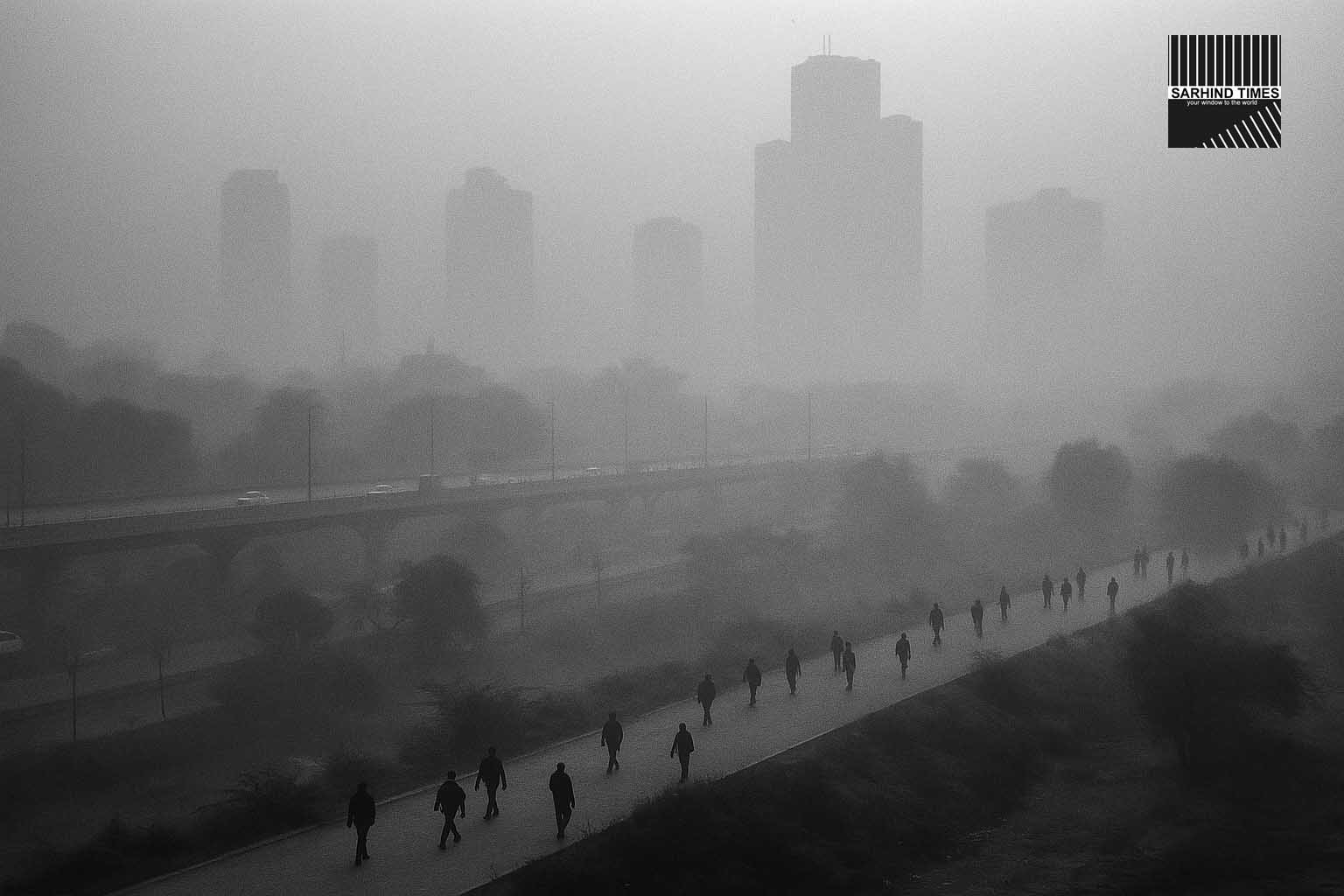
Compounding the international climate narrative is India’s domestic air-pollution emergency—most visible in its capital. Recent studies show New Delhi’s annual death toll from polluted air may exceed 17,000. One report labelled the city “no longer livable” as PM2.5 levels repeatedly cross 400µg/m³ in winter months—far above the World Health Organization guideline of 15µg/m³.
Efforts to address the toxicity—such as smog-towers, cloud-seeding experiments and ad hoc traffic bans—have gained attention but little consistent success. The root drivers remain: agricultural residue burning in nearby states, vehicle emissions, industrial pollution and cold-weather inversion layers trapping pollutants. The human cost is steep: health experts link air-pollution with cardiovascular disease, stroke, lung cancer and lower life-expectancy. And the crisis deepens inequality—the poorer face the worst exposure and have the fewest resources to mitigate harm.
The adaptation vs mitigation divide in policy approach
India has increasingly emphasised adaptation to climate change—how to cope with impacts such as floods, heatwaves, glacial melt and rising sea-levels—rather than solely mitigation (reducing emissions). At COP30 the Indian delegation argued for adaptation to be the central narrative of the next phase of global climate action. Critics say this shift signals a retreat from mitigation responsibility, even though adaptation is undeniably urgent given India’s vulnerability.
There are real adaptation needs: the Himalayan region is experiencing glacial retreat; coastal states face salt-water intrusion; large river-basin shifts are underway. Yet the issue is how adaptation is financed and executed. India pointed to unmet global climate-finance commitments and greater need for billions, not millions, in transfers. Simultaneously, domestic programmes under adaptation remain uneven—raising questions about coherence.
The regulatory and governance challenge
Behind the headlines lies a complex governance story. The shift to greater renewables has been enabled by auction-mechanisms and federal-state co-ordination. But emissions data remains patchy, many coal and industrial licences have post-facto clearance, and regulatory inspection lacks consistency. India’s drop in the climate performance index partly reflects these structural governance shortcomings.
For instance, while new projects get fast-tracked, legacy coal-mines and heavy-industry plants continue to operate under older norms. In parallel, air-monitoring networks, pollution-data transparency and enforcement of environmental laws show gaps. Without institutional strengthening, India’s policy ambition may not translate into tangible outcomes.
Economic development and energy transition: Trade-off or synergy?
India faces what many developing economies face: how to maintain growth and development while transitioning to a low-carbon pathway. The good news is that India’s investment in renewables, its manufacturing ambitions and its leap in capacity suggest synergy is possible. Solar and wind industries are growing, battery storage is entering, and policy-tools such as green-taxonomies are emerging.
The challenge lies in coal. India still relies on coal for a significant portion of electricity generation, and new capacity is under development. The government argues it must support energy access, job creation and industrialisation. Observers say that while India’s newer coal plants are more efficient, the long-term pathway must tilt away from coal if climate targets are to be credible.
Global diplomacy: India’s positioning and what’s at stake
On the global stage, India seeks a leadership role. It co-founded the International Solar Alliance, hosts large auctions, and aims to host global summits. But with the delayed NDC and slipping ranking, its leadership claim is under pressure. Allies and competitors alike will watch whether India steps up with clearly defined targets, credible road-maps and timely submissions. At COP30, India’s push for adaptation funding meets a mixed reception—some developed nations remain cautious while others signal readiness to act.
Future pathway: What must change to restore momentum
Making up ground will require several key changes:
- Finalising and publishing a robust 2035 NDC with clear measurable targets, pathways and timelines.
- Strengthening emissions-monitoring, transparency and enforcement across sectors, especially coal, heavy industry and transport.
- Accelerating retirement of older fossil-fuel plants and halting new coal licences unless carbon‐capture and storage is integrated.
- Coordinating air-quality programmes in Delhi-NCR region with neighbouring states to tackle crop-burning, vehicular emissions and industrial leaks.
- Mobilising finance and private-sector investment in adaptation and resilience, especially in vulnerable regions such as Himalayas, coastlines and flood-prone zones.
- Aligning growth and climate imperatives—making sure that India’s industrialisation push becomes clean-industrialisation push, with high-value jobs, clean energy and circular economy models.
Conclusion
India’s climate story today is one of dualism: a notable renewable victory paired with worrisome inertia in other domains. The country’s delay in submitting its next-phase climate pledge, combined with worsening air-pollution and governance gaps, raises valid skepticism about its trajectory. The good news is that India possesses the resources, the institutional momentum and the global goodwill to turn the corner—but it will require hard decisions, systemic reform and transparent execution.
If India wants to move from ambition to credibility, from capacity to impact, and from national promise to global leadership, it must bridge the gap between what it has achieved and what it still must do. The clock is ticking—not just for India, but for the entire planet.


+ There are no comments
Add yours