
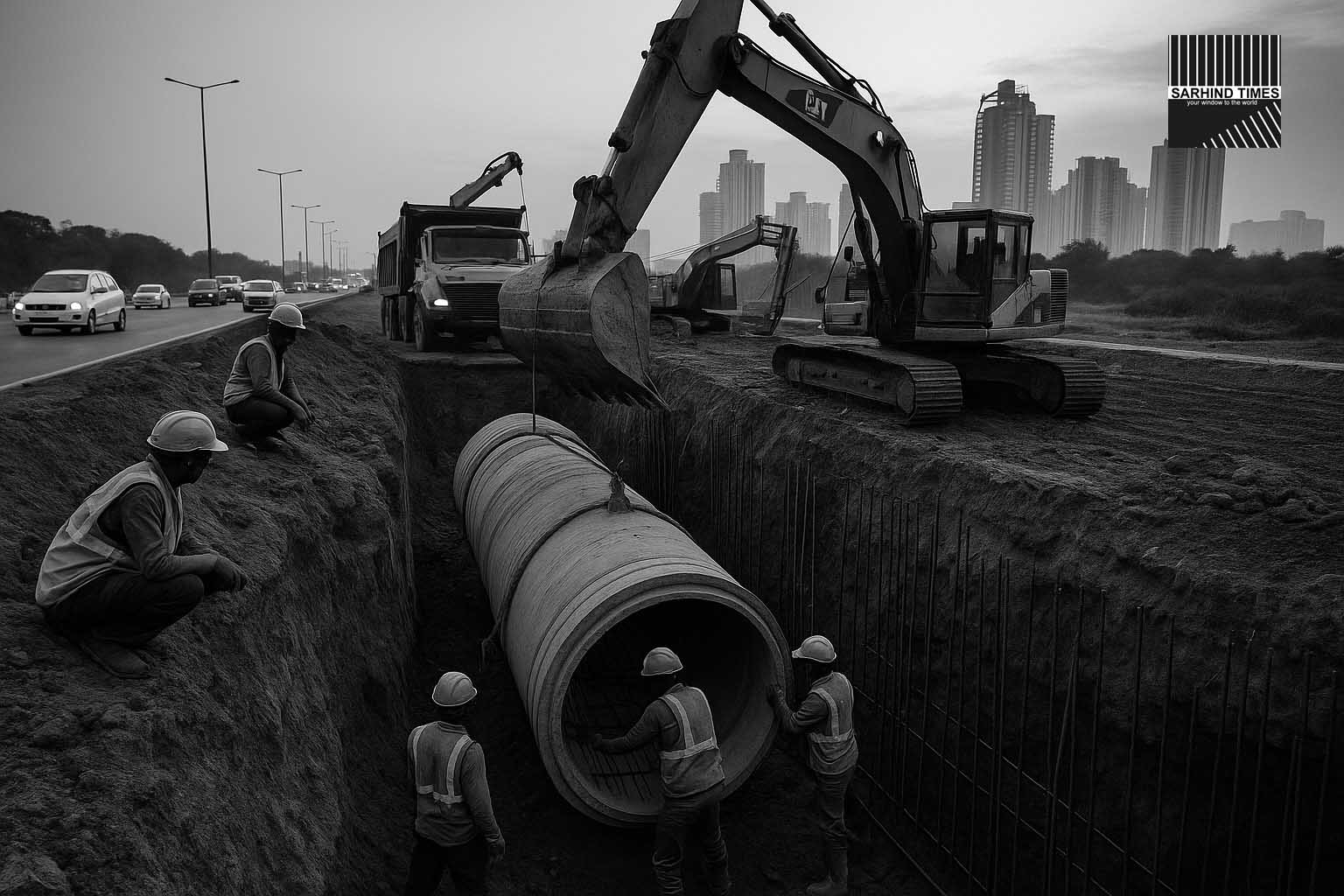
Critical urban drainage and road-repair projects approved, signalling growing focus on Delhi-NCR city’s resilience and connectivity
Dateline: Gurugram | 21 November 2025, Asia/Kolkata
Summary: The Haryana government has approved more than ₹523 crore worth of infrastructure projects for Gurugram, including an 18.32 km reinforced-cement-concrete storm-water drain network and urgent repairs to a 60 km stretch of the KMP Expressway. The drive comes amid mounting concerns over monsoon flooding, urban congestion and pressure on the city’s connectivity within the Delhi-NCR region.
Background: Why the surge of spending matters
Gurugram, once a satellite town of Delhi known for rapid corporate and real-estate growth, has been grappling with chronic infrastructure gaps for years. From water-logging during monsoons to clogged expressways and rising traffic congestion, the city’s growth has outpaced its resilience framework.
Against this backdrop, the state-level approval of over ₹523 crore for key projects reflects a strategic pivot: recognising that simply adding high-end offices and residential towers is not enough unless the supporting infrastructure—drains, roads, expressway upkeep—is upgraded. For citizens, the verdict is clear: growing means maintaining too.
What was approved: The headline items
In a meeting of the High Powered Works Purchase Committee (HPWPC) chaired by Chief Minister Nayab Singh Saini, several infrastructure works were cleared: approximately ₹104.95 crore for construction of 18.32 km of RCC (reinforced cement concrete) storm-water drains through multiple sectors of Gurugram; around ₹48 crore allocated for urgent repair work on a 60 km stretch of the Kundli–Manesar–Palwal Expressway (KMP). Additional funds were earmarked across industrial infrastructure, sanitation, water-supply and traffic-management, though the headline focus is on the drains and expressway repair.
The breakdown is instructive: the storm-water drains will cover sectors 76, 77, 78, 79, 80 along with a segment along NH-48 (about 6 km). The drain-network aims to channel excess rain-water into the Badshahpur drain-system, reducing water-logging risk in low-lying sectors prone to monsoon flooding.
The expressway repair project focuses on a heavily used industrial-corridor stretch of the KMP expressway—where degradation from heavy traffic and older pavement had begun to impact logistics efficiency and safety. The repair aims not only at resurfacing but tackling structural stress and drainage issues along the route.
Why storm-water drainage matters now
Gurugram’s growth has brought with it intense urban development in sectors that were historically marshy or flood-prone. With annual monsoons showing unpredictable patterns and high rainfall events clustered, the city’s older drainage infrastructure has repeatedly failed. The water-logging episodes not only damage property and slow traffic, but also erode investor and resident confidence.
The specific choice of RCC drains is noteworthy. Unlike open-channel or simple culvert systems, RCC drains can withstand heavy flows, accommodate higher capacities and reduce maintenance. By targeting a corridor along NH-48 and through key residential sectors, the project addresses both the industrial-traffic zone and the residential belt. Officials say the 18.32 km network will likely benefit tens of thousands of residents and major arterials
Expressway repair: maintaining logistics lifelines
The KMP Expressway plays a critical role in the Delhi-NCR logistics chain, linking industrial hubs in Manesar, Palwal and beyond. Problems on this road—uneven pavement, inadequate drainage, weaker shoulders—begin to cause bottlenecks. For Gurugram, this is not just a commuter concern but a productivity one.
The ₹48 crore repair sanction indicates an acknowledgement that infrastructure maintenance cannot lag new construction. The state must preserve existing assets if the broader growth narrative is to stay credible.
Execution challenges: Land, approval delays and project capacity
While the approvals are a good step, execution remains the true test. Previous projects in Gurugram have suffered delays—whether due to land litigation, delay in clearances, utility relocation or funding release. The storm-water-drain project, for instance, although approved now, will need right-of-way clearances, coordination with NH-48 highway authorities, and relocation of existing utilities.
Likewise, for the KMP repair, while the alignment is fixed, traffic management during works, coordination with industrial units, and minimising disruption will be key. The committee’s approval does not guarantee instant start; it marks the beginning.
Stakeholder views: Residents, industry and government
Resident associations in sectors within 76-80 have welcomed the decision, citing repeated monsoon-related water-logging in recent years. One local association leader noted: “For years we have been told the drains will be upgraded; this time the sanction gives us hope. Still, we will hold officials to timeline and quality.”
Industrial and logistics firms along the KMP corridor have been pressing for better road conditions and minimal downtime. Some firms praised the approval, but cautioned that closure of lanes or long diversions during repair could itself raise costs in the short term.
On the government side, officials stressed that these approvals form part of a larger strategy: improving core infrastructure (drainage + roads) while also enabling upcoming projects like the upcoming township developments, metro links and expressway extensions. This reflects a multi-front urban development push for Gurugram in 2025-26.
Financial implications and funding sources</ >
The ₹523 crore envelope is significant in the context of Haryana’s infrastructure allocations for the wider state. It signals that Gurugram is still a priority region. These funds are expected to flow via the state budget and may be supplemented by central schemes where relevant (for example, highway funding, urban infrastructure grants). Officials note that portion of expenditure may also come via state-owned agencies such as Haryana State Industrial and Infrastructure Development Corporation (HSIIDC) or Gurugram Metropolitan Development Authority (GMDA) depending on the project. The sanction should help advance contract-award cycles and release of funds to contractors.
Given typical execution timelines for such works (often 12–24 months or more), the actual fiscal spending will likely stretch into FY27. The state must manage cash-flows and contractor capacity to avoid bottlenecks. Delay in earlier projects has sometimes generated cost-escalation and creep in deliverables.
Wider connectivity projects and future linkages
This staggered investment must be seen in the context of other complementary infrastructure in Gurugram. The government is already working on new road links, elevated corridors, township developments and metro extensions. For example, proposals to connect new townships like the “Global City” development via dedicated links to expressways intersect with these drainage and road-repair works.
Thus, the storm-drain and expressway repair works are not standalone. They serve the dual role of improving current lived-conditions and enabling new growth corridors. From a planning perspective, this confluence of upgrade-and-expand is crucial: not just building outward but consolidating inward.
Risks and what could go wrong
Given the track-record, the following risk-factors should be watched closely:
- Approval fatigue and delays: While the HPWPC has approved the works, follow-up actions—environment/utility clearances, contractor selection, mobilization—may lag, pushing timelines outward.
- Land / right-of-way issues: Encroachments or unclear land titles are common in Gurugram’s rapid-growth zones. For example, earlier drainage-projects on NH-48 had to clear encroachments.
- Cost escalation: If contracts are delayed, cost inputs (labour, materials) may escalate, raising budgetary pressure on the state or forcing cut-backs in scope.
- Contractor capacity and quality risk: The rush to mobilise may lead to selection of firms with less capacity, leading to quality compromises or extended defect liability periods.
- Traffic/usage disruption: For impressible drains or expressway re-works, temporary traffic rerouting may cause disruption. If not managed, there could be public backlash or commercial losses for firms using those corridors.
Policy implications: What the state is signalling
By approving these projects, the Haryana government is making several statements:
First, infrastructure maintenance and upgrade is ascending the priority list—not just new marquee projects. The state is signalling that Gurugram’s resilience (not just expansion) matters.
Second, there is recognition that drainage and flood mitigation are no longer niche issues—they affect high-end residential zones, corporate offices and mobile talent pools. The private sector’s presence in Gurugram means standard urban services now derive commercial and economic implications.
Third, the state seems to be aligning urban upgrade works with broader connectivity clusters (KMP, Dwarka Expressway, express-corridors) so that improvements in one domain reinforce others. This integrated-planning approach is significant.
Impact on residents, business and investors
For residents: A stronger drain-network means fewer disruptions during monsoons, less property damage risk, better commute reliability and potentially improved real-estate value. One resident association noted the project is a “long-overdue fix”.
For businesses/logistics: The repair of the KMP expressway means smoother transport, fewer delays, and cost‐savings in operations. Such upgrades enhance the business climate in Gurugram’s industrial corridors.
For investors: Infrastructure improvements act as confidence-boosters. Whether in office real-estate, residential launches or industrial parks, improved foundational services reduce perceived risk and may accelerate investment decisions or expansions.
Next steps and timeline expectations
Officials state that contract tendering should commence within the next quarter. For the drain-project, mobilization and site work are expected to start in the coming monsoon-dry phase (late winter/spring) to avoid delays. The expressway repair work will likely start in early 2026 once detailed surveys are completed and utility clearances secured.
Given standard project durations, the drain‐project may be delivered in 18-24 months while the expressway repair work may span 12–18 months. The state has emphasised that such foundational works will continue beyond FY26, with further allocations expected in multi-year plans.
Conclusion
The recent approval of over ₹523 crore in infrastructure upgrades for Gurugram marks an important moment. The city, long defined by expansion and landmark launches, now appears to be shifting toward consolidation. By addressing critical weak links—storm-water drainage and expressway durability—the government is signalling that rapid growth must be matched with robust foundations.
Nevertheless, execution remains the key. Approvals are only the start. The test will come when tenders are awarded, contracts executed, timelines met and disruptions minimised. For the tens of thousands of residents and businesses in Gurugram who face monsoon water-logging, traffic delays and infrastructure frustration, it’s a moment of opportunity—one that demands vigilant follow-through.
In short: the city’s future may now hinge less on iconic towers and more on the pipes, pavements and drains beneath them. The real work begins now.



+ There are no comments
Add yours