
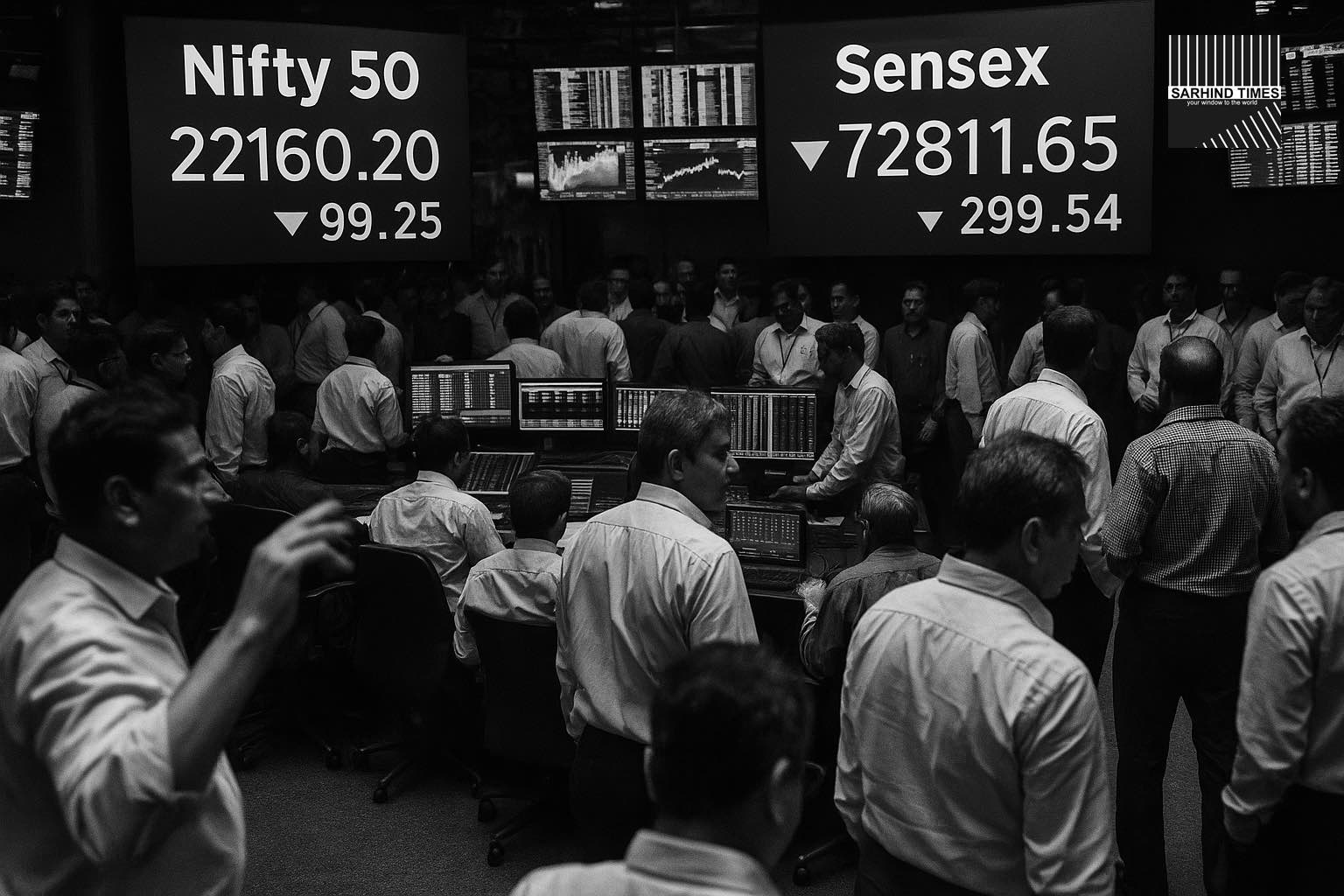
Following a strong October rally, the Nifty 50 and Sensex enter a consolidation phase as investors await post-earnings clarity and global cues.
Dateline: New Delhi | November 7 2025
Summary: Indian equity benchmarks are showing signs of consolidation after a robust October performance. Market analysts point to upcoming earnings, policy triggers, and global developments as key to the next move—while large public-sector banks (PSUs) and mid-cap stocks are poised to play a leading role.
Recent Market Moves: From Rally to Consolidation
Indian stock market logged an impressive rally in October, with the Nifty 50 and Sensex advancing by around 4.5 per cent—a standout monthly performance for the year. Analysts attribute the gain to strong domestic economic data, resilient corporate profits in the second quarter, and positive global risk sentiment. (Market commentary indicates the Nifty surged by 4.51 per cent, and the Sensex by 4.57 per cent during October.) However, in early November the pace has slowed. On 3 November, the Nifty barely rose (+0.1 per cent) to around 25,747, and the Sensex added a mere 0.02 per cent to approximately 83,956. This muted move reflects investor caution after rapid gains and a pause for breath. Investors and market commentators are interpreting this phase as healthy consolidation rather than a reversal. Indeed, as one strategist noted: “While PSU banks climb on reports of a potential hike in foreign investment limits, investors are taking some chips off the table after the sustained rally.” In the trading session of 6 November, the market again showed signs of fatigue: Sensex ended lower by 148 points (-0.18 per cent) and the Nifty down by about 88 points (-0.34 per cent), tracking declines in financials and metals. Mid-cap and small‐cap stocks showed somewhat steeper sell‐offs, indicating profit-taking across more speculative segments. Against this backdrop, global equity markets are playing a moderating role. Although the US and other Asian markets have shown upticks recently (which helped India’s early session open higher), concerns about global trade negotiations, inflation, and interest rates remain unresolved. Indian markets thus appear to be in a holding pattern before the next directional move.
Key Drivers Within the Indian Market
The market narrative ahead is shaped by a set of interlocking factors:
1. Earnings season and stock‐specific moves
Corporate earnings for Q2 are still being digested. While some companies delivered robust profits (for example, some non‐bank lenders and mid‐caps), others posted weak outcomes, leading to divergence in stock behaviour. This has resulted in:
– Select winners driving sentiment (e.g., companies with strong quarter results)
– Broad indices lagging as investors await more earnings cues
– Rotation from large caps into mid and small caps where upside may remain
2. Sectoral leadership — PSU banks, mid‐caps, under‐penetrated segments
Analysts are highlighting PSU banks and mid-cap stocks as potential next-wave drivers. According to one prominent brokerage, the Nifty could retest 26,300 by December, led by PSU banks and midcaps. The rationale: valuations remain relatively attractive, policy support (e.g., foreign investment limit hikes) may provide a trigger, and some of these stocks remain under‐owned.
3. Global risk sentiment and export/linkages
Indian markets continue to be sensitive to external cues: strength in US stocks, commodity movements, export demand, and currency shifts. For example, on 6 November, Indian indices were expected to open higher tracking global cues, but ended with a muted performance. Until clarity on global trade, inflation, and interest rates emerges, the consolidation phase is likely to continue.
4. Liquidity flow and foreign investor movement
Foreign portfolio investors (FPIs) have shown selective activity—while domestic institutional investors (DIIs) have stepped in at times. On days when sentiment is positive, DIIs have supported markets; but caution prevails given valuations and global uncertainties. The broader question remains: will inflows accelerate to fuel another leg up, or will outflows/reduced flows limit upside?
Valuation and Technical Landscape
From a technical perspective, the recent consolidation is viewed as a necessary rest before the next move. The rally from ~24,500 to 26,200 for the Nifty is seen as healthy, and the correction/consolidation around current levels is considered optimal for a fresh thrust. Some of the technical support levels:
– Nifty near 25,500 acts as critical support; breach below may raise risk of deeper pullback
– On the upside, 26,300 is identified as next important target by December if momentum picks up
– Sector rotation into mid-caps/PSUs may shift focus away from large cap leadership, hence breadth may improve
Valuationwise, while large caps appear richly priced, mid-caps and certain PSUs are yet to re-rate fully. This dynamic may shape investor allocation strategies over the coming weeks.
Risk Factors and Headwinds
The consolidation phase does not imply absence of risks. Some of the key headwinds:
– Global headwinds: escalation in US-China trade tensions, rising commodity prices, or rate hikes abroad could dampen sentiment
– Domestic issues: slower‐than‐expected economic growth, inflationary pressures, weaker consumer demand, and earnings disappointments
– Policy uncertainty: any surprise in monetary policy or regulatory changes could unsettle specific sectors
– Valuation fatigue: With rally already in place, margin of safety is arguably thinner; investor discipline and stock selection become more important
In the event of any negative trigger, risk of a sharper correction cannot be ruled out. Thus, many analysts are advising caution and recommending selective “buy‐on‐dips” rather than aggressive fresh bets at current levels.
Implications for Investors and Strategies Ahead
For domestic investors, the current phase offers both opportunity and caution:
– Consider selectively increasing allocation to PSU banks and mid-cap stocks where the re-rating potential remains
– Use dips to accumulate rather than chasing stocks at high valuations
– Maintain diversification across sectors; large cap indices may pause till fresh catalyst arrives
– Monitor global cues and domestic policy announcements for timely actions
For foreign investors, India remains attractive but the wait for major structural triggers (like trade deals, export uptick, domestic demand revival) means flows may remain choppy. The current pause may reflect positioning ahead of the next leg rather than a market top.
Sectoral Focus: What to Watch
A few sectors are likely to be in focus in the coming weeks:
– **PSU banks & financials**: Elevated expectation of regulatory/ownership changes or foreign investment limit hikes
– **Mid-cap industrials & domestic‐consumption stories**: Underpinned by domestic demand revival, post-election spend and infrastructure boost
– **Technology & export‐oriented stocks**: Dependent on global demand and currency; may lag if global growth slows
– **Metal, commodity and cyclical stocks**: Sensitive to global inflation, commodity prices and Chinese demand
– **Defensive/quality stocks**: In a consolidation phase, these may outperform if volatility rises
Outlook for the Next Quarter and Year End
Analysts remain cautiously optimistic. If earnings momentum sustains and policy or global triggers align, the Nifty could reach 26,300 by December, offering further upside albeit at a measured pace. Beyond year-end, the broader momentum will depend on domestic growth, capex revival, export dynamics and liquidity flows.
Should a negative trigger occur—say earnings disappointment or global risk escalation—the consolidation could turn into a correction. Hence market participants are focusing not just on index levels but on breadth, sector rotation and individual stock catalysts.
Conclusion
The Indian equity market has delivered a noteworthy rally but is now entering a consolidation phase. The next leg of the market move is likely to be shaped by sector rotation (especially toward mid-caps and PSU banks), global cues, and corporate earnings. For investors, the message is clear: this is not a time for broad risk-taking but for strategic allocation, disciplined stock selection and vigilance toward upcoming triggers.
With the Nifty in the 25,500-26,300 zone as the immediate battleground, and midcaps and PSUs in focus, how 2025 ends on the equity front will matter not just for investors but for the broader economy—where capital markets reflect both sentiment and structural growth potential.



+ There are no comments
Add yours