
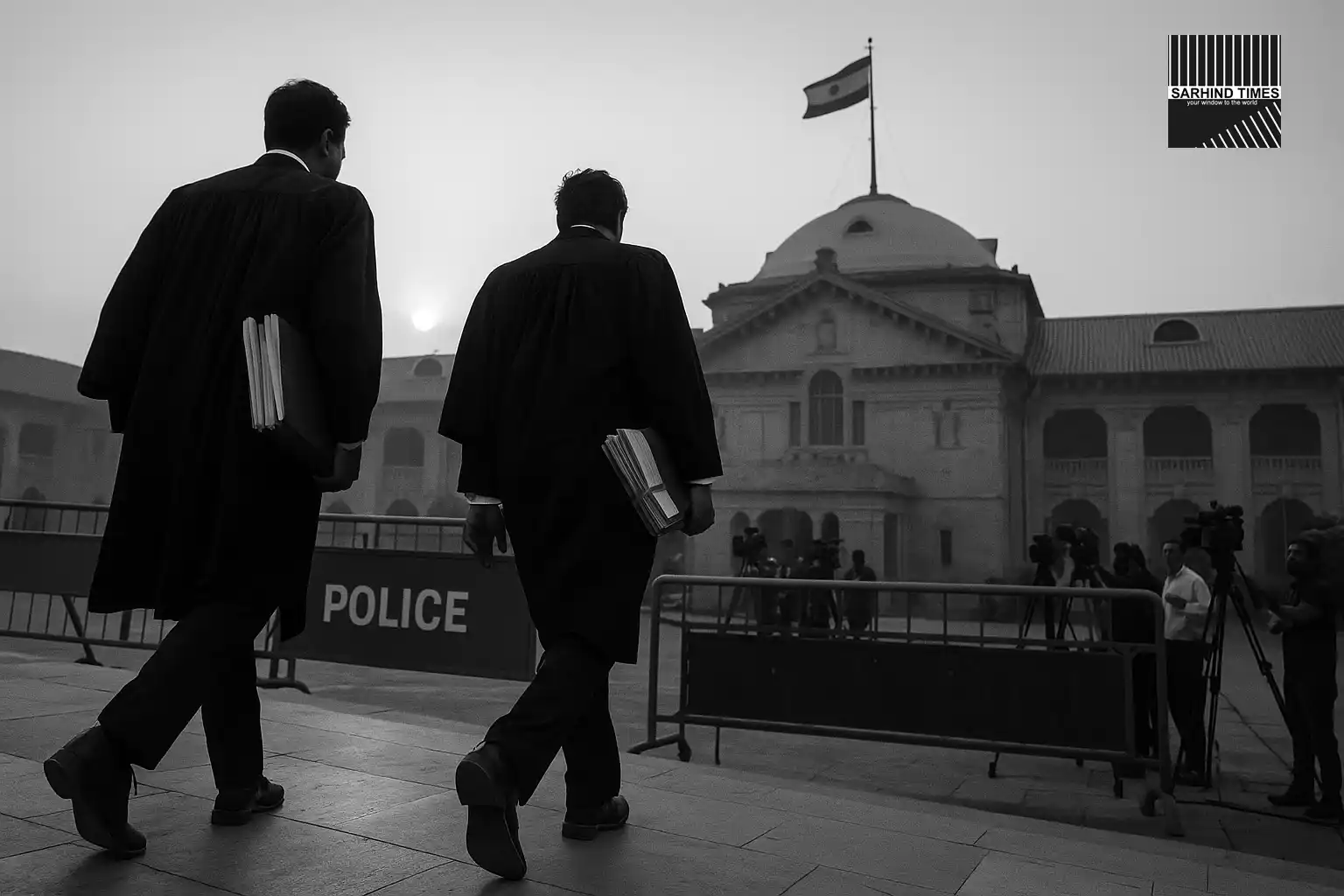
Strong assertion of constitutional turf reignites long-running debate over who frames service rules, manages careers, and sets standards for India’s trial court judges
Dateline: New Delhi | October 30, 2025
Summary: In a forceful note of institutional self-assertion, the Allahabad High Court has told the Supreme Court to maintain a “hands-off” approach with respect to the district judiciary, saying service rules and administrative control fall squarely within the high courts’ constitutional domain. The remarks, reported on Thursday, come amid the apex court’s drive to craft nationwide uniformity on issues such as promotions, seniority, training and reservations for judicial officers—an effort the SC insists won’t dilute high courts’ powers. The exchange reopens an old fault line in Indian judicial federalism at a moment when the top court is also hearing career-stagnation matters and pushing uniform frameworks for the subordinate courts.
What Exactly Happened—and Why It Matters Now
The Allahabad High Court’s message to the Supreme Court—summed up in the headline “Stay off district judiciary, it’s our domain”—is not merely an inter-court squabble. It goes to the architecture of Indian judicial governance. Article 235 of the Constitution vests “control over district courts and courts subordinate thereto” in the High Courts, a phrase that generations of jurists have understood to mean that High Courts oversee recruitment, postings, promotions, disciplinary action, and broad career management for trial judges within their territorial jurisdiction.
But over the past three decades—the period since the All India Judges Association litigation first landed in the Supreme Court—the apex court has repeatedly stepped in to set baselines for pay, service conditions, and structural norms in the district judiciary, often to cure inertia, inconsistency, or inequity across states. Most recently, the Supreme Court has looked to craft uniformities on seniority, reservations (including for persons with disabilities), and progression frameworks while simultaneously clarifying that such moves do not aim to “take over” High Courts’ domain. Even so, Thursday’s reporting of the Allahabad High Court’s pushback underscores the enduring sensitivity around turf and constitutional lines.
The Constitutional Text: Articles 233–237 and the Contours of “Control”
To understand the stakes, recall the constitutional scheme: Article 233 concerns the appointment of district judges by the Governor in consultation with the High Court; Article 234 covers appointments of other judicial officers of the state by the Governor following rules made by him after consulting the State Public Service Commission and the High Court; Article 235 vests “control” of subordinate courts in the High Court; and Article 236 defines “district judge” for these purposes. The Supreme Court’s own jurisprudence has read “control” widely, placing significant administrative and disciplinary levers in the High Courts’ hands.
At the same time, the Supreme Court has taken a systemic view when unevenness among states risks undermining national standards—hence the All India Judges Association line of cases, the Pay Commission decisions, and recent suo motu interventions on disability reservations or timelines for service-rule reforms. This is the institutional context in which the Allahabad High Court’s message lands: it recalibrates the caution with which the Supreme Court must proceed when crafting one-size-fits-all directions.
Immediate Triggers: Uniformity Push vs. Autonomy Concerns
Reports indicate the latest friction arises as the Supreme Court examines frameworks for uniform seniority factors and remedies for career stagnation across the higher judicial services, and as it nudges High Courts and state governments to implement reservation mandates for persons with disabilities within the judicial services. The apex court has stressed it is not undermining the High Courts’ constitutional powers; rather, it is attempting to ensure national parity and timely compliance with rights-based norms. Yet High Courts—particularly one as large and complex as Allahabad, which supervises an immense trial-judiciary universe across Uttar Pradesh—remain wary that broad-brush national directions can crowd out local rule-making, tailored manpower planning, and context-specific institutional design.
The Allahabad High Court’s firm tone must also be read against recent flashpoints: the Supreme Court’s public displeasure with some Allahabad High Court orders, the apex court’s unprecedented (and subsequently modified/withdrawn) directions concerning an Allahabad judge’s roster, and frequent SC-led correctives in administrative-cum-structural disputes. Each episode, viewed alone, is part of standard judicial oversight. In the aggregate, however, they create a perception—especially in large High Courts—that Delhi is micromanaging what the Constitution entrusts to the states’ top courts.
Allahabad’s Scale Problem—and Why UP’s Trial Courts Are a Bellwether
The Allahabad High Court is not an average High Court. It supervises an immense apparatus: hundreds of district and subordinate courts, vast volumes of litigation, and some of the country’s most complex judicial-service rosters. That scale magnifies every policy choice—seniority formulas, transfer cycles, evaluation rubrics, training throughput, reservation rosters, and recruitment pipelines. Uniform national directions may solve one inequity but create friction in another corner of such a massive ecosystem. This partly explains Allahabad’s insistence on autonomy: in a system this large, calibrating rule changes requires granular, context-sensitive management.
What the Supreme Court Has Been Pushing Recently
In parallel to the present pushback, the Supreme Court has been active on several district-judiciary fronts:
- Career stagnation & seniority: A five-judge bench has fixed hearing timelines to iron out seniority factors and stagnation remedies for the higher judicial services.
- Reservations for persons with disabilities: The apex court has imposed deadlines on High Courts (e.g., Madhya Pradesh HC) to implement disability quotas in judicial services, clarifying both the mandate and the pace of compliance.
- Language, decorum & training: High Courts (including Allahabad) have, for their part, issued reminders on courtroom decorum and record-keeping; the SC has repeatedly signalled the district judiciary’s centrality and dignity—at one point even asking that we stop calling it “subordinate.”
Taken together, these moves reflect a Supreme Court seeking to standardize minimum entitlements and procedural fairness while leaving operational details to High Courts. The friction arises in the inevitable grey zones between “minimum standards” and “day-to-day control.”
The Stakes for Litigants and Trial Judges
For the public, this is not an abstract turf war. Most Indians will encounter the justice system, if at all, in a magistrate’s court, a sessions court, or a family court—that is, within the district judiciary. If promotions freeze, vacancies pile up, or transfer policies are inconsistent, the effects are immediate: longer case cycles, reduced morale, and uneven access to justice. Conversely, if rules change too abruptly or without High Court buy-in, the administrative machinery can buckle under transition costs. A workable balance—uniform rights, local control—serves both fairness and efficiency.
Historical Echoes: The All India Judges Association Legacy
The present moment echoes the 1990s–2000s saga of All India Judges Association, where the Supreme Court laid down systemic reforms (pay scales, infrastructure norms, training mandates) precisely because state-by-state variability was hurting the district judiciary. Those decisions improved baseline conditions but also seeded a lasting debate: how far can the SC push “one nation, one framework” for a subject the Constitution places under High Courts’ control?
In 2023, the Supreme Court sent a symbolic signal by saying it would avoid referring to the district judiciary as “subordinate” and instead recognize it as an equal pillar of justice delivery. That semantic shift matters—the rhetoric of dignity frames today’s disputes in a more respectful register even when substantive disagreements remain.
Potential Paths to a Truce: Cooperative Federalism Within the Judiciary
There are at least four paths to avoid a zero-sum outcome:
- Principles vs. playbooks: The Supreme Court can frame principles—equality, non-discrimination, reasonable progression, reservation compliance, time-bound recruitments—while letting High Courts draft the playbooks (detailed service rules) tailored to their ecosystems.
- Consultative codification: Before passing uniform directions, the SC could mandate a structured consultative process: each High Court tables current rules, pain points, and proposed solutions; a national consolidation then sets only the irreducible minimums.
- Data-driven dashboards: To ensure accountability without micromanagement, create public dashboards—vacancies, disposal rates, promotion cycles, reservation implementation—so that citizens, bar councils, and the media see where reform is lagging.
- Capacity-building & funding compacts: Many “control” issues are, in reality, resource issues. The Centre and states should fund systematic training academies, e-courts infrastructure, and HR cells within High Courts so that autonomy is matched by administrative capacity.
Why the Language of Autonomy Resonates with High Courts
High Courts jealously guard Article 235 because it underwrites judicial independence at the level where most justice is dispensed. If the executive is kept out but the apex court overly prescribes, High Courts fear becoming implementers rather than governors of their own trial courts. That anxiety is sharpened in states with massive dockets and diverse districts. The Allahabad message is therefore a plea for the Supreme Court to exercise “minimum necessary” harmonization, not maximal prescription.
Recent Flashpoints Feeding the Perception Gap
In recent months, we have seen two strands of news shaping the perception battle:
- SC’s corrective oversight: The Supreme Court has publicly flagged disappointment with certain Allahabad HC orders, set aside decisions that overlooked settled law, and—most controversially—initially directed restrictions on a judge’s roster before rethinking the approach at the CJI’s request.
- HC’s internal housekeeping: Allahabad HC, for its part, has issued advisories on language decorum in trial records and sworn in additional judges to buttress capacity. Neither strand is unusual; together, they create a sense of heightened scrutiny and defensiveness.
What Comes Next—Procedurally and Politically
Expect the Supreme Court to proceed with hearings on stagnation, seniority, and uniform frameworks while emphasizing that High Court powers will remain intact. Expect, also, a more formal consultative round with High Courts before any binding pan-India templates are notified by judicial order. Politically, even though this is an intra-judiciary matter, state governments—who often foot the bill for judicial infrastructure and service-payrolls—will watch closely, as will the bar councils whose members populate and argue within these courts.
Bottom Line: A Stress Test for India’s Judicial Federalism
The Allahabad High Court’s “hands-off” message is best viewed not as rebellion but as a constitutional stress test. The Supreme Court’s national-equality project and the High Courts’ local-control imperative are both legitimate. The promise of India’s judicial federalism is that they can be reconciled: apex principles that secure minimum rights and reforms, coupled with High Court-anchored rule-making and administration that respects local complexity. Thursday’s sharp words should catalyse a clearer compact—one that serves the ultimate stakeholder: the citizen who needs timely, fair justice in the trial court.



+ There are no comments
Add yours