
Police suspect a drunken escalation after early-morning discovery of body and weapons in Sector 29 parking zone
Dateline: Gurugram | October 30, 2025
Summary: A 30-year-old man’s body was found dumped in the parking area opposite the entertainment complex near Kingdom of Dreams in Sector 29, Gurugram, early Wednesday morning. Investigating officers say the victim suffered repeated head and facial injuries, with an iron rod and blood-stained bricks recovered at the scene, and believe the murder stemmed from a drinking-related dispute.
Discovery of the Body: Early Morning Horror
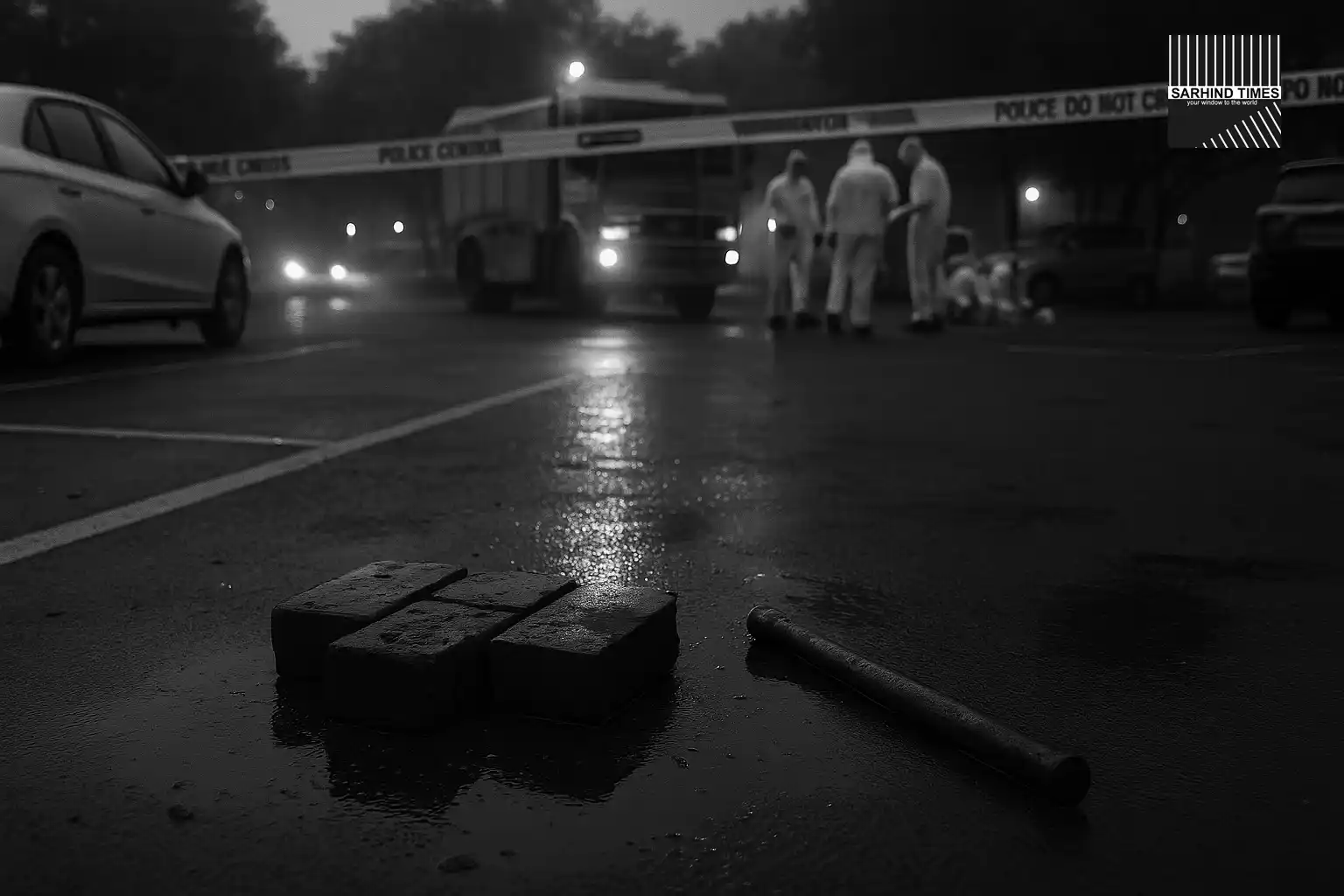
A passer-by discovered the body of a man around 8 a.m. on Wednesday, October 29, in the parking area opposite the Kingdom of Dreams entertainment complex in Sector 29, Gurugram. The man, estimated to be around 30 years old, was found lying face-down among the bushes by the lot’s edge. Blood-stained bricks and an iron rod lay nearby — prompting the local Sector 29 police to immediately launch a homicide investigation.
According to the SHO at Sector 29 police station, the victim “was beaten to death after being repeatedly hit by bricks and a rod, as he sustained several injuries on the head and face.” The items recovered—bricks and rod—suggest a brutal assault. The case has been registered under Section 103 of the BNS (Bryan–Nair statute) as a suspected homicide.
No identification of the deceased was immediately available. Locals had no information linking him to nearby residences or businesses, suggesting he may have been from out of town or using the area transiently. This complicates immediate identification efforts and increases urgency for the investigators.
Scene Details & Investigative Leads
The crime scene lies in a public parking section adjacent to the Kingdom of Dreams complex on the Gurgaon-DLF corridor—a location frequently used by patrons of the entertainment and hospitality zones in Gurugram. According to police, the presence of empty beer bottles near the body indicates alcohol consumption and suggests the incident may have arisen from a drinking-related dispute. “Since beer bottles were also recovered at the spot, it seems that the victim drank with someone, but they later fought there,” the SHO commented.
Investigators are systematically examining CCTV footage from nearby cameras, including those at the entertainment complex, parking lot entrances, and adjacent roads. They are also appealing to witnesses who were in the area late on Tuesday night—particularly those who used the parking and may have heard or seen the incident. They believe the assault may have occurred late on Tuesday, and the body left until morning. The missing identification adds a layer of challenge, as forensic teams are considering fingerprint analysis, facial recognition systems, and checking missing-person databases. The body has been shifted to the local mortuary for a post-mortem and forensic evaluation of injuries, including time of death, nature of blows, and possible murder weapon dimensions.
Geographic & Socio-Context: Gurugram’s Night Economy and Risk Zones
Gurugram (formerly Gurgaon) has experienced rapid development of its hospitality, retail, and entertainment sectors. Zones like DLF Phase IV, Sector 29, and MG Road host numerous bars, clubs, multiplexes, and high-end restaurants that operate late into the night. With this night-economy come challenges: alcohol-related disputes, unregulated parking lots, and the movement of diverse groups of people—including transient visitors, service staff, and local youth. The parking lot opposite Kingdom of Dreams is one such hub where crowds, vehicles and foot-traffic persist late into the evening.
While Gurugram’s policing and security posture has improved in recent years, experts note that the growth of night-economy zones has outpaced surveillance infrastructure in some peripheral areas. Dark zones in parking lots, weak lighting, and sparse witness presence create opportunities for violent incidents. The current incident underscores how the convergence of alcohol consumption, poorly lit parking, and limited oversight can result in tragic outcomes.
Possible Motives: Drinking + Dispute = Fatal Violence
Based on early statements and scene evidence, police believe the sequence may have been:
- The victim and one or more individuals consumed alcohol together in or around the parking lot or adjoining venue on Tuesday night.
- A verbal dispute—possibly triggered by insult, payment disagreement, refusal, or intoxication—escalated into physical confrontation.
- The assailant(s) used heavy blunt-objects (bricks, iron rod) to strike the victim, centring blows to head and face, resulting in death.
- The body was dumped in the bushes adjacent to the parking lot. The assailants possibly fled the scene, leaving behind weapons/items.
If confirmed, this suggests no pre-meditated murder but a spontaneous violent escalation—a “fight that got out of hand” scenario. However, the brutal nature of the assault, the number and severity of injuries, and the decision to dump the body might point to a more calculated action than a mere drunken brawl.
The recovery of bricks implies prior preparation or opportunistic use of items at the scene. Police will assess whether the assailants brought weapons, or used what was available nearby. Forensic injury pattern analysis may differentiate a fight vs. an execution-style killing (rapid, precise blows) vs. multiple attackers (multiple entry-wounds/blunt-trauma marks). In high-intensity blunt-force trauma, survival chances drop rapidly—prompt post-mortem findings will clarify the nature of the attack. The investigation will determine who among companions, bystanders or car-park users may have acted or assisted post-attack.
Victim Profile and Identification Efforts
Since locals did not recognise the victim, and no ID was found at the scene, police are actively checking missing-person reports from Gurugram, Delhi, and adjacent Haryana/UP districts. The forensic team has taken fingerprints and photographs; DNA swabs may also be taken to cross-check family members. Meanwhile, the hospital mortuary will preserve the body and review any past hospital records (if name is found). Investigators are reaching out to taxi/ride-share services, valet parking records, vehicle number logs and late-night club/restaurant bookings to shortlist likely co-visitors to the lot.
Given the victim’s age (estimated 30) and physical injuries, the police are examining whether he was a resident of nearby areas or a transient person who came by for leisure. Locating his mobile phone usage (last known ping), call-records, and wallet/accounts may help trace his last-known movements and companions. Assistances from telecom service providers are being sought under legal process to map cell-towers near the scene between midnight Tuesday and early Wednesday. Additionally, CCTV logs of taxis or Ubers dropping patrons may hold clues.
Role of Security & Urban Design in Parking-Lot Safety
The incident highlights broader urban-design and security concerns. Parking lots adjacent to nightlife venues should ideally feature adequate lighting, CCTV coverage and periodic patrolling. In many Gurugram cases the security falls in a grey zone: private lots, open to public, often relying on outsourced surveillance or on-call guards. In this case, the bushes near the lot provided concealment for disposal of the body, indicating weak perimeter control and lack of adequate lighting/visibility.
Urban security analysts point out that such spaces can act as residual risk zones—where intoxicated patrons, parking lot workers, cleaners and night-shift staff intersect and oversight is minimal. Recommendations include:
- Installation of high-definition CCTV cameras covering all access points and stand-alone zones in the lot.
- Periodic patrolling by law-enforcement or private security during peak nightlife hours (10 p.m.–3 a.m.).
- Better lighting, removal of debris/overgrowth near lot edges, controlled access and clear signage.
- Working with local businesses to maintain shared responsibilities for parking-lot safety: bar/restaurants, malls and parking operators coordinating with police on evening/late-night risk mitigation.
- Public-awareness campaigns urging patrons not to linger in isolated parking zones, to escort friends back to vehicles, and to avoid disputes while intoxicated. Quick de-escalation of potential fights is key to preventing violence.
Police Response and Next Steps
Following the discovery, the Sector 29 police station formed a multi-discipline investigation team (including forensic, crime-branch and cyber units) to map the entire incident chain: from victim’s last movement, possible companions, to weapon origin. They are analyzing:
- CCTV footage from surrounding area (both public and private) between midnight Tuesday and Wednesday morning.
- Mobile-phone call records for any phones pinging towers around the lot.
- Vehicle logs of lot entrances/exits, and valet/parking-staff records.
- Blood-spatter and injury-pattern evidence to ascertain number of assailants, direction of attack, weapon use.
- Search for missing-person alerts that match the age/appearance of the victim.
The SHO stated: “We will soon arrest the suspects.” The police are confident of arresting culprits given the number of investigatory leads, but they emphasised that time is of the essence—intoxication, possible clean-up by participants, and potential mobile-phone deletion may pose challenges. Continued patrolling and intelligence gathering in the area has been stepped up; possible witnesses—parking-lot staff, nearby eatery staff, night-shift workers—are being interviewed. Meanwhile, forensic results are awaited, including post-mortem, injury analysis and weapon trace.
Community & Business Reaction
Local businesses around the entertainment-corridor parking lot expressed concern at the incident. Occupants of nearby restaurants and bars told reporters they were “shocked” at the violence happening so close to the heart of the nightlife district. Some owners said they would cooperate with police and review their own security protocols—including parts of the parking area they treat as shared with patrons.
A mall security head in the vicinity noted that while the public parking is open 24 hours, post-midnight staffing is minimal and that “we treat the bush-covered back edge of the lot as low-foot-traffic zone; perhaps that is where such a dumping happened unnoticed.” There is also renewed calls from residents of adjacent sectors to the Gurugram Municipal Corporation and Police to tighten oversight of late-night parking and adjoining public spaces.
The Bigger Picture: Late-Night Risk, Alcohol & Urban Violence in Gurugram
Though Gurugram remains one of India’s fastest-growing urban hubs, its rapid nightlife expansion, inflow of transient workforce, and spatial mismatches in infrastructure have created vulnerabilities. Experts note that the confluence of:
- Large numbers of late-night patrons and staff in hospitality venues, often under the influence of alcohol;
- Shared public-private parking zones with mixed usage (day-visitors, night-shifts, patrons);
- Insufficient lighting/visibility and under-monitored perimeter zones; and
- Delays in emergency response or witness intervention during night hours;
Under these conditions even a minor dispute can escalate swiftly and violently.
In the present case, investigative agencies will likely examine whether there were prior altercations, whether the victim was alone or part of a group, and whether security footage shows entry of unknown vehicles late Tuesday night. The aftermath could trigger a review of Gurugram’s governance of parking-zone safety and nightlife-zone policing. Policymakers may also consider guidelines for late-night parking lot management adjacent to entertainment clusters.
Legal Dimensions & Potential Charges
The early registration of the case under section 103 BNS (homicide) signals intention to treat as murder. Depending on forensic results (weapon used, number of assailants, pre-meditation), charges may escalate to Indian Penal Code sections for murder (Section 302), abetment, disposal of body, destruction of evidence, and possibly violation of Arms or Weapon statutes if weapon recovered is not licensing. The discovery of bricks and rod suggests blunt-force murder rather than firearm or sharp weapon, but investigations will examine whether any other lethal instruments or cutting tools were used.
Victim’s unknown identity may complicate bail/prosecution issues of accused until identification is confirmed. Witness statements, CCTV evidence, phone records will play crucial role in establishing chain of culpability. The prosecution may also explore charges of concealment of body or accessory involvement if evidence shows others assisted in disposal. Given the location in a public parking lot, the Crown may argue public endangerment and reckless act causing death in a public place, which may aggravate sentencing considerations.
What’s Next: Timeline and Key Milestones
Investigators have laid out a rough timeline:
- Within the next 24–48 hours: Complete CCTV sweep, phone-ping mapping, and witness interviews.
- Post-mortem (expected within 48 hrs) to determine time of death, nature of injuries, possible self-defence or one-sided attack.
- If victim is identified, family traced and detailed history of his movements in last 48–72 hours taken.
- Based on leads, arrests likely within 72 hours if links are established via phone/vehicle/FIR records.
- Follow-up enforcement: security audit of the parking lot and notification to nearby businesses to improve lighting and surveillance – the Police and Municipal Corporation may issue advisory.
The SHO emphasised that “time is critical — intoxicated persons, adversaries, possible cleaning up of the area overnight may hide trails.” Authorities have assigned additional foot-patrol units to the area to locate any discarded bottles, sensors, or witnesses whose vehicles may have recorded movements. They have also appealed publicly for Uber/ Ola drivers, private cab users and valet staff to review their CCTV or dash footage and come forward if they dropped off or carried out rides in the lot after midnight.
Analysis: Underlying Urban Vulnerabilities and Policy Implications
While this case presents as a violent altercation gone wrong, it underscores deeper policy issues for Gurugram’s urban management:
- Night economy governance: With rapid growth of entertainment, dine-out and night-shift jobs, the city’s security architecture must extend into midnight hours and associated spatial zones (parking, transport hubs, back-streets) rather than just core business hours.
- Shared space risk zones: Parking lots, alleyways and bush-covered edges nearby high-traffic hubs are under-monitored. They should be incorporated into city surveillance and private-public safety universe.
- Alcohol-related violence: Evidence of beer bottles suggests alcohol played a role. The city’s safety strategy must include law-enforcement and security protocols for late-night drinking zones, patron dispersal, safe-exit pathways, and rapid intervention capacity in case of escalation.
- Infrastructure gap: Even though Gurugram is a high-income district, infrastructure upgrades like 24-hour lighting, CCTV in all parking edges, rapid-response patrols and coordinated private-security protocols are unevenly implemented. Public-private coordination is needed.
- Data-driven policing: Real-time analytics of CCTV, mobile-ping data, taxi drop-patterns and parking lot usage could help pre-empt high-risk clusters. This case may prompt the local police to adopt more granular zone-risk mapping.
If authorities follow through, this tragic incident might catalyse reforms in how nightlife zones and peripheral parking areas are governed in growing Indian metro-peripheries like Gurugram. But that outcome hinges on sustained political and administrative will—not just reactive policing.
Public Reaction and Media Coverage
Though the story is only hours old, social-media platforms echoed early citizen concern. Local resident groups on WhatsApp and NextDoor-style apps in the DLF/Sector 29 area reported increased anxiety about night-time parking safety. There have been posts urging nearby clubs and restaurants to “clean up” the parking area and install cameras/guards. Some patrons commented that they avoid the far end of the lot after midnight due to poor lighting and limited visibility.
Media outlets emphasise the “shock” factor: a murder, apparently after a night out, happening so close to a high-end entertainment zone. Commentators noted that relatively affluent areas like Sector 29 are not immune to violent incidents—even those that may stem from casual drinking. The coverage is also spurring conversation around policing of Gurugram’s nighttime economy and the costs of rapid urban change outpacing safety planning.
Victim and Family Support Issues
Because the victim is yet to be identified, outreach to his family is pending. Once identified, the police will offer standard victim-support protocols: assistance in body-identification, legal and psychological counselling, compensation claims where applicable, and liaison with media. If the victim is found to be from outside Gurugram, interstate coordination may be required (e.g., home state police, missing-person alerts, cross-check with hostels/hotels). The delay in identification adds trauma to any family awaiting news.
Wider Crime Trends: Is Gurugram Safe After Dark?
Experts note Gurugram’s crime-statistics remain better than many Indian mega-cities, but the patterns are shifting with city-growth: from daylight thefts and domestic disputes to late-night violent incidents tied to nightlife, alcohol and urban transit. Golf-course area suburbs and luxury hubs bring their own vulnerabilities: staff working odd hours, patrons leaving clubs late, private vehicle drop-offs, parking lots adjacent to bars—these all create a complex safety matrix. This case may become a wake-up call that even upscale zones require proactive safety infrastructure, not just policing of major roads.
Conclusion: A Brutal Incident with Lessons for City Safety
The discovery of a young man beaten to death with an iron rod and bricks, in a parking lot near one of Gurugram’s major entertainment hubs, is a jarring reminder of the latent risks embedded in rapid urban nightlife growth. While the immediate blame lies with the unknown assailant(s) and circumstances of the attack, the larger challenge is systemic: ensuring that the infrastructure, surveillance, policing and public-awareness keep pace with changing urban behaviour.
For the victim—whose identity remains unknown—justice hinges on swift and meticulous investigation by the Gurugram police, forensic diligence and coordination across agencies. For the city, the lesson is equally sharp: urban expansion, economic growth and nightlife pleasures cannot exist in isolation from safety systems. The incident demands a reassessment of how parking zones near nightlife clusters are managed, how police coordinate with private security, and how urban design mitigates after-hours risks.
As the investigation progresses, what remains critical is transparency, timely updates to the public/family, and the implementation of preventive frameworks so that future evenings in Gurugram’s vibrant zones need not carry an under-current of risk. The hope is that out of this tragedy will emerge not only accountability but also improved urban-safety architecture for one of India’s fastest-evolving cities.


+ There are no comments
Add yours