
New Delhi | 4 November 2025
Dateline: New Delhi | 4 November 2025
Summary: The central government has rolled out the long-anticipated Scheme to Promote Manufacturing of Electric Passenger Cars in India (SPMEPCI), a landmark policy aimed at transforming India into a major global manufacturing hub for electric vehicles (EVs). With incentives designed around large-scale investment, localization of value-chains and import-duty concessions tied to domestic production, the initiative signals a strategic shift in India’s green mobility ambitions and industrial roadmap.
The policy launch and key design features
On 24 June 2025 the Ministry of Heavy Industries formally opened the application portal for the SPMEPCI scheme, marking a major step in India’s EV policy-evolution. Under the scheme, global automobile makers, component manufacturers and EV ecosystem players are invited to invest significantly in domestic manufacturing of electric passenger cars, with strong localisation targets, large investment thresholds and attractive customs-duty relief.
Key features of the scheme include:
- A minimum investment commitment of ₹41.5 billion (approx. US $485 million) by a manufacturer within three years of approval.
- Eligibility for reduced customs duty (as low as 15 %) on imported electric cars (completely-built units, CBUs) priced at US $35,000 or more, subject to manufacturing commitments in India.
- Domestic value-addition (DVA) targets: three years to achieve ~25 % DVA, five years to reach ~50 % DVA.
- Applications for the scheme are open until 21 October 2025 under the current window; additional windows may follow.
- The broader objective is for India to push EV penetration to 30 % of total vehicle sales by 2030 — both as a domestic transition and an export-oriented manufacturing hub.
This policy marks a departure from prior subsidy-centric models: rather than only offering purchase incentives to buyers, SPMEPCI privileges manufacturing, supply-chain localisation and global-export orientation as the core focus.
Why now — strategic imperatives
India’s decision to launch this scheme reflects several intertwined strategic drivers:
- Climate and mobility transition: The transport sector is a key contributor to greenhouse-gas emissions, urban pollution and energy import dependency. Accelerating EV adoption while building manufacturing capacity helps address these multiple vectors simultaneously.
- Industrial competitiveness and supply-chain resilience: Global disruptions — such as rare-earth supply constraints, semiconductor shortages and China’s export curbs — have exposed risks for auto manufacturers. India sees an opportunity to attract global OEMs seeking diversified manufacturing bases.
- Employment, economic growth and export potential: Large-scale EV manufacturing can stimulate investment, create high-skilled jobs, foster component clusters, and generate export flows — aligning with broader Make in India and Atmanirbhar Bharat goals.
- Domestic demand and market shift: While EV passenger-vehicle share remains low (around 2–4 % in recent years), two- and three-wheel EVs have grown rapidly. Policy momentum now aims to accelerate four-wheel EVs and integrate manufacturing with demand growth.
In this context, the SPMEPCI scheme serves as a pivotal leap — offering clear signalling to industry and investors that India is serious about marrying mobility transition with manufacturing expansion.
Expected industry impact: winners and ecosystem shifts
The new scheme is poised to reshape the Indian auto and mobility industry in multiple ways:
Global OEMs ramping local presence: The scheme is already drawing attention from major global automakers and component makers. While some companies had earlier sought purely import-based entry, the investment threshold and duty incentives now nudge them toward localising manufacturing operations.
Component and battery value-chain deepening: As DVA targets tighten, component suppliers (motors, battery modules, power-electronics, wiring, chargers) stand to gain. Domestic companies with R&D capability or global ties may find new opportunity. The indirect supply-chain effects include battery manufacturing, occupant electronics and connected-vehicle systems.
Exports and scale advantage: India aims to position itself not simply as a domestic market but an export base. Vehicles manufactured under SPMEPCI-approved units can target global markets, making India a regional hub for EV exports, thus leveraging scale across South Asia, Africa and the Middle-East.
Market differentiation and investor flows: With clarity in incentives, investors may accelerate funding into EV start-ups, battery R&D, manufacturing parks and charging-infrastructure. The policy provides a longer-term horizon and signal loyalty to manufacturing, helping reduce policy-risk perception among global players.
Challenges and risk factors ahead
While the policy is ambitious, translating it into outcomes will require navigating multiple challenges:
- Supply-chain bottlenecks and raw materials: Global access to critical minerals (lithium, nickel, rare earths) remains constrained. As one major manufacturer cut production due to rare-earth shortages, India’s manufacturing ambition must hedge such risks.
- Infrastructure and charging ecosystem: Manufacturing alone won’t guarantee adoption. Charging-infrastructure deployment, grid readiness, battery-recycling frameworks and logistics are critical complementary elements. Recent reports show ~8,885 public charging stations as of mid-2025 under previous schemes — more is needed.
- Policy implementation and timelines: Investment targets, DVA certification and monitoring mechanisms must function efficiently. Administrative delays or unclear criteria may dampen investor confidence. For example, earlier Production Linked Incentive (PLI) schemes faced sluggish uptake.
- Domestic demand uncertainty: While subsidies and incentives matter, consumer adoption hinges on affordability, product range, charging convenience and cultural shift. If demand stagnates, manufacturing capacity may under-utilise.
State-level alignment and ecosystem coordination
The national scheme must be complemented by state-level policies and ecosystem readiness. Several states have already introduced or updated EV policies — for example, the Maharashtra Electric Vehicle Policy 2025 lays out subsidies, toll waivers and charging-infrastructure targets. Coordinating land-allocation, power supply, logistics, incentives and roads will prove essential. For instance, states that align investment-incentives with national SPMEPCI eligibility could capture manufacturing hubs and supplier clusters.
The interplay between Centre and states thus becomes critical: manufacturing projects require synergies across approvals, infrastructure-clearance, workforce readiness and regional planning. Where states lag, investment may shift to more enabling jurisdictions.
What this means for consumers and the broader public
For consumers, the SPMEPCI scheme may portend several downstream benefits:
- Better and more affordable EV choices, as scale and manufacturing localisation reduce costs and margins.
- Expanded charging-network coverage, improved servicing and battery support, especially if manufacturing and ecosystem growth bring complementary infrastructure.
- Job creation in manufacturing clusters, boosting local economies, particularly in auto-cluster states and hinterlands positioned for supplier growth.
- Potential environmental and energy benefits: increased EV penetration reduces fuel imports, lowers urban pollution, supports climate-goals and helps shift mobility paradigms.
Pilot outcomes and early indicators
Early implementation signals are visible: the government reports that under the earlier FAME II scheme more than 16.29 lakh EV units (including e-2W, e-3W and buses) have been supported as of June 2025, and nearly 8,885 public charging-stations have been installed out of ~9,332 sanctioned. These indicate infrastructure and uptake gains, though the major impact of SPMEPCI remains yet to show full momentum.
Strategic outcomes and export ambitions
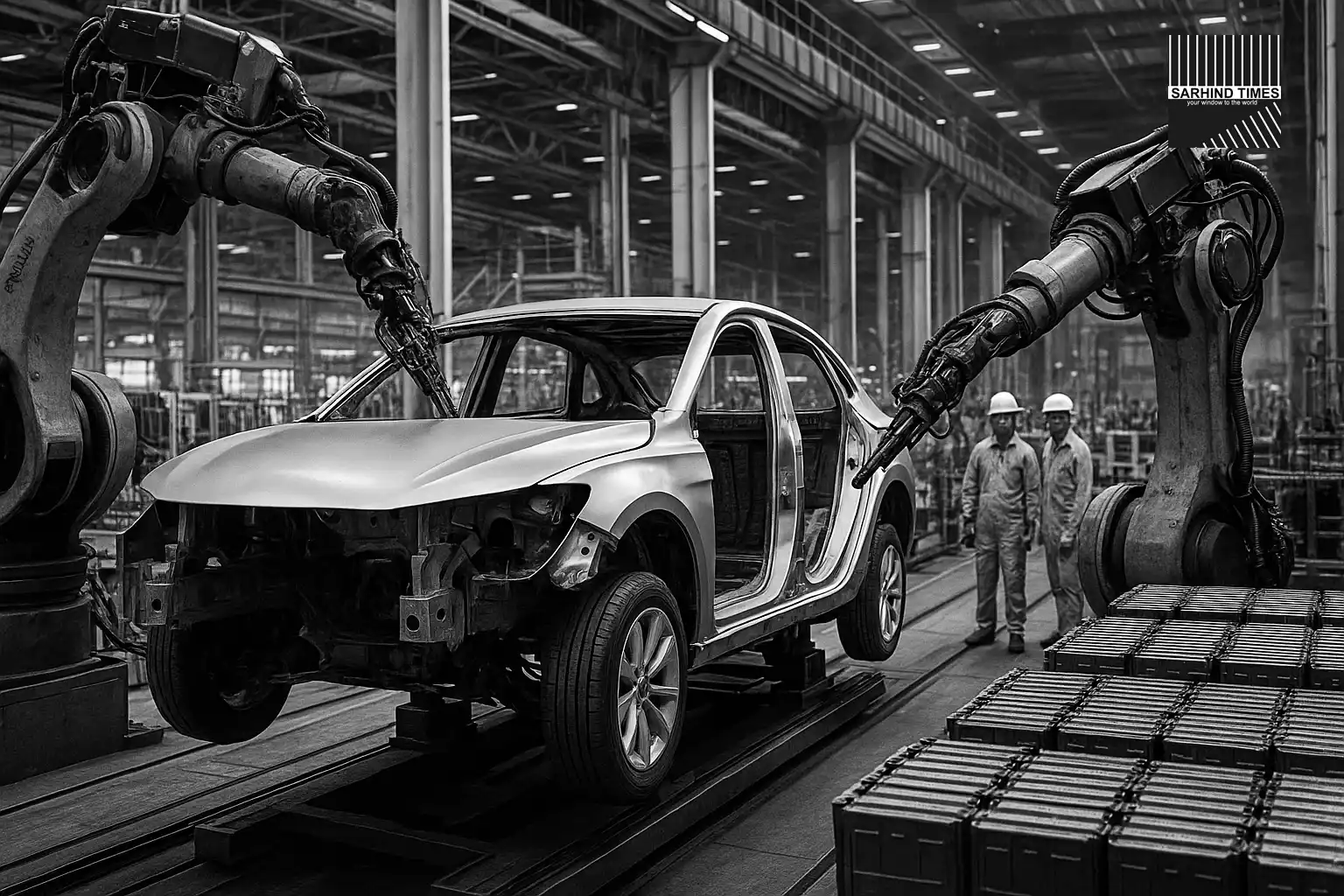
One of the striking shifts embedded in the policy is the export-first mentality. India is not only preparing for domestic mobility transition but seeks to become a competitive global manufacturing base for EVs destined for international markets. This dual objective — domestic transformation and global integration — sets the policy apart from many earlier frameworks which emphasised import substitution rather than export orientation.
If globally competitive EV-manufacturing emerges, India could offer a strategic alternative to China-centric supply chains, deepen ties with global OEMs, attract foreign direct investment, and capture a share of the fast-growing EV market worldwide.
Final reflections
The launch of the SPMEPCI scheme marks a watershed moment in India’s electric-mobility and manufacturing roadmap. By anchoring large-scale investment, localisation, export orientation and ecosystem development in one policy-framework, the government signals that the EV transition is not just an environmental imperative — it is an industrial opportunity.
The success of the policy will depend on execution, coordination between national and state level, and alignment across manufacturing, infrastructure and demand-side conditions. If fulfilled, the rewards are significant: cleaner mobility, stronger manufacturing base, global competitiveness and job creation. If not, capacity may sit idle and momentum may falter.
For the auto-industry, investors and consumers, 2025 therefore stands as a pivotal year. The policy lays out ambitious horizons. The coming months will test whether India can translate ambition into action — and emerge as a global EV power-house.



+ There are no comments
Add yours