
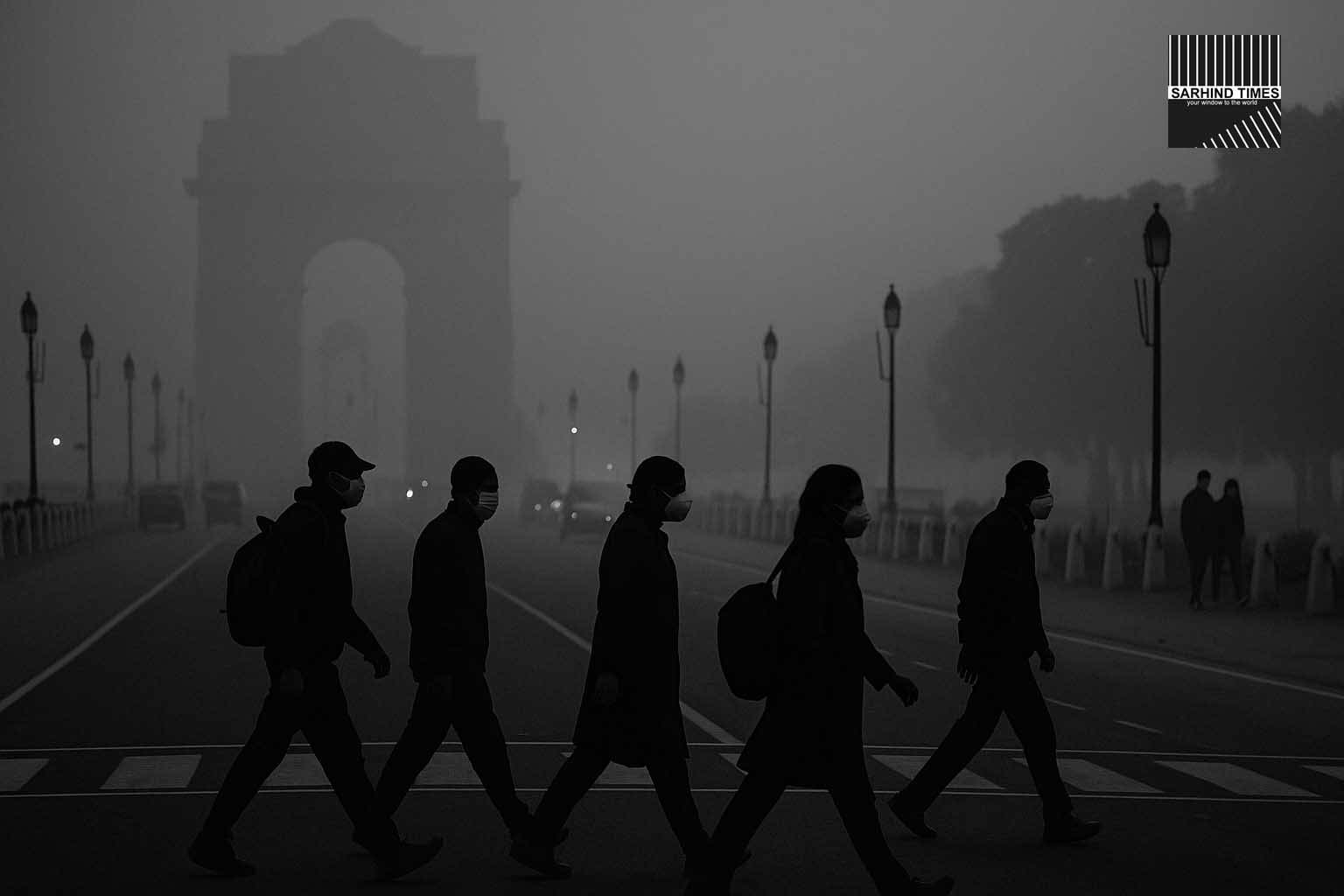
Warnings of winter-smog season arriving early as residents in the National Capital Region demand urgent action
Dateline: New Delhi | November 12, 2025
Summary: The Commission for Air Quality Management (CAQM) has invoked Stage III of the graded response action plan in the Delhi-NCR region after the Air Quality Index climbed past 350. Demonstrations outside the India Gate area reflected public frustration at recurring pollution episodes, signalling an early start to the smog season and raising concerns for public health, transport and governance.
Smog blankets the capital once again
The morning of November 10 in the capital city saw the Air Quality Index (AQI) breach the 350 mark, placing conditions firmly in the “very poor” to “severe” category. Residents in the National Capital Region woke up under a thick grey haze as visibility plummeted and the city’s iconic landmarks faded into the murk. Schools issued advisories to vulnerable children, joggers postponed outings and many offices urged remote work or earlier commutes to avoid the worst of the smog-belt traffic. The pollution spike triggered immediate action by the CAQM, which declared Stage III of the Graded Response Action Plan (GRAP) for the entire region — a move reserved for times when air quality enters the highest danger zone.
Public rage: Demands erupt at India Gate
As pollution-levels worsened, hundreds of protestors gathered near the India Gate monument in central Delhi, brandishing placards demanding cleaner air and accountability. Demonstrators ranged from school-children to elderly residents, many wearing N95 masks and chanting slogans against vehicle-emissions, crop-burning in adjoining states and policy inaction. Organisers said the protest was unauthorised and several attendees were detained by the police, yet the message resonated: “We cannot breathe any more,” read one banner.
For many this was more than political theatre—it was a lived experience. “We’ve seen this same smog-cycle every winter. Why are we surprised again?” asked a teacher who brought her two children to the rally. As dusk approached, the haze deepened and the protesters dispersed into the gloom, merging with the mask-clad crowd retreating to their homes.
What triggered this early smog-onset?
Several factors converged to drive the early spike in pollution:
- Vehicular emissions and stalled policy initiatives: The city’s traffic remains dense. Older diesel and petrol vehicles continue to ply major thoroughfares. The lack of stricter phasing-out of high-emission vehicles reduces the margin for clean-air improvement.
- Crop residue burning in neighbouring states: As wheat-harvest begins and stubble-burning resumes, emissions from agro-fields add to the regional haze. Air-mass movement carries smoke into Delhi-NCR especially in the early morning and evening hours.
- Chats of meteorology and stagnant air: Low wind-speeds, stable atmospheric conditions and dropping temperatures prevent the dispersion of pollutants. The onset of cold nights traps emissions near ground-level, intensifying exposure.
- Construction and dust-loads: Despite regulatory norms, excavation, demolition and road-work carry on in outer-Delhi sectors. These activities generate coarse particulate matter, which adds to the overall PM10 and PM2.5 burden.
Analysts note that the early timing—November rather than deep-winter—is itself a concern because it cuts into meaningful exposure time and elongates the season of poor air-quality.
Impact on health, transport and business</
The immediate health-impact is stark: hospitals in the Delhi-NCR region reported an increase in respiratory complaints, eye-irritation cases and wheezing among older residents. While full data may take days to surface, private clinics operating in the city-centre told reporters they were seeing a 15-20 % uptick in short-term-respiratory diagnoses compared with the week before.
Transport was also affected. Visibility dropped, affecting early-morning commutes and airport operations saw minor delays. Ride-sharing operators warned that surge fares could spike as indoor-wait-times lengthened and some homes opted out of morning–traffic entirely. Retail-foot-fall in open-air malls dropped in the later part of the afternoon as shoppers opted to stay indoors, citing discomfort and hazy skies.
Governance response and policy execution
With the GRAP Stage III notification, several immediate regulatory actions kicked in:
– Heavy-diesel trucks entering from adjacent highways were restricted until further notice.
– Odd-even vehicle schemes were re-activated in the capital for selected zones.
– Construction‐site operations reducing dust-emission were mandated to pause outdoor work during peak-pollution hours.
– Schools in the worst-affected inner zones moved to online-classes for the day, and older students were asked to avoid outdoor activities.
The state environment ministry emphasised that these steps are *reactive* and that the city must invest in *structural change* to remain resilient. A senior minister admitted that “we have the tools but not always the political will to sustain them.”
Data gap: Measuring what remains unmeasured
Fresh data released earlier this year by the Centre for Science and Environment showed that no Indian-state scored above 70 out of 100 in environmental-performance indicators, largely because of serious gaps in sewage-treatment and river-health. While that figure covers broad environmental governance, its implications extend to air-quality—because systemic under-investment in pollution-monitoring and infrastructure makes timely alerts and enforcement harder.
The report noted that 27 states scored below 50 in the “water and waste” theme and argued that data-deficits hamper planning and action. In short: ‘if you cannot measure it you cannot manage it’. The timing of the report and its conclusions add weight to current events in the capital.
Modeling the seasonal horizon and regional risk
Historically, Delhi’s air-quality worsens in December and January, when colder temperatures, fire-cracker bursts around celebrations and crop-fire smoke compound to raise PM2.5 levels dramatically. This year the season appears to have started early. Experts warn that if active measures are not taken *now*, the city may incur an extended smog-season reducing effective outdoor-quality days by up to 30%.
A senior atmospheric scientist commented: “When pollution builds in November and remains high through January, the cumulative exposure for citizens nearly doubles compared to a normal season. That has long-term health-costs.”
Further, policy-makers must consider regional links: air-mass movement from Punjab and Haryana, wind patterns carrying burnt-crop smoke, unfiltered vehicular and industrial emissions all play into the same airshed. Without coordination across state boundaries, the short-term triggers will keep emerging even if local restrictions bite.
Challenges ahead: Beyond one-off emergency fixes
Despite the regulatory measures, a few structural issues remain unresolved:
– The city remains overly reliant on diesel and older-engine vehicles; while new vehicles are being hit with stricter norms, the pace of scrappage remains slow.
– A comprehensive ban on outdoor-construction and demolition during severe pollution episodes exists, but it is not always enforced consistently in peripheral sectors.
– Crop-burning protocols across Punjab and Haryana are slow to implement, triggering repeated episodes of trans-boundary smoke influx.
– Real-time integrated data-systems linking pollution sources, satellite-tracking and local enforcement are still under development. Without them, policy remains reactive rather than pre-emptive.
Experts emphasise the need for deeper reform: outright subsidies for electric vehicles, dust-encapsulation norms for construction, satellite-based enforcement of farm-burning bans and stronger cross-state governance frameworks.
Economic and social implications
The economic cost of the early smog-onset is multi-faceted. For households, increased absenteeism, health-expenditure and indoor-air-management costs (air-purifiers, masks) will bite at disposable incomes. For businesses, lower foot-traffic, higher HVAC ventilation loads, delayed logistics and staff absence translate into slower productivity. Insurance firms have begun modelling pollution-risk as part of operational-exposure in Delhi-NCR offices.
Socially, the early smog season adds to urban-stress. With visibility down and outdoor activity thwarted, the quality-of-life for residents takes a hit. Public commentary is turning from “winter-smog we expect” to “winter-smog we must avoid”. Civic groups are questioning whether the relief promised every year ever materialised.
What to watch in the next weeks</h’ll items include:
- Whether the AQI surpasses 400 or enters the “severe” band in multiple locations (this would trigger further restrictions).
- How effectively odd-even and truck-ban measures are enforced and whether real-time visibility metrics improve.
- If schools move to hybrid or online schedules to protect children in zones registering high PM2.5.
- Whether state-to-state coordination (Punjab, Haryana, UP) accelerates to address stubble-burning and regional smoke transport.
- Whether a longer-term plan is announced to improve data, monitoring, enforcement and urban vehicle-fleet transition—rather than short-term fixes.
Conclusion
The early arrival of smog in Delhi-NCR is more than a seasonal annoyance—it’s a warning signal. The structural challenges of air-quality in India’s capital region won’t be solved by emergency measures alone. As the haze deepens, residents grow weary of repeated cycles of smog followed by temporary regulatory fixes. For meaningful change, sustained investment, coordination across states, updated monitoring systems and citizen mobilisation are crucial. For now, Delhi remains shrouded in grey, its clearance delayed, and its patience thinner than ever.


+ There are no comments
Add yours