
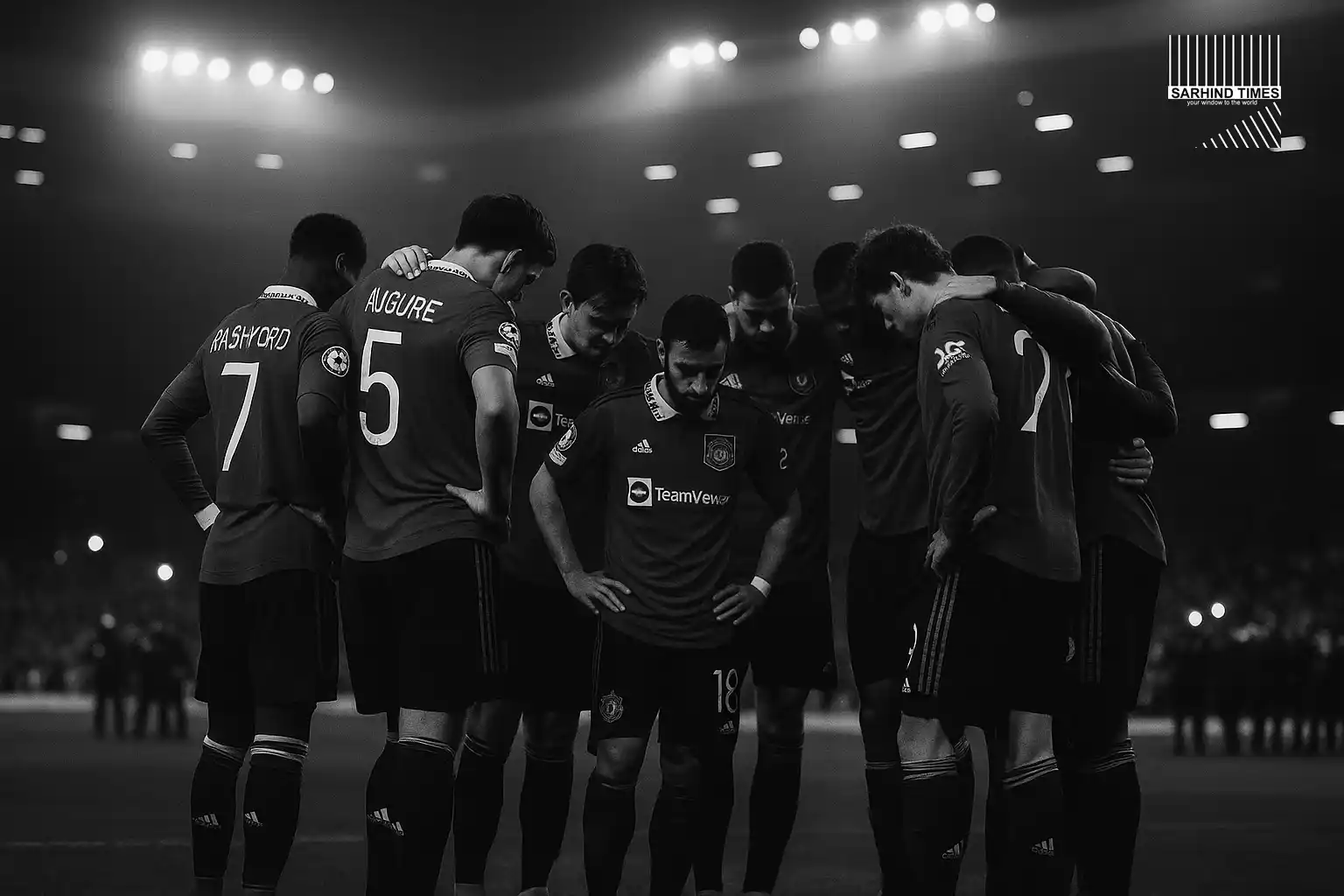
From contenders to casualties: a late-season unraveling leaves fans, analysts and stakeholders searching for answers
Dateline: London | 8 November 2025, Asia/Kolkata
Summary: The Manchester United have been eliminated from the UEFA Europa League after failing to advance from the group stage, marking their earliest European exit in over a decade. Their campaign unravelled due to tactical missteps, inconsistent performances and internal tension — a dramatic downturn for a club once competing consistently at the highest levels.
1. The unexpected downfall
In a football season where expectations were high, Manchester United’s early exit from the Europa League stunned supporters and pundits alike. The club, which has long been associated with Europe’s premium competition success, bowed out at the group-stage phase after a series of disappointing results, including a crucial 3-1 home loss and a draw in a decisive match. The elimination spotlighted not only one match or moment—but a larger pattern of tactical indecision, lack of cohesion and leadership gaps.
United entered the competition with a rebuilding squad, a new manager under pressure and a heavy fixture list that included domestic commitments. Their group featured two mid-level European clubs and one rising under-dog, but even so the expectation was that United would progress. Instead, they found themselves failing to close out games, showing lapses in defence and attack, and ultimately unable to secure the points needed.
The failure is more significant in the context of the club’s history. United have been a staple of European competition for decades, reaching finals, lifting trophies and maintaining a global brand reach partly built on European-success momentum. This early exit therefore not only affects their trophy ambitions but also impacts brand value, recruitment narrative and the mood around the club.
2. Tactical and squad issues
Several issues converged to create the collapse:
– The new manager adopted a high-press system that required athletic intensity and understanding; players struggled to adapt, and when stretched the defence was exposed.
– Injuries to key midfielders disrupted balance, forcing bench players into major roles before they were ready.
– The attack lacked a consistent goal-scorer, meaning United often dominated possession without converting chances. In two group matches they created over 20 shots but managed only one goal.
– Squad rotation was heavy to accommodate Premier League demands, but this rotation lacked strategic depth: drop-in players did not contribute meaningfully and dropped the standard.
– Leadership on the pitch seemed absent. Several senior players were noted publicly to be out of form and less engaged; the galvanising force that typically defines the club was missing.
Overall, the elimination is not down to one bad match—it is symptomatic of deeper issues: transition, identity, and execution.
3. Emotional and commercial fallout
For fans the mood is one of disappointment and frustration. United supporters travelled in large numbers to group matches, anticipating progression, and now are left grappling with the implications. The club’s brand, once synonymous with European success, now faces questions over recruitment and global expansion.
Commercially, the ramifications are significant. European competition exposure affects sponsorships, television‐rights payments, merchandise turnover and global fan-engagement metrics. United’s sponsors will want clarity on the path forward; investors and stakeholders may view this exit as a signal of risk in the club’s competitive trajectory.
Player morale is also impacted. Some squad members, including long-serving veterans, were visibly emotional after the final match, while younger players expressed regret at missing a major opportunity. The internal atmosphere may now face pressure: when fans and media turn critical, the environment becomes more volatile.
4. Competitive implications and recruitment
The European failure will influence recruitment planning. United’s ability to attract top-tier talent often rests on the promise of playing deep into European competitions. With this result, the club may face challenges: elite players may reconsider joining a side that cannot guarantee continental exposure; younger players may look elsewhere for more stable European platforms.
Transfer strategy may shift towards shorter-term fixes rather than long-term plans if pressure intensifies. Management may also feel compelled to overhaul the squad or change leadership more radically than originally intended. Either way, the club enters a period of heightened uncertainty.
5. Wider context: the Premier League and Europe
United’s elimination is also indicative of wider shifts in European football. Clubs that rested on legacy advantage are now being challenged by better-capitalised rivals, sophisticated analytics, global scouting and improved management practices across Europe. The margin of error has shrunk; staying competitive requires sharper execution and clearer identity.
For the Premier League, United’s failure underlines that evidence of depth does not equal success. Domestic competition has become more intense, and European tournaments have fewer buffer zones for error. United will need to improve not just its squad but its planning, rotation, and injury-management systems to compete effectively on two fronts.
6. Reactions from key stakeholders
The club’s manager held a subdued press conference after the final match, acknowledging “we were not good enough” but emphasising the focus will now shift fully to domestic league performance and rebuilding for next year. He stressed that the squad needs to learn from this early exit rather than see it as an aberration.
Some senior players spoke of disappointment but vowed to fight back: “We understand what United stands for — and we will make this right,” one said. Another noted: “This outcome hurts not just because we lost—it hurts because we didn’t compete in the way our supporters expect.”
Analysts reflected that the exit will prompt a serious evaluation of the club’s structure, not just tactics. One suggested that United needs a cultural reset, not just a player-shakeout.
7. What happens now: immediate next steps
Over the next few months, United will undertake:
– A full review of the Europa League group performance, identifying key failures in match preparation, player fitness, tactical choices and squad balance.
– Possible changes in coaching staff or support structure addressing fitness, analytics and rotation strategy.
– Accelerated focus on domestic league performance as the club shifts energy from European disappointment to local re-assertion.
– Recruitment planning will likely target players with proven European experience, and possibly a reduction of older squad members whose output has dropped.
– Communication with supporters will be important: the club must show accountability and plan to rebuild trust rather than shift blame.
8. Longer-term implications: rebuilding phase begins
United are entering a transitional phase. The brand strength remains, but competitive credibility is now under pressure. If they do not respond effectively, the club risks sliding from elite contender to mid-tier European participant. To restore status, they must clarify identity (press-counter-attack? possession-oriented? balanced?), invest in younger talent tied to a strategy and rebuild internal cohesion.
For global football watchers, this case may even mark a turning point: when a historically dominant club fails at a European stage, it invites reflection on strategy, leadership and adaptation to new-era football. United must decide whether to view this as a wake-up call or as a new normal.
9. What fans and stakeholders should track
Key indicators to watch in the coming season include:
– Managerial signals: Will the club stick with its current leadership or change direction?
– Transfer activity: Are marquee signings centred on leadership, European experience and urgency, or incremental?
– Youth integration: Are younger players given defined roles or is cobbling continued?
– European performance: How does United respond in the next European campaign? Is the elimination a short-term aberration or a trend?
– Domestic rebound: Success in the Premier League could provide a platform for return, while failure at home would signal deeper issues.
10. Conclusion: a big name, big fail, big opportunity
Manchester United’s Europa League exit is undeniably a high-profile failure. But the story isn’t over. For a club with history, resources and global reach, this is not a crisis without remedy—it’s an opportunity for strategic reset. The question is whether they will act. If they do, they may emerge stronger. If they don’t, the risk is that the loss becomes a collision with a lower tier of European football rather than a temporary setback.


+ There are no comments
Add yours