
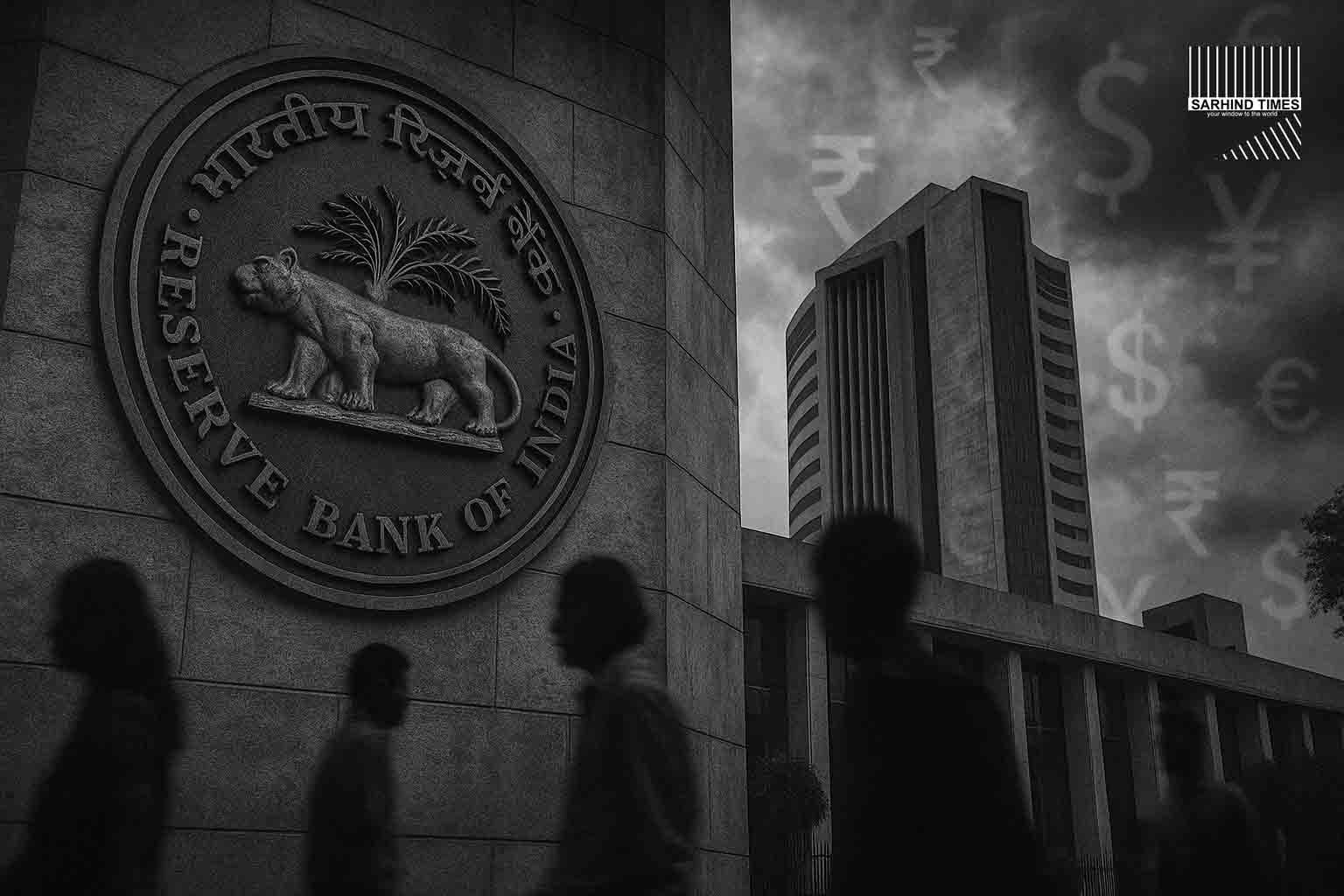
India’s foreign exchange reserves dipped by $276 million to $699.96 billion in the week ended October 3. The Rupee stayed largely steady, supported by strong inflows and resilient macro fundamentals.
Mumbai | October 11, 2025
India’s foreign exchange reserves registered a mild decline of $276 million for the week ended October 3, standing at approximately $699.96 billion, according to the latest data released by the Reserve Bank of India (RBI) on Friday.
Despite the small dip, economists and market participants described the overall sentiment as constructive, citing the country’s near-record reserve position and a broadly stable Rupee, which continues to trade in a tight range.
The minor drawdown, analysts said, was likely due to RBI’s routine interventions to manage exchange rate volatility amid shifting global capital flows and fluctuations in crude oil prices.
Rupee Remains Stable, Range-Bound
The Indian Rupee has remained remarkably steady, hovering around ₹83.10 per US dollar, with intraday volatility contained within a narrow 20–25 paise band.
Currency traders said the stability was aided by strong portfolio inflows, robust IPO subscriptions, and the RBI’s active presence in the spot and forward markets.
“The rupee has shown resilience in the face of global headwinds,” said Anindya Banerjee, FX strategist at Kotak Securities. “The RBI’s intervention strategy appears finely balanced—smoothing volatility without setting artificial levels.”
Importers, however, continued to hedge cautiously amid concerns about potential oil spikes and the upcoming US inflation data, which could influence global yields and the dollar index.
India’s Forex Cushion Near Record High
At nearly $700 billion, India’s reserves remain the world’s fourth-largest after China, Japan, and Switzerland. The stockpile is sufficient to cover over 11 months of imports, providing a substantial buffer against external shocks.
Breakdown of reserves as per RBI data:
- Foreign Currency Assets (FCA): $649.12 billion
- Gold Reserves: $57.83 billion
- Special Drawing Rights (SDRs): $18.4 billion
- IMF Reserve Position: $4.61 billion
The marginal decline this week followed a larger drawdown of $2.9 billion the previous week, attributed to revaluation changes in gold and currency assets.
Why Forex Reserves Matter
Forex reserves are the backbone of India’s external sector stability, enabling the RBI to manage currency fluctuations, maintain investor confidence, and provide liquidity in times of stress.
In 2013, during the “taper tantrum” crisis, India’s reserves had slipped below $280 billion, leading to a sharp rupee depreciation. In contrast, today’s near-$700 billion cushion reflects a decade of prudent reserve management.
“The comfort of a large reserve position allows India to withstand sudden capital flow reversals or commodity shocks,” noted Dr. Soumya Kanti Ghosh, Chief Economist at SBI. “It also gives the RBI confidence to manage the rupee flexibly rather than defensively.”
RBI’s Strategy: A Balancing Act
The RBI does not explicitly target an exchange rate level but intervenes periodically to prevent disorderly movement. This includes selling dollars to curb sharp rupee depreciation or buying them to prevent excessive appreciation.
Market data suggests the central bank has been sterilizing its interventions effectively—absorbing or injecting liquidity through open market operations (OMOs) and forward swaps to ensure minimal disruption to domestic liquidity.
Economists say this approach underscores the RBI’s managed float regime, which has helped maintain currency stability without compromising monetary policy independence.
Global Context: A Dollar-Dominant World
Globally, the US Dollar Index (DXY) has remained strong around 105, buoyed by firm US economic data and the Federal Reserve’s cautious stance on rate cuts.
Emerging market currencies, including the yen, won, and baht, have faced depreciation pressures this quarter. Against that backdrop, the Indian Rupee’s relative steadiness has impressed global investors.
“India’s external metrics are among the healthiest in the emerging market universe,” said Priya Misra, Head of Global Rates Strategy at TD Securities. “The country has twin-deficit challenges but compensates through strong capital inflows and a credible central bank.”
IPO Boom and Dollar Supply
Recent blockbuster IPOs, including those from fintech and logistics firms, have led to a wave of dollar inflows, helping balance the market’s demand-supply dynamics.
“IPO-related flows have given a timely cushion,” said HDFC Securities in a note. “Even as oil importers hedge dollar exposure, equity inflows are offsetting outflows.”
According to NSE data, total foreign portfolio investment (FPI) inflows stood at ₹8,400 crore during the first week of October, further supporting the currency.
Corporate Treasury Response: Hedge Smartly, Not Aggressively
Corporate treasurers are being advised to maintain layered hedging positions rather than attempting to time the market.
“We expect the rupee to remain range-bound between 82.80 and 83.40 in the short term,” said Rahul Kothari, Chief Dealer at ICICI Treasury. “Layered hedging ensures cost efficiency without overpaying for forward premiums.”
Forward premiums, reflecting the interest rate differential between India and the US, have stayed low—around 1.8% for one-year tenors—making long-term hedging relatively affordable.
Global Drivers: US Yields and Oil Prices
Two major global forces continue to shape India’s FX outlook: US Treasury yields and crude oil prices.
- US Yields: The 10-year Treasury yield remains elevated near 4.6%, maintaining the dollar’s strength.
- Oil Prices: Brent crude has softened from $90 to $82 per barrel, easing pressure on India’s import bill.
If oil remains stable and global inflation cools, analysts expect India’s reserves to hover around the $700–720 billion mark for the rest of FY2025.
What Analysts Are Saying
Market experts see this week’s dip as a non-event, part of regular adjustments.
“Small weekly fluctuations are normal,” said Madhavi Arora, Lead Economist, Emkay Global. “The RBI’s steady accumulation over the past two years has rebuilt confidence after 2022’s outflows.”
“India’s reserves are well above any red flag threshold,” said Nomura India. “The focus now is on how the RBI uses them during bouts of volatility rather than their absolute size.”
Historical Perspective: From Fragility to Fortress
India’s forex story has come full circle since the 1991 balance-of-payments crisis when the country’s reserves had dwindled to barely cover two weeks of imports.
Today’s $700 billion buffer marks a 2,400% increase over three decades, reflecting economic maturity and cautious policy.
Key milestones:
- 1991: Reserves below $2 billion; gold pledged to avoid default.
- 2008: Global Financial Crisis — reserves cushion helped absorb shocks.
- 2013: Taper tantrum — RBI’s intervention and swap windows stabilized rupee.
- 2020–22: Pandemic volatility offset by record inflows and FDI.
- 2025: Near-record reserves reinforce India’s resilience narrative.
RBI’s Gold Reserves and Diversification
The RBI’s holding of gold reserves, valued at $57.83 billion, forms nearly 8% of total reserves.
Over the past five years, the central bank has gradually increased its gold share to diversify away from dollar assets and hedge against currency volatility.
Experts say this aligns with a global central bank trend, as many reserve managers worldwide are reducing dependence on the US dollar amid geopolitical fragmentation.
India’s External Sector: Strong Fundamentals
India’s current account deficit (CAD) has narrowed to an estimated 1.3% of GDP, well within sustainable limits.
Merchandise exports have moderated, but strong services exports, particularly IT and financial services, continue to generate surplus inflows.
Remittances from overseas Indians are also robust, crossing $120 billion in FY2025.
“The external balance remains solid,” said Crisil Research. “The combination of strong reserves, moderate CAD, and healthy FDI inflows ensures macro stability.”
Monetary Policy Outlook
With inflation gradually easing and the rupee stable, the RBI is expected to maintain its policy pause in the next monetary review.
The central bank has repeatedly emphasized macro stability over short-term growth trade-offs, signaling a cautious stance on rate cuts until global conditions normalize.
“We’re in a sweet spot,” said Aditi Nayar, Chief Economist, ICRA. “Inflation is contained, the rupee is stable, and reserves are healthy. There’s little urgency to tweak policy.”
Investor Perspective: India’s Credibility Grows
For global investors, India’s large reserves are a signal of policy credibility and financial strength.
“Reserves are not just numbers on a balance sheet; they’re symbols of trust,” said Ruchir Sharma, global investor and author. “They tell markets that India can defend its currency without panic.”
This confidence is reflected in India’s sovereign credit ratings, where agencies like S&P and Moody’s have maintained stable outlooks citing fiscal discipline and reserve adequacy.
Looking Ahead: Stable, but Vigilant
Going forward, market participants expect the RBI to continue its fine balance — intervening only to prevent volatility while allowing natural market adjustment.
Key data points to watch in coming weeks:
- October CPI inflation (due next week).
- US Federal Reserve policy commentary.
- OPEC’s production decisions.
- Q2 corporate earnings trends.
If global conditions remain supportive, India’s reserves could inch back toward the $705–710 billion mark by November.
Conclusion: Quiet Strength in Volatile Times
The latest RBI data tells a story not of weakness, but of quiet strength. A $276 million dip in a $700 billion reserve is, in perspective, a rounding error — and a reminder of how far India’s economy has come.
The Rupee’s calm amid global currency storms showcases both the RBI’s policy maturity and India’s deepening financial resilience.
As global uncertainty lingers, India’s forex fortress stands as both shield and symbol — guarding the economy’s stability and global credibility.






+ There are no comments
Add yours