
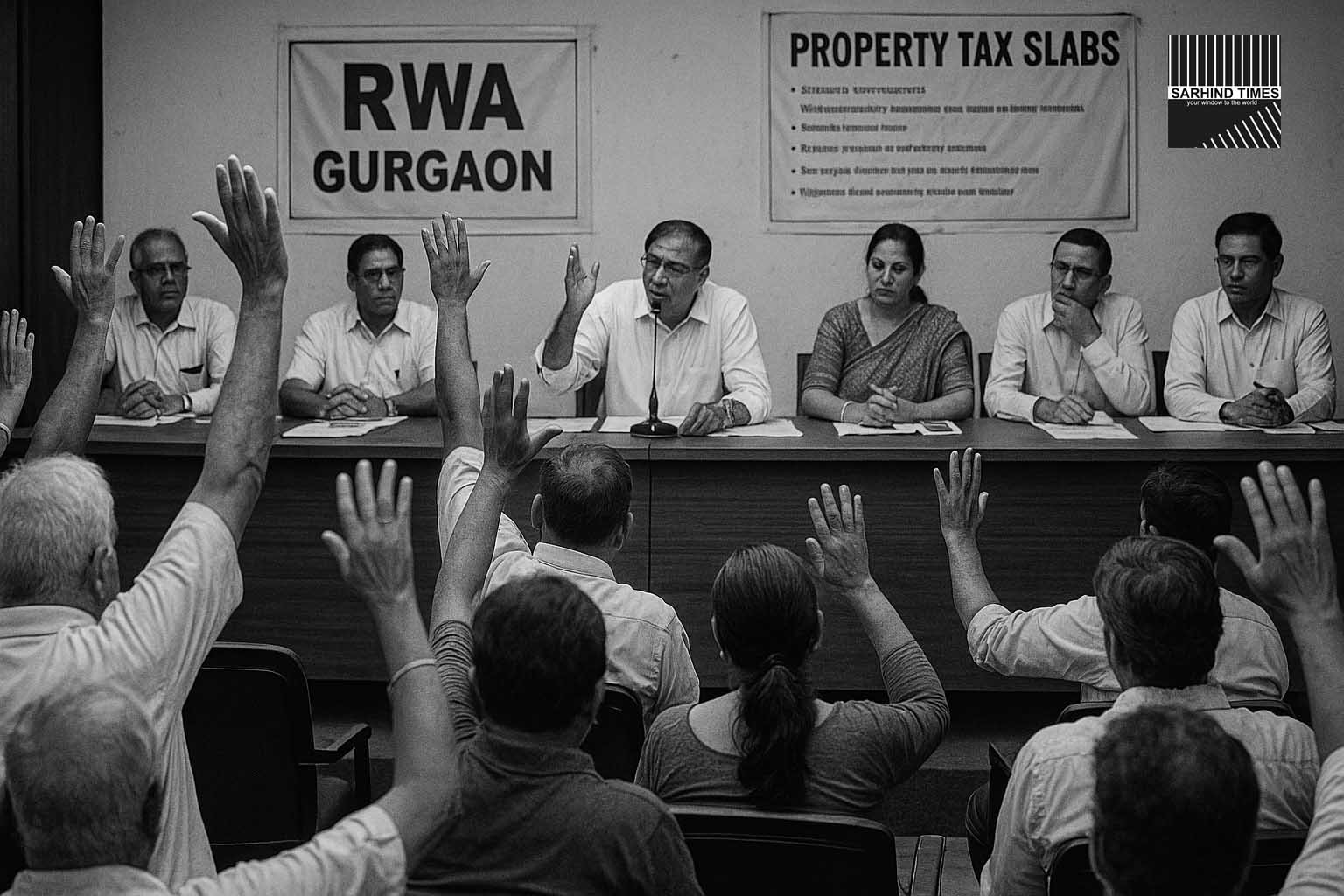
Residents raise concerns over new slabs, demand transparency and rollback; officials defend move as essential for city infrastructure funding
Dateline: Gurugram | November 16, 2025
Summary: The Municipal Corporation of Gurugram’s revised property tax structure has triggered widespread debate and criticism across the city as RWAs, homebuyers, and business owners protest steep increases and alleged inconsistencies in assessment categories. Several sectors have formed joint committees to challenge the hike, calling it “unfair and abrupt,” while MCG maintains that the new system is vital for improving civic services and meeting growing urban demands.
The Tax Storm That Has Split Gurugram
What started as a routine municipal notification has snowballed into one of the most contentious civic issues Gurugram has seen this year. The Municipal Corporation of Gurugram (MCG) recently released a draft proposal to change the property tax slabs applicable to residential, commercial, and mixed-use properties across the city.
Within hours of circulation, Resident Welfare Associations (RWAs) across multiple sectors began raising objections, claiming the revised tax framework was “unscientific, arbitrary, and financially burdensome.” Several RWAs reported receiving hundreds of messages from worried homeowners, especially those in mid-income and older sectors.
What the New Proposal Suggests
While the final draft is still awaiting approval, the proposed revisions include:
- A reclassification of residential sectors based on “market potential”
- Higher tax slabs for builder floors, premium societies, and high-rise apartments
- Revised levies for commercial and mixed-use units
- A new formula linking tax to building age, plot size, and locality score
- Mandatory self-declaration of built-up areas by property owners
Officials argue that the new formula will create a “fair and scalable” taxation ecosystem, but residents insist the methodology is opaque and lacks proper consultation.
RWAs Push Back: ‘This Is Not Justified’
RWAs from Sectors 4, 9, 14, 21, 22, 23, 37C, 57, 70+, and DLF phases have collectively voiced strong opposition. Several groups allege that the new slabs disproportionately burden older sectors where civic amenities remain inadequate.
In recent meetings, RWA leaders argued:
- Drainage, waste collection, and road maintenance remain inconsistent
- Streetlight coverage is patchy in several colonies
- Water supply issues persist in multiple inner-sector streets
- Green belt maintenance has been erratic
“How can the city justify increasing taxes when basic services are still unreliable?” asked an RWA president from Sector 14 during a weekend gathering attended by over 120 residents.
Middle-Class Families Fear Rising Financial Pressure
For thousands of families living in mid-income societies and independent floors, the prospect of a sudden tax increase has triggered significant worry. Many households already face rising maintenance fees, school costs, and higher utility bills.
“Every few months something new comes—waste charges, parking rules, power bills, now property tax hikes. It is becoming too much for the average middle-class resident,” said a resident of Sector 46.
Builder Floors and High-Rises Hit the Hardest?
The highest jump appears in the proposed slabs for builder floors and luxury apartments. Residents argue they are being unfairly “targeted” simply for living in newer developments.
RWAs from multiple condominium clusters along Golf Course Extension Road, Southern Peripheral Road, and Dwarka Expressway have demanded a re-evaluation of slab categorization, pointing out that many high-rises already pay hefty maintenance charges that cover services the city does not provide.
Commercial and Mixed-Use Concerns
Shop owners in older markets such as Sadar Bazaar, Sector 4 Market, HUDA Market, and Sector 14 Market claim that higher commercial taxes will shrink already-thin margins.
“Small businesses are still recovering. Increasing property tax at this time will be a big setback,” said a shopkeeper from the Sector 14 market association.
MCG Responds: ‘Essential for Urban Development’
MCG officials have responded firmly, defending the tax revision as overdue. According to the corporation, Gurugram’s rapid expansion places significant pressure on public infrastructure—roads, drains, sewage lines, streetlights, and sanitation logistics.
Officials claim the current tax revenue is insufficient to meet the growing needs of the city.
“If Gurugram wants world-class facilities, we need a world-class municipal revenue system,” said a senior MCG officer. The department maintains that residents will see improved services once the new system stabilizes.
Residents Question Transparency and Methodology
The protest is not merely about the quantum of tax but the lack of clarity around how figures were computed.
RWAs have raised several key questions:
- What data was used to determine locality scores?
- Why were public hearings not held in advance?
- How were building age factors calculated?
- Why do some poorly serviced sectors fall into higher brackets?
- How will accountability for service improvement be monitored?
Many RWAs demanded that MCG publish a sector-wise justification for each classification.
A Joint RWA Action Committee Takes Shape
To streamline efforts, RWAs across multiple sectors are forming a citywide Joint Property Tax Action Committee. The goal: to create a unified negotiation platform with MCG.
Committee members plan to:
- Draft a consolidated objection report
- Request public hearings and consultations
- Seek temporary stay on implementation
- Approach state leadership if needed
Political Overtones Emerge as Parties Weigh In
With local elections not too far away, political parties are beginning to comment on the controversy. Some leaders criticize the corporation for pushing revisions without adequate dialogue. Others argue that modern cities cannot sustain infrastructure without updated revenue streams.
Analysts note that property tax debates often become politically sensitive, especially in urban constituencies.
Urban Planners Call for Balanced Reform
Experts in urban governance suggest that property tax overhauls are inevitable in high-growth cities like Gurugram, but must be rooted in transparency, consultation, and data-driven assessment.
They recommend:
- Publishing detailed GIS-based locality assessments
- Bringing RWAs into pre-draft discussions
- Ensuring service quality improvements before tax increases
- Implementing grievance redressal mechanisms
- Phased introduction to reduce financial shock
According to experts, property tax should reflect not just market value but fairness in service delivery.
What Happens Next?
The MCG has invited written objections and suggestions from residents. Once reviewed, the corporation will finalize the revised structure and send it to the state government for approval.
RWAs are preparing detailed sector-wise submissions highlighting inconsistencies, service gaps, and financial burdens on middle-income households.
The Bottom Line
Gurugram’s property tax debate highlights a much larger challenge faced by rapidly growing cities: balancing revenue needs with citizen expectations. As the city expands and infrastructure demands multiply, sustainable governance requires both financial resources and trust between administration and residents.
For now, the city stands divided—one side urging caution and fairness, the other insisting on the necessity of reform. The coming weeks will determine whether the revised tax slabs are implemented as planned, moderated through dialogue, or significantly altered in response to public pressure.



+ There are no comments
Add yours