
New Delhi | October 25 2025 | Sarhind Times Business Bureau
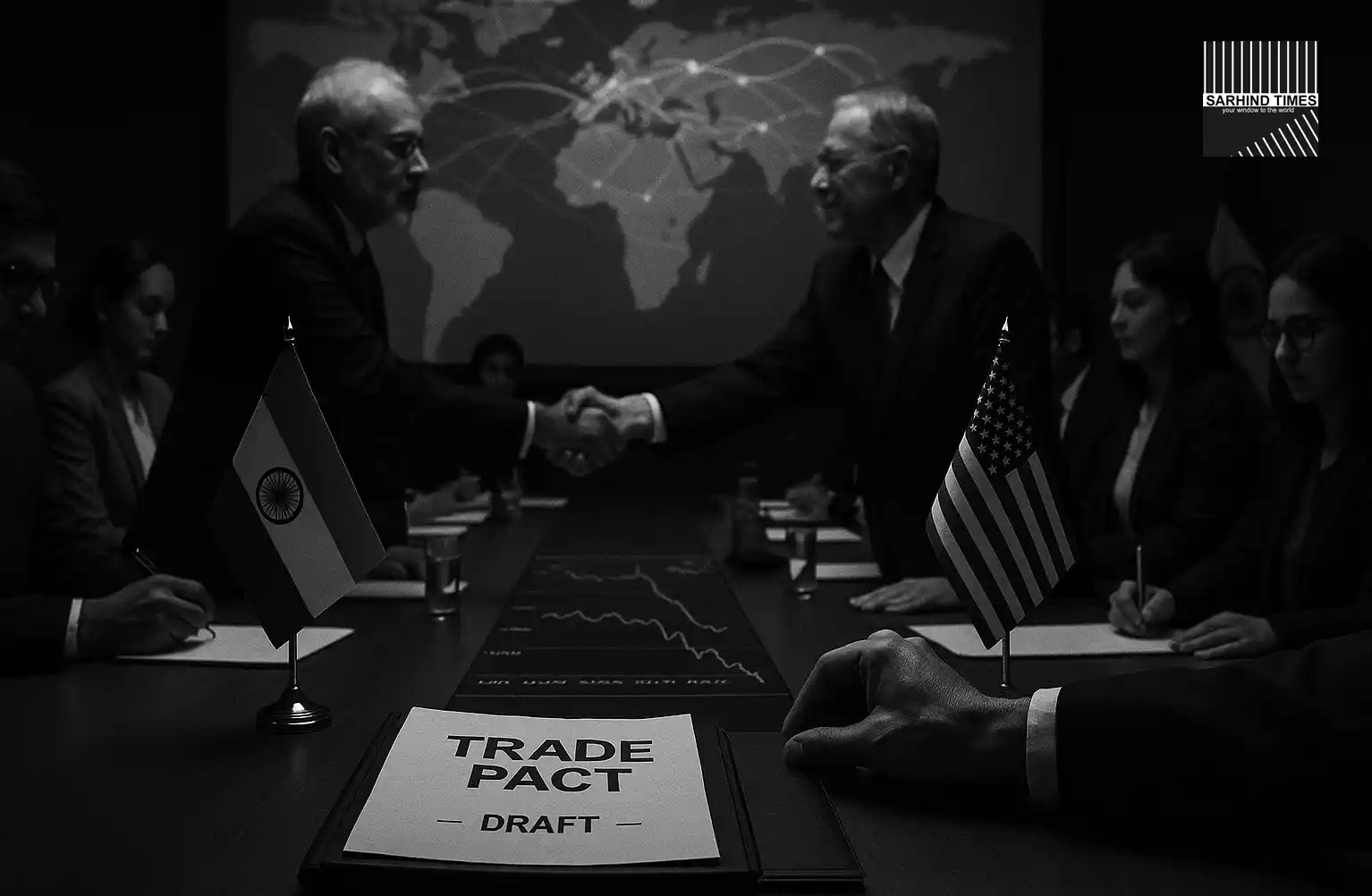
New Delhi — India will not rush into signing trade deals that compromise national interest, Commerce and Industry Minister Piyush Goyal said on Friday, even as officials confirmed that negotiations for a limited free-trade agreement with the United States have entered their “final drafting stage.” The remarks reflect India’s increasingly calibrated approach to international commerce—seeking growth through strategic engagement rather than headline-driven speed.
India’s trade diplomacy shifts gears
At a press briefing following a review of bilateral trade engagements, Goyal said the government was focused on “high-quality, win-win outcomes” that protect domestic manufacturing while expanding export access. “India will not sign an agreement for the sake of optics,” he stressed. “Every clause must align with our national priorities—energy security, employment, and technology sovereignty.”
Sources in the ministry told Sarhind Times that the proposed pact with Washington—technically termed a ‘Trade and Technology Understanding’ (TTU)—is narrower than a full FTA but broader than previous mini-deals. It is expected to cover tariff concessions on select goods, reciprocal market access for critical minerals, digital-trade standards, and cooperation on supply-chain resilience for semiconductors and pharmaceuticals.
The development marks a significant thaw after years of on-again, off-again talks derailed by differences over agricultural subsidies, e-commerce regulations, and medical-device pricing. Negotiators from both sides reportedly closed several chapters this week through video conferences, leaving “a handful of sensitive issues” for ministerial decision.
“We have made substantial progress, but India is not in the business of hurried signings,”
a senior commerce-department official told Sarhind Times. “The idea is sustainable cooperation, not temporary applause.”
The economic backdrop: balancing growth with caution
The renewed trade push comes amid an uncertain global environment. With the IMF projecting India’s GDP growth at 6.6 percent—the world’s fastest among major economies—New Delhi is under pressure to translate momentum into export gains. Merchandise exports have plateaued around $450 billion annually, while services trade continues to surge on IT, consulting, and financial back-office strength. Policymakers hope that carefully crafted FTAs can lift the overall trade-to-GDP ratio back above 45 percent, last seen before the pandemic.
However, the government’s philosophy has evolved since early 2010s when India exited several multilateral agreements like RCEP (Regional Comprehensive Economic Partnership). The lesson, officials say, was clear: premature liberalisation without reciprocal access can hollow out domestic manufacturing. “The global trade order is not altruistic,” a senior bureaucrat remarked. “We must engage from a position of strength, not anxiety.”
Inside the India–US deal: what’s on the table
Officials familiar with the talks outlined four primary pillars:
- Tariff rationalisation on limited goods such as textiles, leather, and certain engineering products in exchange for lower U.S. duties on generic pharmaceuticals and gems-and-jewellery.
- Digital-trade norms addressing data localisation, cross-border digital flows, and source-code protection—seen as a blueprint for India’s future e-commerce policy.
- Critical-mineral cooperation to secure lithium, cobalt, and rare-earth supply chains for electric-vehicle and semiconductor sectors.
- Ease of services mobility through faster visa processing for Indian professionals under H-1B and L-1 categories, including recognition of remote-work contracts.
Negotiators emphasise that agriculture and dairy—historical flashpoints—remain outside the current draft. Instead, the focus is on future-proof sectors tied to technology, sustainability, and resilient supply chains. Trade economists call the model “FTA 2.0,” where traditional goods liberalisation gives way to digital and strategic domains.
Why ‘no haste’ matters politically
Domestically, Goyal’s caution also serves political optics. India’s upcoming state elections and the 2026 general election make the government wary of any perception that farmers or small manufacturers could be disadvantaged. Previous FTAs with ASEAN and Japan are often cited by critics as examples where benefits skewed toward imports rather than exports. The Commerce Minister’s repeated use of the phrase “Atmanirbhar globalisation” signals an attempt to blend self-reliance with outward engagement.
Opposition leaders welcomed the transparency but urged parliamentary oversight once the draft is ready. Congress spokesperson Anand Sharma said, “We support pragmatic trade diplomacy, but all stakeholders—from MSMEs to farmers—must know what’s being negotiated in their name.” Industry bodies such as FICCI and CII, meanwhile, have urged speed, arguing that delayed deals risk ceding market share to competitors like Vietnam and Mexico.
Industry reactions: optimism with caveats
The business community remains broadly upbeat. Tech exporters see the TTU as a path to unlock smoother cloud-data transfers and reduce compliance costs. Pharmaceutical firms hope to win faster U.S. approvals through mutual recognition. Engineering exporters expect tariff cuts on finished goods and machinery spares. However, auto component and dairy sectors seek explicit protection clauses. “A fine balance is needed,” said Rajiv Bajaj, MD of a leading manufacturing association. “Trade should not become a Trojan horse for dumping.”
Economist Dr Ila Patnaik believes India must institutionalise post-deal monitoring. “The success of an FTA lies in utilisation rates, not signatures,” she noted. “We should measure how many exporters actually use the tariff lines opened, and whether small firms benefit or just conglomerates.”
Comparing other FTAs – lessons learnt
India has inked three major FTAs in recent years—with the UAE (2022), Australia (2023), and the European Free Trade Association (EFTA) in 2025. While the UAE pact boosted gems and jewellery exports, Australia’s deal triggered competitive pressure on domestic wine and dairy producers. The EFTA agreement, however, introduced an innovative model of “investment for market access”—where partner nations pledged $100 billion in manufacturing investment over 15 years in return for tariff concessions. Officials suggest the India–US pact may follow a similar hybrid structure, embedding investment targets alongside tariff schedules.
Trade analysts point out that India’s FTA strategy is gradually aligning with its Make-in-India agenda: using deals to attract capital and technology rather than simply lower import barriers. The current talks emphasise supply-chain security, particularly in semiconductors, batteries, and renewable-energy components—areas where dependence on China has long been a strategic vulnerability.
The digital-trade dimension
One of the most debated aspects is the treatment of digital data. The U.S. seeks open cross-border data flows to support e-commerce and cloud services, while India advocates data localisation for privacy and security reasons. Officials indicated that a “mutually respectful compromise” is emerging: sensitive personal data may remain local, but anonymised industrial and research data could flow freely under audit trails. A joint working group will oversee the framework’s implementation once the pact is signed.
Legal experts view this as a precedent for India’s upcoming Digital India Bill, which will replace the IT Act 2000. “Whatever India agrees with the U.S. could become the default template for future data-governance pacts,” said technology lawyer Sumeet Kaur. “That makes it crucial to strike the right balance between innovation and sovereignty.”
Strategic stakes: trade as foreign policy
Beyond economics, the deal carries geopolitical significance. The U.S. has been seeking to anchor India within a network of “trusted trade partners” spanning the Indo-Pacific. Washington views the pact as part of a broader effort to diversify supply chains away from China. For New Delhi, it offers a chance to deepen ties without joining military blocs. Analysts say such economic pacts act as “soft alliances”—binding partners through shared prosperity rather than defence treaties.
“Trade is now the frontline of diplomacy,” said Prof. C Raja Mohan, a leading strategic affairs commentator. “India’s cautious engagement with the U.S. sends a clear signal: we will cooperate, but on equal terms.”
Challenges ahead: agriculture, IPR, and domestic politics
Despite optimism, hurdles remain. The U.S. continues to press for stronger intellectual-property protections, particularly in pharmaceuticals and digital software. India resists clauses that could limit generic-drug exports or raise medicine prices. Agricultural lobbies on both sides remain wary. Meanwhile, any concessions on data or e-commerce taxation could trigger domestic political backlash from small traders and digital-privacy advocates.
Former commerce secretary Rahul Khullar cautioned that “fine print often hides asymmetry.” He cited past experiences where developed partners leveraged non-tariff barriers—standards, certifications, and environmental clauses—to offset India’s tariff gains. “We must guard against disguised protectionism,” he warned.
Potential gains: a numbers game
Preliminary government assessments project an additional $25–30 billion in annual bilateral trade within five years of implementation. India could gain from increased access for textiles, leather goods, and engineering exports, while the U.S. may benefit from reduced tariffs on high-end equipment and agricultural machinery. Analysts estimate up to 1.2 million new jobs could emerge across logistics, digital services, and manufacturing if downstream investments follow.
However, the impact will hinge on complementary domestic reforms—faster customs clearances, port modernisation, and stable export incentives. Economists urge synchronising FTA rollouts with GST simplification and credit access for MSMEs to truly unlock potential.
The political economy of delay
Why, then, the deliberate pace? Officials cite three reasons: first, India’s aversion to repeating the “negotiation fatigue” of RCEP; second, the need to build internal consensus across ministries; and third, the geopolitical balancing act between major powers. “Trade negotiations are no longer just about tariffs—they’re about technology, data, and ideology,” one diplomat observed. “Haste could be costly.”
By publicly emphasising patience, Goyal signals confidence that India’s negotiating position is strong. The country’s $4-trillion-plus economy, robust foreign-exchange reserves, and demographic dividend give it leverage previously lacking. “When the buyer is in demand, the buyer dictates terms,” an official quipped.
Global context: slowbalisation and supply-chain rewiring
The India–US discussions unfold against a backdrop of “slowbalisation”—the global deceleration of trade growth after decades of hyper-integration. Nations are re-shoring or “friend-shoring” critical industries to mitigate geopolitical risk. India’s production-linked incentives (PLIs) in electronics, solar, and EVs align with Western economies seeking diversified supply networks. As a result, trade agreements today double as industrial-policy instruments.
“Every modern FTA is partly an investment treaty, partly a security pact, and partly a tech-governance framework,” said economist Devika Rane. “India’s challenge is to extract maximum value across all three fronts.”
What next: timelines and ratification
Both sides have agreed to complete legal scrubbing by December 2025. Signing could take place early next year if political calendars align. The agreement will likely begin as an executive understanding, followed by legislative ratification in due course. Industry chambers expect the first phase—tariff revisions and digital-standards protocols—to roll out by mid-2026.
In parallel, India continues negotiations with the UK, Oman, and the Gulf Cooperation Council (GCC). Officials emphasise that each track is “independent and context-specific,” rebutting claims that India is overstretched. “We negotiate at our own pace, based on merit,” Goyal reiterated.
Public sentiment: cautious optimism
Public opinion surveys by CSDS-Lokniti indicate that 68 percent of urban respondents support trade liberalisation if it generates jobs and technology inflow. Yet 55 percent fear small businesses could be hurt. Experts say managing perception will be as critical as drafting clauses. Transparent communication—explaining benefits in relatable terms—will determine whether FTAs become electoral assets or liabilities.
Conclusion: patience as policy
As India stands on the cusp of another major trade milestone, Goyal’s message—“no haste, only strategy”—captures the tenor of a new economic realism. The era of unconditional openness has given way to calibrated ambition. The India–US pact, when finalised, may become the template for how developing economies negotiate power parity in an asymmetric world.
For New Delhi, the wait is not a delay—it is due diligence. In global trade, as in diplomacy, speed wins headlines but patience wins terms.
Hashtags: #Trade #FTA #USIndia #Commerce #Economy #GlobalBusiness #SarhindTimes


+ There are no comments
Add yours