
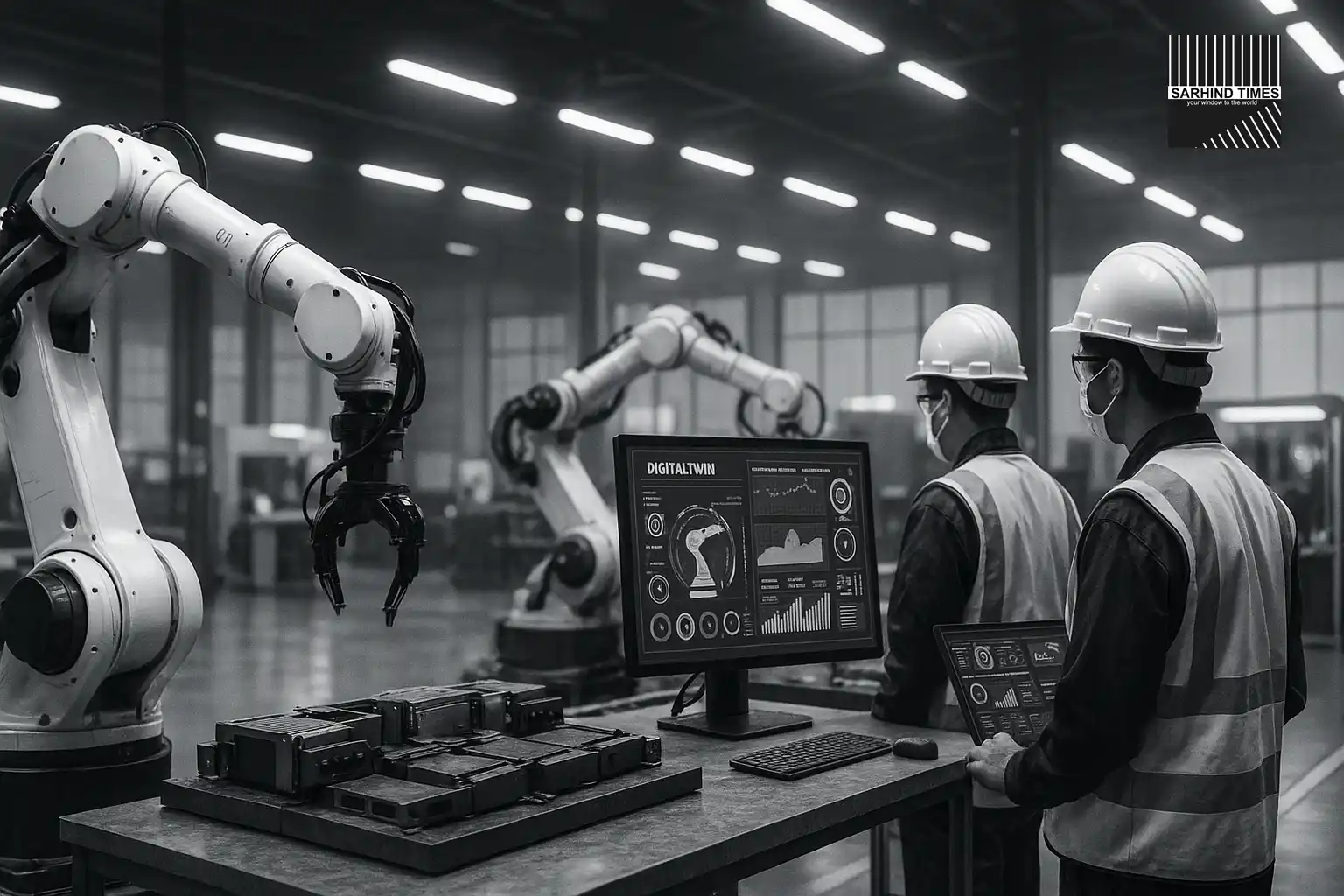
“Reimagining Manufacturing” aims to raise manufacturing share to 25 % of GDP and create over 100 million jobs by 2035
Dateline: New Delhi | October 30, 2025
Summary: The NITI Aayog today launched a detailed 10-year strategic roadmap titled “Reimagining Manufacturing: India’s Roadmap to Global Leadership in Advanced Manufacturing”, which maps out how India will leverage frontier technologies—AI, robotics, digital twins, advanced materials—to elevate manufacturing productivity, drive job creation and reposition India among the top global manufacturing hubs.
Introduction: A Moment of Manufacturing Reckoning
India’s manufacturing sector, historically a key pillar of economic policy under schemes such as Make in India and the Atmanirbhar Bharat push, has faced persistent challenges: its share of GDP has hovered around 15–17 per cent, well below the 25–30 per cent typical of high-performing East Asian manufacturing economies. With global supply chains undergoing rapid restructuring and advanced manufacturing technologies changing the calculus of industrial competitiveness, India finds itself at a crossroads. The NITI roadmap signals that incremental reform is no longer sufficient—the country must embark on a technology-embedded transformation of its manufacturing DNA.
Why Now? The Strategic Imperative
The roadmap warns of a narrowing window of opportunity. Without adoption of frontier technologies in high-impact manufacturing sectors, India faces the risk of missing out on an estimated USD 270 billion by 2035 and up to USD 1 trillion by 2047 in additional manufacturing GDP. The logic is clear: global manufacturing leaders are harnessing automation, digitalisation, robotics and AI to raise productivity, shorten lead times and integrate into global value chains. India cannot afford to remain on the periphery.
At the same time, job creation and inclusive growth remain central. The roadmap estimates generating over 100 million quality jobs through advanced manufacturing by 2035. This is not simply about employment; it is about future-ready employment requiring new skills in robotics, AI, digital operations and advanced materials. For India’s youth bulge and aspirations of economic security, this becomes a foundational pillar of the broader vision of Viksit Bharat @ 2047.
Key Ambitions at a Glance
- Increase share of manufacturing in India’s GDP from current ~15-17 per cent to **over 25 per cent** by 2035.
- Create **100 million+ quality jobs** in advanced manufacturing by 2035.
- Position India among the **top three global hubs** for advanced manufacturing by 2035.
- Embed **16 identified frontier technologies** across 13 priority manufacturing sectors.
- Establish a robust IP & regulatory ecosystem, ensuring access to reliable, green energy and global-scale industrial infrastructure.
What Are Frontier Technologies? From Buzz to Backbone
The roadmap identifies key enablers of advanced manufacturing: Artificial Intelligence & Machine Learning, Digital Twins, Robotics/Automation, Advanced Materials, Additive Manufacturing, Sensor-led Systems, Augmented Reality/Virtual Reality operations and more. Rather than being peripheral, these technologies are embedded into the manufacturing process—from design, prototyping, production, quality control, supply-chain optimisation to predictive maintenance.
For example, a digital twin allows a virtual replica of a physical manufacturing line to simulate changes, predict failures, optimise throughput and minimise downtime. When integrated with real-time data, AI-driven analytics, robotics and advanced materials, the manufacturing floor becomes not just production-centric but intelligence-centric.
The rationale: global competitiveness in manufacturing is no longer driven purely by low labour cost. It is driven by agility, speed, flexibility, high asset utilisation, customisation, sustainability and global supply chain resilience. India’s manufacturing ecosystem must align with this new paradigm.
Map of Priorities: 13 Sectors to Watch
The document outlines 13 priority manufacturing sectors in which India must gain global leadership. These include electronics, automotive and auto-components, industrial machinery, advanced materials (including composites, polymers, ceramics), high-precision equipment, medical devices, defence manufacturing, renewable energy equipment, textiles-to-technical textiles, aerospace, ship-building, semiconductors or micro-electronics, and chemicals/petro-chemicals. The sectoral selection signals both continuity (automotive, electronics) and ambition (semiconductors, advanced materials, aerospace) in India’s industrial strategy.
India has already begun to make inroads: the ₹1,653 crore OSAT facility in Sanand under the India Semiconductor Mission shows India’s intent to join the semiconductor value chain. But the roadmap signals a major step-change: moving from discrete pockets of success to a systemic, time-bound transformation.
Implementation Framework: How Will India Make It Happen?
The roadmap outlines two broad phases: an ecosystem build-up phase (2026–2028) and acceleration phase (2029–2031), with subsequent scaling up leading into 2035. Key enablers include:
- Governance & institutional reforms: Establishing the NITI Frontier Tech Hub as a nerve-centre, aligning state manufacturing missions, creating a national manufacturing council with industry-academia integration.
- Regulatory & IP ecosystem: A proactive intellectual-property framework to encourage domestic innovation, simplify approvals for technology deployment, standardise certification.
- Infrastructure & cluster development: World-class smart-manufacturing clusters, testing and validation centres, digital infra for factories, reliable green energy access.
- Workforce skilling & up-skilling: Massive programmes to equip millions with skills in robotics, AI, digital operations, material sciences; modular credentialing and apprenticeships built for MSMEs (micro, small & mid-sized enterprises).
- Technology deployment at scale: Incentivisation models, “factory of the future” demonstrations, public–private collaboration, standards and toolkits for MSME integration.
- Measurement & monitoring: Milestones and metrics embedded: manufacturing share, job numbers, exports, unit-cost improvements, GVC (global value chain) capture. \
Economic Rationale: Numbers That Matter
According to the report cited by Economic Times, manufacturing must rise to 25 per cent of GDP to realise India’s “Viksit Bharat @ 2047” aspirations. Current levels of ~15-17 per cent leave a large gap compared to advanced manufacturing nations. The report estimates the gap in future additional manufacturing GDP by 2047 if no technology leap occurs is around USD 1 trillion—a stark wake-up call.
On job creation: generating 100 million+ quality jobs implies not just employment volume but elevation of worker productivity, formalisation, upskilling, and resulting rise in incomes. For a country with over 500 million young people entering the workforce, this dimension becomes pivotal. Further, higher manufacturing share also tends to raise productivity across the economy—spill-overs into services, trade, logistics and technology clusters.
Exports and trade: Advanced manufacturing creates higher value-added goods, enabling India to move beyond commodity and low-tech exports. Integration into global value chains (GVCs) and export of “Made in India” high-tech goods can help balance trade, attract foreign investment, and build sovereign supply-chain resilience.
Challenges & Risk Factors: The Road Is Far From Smooth
Despite ambition, the roadmap acknowledges several hurdles:
- Infrastructure gaps: India’s manufacturing ecosystem still faces power reliability issues, inadequate logistics, port and transport bottlenecks, and land-use constraints for large-scale clusters.
- MSME fragmentation: A large portion of Indian manufacturing is in small, informal units without digital adoption, standardisation or global integration; scaling frontier tech in these units is non-trivial.
- Skills shortage: While India has a large workforce, bridging the existing skill-gap to frontier-tech operations will require huge up-skilling and changing mind-sets in many legacy industries.
- Regulatory & institutional inertia: Mobilising coordinated action across 28 + states, aligning policies, enabling seamless clearances, and embedding IP-friendly norms is complex. The roadmap warns of lost opportunity if action isn’t timely.
- Capital intensity & global competition: Frontier manufacturing is capital-intensive and global players are moving aggressively—India must attract investment, ensure ease-of-doing-business, reduce red-tape and compete with China, Vietnam, Mexico and others for wave 2 manufacturing relocation.
State-Level Implications & Role of Industry
While the roadmap is national in scope, its success depends heavily on state-level action. Manufacturing is a concurrent subject, so states must align their manufacturing missions, provide land, logistics, skilling, and plug into national clusters. The document highlights that Maharashtra (with its launch event held in Pune) will be among the early states to fully align.
Industry and academia are co-partners: the roadmap is developed in collaboration with Confederation of Indian Industry (CII), Deloitte India and over 100 experts from government, industry and academia. This industry-academia linkage is critical for translation of frontier-tech research into manufacturing scale-up.
Case Study: Electronics & Semiconductor Focus
One of the sectors spotlighted is electronics and semiconductors. India’s semiconductor mission has already committed over ₹1,600 crore for the Sanand OSAT (Outsourced Semiconductor Assembly & Test) facility. The roadmap positions electronics and semiconductor assembly, testing and packaging as a frontier manufacturing opportunity where India can capture value-chains currently dominated by East Asia.
Similarly, automotive and auto-component manufacturing—which already has significant Indian base—will be expected to leapfrog into EV chassis, battery manufacturing, advanced materials and digital twin-based production lines. The transition isn’t just incremental growth; it is re-engineering the manufacturing ecosystem.
Workforce Transformation: From Factory Work to Tech-Enabled Work
Transitioning large numbers of workers into “factory of the future” operations requires profound change—robots, AI-driven quality checks, predictive maintenance, digital workflows will become mainstream. The roadmap calls for modular credentials, apprenticeships, on-the-job skilling and partnerships with ed-tech to accelerate this.
For India, there is also a geopolitical dimension: reducing dependency on low-skilled manufacturing (and thus on cheap labour) and shifting to a model where higher skills, higher value-adds, innovation and exports dominate. This addresses long-standing concerns that India’s manufacturing has grown in volume but not value-addition.
Technology Adoption: MSMEs at the Heart of the Challenge
India’s manufacturing base is heavily MSME-driven. Integrating frontier technologies into small units, many of which lack digital maturity, capital or standards, is the critical challenge. The roadmap suggests setting up Technology Adoption Kits, shared common-facility centres, clusters of demonstration factories, and sector-specific toolkits for MSMEs.
The aim is that even small foundries and component units should evolve toward “smart factories” rather than being bypassed as India leaps into advanced manufacturing. The inclusive model preserves employment and regional balance while raising productivity.
Sustainability & Green Manufacturing: A Key Thread
The roadmap emphasises reliable, affordable access to **green energy** as an enabler for advanced manufacturing, recognising that future competitiveness is tied to sustainability credentials. India’s commitment to renewable energy, carbon-neutral targets and circular manufacturing ecosystems becomes part of the industrial strategy—not a bolt-on.
In practical terms, this means that manufacturing clusters will need to integrate clean energy supply, waste-minimisation, recycling of advanced materials, energy-efficient operations, and traceability of supply-chains. The global market increasingly prizes “green” manufacturing—India must align.
Global Supply-Chains, Resilience and Geopolitics
The roadmap also has a timing advantage: global supply chains are undergoing geopolitical realignment—firms are seeking diversification away from China, Vietnam, Malaysia and evolving new hubs. India as a large-scale, democratic, and English-speaking market with a young workforce can aim to capture the next wave of manufacturing relocation. But that requires readiness—leading technology adoption, legal clarity, infrastructure, logistics efficiency and global linkages.
By targeting advanced manufacturing (rather than just labour-intensive assembly), India can avoid the race to the bottom trap and instead aim for higher value niche in global value chains. The roadmap seeks to anchor India in clusters where innovation, prototyping, design and production are integrated—this is where frontier technologies matter most.
Monitoring, Milestones & Governance Mechanisms
The document establishes a governance framework that includes regular monitoring of key metrics—manufacturing share of GDP, job creation numbers, export performance, adoption rates of frontier tech, number of smart clusters, and training throughput. It also envisages state-level performance dashboards and high-frequency reviews at the Centre.
Importantly, the roadmap gives not just ambitions but also warns: failure to act could lead to lost opportunity of USD 1 trillion by 2047. This creates a sense of urgency rather than gradual reform.
Implications for Businesses & Investors
For businesses, the roadmap signals a favourable investment climate: focus on smart manufacturing, incentives for tech-embedded operations, increased emphasis on R&D, and clustering. It also implies that supply-chain localisation will accelerate, government procurement may prioritise domestically produced advanced goods, and partnerships between global firms and Indian manufacturing units will grow.
For investors, India becomes a more compelling destination for advanced manufacturing play—especially in areas such as robotics, automation services, digital twins, AI-analytics for manufacturing, advanced materials, and testing/validation infrastructure. The scale ambition (100 million jobs, and 25 % GDP share) implies large-scale programmes and opportunities.
What this Means for the Indian Workforce
The transformation touches the workforce fundamentally: from manual or semi-skilled roles to tech-enabled roles. The categories of future jobs include robot-maintenance technicians, digital-ops managers, predictive-analytics engineers for manufacturing lines, design-for-manufacture specialists in advanced materials, and lifecycle-managers for smart factories. This implies a shift in education/training, career-profiles and job expectations.
For policymakers and educators, the roadmap underlines the need to ramp up skilling programmes, ensure curriculum alignment with industry 4.0, boost vocational training in these domains, partner with industry for apprenticeships, and ensure that foundational STEM (science, mathematics) training is strengthened across schools and colleges.
Regional Balance & Inclusive Growth
While manufacturing clusters may naturally form in established industrial corridors (Gujarat, Maharashtra, Tamil Nadu, Karnataka), the roadmap emphasises regional balance—cluster development in emerging states, inclusion of small units, and linkage of manufacturing growth to local employment and regional development. This is key to avoiding a new “two-India” scenario where only a handful of states prosper.
Connected infrastructure—ports, logistics hubs, freight corridors, power, digital connectivity—will need to be aligned. States that align their manufacturing missions, build enabling ecosystem, align policy and finance will be the winners. The launch in Pune (Maharashtra) signals early alignment, but wider national synchronisation is imperative.
Potential Pitfalls & What Could Derail the Plan
The roadmap is ambitious and execution will matter. Some risk areas include:
- Delayed cluster development or land-acquisition bottlenecks.
- Lack of financing for MSMEs to upgrade to “smart” factories.
- Mismatch between promised jobs and actual absorption of skilled workforce.
- Inconsistent state-policies, bureaucratic inertia or regulatory overlap.
- Global headwinds: supply-chain disruptions, protectionism in export markets, rapid tech evolution making today’s “frontier” tomorrow’s legacy.
Hence, while the roadmap provides direction, real value will stem from disciplined implementation, timely monitoring and course-correction where required.
Comparisons: How India’s Ambition Stacks Up Globally
Historically, countries such as South Korea, Germany, Japan grew their manufacturing share well beyond 25 % of GDP during their industrial-take-off phases. India’s current ~15–17 % suggests significant upside.
Other emerging manufacturing hubs (Vietnam, Mexico, Thailand) have leveraged low-cost labour plus targeted investment—but many now face rising wages and competition. India’s window lies in leapfrogging into smart manufacturing rather than competing purely on cost.
For example, China’s “Made in China 2025” plan emphasised robotics, high-tech manufacturing and domestic supply-chains—India’s roadmap echoes similar themes but places emphasis on inclusive employment and democratic ecosystem.
What’s Next? The Immediate Steps
According to the release, the next 12 months will see:
- Establishment of a national governance cell under NITI Frontier Tech Hub.
- Launch of pilot “smart manufacturing clusters” across multiple states—demonstration factories integrated with robotics, digital twins and AI operations.
- Design of modular skilling curricula aligned to frontier technologies for MSMEs and manufacturing workers.
- Launch of policy instruments—IP reform draft, regulatory sandbox for manufacturing technologies, financing window for small units to adopt advanced manufacturing.
Industry and state-governments have been urged to participate immediately and align their mission statements and incentives. The roadmap emphasises that states that act early could attract growth first, thereby gaining competitive advantage.
Broader Implications: Economy, Society & Geopolitics
A resurgence of manufacturing has manifold implications:
- Economic resilience: Boosting manufacturing reduces dependence on imports, strengthens supply-chains, improves trade balance and anchors high-value jobs at home.
- Social upliftment: Quality manufacturing jobs contribute to income security, impetus to vocational education, regional development and inclusive growth.
- Technology ecosystem: The roadmap fosters stronger linkages between industry, academia and R&D, stimulating innovation, start-ups and higher value-added work.
- Geopolitical strategy: As global manufacturing relocates or diversifies, India’s readiness to absorb the shift determines its role in future global value chains; advancing manufacturing elevates India’s strategic economic weight.
Closing Analysis: Is the Vision Realistic?
The roadmap is clear-eyed: incremental change will not suffice. The document explicitly states the window of opportunity is narrow and warns of the cost of inaction. The question is whether execution can match ambition.
India has many pieces in place: strong policy momentum, large domestic market, young labour force, sizable technological talent, government impetus. Success will depend heavily on coordination between Centre and states, follow-through in infrastructure, MSME integration and global integration.
For businesses and manufacturing units, this means the future is no longer optional—it is mandatory to upgrade, digitalise, adopt frontier technologies and align to global standards. Those who move early could leapfrog; those who wait may be left behind.
In short: this roadmap marks a turning-point. For India to become a manufacturing powerhouse by 2035 and realise the vision of Viksit Bharat, it must move from rhetoric to action—and fast.



+ There are no comments
Add yours