

Research links ocean-warming and rainfall deficits to worsening ecosystem stress, raising red flags for peri-urban belts around Gurugram
Dateline: New Delhi / Gurugram | 01 November 2025
Summary: A new study by researchers at Indian Institute of Technology Kharagpur has found that ecological droughts—a form of long-term vegetation and ecosystem stress—are increasing in India. The work highlights influences from ocean-surface warming and lower moisture levels, pointing to elevated risk for regions including the Indo-Gangetic plains and fringe zones of Haryana like Gurugram. The findings have serious implications for food-security, urban-expansion zones and environmental governance.
What the study reveals
The recent work by scientists at IIT Kharagpur uses remote-sensing data, machine-learning techniques and long-term vegetation-health metrics to map a worrying trend: ecological droughts are increasing across large parts of India. Unlike meteorological drought or agricultural drought, which focus respectively on rainfall deficits or crop-soil moisture shortages, ecological drought is defined by prolonged ecosystem stress—where vegetation vigour falls, biodiversity suffers, and the structural integrity of forests or croplands declines.
The research covers the period 2000-2019 and identifies two major non-linear drivers: (i) meteorological aridity (i.e., rainfall deficits leading to dry atmospheric conditions) which contributed about 23.9 % of the overall vegetation-health decline in the datasets, and (ii) sea-surface temperature increase (a proxy for ocean-warming) which contributed about 18.2 % of the decline. The report notes that while ocean-warming doesn’t act in isolation, the heating of adjacent seas influences land-surface moisture and atmospheric stress, thereby increasing the vulnerability of ecosystems to drought-type behaviour. The key message: India’s ecosystems are being squeezed both from reduced moisture input and rising background thermal/aridity stress.
Why it matters for Haryana and Gurugram region
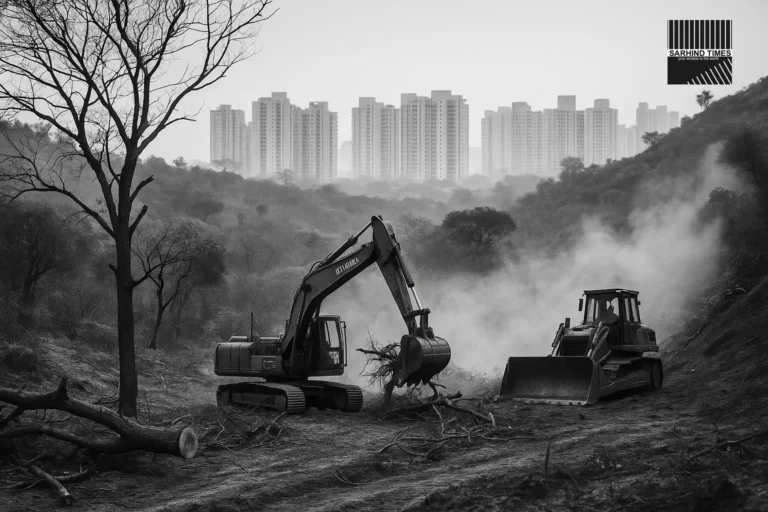
Although the study takes a pan-India view, it flags particular vulnerability in the eastern Indo-Gangetic Plain, southern India and the Himalayan foothills. Haryana, especially its southern and peri-urban fringe regions such as those adjoining Gurugram, falls within the transitional zone where rapid urban expansion meets agricultural hinterland. This zone is uniquely exposed to both land-use change (which reduces natural vegetation cover and continuity) and climatic stress.
For the Gurugram region, the implications are two-fold:
– First, the diminishing resilience of vegetation (greens, trees, buffer zones) means that urban expansion may proceed in an environment that is less resilient to drought-stress, heat accumulation and dust infiltration.
– Second, the encroachment of built environment into agricultural and semi-natural zones may exacerbate ecosystem stress, thereby reducing recharge of groundwater, increasing surface runoff, and weakening the natural buffer that peri-urban plant-life provides.
Data and methodology in brief
The IIT Kharagpur research team used a Vegetation Health Index (VHI) derived from two components: the Vegetation Condition Index (VCI) which measures vigour of vegetation, and the Temperature Condition Index (TCI) which measures heat-stress on vegetation. When VHI falls below a threshold (0.4 in their model), the zone is classified as facing ecological-drought risk. Remote-sensing imagery, satellite-derived land-surface temperature data and sea-surface temperature series were used. A random-forest model allowed quantification of the relative contributions of different drivers. The researchers point out that aridity (dry air, low moisture) led in many cases, but the sea-surface-temperature effect was substantial and less anticipated.
Urban and peri-urban linkages: what these findings mean for policy
The link between ecosystem stress and urban/peri-urban zones is often under-appreciated. In growth hubs like Gurugram, urban spread frequently reduces vegetation, increases impervious surfaces, alters micro-climates and stresses water-catchment systems. The study’s signals suggest that unless land-use change is accompanied by deliberate ecological resilience planning, the cumulative effects of anthropogenic stress and climatic aridity may compound.
From a policy-perspective, the findings push for integration of ecosystem-resilience criteria into urban planning: ensuring that vegetation buffers remain intact, that landscaping in peri-urban zones uses drought-resistant native species, that groundwater recharge is maintained, and that heat-stress mitigation is built into the design of expanding zones. The concept of “green infrastructure” thus becomes more than aesthetic—it becomes an ecological necessity.
Implications for agriculture, food-security and groundwater
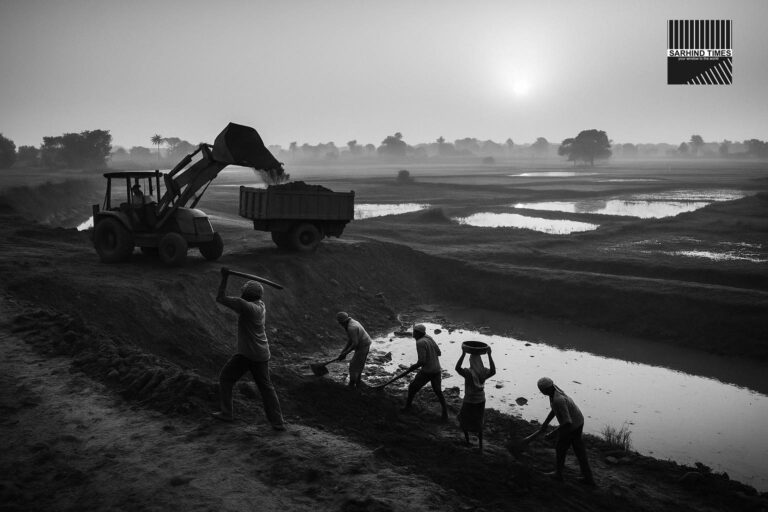
The study also has implications beyond city fringes, especially for agricultural areas supplying food to urban hubs. Ecological drought weakens cropland-resilience, reduces scouting for pests and diseases, and undermines yield stability. In Haryana, although irrigation is relatively well-developed, the overlap of agro-zones with peri-urban expansion creates risk: farm-land converted to housing may reduce buffer zones, reduce recharge areas and intensify heat-stress.
Groundwater systems too stand at risk: if vegetation health declines, evapotranspiration patterns change, recharge cycles could be altered and the ability of the land to absorb monsoon rainfall may reduce. Over time, this challenges the sustainability of water supplies for both agriculture and urban usage—a key concern for rapidly growing cities such as Gurugram.
The economic dimension: damage risk, adaptation cost and resilience investment
The researchers emphasise that while drought-resilience is often discussed in agricultural terms, ecological-drought imposes hidden costs: more frequent vegetation die-back, increased dust storms, loss of ecosystem services (cooling, air-filtering, water-regulation) and higher urban-heat-load. For urban-fringe economies, this shifts the equation: infrastructure investment must account for ecological buffers, maintenance of green cover and heat-mitigation systems. In practice, this means that cities like Gurugram may need to plan more investment in landscaping, tree-planting, stormwater-management, and integrated groundwater recharge if they wish to maintain liveability and avoid rising heat/ dust/ water-stress costs.
Response and adaptation strategies
A range of actionable steps flow from the study. Some of the key ones:
– Identification of vulnerable zones (using vegetation health indices) and prioritising them for ecological upgrade (tree-planting, removal of invasive species, improved soil-moisture retention).
– Protection of peri-urban green belts from conversion purely to built-environment use; regulatory instruments should incorporate ecological-drought risk into land-use decisions.
– Enhancement of urban-water-management systems that explicitly use vegetation and permeable surfaces to maintain recharge and reduce heat-island effects.
– Integration of ecosystem monitoring into city/ state planning frameworks, especially for regions undergoing rapid transformation like Gurugram.
– Strengthening research-policy linkages to incorporate remote-sensing tools into government monitoring of ecological health.
– Early childhood and public-education campaigns emphasising the role of vegetation, trees, recharge and biodiversity even in urban contexts—this helps build citizen-ownership of ecological resilience.
Challenges for implementation
Deploying these strategies is easier said than done. In urban fringe zones, land-market pressures are strong, and municipal/regulatory bodies often prioritise built-space growth over ecological buffers. For Gurugram, jurisdictional overlaps (municipal corporations, development authorities, revenue department) complicate ecosystem-planning. Secondly, funding for green-infrastructure is often constrained and competes with visible hard-infrastructure such as roads, housing, malls. Thirdly, measuring and verifying ecological-health improvements (over years) is technically challenging—unlike more visible infrastructure. The study warns that unless such monitoring becomes institutionalised, adaptation efforts may falter.
Significance for the broader Indian environment agenda
On the national scale, the findings feed into India’s broader climate-adaptation agenda. While much focus is on visible shocks (heatwaves, floods, glacial melt), ecological droughts represent slower-moving but insidious threats that erode ecosystem-services and long-term resilience. The study acts as an early-warning marker: that climate change, ocean-warming and human land-use change are not only driving large-scale events, but also creeping degradation in ecosystems. For an economy like India’s—which depends on its natural capital for agriculture, urban-services, tourism and liveability—this is a strategic risk.
What to watch next
Given these findings, the following indicators merit monitoring:
– Vegetation-health indices derived from satellite data for the Indo-Gangetic plains, the Aravalli/ Haryana zone, and major peri-urban belts.
– Trends in groundwater recharge and aquifer levels in peri-urban zones like Gurugram and surrounding villages.
– Urban-surface-temperature and green-cover loss data in expansion regions—especially new housing/industrial estates in Gurugram’s outskirts.
– Policies and incentives adopted by state governments for eco-drought-resilience—such as grants for vegetation restoration, mandatory green-belt maintenance in new developments, incentives for pervious-surface design.
– Conversion-rate of agricultural/green zones around city fringes and how much buffer is retained as open or vegetated land during urban growth.
Conclusion
The emergence of ecological drought as a measurable, growing threat in India is a reminder that climate-change impact is not only about the dramatic headlines of floods or heatwaves, but also the slower erosion of ecosystem-health. For Haryana, and for fast-growing cities like Gurugram, the message is clear: expansion must be synchronised with resilience. Vegetation, soil-moisture retention, green-infrastructure and buffer-zones are no longer optional—they are strategic.
As the study by IIT Kharagpur shows, ocean-warming and land-drying are conspiring quietly behind the scenes. Without timely adaptation, India’s urban-agricultural interface may face growing stress, higher heat loads, reduced groundwater recharge and diminished ecosystem services. The hope is that the findings trigger policy action faster than the degradation itself. For Gurugram, that means rethinking growth not just in terms of buildings and roads, but in terms of soil, trees, water, air—and the silent health of the land beneath them.




+ There are no comments
Add yours