
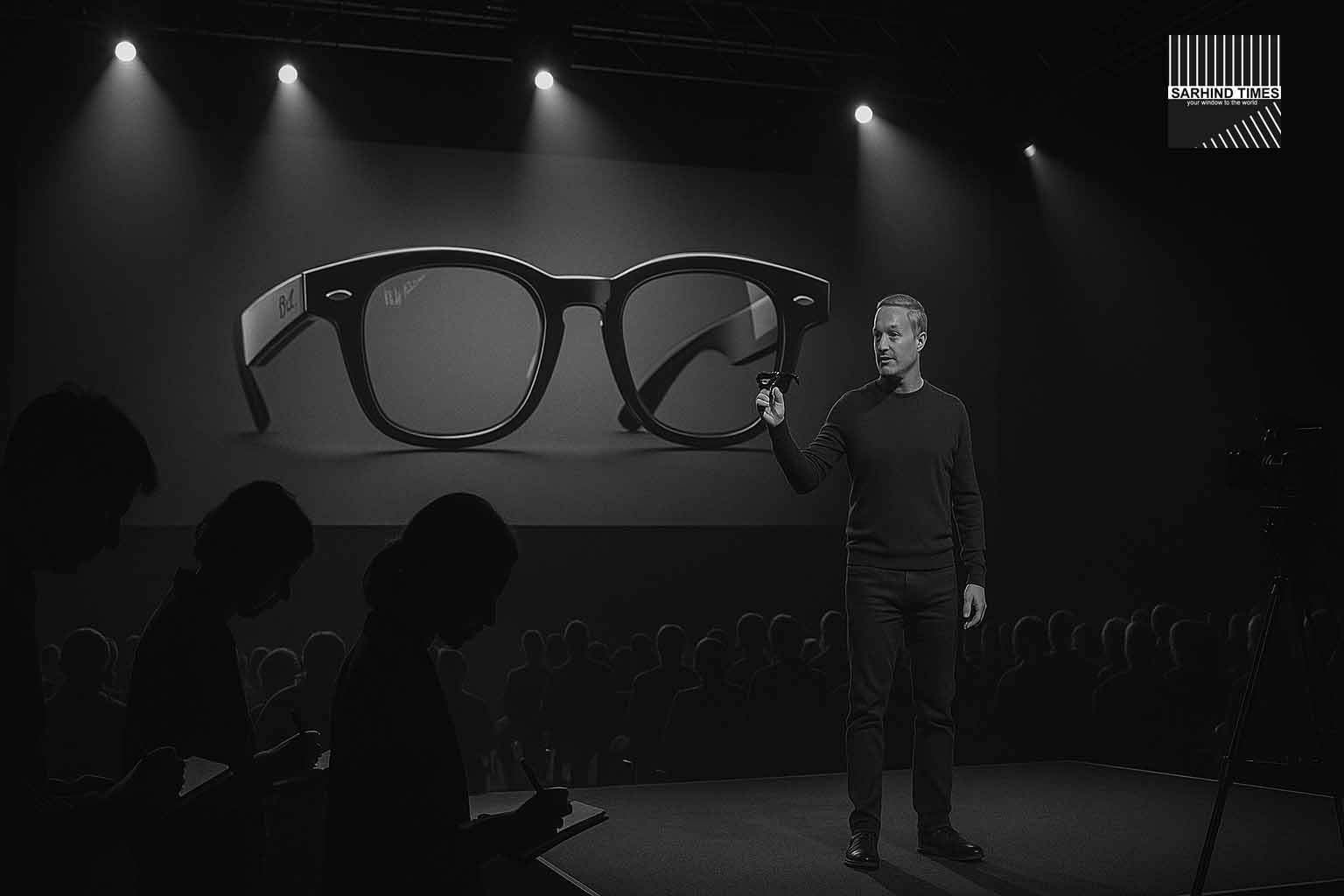
New era of hands-free creation begins as Meta brings its flagship smart eyewear to the Indian market
Dateline: New Delhi | 25 November 2025
Summary: Meta’s AI-powered Ray-Ban smart glasses have officially launched in India, marking one of the biggest wearable technology entries into the country. Featuring voice-based AI assistance, advanced camera capabilities and hands-free content creation, the launch signals a potential transformation in how Indians capture, share and interact with digital content in daily life.
Introduction: A New Phase for Wearable Computing in India
For the past decade, most conversations around wearable technology in India have remained anchored to smartwatches, fitness trackers and true wireless earbuds. Every once in a while, prototypes of augmented reality (AR) glasses or mixed-reality headsets created buzz, but mainstream adoption remained distant. With Meta’s official launch of its AI-powered Ray-Ban smart glasses in India this week, the conversation has changed dramatically.
Unlike previous wearables that largely focused on fitness or notifications, the Ray-Ban Meta glasses bring something fundamentally new: the power to capture life, interact with AI and tap into real-time information without ever lifting a phone. This is Meta’s strongest attempt yet to integrate social technology into everyday life—through devices people already know how to wear.
The India launch comes on the heels of successful rollouts in the US and Europe. For Meta, the Indian market is strategically critical—not just for user volume but for creator-driven momentum. India now has the world’s largest population of short-form video creators, making the country a perfect stage for glasses designed for hands-free content creation.
What the Glasses Offer: Features That Redefine Everyday Usage
The newly launched Ray-Ban Meta smart glasses are built on two core pillars: advanced camera capabilities and deeply embedded AI functionality. The glasses include:
- Ultra-wide 12 MP cameras for high-definition photos and 1080p video
- Hands-free voice prompting for capturing video (“Hey Meta, start recording”)
- Live streaming directly to Facebook and Instagram
- AI narrator that describes scenes in front of the user
- Built-in speakers with open-ear audio for calls and music
- Instant translation and real-time object identification
- Ray-Ban’s classic styles including Wayfarer and Headliner frames
While early generations of smart glasses struggled with clunky design and limited features, Meta has learned from past failures in the industry. This iteration places overwhelming emphasis on comfort, fashion and real-life utility. Unlike VR headsets, these glasses can be worn for hours without fatigue—and blend naturally with everyday outfits.
Meta has repeatedly stated that its aim is to make AI invisible, accessible and wearable. The India launch echoes that ambition, aligning with CEO Mark Zuckerberg’s long-term vision of the “AI-first future” where computers fade into the background.
Why India? The Strategic Logic Behind the Launch
Meta’s choice to launch in India before several other major markets is not accidental. The company sees India as one of the fastest-growing centers for creator-driven digital culture. Studies show India has over:
- 448 million active social media users
- Over 100 million active content creators
- The world’s largest Instagram user base
- Massive adoption of short-video formats
Creators often shoot content in dynamic environments—markets, traffic, cultural festivals, sports events—where handheld shooting is either inconvenient or disruptive. Meta’s glasses offer them a seamless, stable and hands-free shooting method that keeps the creator immersed in the environment.
This aligns well with India’s vibrant street culture, festival ecosystem and daily life scenarios where spontaneous moments often become viral content. It also reduces dependency on bulky gimbals, tripods and stabilizers.
Creator Economy: How the Glasses Reshape Workflows
India’s creator economy is now a multi-billion-dollar industry, with influencers, educators, vloggers, chefs, fitness experts, gamers and comedians producing thousands of videos daily. The Ray-Ban Meta glasses could add significant acceleration to this boom.
With wearable cameras:
- Creators can film POV (point-of-view) content naturally
- Chefs can record recipe steps without touching their phones
- Travel vloggers can shoot while biking or hiking
- Craft artists can capture hands-on demonstrations effortlessly
- Fitness trainers can shoot workouts with body-line accuracy
The AI narrator also allows users to create contextual videos—adding information, context and object recognition overlays through voice explanations.
Meta predicts that these glasses could become one of the most essential creator tools by mid-2026, especially for real-time streaming during festivals, political rallies, concerts and public events.
Privacy Questions: The Biggest Debate
No wearable technology launch is complete without privacy debates—and this one is no exception. Many experts are cautiously optimistic but acknowledge the risks.
The glasses include an LED indicator that lights up whenever recording is active, but privacy advocates argue that such tiny signals are often overlooked in crowded settings. Meta insists that users are required to follow local laws, especially in sensitive locations such as banks, metro stations, hospitals and government buildings.
Indian regulators are expected to review the product under the Digital Personal Data Protection Act (DPDP), and additional compliance frameworks may follow in early 2026.
Impact on Consumer Behavior: A Cultural Shift Begins
India has historically adopted new technology in accelerated waves—smartphones, UPI payments, OTT streaming and wireless earbuds being prime examples. Wearable AI glasses might follow the same trajectory, provided they deliver enough real-world usefulness.
Experts forecast the following behavioral shifts:
- More spontaneous video content created daily
- Increase in POV-style videos across Instagram and Facebook
- Higher use of wearable AI for translation, navigation and assistance
- New etiquette norms in public spaces (“glasses recording zones”)
- Rapid rise in hands-free vlogging on Indian festivals and street tours
The glasses also have potential to become a workplace tool. For example:
- Engineers can record repair procedures hands-free
- Doctors can document non-sensitive medical steps
- Journalists can capture field reporting discreetly
- Educators can produce on-the-go lessons without shooting rigs
Market Competition: What This Means for Rivals
With Meta’s entry, competing brands such as Apple, Samsung, Google and Xiaomi now face renewed pressure to bring their own glasses to India. Apple’s Vision Pro is still too expensive and bulky for mass adoption, while Google’s Project Iris remains in early prototyping.
The Ray-Ban launch gives Meta a 12-18 month head start in the Indian smart-eyewear space. Meanwhile, Chinese manufacturers are experimenting with budget AR glasses but are far from delivering mainstream camera-driven wearables with Meta-level polish.
Industry analysts believe that the Indian market may offer Meta its largest growth runway for the glasses anywhere in the world, given the country’s young digital population and content-first culture.
Pricing, Availability and Indian Variants
The glasses start at a premium price bracket in India, with multiple customizations based on frame, lens type and storage. Ray-Ban’s iconic designs—Wayfarer, Headliner and custom transparent frames—have all been made available.
Prescription lenses can be fitted at partner stores. The glasses are available both online and offline, including at Ray-Ban boutiques, premium optical shops and Meta’s authorized retail network.
The early demand appears strong, with pre-orders reportedly selling out in multiple Tier-1 cities. Tier-2 markets like Jaipur, Kochi and Lucknow are also showing rising interest from vloggers and travel creators.
The Road Ahead: Will India Become Meta’s Largest Smart-Glasses Base?
India’s massive social media population, combined with an aggressive creator economy, means the Ray-Ban Meta glasses could see exponential adoption if priced right and supported well. If Meta rolls out India-specific features—vernacular AI, localized narration, festival color optimization—the glasses may become a standard tool for millions of creators.
The next version, expected in late 2026, may include AR overlays, holographic direction prompts and connected AI assistant upgrades. If those materialize, India will likely play a central role in testing and scaling the technology.
Conclusion: A Bold New Step into Wearable AI
The launch of Meta’s AI-powered Ray-Ban glasses in India represents far more than a product unveiling—it marks the beginning of a new computing era. From creators and professionals to early-tech adopters and urban explorers, the glasses open a completely new interface between life and technology.
If Meta succeeds in aligning price, features and India-specific user needs, these glasses may become as common as Bluetooth earbuds in the next few years. For now, India stands at the starting line of a wearable AI revolution, and the Ray-Ban Meta launch is the first major push.



+ There are no comments
Add yours