
New Delhi | 4 November 2025
Dateline: New Delhi | 4 November 2025
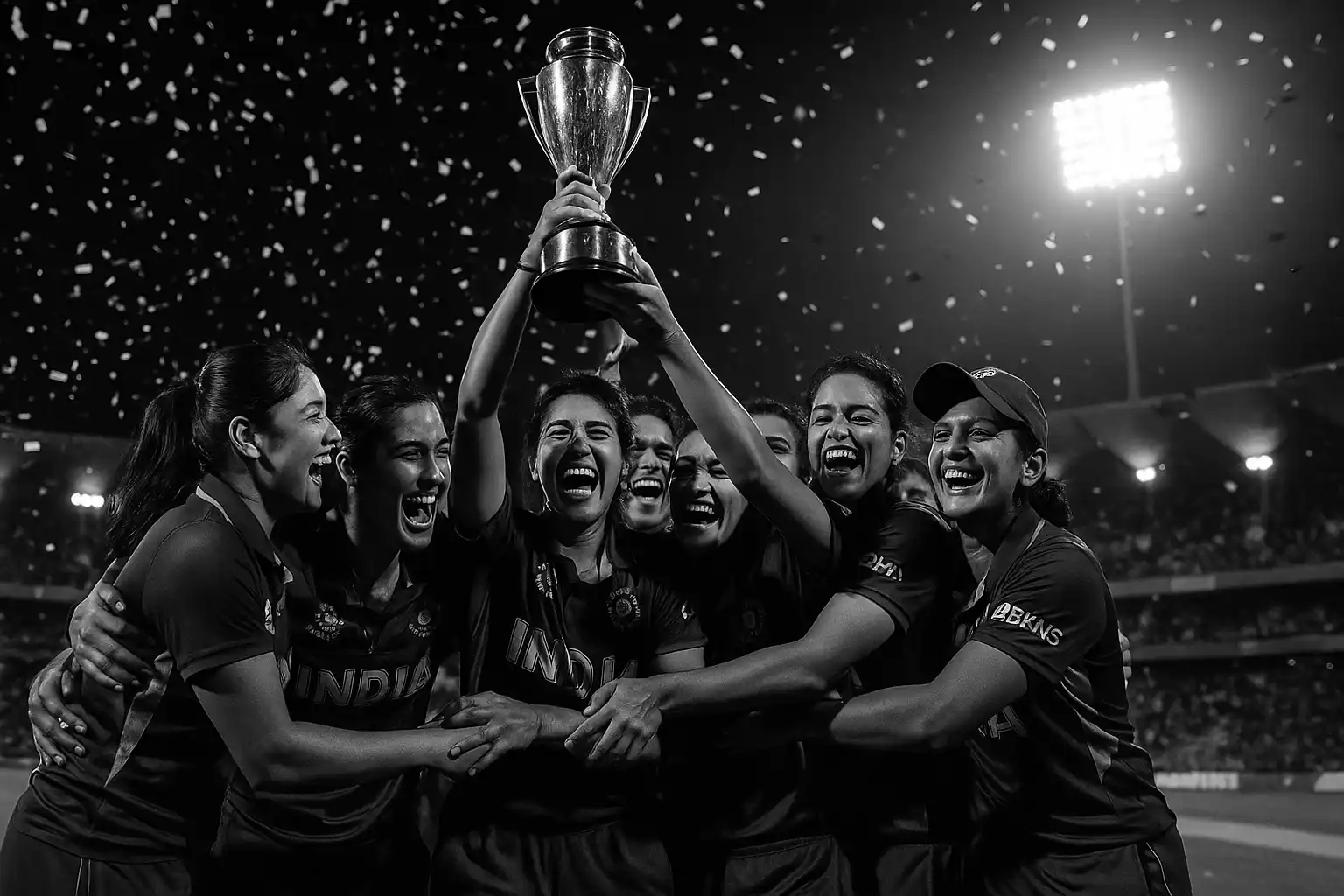
Summary: The India women’s national cricket team scripted a landmark victory by clinching their maiden ICC Women’s Cricket World Cup 2025 title, defeating South Africa women’s national cricket team in the final by 52 runs. Under the leadership of Harmanpreet Kaur, the win is being hailed as a transformational moment for women’s sport in India, offering fresh momentum and possibilities for gender-equitable growth in cricket.
A breakthrough victory
On 2 November 2025 the Indian women’s cricket team real-ised a long-cherished ambition by lifting the Women’s Cricket World Cup trophy for the first time. The tournament, hosted across India, culminated in a final at the DY Patil Stadium where India defeated South Africa by a margin of 52 runs. The victory has resonated far beyond the sport itself — it signals a shift in mindset, opportunity and recognition for women’s cricket in the country.
Skipper Harmanpreet Kaur, who has long been a figure of resilience and leadership in Indian cricket, became the first Indian captain (in either gender) to clinch a Women’s ODI World Cup. Her on-field decision-making, composure and the team’s collective spirit combined to create a defining chapter in Indian sporting history.
Path to the final: momentum, challenge, redemption
The tournament’s journey for India was marked by high expectations and pressure. While women’s cricket has steadily grown in the country, a World Cup win had remained elusive. The team entered the knockout stages amid rising interest and media scrutiny. Early group-stage results showed promise but also exposed vulnerabilities.
A pivotal moment came in the semi-final, where India delivered one of the highest successful chases in Women’s ODI history. This not only boosted confidence but also signalled that the team could operate at the highest level under pressure. In the final, India posted a competitive total and then bowled out South Africa, with key contributions across departments.
Key performances and match turning points
While cricket is a team sport, a few standout performances tipped the balance:
- Harmanpreet Kaur’s batting in the semi-final set the tone, as she anchored a high-pressure chase against Australia. Her 89-run contribution and smart leadership on field were widely praised.
- Batter Shafali Verma and all-rounder Deepti Sharma delivered crucial knocks and tight bowling spells that anchored both innings in the final.
- The bowling unit executed plans well: disciplined line and lengths, field-settings tailored to strengths, and a spirit of collective mission rather than individual showmanship.
In many ways, the tournament became a statement: India had matured as a side that could execute under pressure, adapt to conditions, manage resources and translate promise into results. The final victory, while deserved, is just the visible apex of a broader preparation, investment and team culture shift.
Significance beyond sport: women’s empowerment and domestic impact
This victory carries significance far beyond the boundary ropes. It aligns with several broader themes:
- Women’s sport elevation: Indian women athletes have long delivered outstanding performances across Olympic sports, but cricket — due to its mass audience — holds special cultural weight. A World Cup win raises the profile of women’s cricket and sport-equity debates significantly.
- Role-modelling and aspiration: Young girls watching this triumph will now have tangible evidence that professional success in sport is achievable at the highest level. It may accelerate grassroots participation and nurture talent pipelines.
- Investment and commercialisation: Sponsorship, broadcast rights, leagues and domestic tournaments may now place women’s cricket on a more equal footing. Boards, state associations and franchise owners are likely to capitalize on this momentum.
- Cultural narrative change: The triumph also helps shift narratives — from “women’s cricket as a side-show” to “women’s cricket as mainstream sport.” It challenges structural biases and opens new conversations about resource allocation, infrastructure, media coverage and governance in sport.
Implications for Indian cricket ecosystem
The win has immediate and future-facing implications for the cricketing ecosystem in India:
Domestic leagues and talent pathways: With increased attention on women’s cricket, domestic leagues such as the Women’s Premier League are expected to expand, draw deeper talent and increase financial investment. State associations may prioritise women’s age-group tournaments, talent scouting and state-to-national pathways.
Administration and governance: The tournament success places pressure on administrative bodies — including the Board of Control for Cricket in India (BCCI) and state associations — to ensure women’s cricket doesn’t revert to “cycle of neglect”. It calls for sustained support in training, fitness, scheduling, travel, welfare, pay equity and marketing.
Broadcasting and commercial value: Broadcasters and sponsors now have a tangible success story to sell. Women’s matches can now attract larger audiences, corporate partnerships, and media space. That may enable higher prize money, better facilities and more competitive markets for players.
Challenges and caution ahead
While the triumph is momentous, it does not guarantee seamless transformation. Several caution-points remain:
- Maintaining consistency: The success must translate into regular performance rather than one-time glory. India must sustain deeper bench strength, manage injuries, and cope with evolving opposition.
- Avoiding tokenism: The institutional momentum must not stop at symbolic gestures. Coaching, infrastructure, domestic competition must be upgraded meaningfully and continuously.
- Balancing men’s and women’s game: Cricket resources have long been skewed. The win may shift the balance, but navigating resource allocation without backlash will be a policy challenge.
- Global competition rising: Other nations are also investing in women’s cricket. Maintaining competitive advantage will require continuous innovation, talent renewal and strategic leadership.
Reactions and societal resonance
Reactions to the win poured in across India: political leaders, state governments, former players, media and corporate entities all celebrated. More importantly, the public reception has been enthusiastic — social-media traction, local celebrations and heightened awareness of women’s cricket indicate a potential pivot in public sentiment.
For many fans, this victory is symbolic: a reckoning with past “narrow misses”, a celebration of persistence, and a statement of collective national ambition. In schoolyards, academies and training centres across India, the imagery of this win will serve as inspiration for girls and young women to pursue cricket seriously.
Strategic road-map: what lies ahead
To consolidate this momentum and translate it into sustainable change, several strategic initiatives merit focus:
- Investment in age-group and grassroots women’s cricket – ensuring that girls aged 10-16 have access to quality academies, training, touring and competition.
- Strengthening women’s domestic structure – expanding the Women’s Premier League and state-level competitions, ensuring calendar stability and professional contracts for women cricketers.
- Aligning sponsorship and broadcast – ensuring that women’s cricket has visibility, marketing budgets and brand–partnership opportunities comparable to men’s game.
- Enhancing player welfare – pay parity, insurance, travel/medical benefits, injury-management, career transition planning and mental-health support for women athletes.
- Leveraging infrastructure – sharing stadiums, technology and analytics resources between men’s and women’s programmes, ensuring equitable access to high-performance support systems.
Conclusion: a new chapter begins
The victory by India’s women’s cricket team is nothing short of historic. It can serve as an inflection point — not just for cricket, but for the country’s sporting culture. While challenges remain, the momentum is real and the opportunity enormous. The players have done what mattered most: win, make their mark and invite the nation to listen.
What happens next will determine how this triumph translates into sustained legacy, institutional shifts and cultural transformation. If leveraged wisely, this win may spark a generational change in Indian sport — where young girls believe they belong at the top, where women’s teams are funded, broadcast and credibly commercialised, and where success is the baseline expectation, not the exception.
For the nation, the win resonates with deeper themes of aspiration, equality, performance and recognition. India has long invested hope in its sportswomen. Now, they have delivered the trophy. How the system, the stakeholders and the public respond will shape the next decade of women’s sport in the country.



+ There are no comments
Add yours