
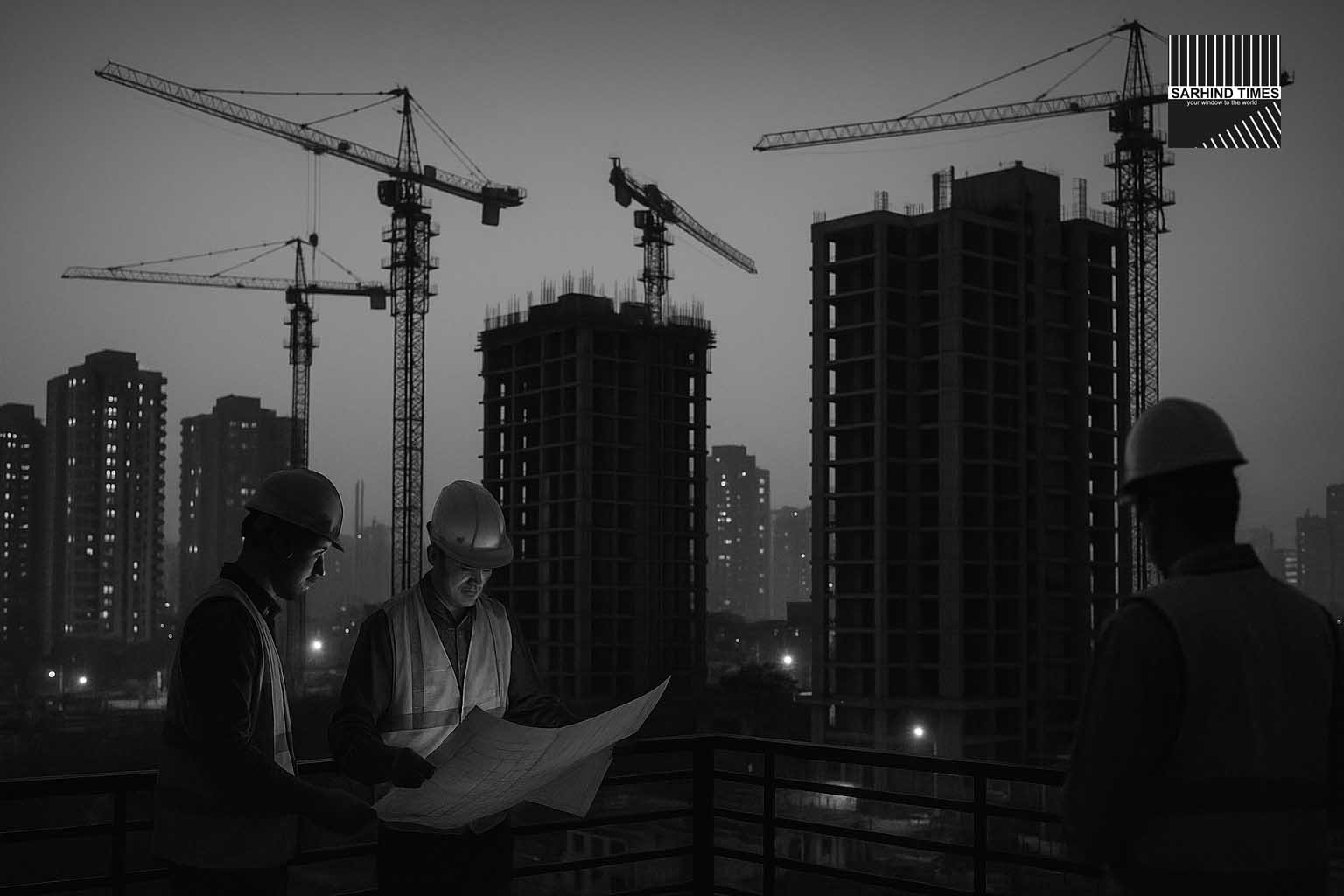
With record budgets, regulatory relief and massive investment pledges, India’s infrastructure sector is entering a new phase—but execution challenges persist.
Dateline: New Delhi | 17 November 2025
Summary: India’s infrastructure story is gaining fresh momentum: budget allocations for 2025-26 top ₹11 lakh crore, new lending rules ease credit for under-construction projects and global institutions signal trillions in long-term urban infrastructure need. Yet analysts warn that without faster project implementation, policy clarity and private-sector traction the headline numbers could drift into delivery gaps.
1. The investment backdrop
The scale of India’s infrastructure ambitions is unambiguous. The government’s budget for 2025-26 allocated approximately **₹11.21 lakh crore** for the infrastructure sector, signalling prioritisation of roads, rail, ports, urban development and energy.
This follows earlier estimates that India’s infrastructure sector required roughly **US$ 1.4 trillion** by 2025 to support planned pipelines of roads, railways, urban networks and power.
Taken together, the policy signal and investment envelope underscore a pivot: India is now not merely maintaining its infrastructure but scaling it significantly.
Yet context matters. While headline numbers are large, analysts estimate that infrastructure financing gaps remain high—some suggest shortfalls of more than **5 % of GDP** could persist unless private capital and improved execution close the loop.
2. Regulatory and financing reform: unlocking the bottlenecks
A major constraint historically has been financing and credit-risk for infrastructure projects. Many projects lag due to delays, cost-escalation and financing freezes. In mid-2025, India’s top banking regulator announced new rules reducing provisioning requirements for loans to under-construction infrastructure projects to just **1 %** (down from 5 %).
This change is expected to lower risk perception for lenders and unlock fresh infrastructure credit.
At the same time, state-owned infrastructure finance firms (such as Housing and Urban Development Corporation, HUDCO) are negotiating to raise external funding—HUDCO is in talks with multilateral development banks to raise around **US$ 1 billion** for on-lending to infrastructure projects.
These combined signals are positive: regulatory relief, improved credit availability and an investment push may finally translate into ground-realities.
3. Where the growth is anchored: sectors and corridors
Infrastructure growth is concentrated in several key vectors:
– **Roads and expressways**: India is pursuing multiple greenfield corridors and access-controlled expressways linking major hubs.
– **Urban infrastructure**: With rapid urbanisation, demand for water, sewage, urban roads, public transport and smart cities infrastructure is rising. A World Bank estimate puts India’s resilient urban infrastructure need at approximately **US$ 2.4 trillion by 2050**.
– **Digital and energy infrastructure**: Modern infrastructure is not only physical roads and bridges, but also data centres, renewable-energy networks and smart electricity grids.
The strategic intent is clear: build connectivity, scale capacity and future-proof the infrastructure base.
4. Private-sector role and challenge of execution
While public capital is ramping, the private sector remains critical to delivery. Government policy is pushing for more public-private partnership (PPP) models, asset monetisation of completed projects and blended finance.
However, execution remains the Achilles’ heel. Common obstacles include land-acquisition delays, inter-departmental clearances, cost overruns, contractor capacity constraints, supply-chain disruption and regulatory uncertainty.
Without tackling these, large capital alone may not yield proportionate infrastructure output. Many analysts warn that India’s “investment promise” must convert to “implementation performance”.
5. Risk-factors and structural vulnerabilities
With ambition high, several structural risks require attention:
– **Credit risk**: Infrastructure loans carry long gestation, uncertain cash flows and high leverage. Lenders remain cautious despite regulatory relief.
– **Commodity inflation and supply-chain stress**: Rising steel, cement and equipment costs threaten project viability and completion timelines.
– **Environmental and social clearances**: Large projects increasingly encounter regulatory push-back, litigation and delay.
– **Maintenance and operations gap**: Building infrastructure is only half the equation; operations, upkeep, lifecycle cost and service quality matter for long-term efficacy.
– **Demand risk**: Some projects hinge on revenue streams (tolls, freight, real-estate), which may not materialise if economic assumptions falter.
If these risks materialise in clusters, the infrastructure drive could face significant headwinds.
6. What success would look like
To realise its ambitions, India will need more than budget statements—it will require:
– Faster project awards, clearer timelines, and predictable investment-cycles.
– Greater private-capital infusion and credible asset-monetisation models.
– Transparent tracking of infrastructure output-metrics (km of roads built, rail electrified, urban water systems commissioned).
– Focus on quality and reliability, not just quantity. A 6-lane road delivered without safe shoulders, good lighting or proper maintenance will not sustain the infrastructure promise.
– Integration of digital/energy infrastructure with physical assets: e.g., building smart-grid capability alongside electrified rail, data centre capacity alongside power-supply.
7. Implications for stakeholders
– **For policymakers**, the message is: ensure regulatory and institutional bottlenecks are cleared, not just capital mobilised.
– **For investors and financiers**, infrastructure in India remains a long-term play. Risk-reward is improving but still demands deep due-diligence on project execution, contract risk, demand assumptions and off-take models.
– **For companies and contractors**, the volume of upcoming work offers opportunity—but only those with execution-discipline, supply-chain resilience and financial head-room will thrive.
– **For citizens**, improved infrastructure means better connectivity, reduced travel times, improved urban services and stronger economic outcomes. But the gap between promise and delivery matters.
8. What to watch in coming quarters
Key watch-points include:
– Announcements of large contracted projects (public procurement + PPP) and awards pipeline size.
– Trends in infrastructure credit flows and non-performing asset exposure in the sector.
– Time-to-completion data of major corridors and whether tenders are downstreaming efficiently.
– Supply-chain stress signs (cost escalations, contractor defaults, material shortage).
– Private-sector asset sales/monetisation activity progress and new financing instruments (infrastructure bonds, REIT-like structures for roads).
9. The wider economic significance
Infrastructure underpins sustained economic growth: it raises productivity, lowers logistics cost, expands access to markets, improves urban and rural connectivity and encourages private-sector investment. If India can scale delivery, the infrastructure push could serve as a major engine of growth for the next decade, aligning with broader ambitions to become a global manufacturing and services hub.
Conversely, if infrastructure growth falters, the risk is that bottlenecks—especially in logistics, transport, utilities and urban services—become growth constraints rather than enablers. The next few years are thus pivotal: growth will depend not just on investment but its translation into usable, reliable assets.
10. Final reflection
India’s infrastructure narrative is shifting gears. From incremental maintenance to large-scale expansion, the country is clearly on a drive. The policy environment, funding signals and project ambitions are aligned. That’s the good news.
The caution is simple: ambition without delivery is not enough. The true test will lie in how many kilometres of highways, gigawatts of power, classroom blocks and metro stations are completed—not merely how many crores are budgeted. India is rolling up its sleeves on infrastructure; the question now is whether the country will finish what it started—and finish it well.
For India, infrastructure is not just about roads and rail—it’s about tomorrow’s economy, societies and global competitiveness. And for once, the runway is long—but the aircraft must take off and land safely


+ There are no comments
Add yours