
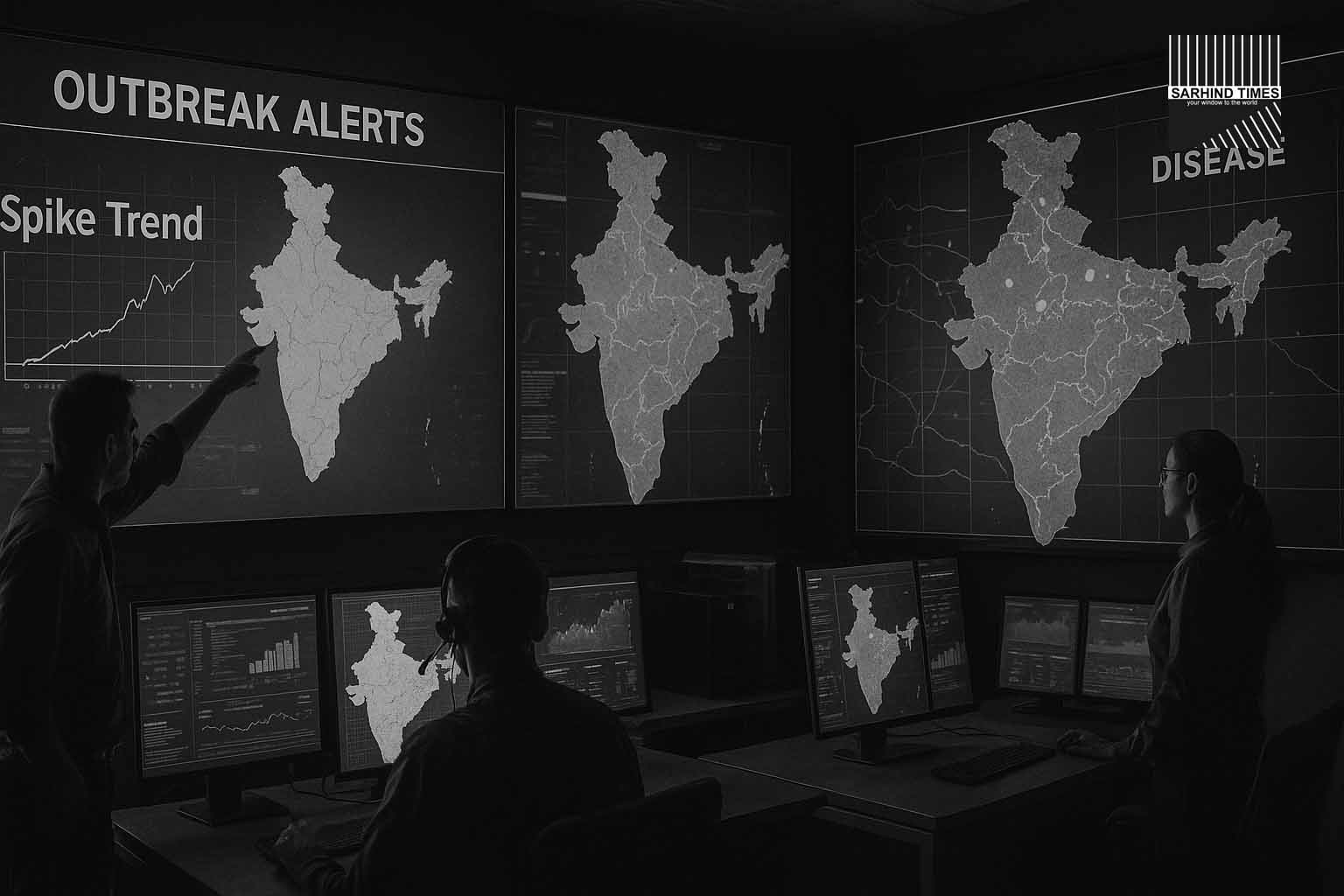
“Health Sentinel” tool strengthens public-health readiness by issuing rapid alerts of infectious disease threats across India
Dateline: New Delhi | 24 November 2025
Summary: The India-based AI tool Wadhwani AI’s *Health Sentinel*, now in collaboration with the National Centre for Disease Control (NCDC), has reportedly issued more than 5,000 outbreak-alerts to health authorities since its deployment. The system’s ability to scan multilingual media sources and flag public-health signals rapidly is seen as a game-changer in India’s disease-surveillance regime—yet experts caution about implementation, integration and data-quality challenges ahead.
Introduction: A New Era in Outbreak Monitoring
India’s public-health apparatus may be on the cusp of a transformation. A recent study indicates that the AI-powered tool *Health Sentinel*, developed by Wadhwani AI, has assisted the National Centre for Disease Control in issuing more than 5,000 alerts of potential infectious-disease events across India since its rollout. This development aligns with a global shift towards leveraging artificial intelligence for early detection of epidemics, but in India’s context—with a complex public-health environment, hundreds of diseases, multilingual media sources and decentralised health systems—the scale and ambition are remarkable.
So what does this really mean for the health system? And what gaps remain before this can translate into saved lives or prevented outbreaks? That’s what we explore here.
The Mechanism: How Health Sentinel Works
Health Sentinel is described as a software platform that scans press-articles, official bulletins, social-media posts and web-feeds in 13 Indian languages every day. It uses natural-language processing, machine-learning classification and network-analysis algorithms to detect anomalies or patterns that could indicate a public-health threat—such as clustering of fever-cases, news of localised deaths, spike in hospital admissions or sudden lack of water treatment in a specific region.
According to the study, the system our data shows that since its installation in 2022, the tool has dramatically lowered manual monitoring efforts, with the majority of alerts previously identified by health-officials through traditional channels now emerging through automated feeds. Health officials claim that nearly 98 % of the old manual workload has been replaced by automation in certain functions.
Once an alert is generated, protocol involves verification by NCDC regional units, followed by field-verification, deployment of rapid-response teams (in some cases) and coordination with state health departments. The objective is to shrink the timeline between observation of abnormal signals and initiation of action—a gap that historically has been a weak point in India’s outbreak management system.
The Scale: 5,000+ Alerts and Counting
The headline number—the more than 5,000 alerts internally—is significant. It reflects a volume of signals being monitored across the country, rather than a tally of confirmed outbreaks. According to the published data, the system has processed thousands of items, flagged hundreds of high-priority signals, and triggered dozens of state-level investigations.
The tool’s reach spans all major states, union territories, and both urban and rural settings. The multilingual inputs ensure that local news in regional languages are captured, which is particularly valuable in areas where surveillance infrastructure is weaker or official reporting may lag.
Why It Matters: Key Benefits & Implications
The adoption of digital disease-surveillance systems at this scale matters for several reasons:
- Faster detection: Traditional surveillance often relies on passive reports from hospitals, labs or officials—delays are common. Automated tools accelerate detection of patterns or raise early flags.
- Broader coverage: By monitoring media and indirect signals (e.g., social-media chatter, local news) the system helps pick up outbreaks even in remote or under-resourced settings.
- Resource optimisation: In a large system such as India’s, health-officials face massive data overload. AI helps triage and prioritise alerts that are more likely to warrant investigation.
- Supports policy-planning: Aggregated data from the system can feed into macro-planning—identifying geographic hotspots, vulnerable populations, and recurring risk patterns over time.
For Indian policymakers, the emergence of such a tool is more than a technical novelty—it aligns with the country’s broader imperatives of building health-system resilience, preparing for climate-driven disease change, and integrating digital technology into public-health governance.
India’s Public Health Context: Why the Timing Is Right
The need for stronger outbreak-surveillance in India is not hypothetical. The country continues to host a high burden of infectious diseases—dengue, malaria, chikungunya, influenza, viral encephalitis—as well as rising non-communicable-disease challenges and climate-driven health shocks.
In recent years, India has been pushed to modernise its surveillance systems. The Integrated Disease Surveillance Programme (IDSP) has provided foundational weekly outbreak tracking, but it has faced challenges of manual data entry, delays in verification and uneven state-level coverage. The introduction of AI tools like Health Sentinel is a supplementary step in bolstering early-warning capacity.
The country’s decentralised structure (with over 700 districts, multiple state health departments and varying capacity) means that any enhancement in speed and reach of alerts is welcome. For example, local media reports in regional languages often surface long before formal epidemiological reports are released; Health Sentinel taps into that “early signal” space.
Case Studies: Where Alerts Made a Difference
While many of the 5,000 alerts have not yet led to large declared outbreaks, specific instances provide insight:
- In a major eastern-state district, media reports of rising fever-cases in two adjacent blocks triggered an alert, enabling health-officials to dispatch investigation teams before hospitalisations peaked.
- In a coastal region with flooding, local social-media chatter about water-logging and joint household illness triggered a hygiene-intervention campaign—likely averting a potential diarrhoeal surge.
- In villages near Himalayan foothills, early detection of “unusual livestock deaths” (via local news scanning) triggered veterinary and human-health coordination under the One Health approach—important given zoonotic risk-profiles.
These examples illustrate how the system moves from data to action—though the magnitude of results (i.e., avoided outbreaks or saved lives) remains to be independently quantified.
Challenges & Critical Junctures
While the system shows promise, multiple caveats remain before it can deliver its full potential:
- False positives and alert fatigue: With 5,000+ alerts, distinguishing between genuine threats and noise is extremely important. Health officials emphasise the need for refined prioritisation and human oversight.
- Integration with field-level response: Early alerts are meaningful only if subsequent actions—investigation, lab confirmation, control measures—are timely and effective. In some districts, weak infrastructure may limit follow-through.
- Data privacy and ethics: Monitoring media and social feeds raises questions around privacy, consent and surveillance ethics—though for public-health purposes these are often justifiable, transparency is still needed.
- Regional disparity in response capacity: A detected signal in a remote district may still face delays in investigation, lab testing and treatment—thus the value of the alert can be diluted by systemic delays downstream.
- Resource constraints for scale-up: Deploying coordinated responses requires resources—labs, trained staff, field teams, logistics—which are state-dependent and unevenly distributed.
- Quantifying impact: While alerts have been issued, measuring how many outbreaks were prevented or how many lives were saved remains complex.
Policy Implications: Strengthening the Health Tech-Ecosystem
The growing integration of AI in public-health surveillance suggests several policy priorities:
- Standardisation of protocols: Health-sentinel systems should link with national and state surveillance frameworks, mandating clear pathways from alert to investigation to response.
- Capacity-building at the district level: Investment in labs, rapid-response teams, digital data flows and training is required—without that, early detection alone won’t be enough.
- Cross-sectoral coordination: Zoonotic risk-management, environmental health, water and sanitation, agriculture and public-health units must integrate under a One Health approach (already being championed by India’s health ministry). For instance, the recent One Health Assembly endorsed harmonised protocols for biosafety labs.
- Regional equity: Ensuring that smaller states and remote districts are not left behind—surveillance alerts should be matched with state-led capacity-boosting initiatives.
- Transparency & public trust: Communicating about alerts, risks and response transparently to the public is essential for trust; otherwise alerts may cause panic or scepticism.
Future Outlook: Where Do We Go From Here?
Looking ahead, a few questions will define whether this initiative scales into a resilient, impactful system:
- Will India move toward a model where every district is integrated into a real-time surveillance loop, combining digital and field signals?
- Will the system evolve to include climate-health signals, vector-borne disease modelling, and predictive analytics that forecast outbreaks rather than just detect them?
- Will resource allocation follow the tech—i.e., will districts flagged by alerts receive extra funding, manpower and equipment to act on those signals?
- Could India still face a major outbreak (such as an unknown zoonotic spill-over) that tests how well digital alerts translate into actual containment? The test has not yet fully come.
Conclusion
The deployment of Health Sentinel and its reported 5,000+ alerts is a clear indicator that India’s health-system landscape is evolving. The move toward proactive, technology-driven surveillance is timely, given the increasing frequency of complex infectious threats, climate-driven health shocks, and the need for speed in public-health response.
But as with all promising tools, the real measure will be impact—not just alerts. Time will tell whether this tech becomes a backbone of India’s outbreak-response strategy or remains another layer of capability with limited downstream effect.
For now, health-officials, investors, technologists and citizens should all watch this space. Because the next outbreak may not announce itself in hospital wards—it may first show up in algorithm-driven alerts on a screen.



+ There are no comments
Add yours