
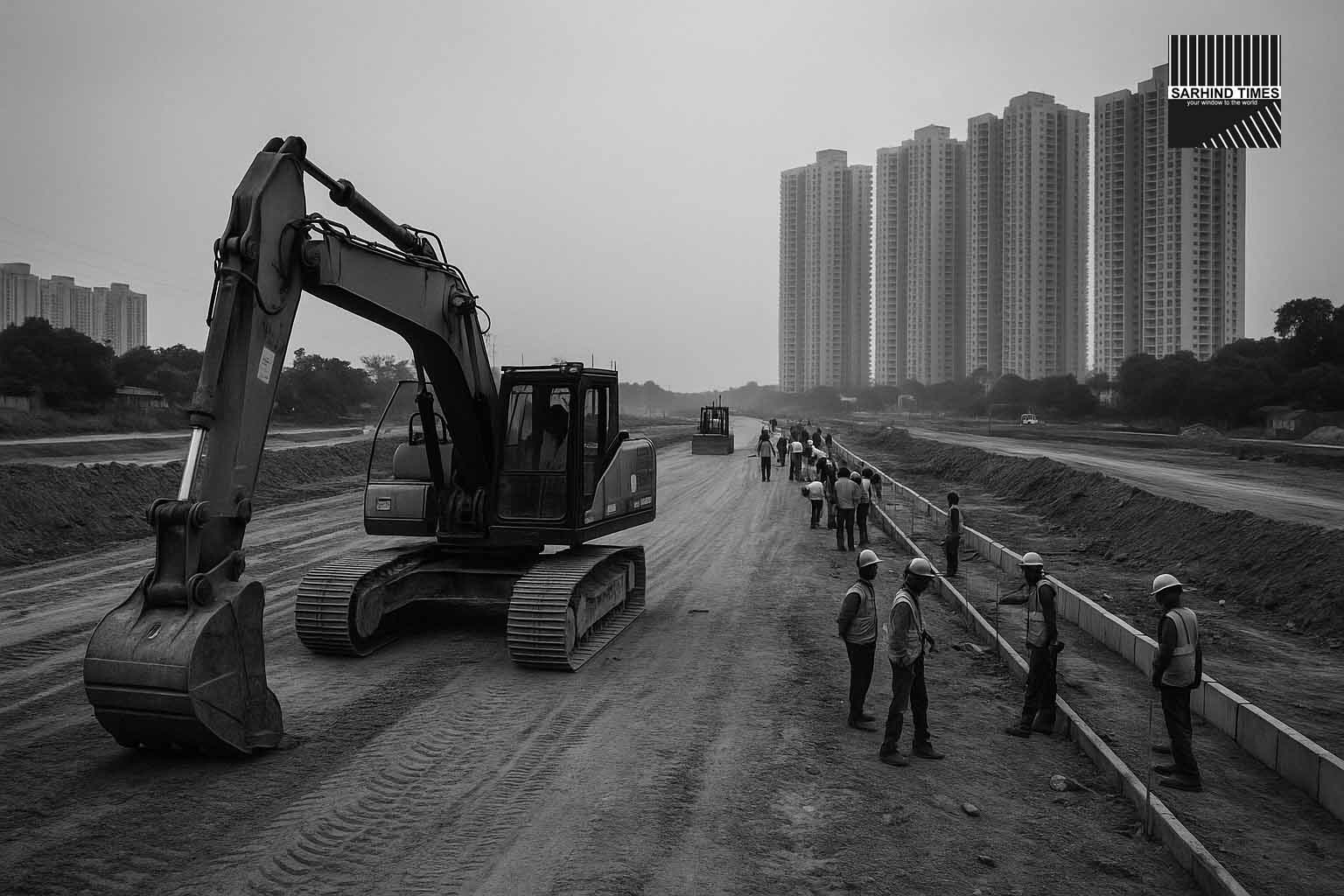
Major infrastructure link aims to unlock access, boost investment and ease congestion in Gurugram’s Sector 36 corridor
Dateline: Gurugram | 24 November 2025
Summary: The Government of Haryana has approved the construction of a 60-metre wide arterial road to connect the Delhi–Gurgaon Expressway with the Global City township project in Sector 36, Gurugram. The new road will run alongside the Narsinghpur drain, providing a critical access link for the 1,000-acre mixed-use development and reducing travel time and bottlenecks in one of NCR’s fastest-growing corridors.
Project Overview and Strategic Importance
In a significant move toward improving connectivity and supporting urban development in the National Capital Region, the Government of Haryana has given the green light to construct a 60-metre-wide road linking the existing Delhi–Gurgaon Expressway to the under-construction Global City township in Sector 36, Gurugram. The road is expected to traverse alongside the newly constructed Narsinghpur drain, covering land under the villages of Khandsa and Mohammadpur Jharsa, and come under the aegis of the Gurugram Metropolitan Development Authority (GMDA) and the Haryana State Industrial and Infrastructure Development Corporation (HSIIDC).
This link is more than a mere road—it is the linchpin for unlocking development value in one of Gurugram’s most rapidly evolving zones. Global City, sprawling over more than 1,000 acres of mixed‐use development on Pataudi Road, is designed to house commercial towers, residences, retail hubs, schools and hospitals. The enhanced access through a dedicated wide road will elevate connectivity for residents, commuters and businesses alike.
Officials estimate that once operational, the road will significantly reduce travel time for vehicles entering and exiting the township from the Delhi–Gurgaon Expressway and alleviate congestion along key feeder roads. For investors, the move signals a clear commitment to infrastructure support from both state and local agencies, which could accelerate real‐estate and commercial absorption in the area.
Route Details, Land and Infrastructure Aspects
According to a senior GMDA official, the proposed road will align parallel to the drain corridor in Narsinghpur, extending from the Expressway to the approximate boundary of the Global City project. The land is spread across two villages—Khandsa and Mohammadpur Jharsa—with portions privately owned and still under litigation, while others lie within HSIIDC’s possession.
The choice of this alignment is driven by dual objectives: first, to make use of the existing drainage corridor to minimise disruption; and second, to facilitate water‐management synergies, since the Narsinghpur drain serves as a stormwater conduit for the area. Engineering plans filed with the state indicate the road will not just be a traffic corridor—it will include service lanes, pedestrian sidewalks, street lighting, landscaping and integrated water‐runoff systems to handle monsoon flows.
Estimated timelines suggest that once land clearances and litigation issues are resolved, construction could commence within 12–18 months and may take another 18–24 months for full operationalization, subject to approvals and contractor mobilisation. Cost estimates remain under refinement but are likely in the order of hundreds of crores once linking infrastructure and utility relocations are factored in.
Development Context: Why Now?
Gurugram has been undergoing rapid transformation. With commercial concentration shifting toward the Dwarka Expressway–Pataudi Road axis, combined with rising pressure on older corridors, the state government has identified connectivity as a key constraint for future growth. The Global City development is a flagship project of the HSIIDC, aimed at creating a new urban hub with state-of-the-art amenities and high-value employment.
By strengthening the link between the Expressway and the township, the road becomes part of a strategic infrastructure portfolio: it eases inbound and outbound traffic, enhances real-estate value, and integrates land use and transport planning. State planners view this as a proactive infrastructure intervention rather than a reactive fix, aligning with broader objectives of the NCR’s next generation urban evolution.
With concerns around waterlogging, traffic congestion and circular travel growing, the site selection and route planning appear to factor in local environmental and human-mobility challenges. The road runs along the drain corridor, which also provides an opportunity for integrated drainage and road infrastructure, improving monsoon run-off handling while catering to transport demands.
Stakeholder Perspectives: Government, Real-estate, and Residents
From the government side, the Haryana Cabinet and GMDA have emphasised how improved connectivity contributes to the state’s goal of positioning Gurugram as a global business and living hub. A senior state official remarked, “Connectivity is the foundation. Without robust access infrastructure, the value generation potential of such large-scale township projects remains constrained.”
Real-estate developers, many of whom have invested in the region, welcomed the announcement. They point out that ease of access is one of the most cited pain-points by potential buyers and occupiers. With the new link, attractiveness of the Global City site, as well as adjacent sectors, may rise significantly.
However, resident groups and local village communities caution that land acquisition, utility relocation and construction traffic must be managed carefully. In the Khandsa and Mohammadpur Jharsa villages, issues around private ownership and litigation over old titles still persist. Some villagers fear displacement or inadequate compensation unless the state responds with transparent processes. GMDA has indicated that stakeholder consultations will be initiated shortly, and the project will include rehabilitation of affected households where necessary.
Traffic Relief and Urban Mobility Implications
One of the major issues plaguing this corridor has been bottlenecks and travel time variability for commuters on the Expressway side heading into Pataudi Road and the township developments. The new 60-metre-wide road aims to channel traffic away from narrower feeder roads, segregate township traffic from through traffic and create a smoother link between major highways and internal roads.
The urban planning team also points out that the design will incorporate service lanes and pedestrian facilities, which can shift travel behaviour toward less car-centric movements. In the long term, as metro and mass-transit expansion continues in the region, this road may act as a feeder corridor, linking into public transport hubs and enabling transport-oriented development around the Global City project.
Improved mobility also has broader implications for emissions, commute times and quality of life—especially in a region which already grapples with heavy traffic and rising vehicle counts. The new road, by offering a dedicated lane network to a major township, may reduce pressure on older access roads and help the GMDA manage arterial traffic better during peak hours.
Real-Estate & Economic Value Unlocking
From a real-estate perspective, connectivity is often the hidden multiplier of value. Analysts say that when township access improves from 15–20 minutes to 7–10 minutes, buyers’ willingness to pay rises by 10–15 percent in certain markets. In Gurugram’s Sector 36 corridor, such a jump could accelerate absorption of office space, residential units, retail leases, and hospitality developments.
The Global City project itself draws on a mixed-use model: residential, office towers, retail amenities, healthcare, education and green spaces. With the new road access, the commercial side of the development may attract multinational occupiers seeking modern campuses with strong expressway connectivity—an edge in the NCR region.
On the economic front, enhanced infrastructure improves the ease of doing business, reduces logistics cost, improves employee commute time and adds to the talent advantage of corporates. For Haryana’s industrial strategy—especially in a state pushing for high-value Global Capability Centres and export-oriented units—the connectivity enhancement supports a broader ecosystem narrative.
Risks & Implementation Challenges
No major infrastructure project materialises without risks. In this case, key challenges include:
- Land Acquisition & Litigation: Portions of the required land are privately owned and under dispute, which may delay project initiation. Transparent acquisition and stakeholder buy-in will be crucial.
- Utility Relocation & Drain Integration: The alignment runs alongside the Narsinghpur drain and will require complex coordination for drainage, water-table management, and existing pipelines. Delays in utility relocation could hamper start-dates.
- Construction Impact on Residents: During construction, traffic diversions, noise, dust and site management will affect local communities. Effective mitigation, planning and communication will matter for public acceptance.
- Budget Escalation & Timing Risk:</strong > As with many large-scale urban roads, cost overruns, inflation in raw materials, and contractor mobilization issues can extend timelines and increase budgets beyond initial estimates.
Additionally, coordination between multiple agencies—GMDA, HSIIDC, PWD, local village bodies, and the Haryana urban environment wing—will be critical. The project’s success depends not just on construction, but on seamless integration with adjacent infrastructure such as service roads, transit links, and future metro/rapid-rail lines.
Future Outlook and Broader Significance
The approved road is not simply for local benefit—it fits into a broader infrastructure vision for Gurugram and the NCR. As the region moves toward multi-modal transport, smart urban corridors and value-driven real-estate growth, such targeted access roads become the connective tissue of future cities.
For Gurugram, this means shedding some of its legacy issues (traffic bottlenecks, fragmented land use, inadequate access) and anchoring growth in newer zones that are prepared, planned and infrastructure-ready. The Global City project, once combined with this access corridor, positions itself as a next-generation township rather than just an incremental development.
If implemented well, the corridor could stimulate further land-value appreciation, catalyse commercial leasing, attract investment into ancillary services (logistics, support services, residential rentals) and reinforce Gurugram’s position as a high-growth urban investment destination in North India.
Conclusion
The decision to build the 60-metre wide access road linking the Delhi–Gurgaon Expressway with the Global City township in Sector 36 marks an important step in Gurugram’s infrastructure evolution. It signals maturity in urban planning—where connectivity, land-use and utility integration are being aligned rather than left to lag.
But the announcement is just the beginning. Implementation will separate promise from performance. Land-clearance, stakeholder engagement, disciplined execution, timely utility relocation and minimisation of disruption will determine whether the project meets its full potential.
For residents, investors and city-planners alike, the next 18–24 months will be pivotal. If the road delivers as intended, it will not only transform mobility for a major township but also pave the way for Gurugram’s next wave of urban growth. The question is: will it? Only time—and execution—will tell.



+ There are no comments
Add yours