
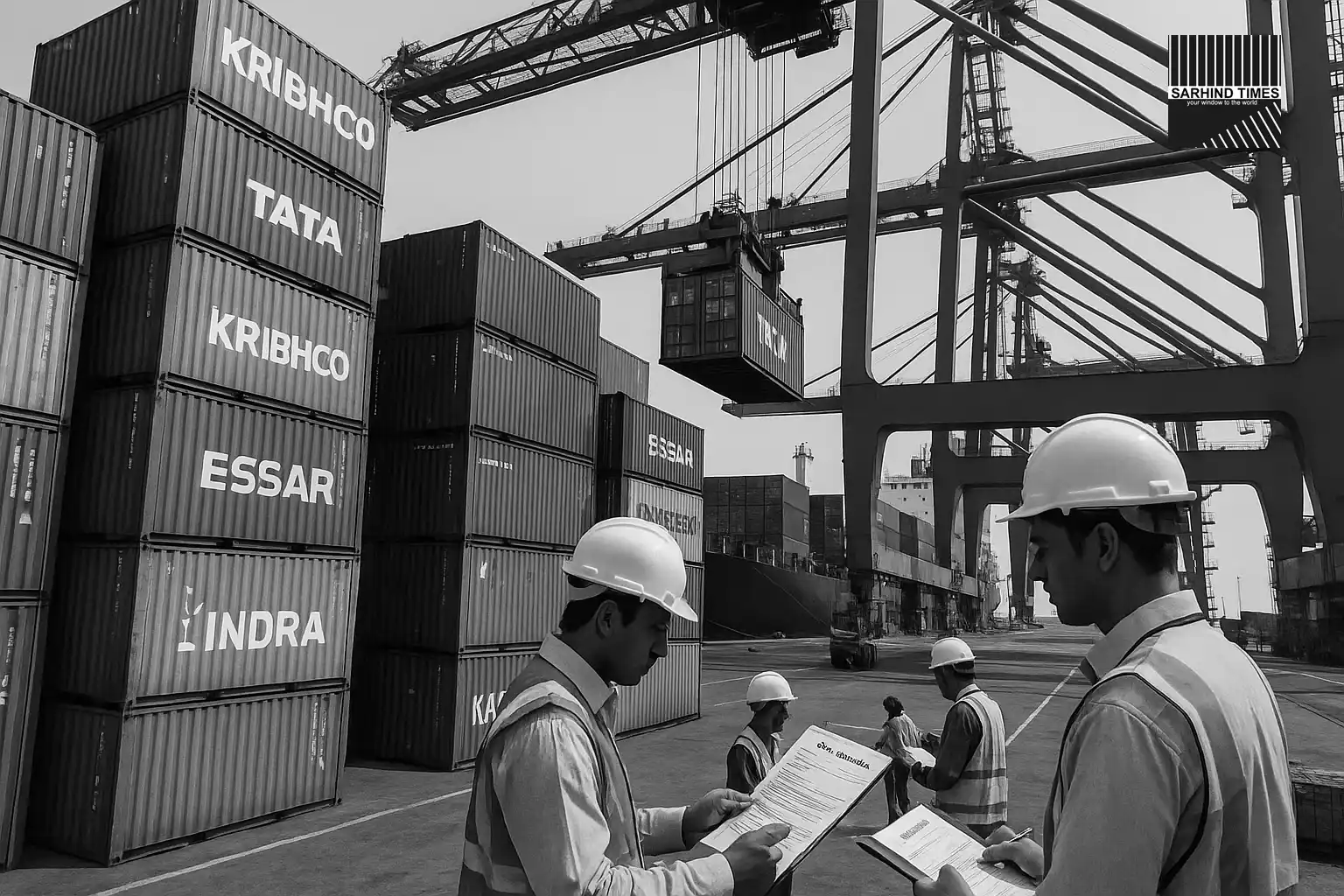
Growth remains robust domestically, but global trade headwinds and tariff shocks are forcing India to recalibrate its manufacturing and export roadmap
Dateline: New Delhi | 28 October 2025
Summary: India’s export and manufacturing ecosystem is facing a complex moment in late 2025: while electronics exports are on a surge, punitive U.S. tariffs—particularly linked to India’s oil imports from Russia—are creating headwinds, and manufacturing growth has begun to soften. The government and industry now find themselves balancing domestic demand, global trade diversification and strategic manufacturing investment.
Export growth amid tariff turbulence
< Indian commerce-ministry data show that India’s total exports (merchandise + services) for April–September 2025 rose by about 4.45 % year-on-year to US $413.3 billion. Merchandise exports were somewhat slower — up ~3.0 % to US $220.1 billion, while services exports climbed ~6.1 % to US $193.2 billion.
While the headline numbers suggest resilience, deeper signals raise caution. A key development: exports to the U.S. have come under pressure due to punitive U.S. tariffs of up to 50 % on certain Indian goods—linked to India’s continued import of Russian oil despite U.S. sanctions.
Further, the flash PMI released in late October showed new export orders in manufacturing were at their weakest since March, signalling that the tariff shock and weakening demand may be biting.
Manufacturing momentum cools despite underlying strength
The manufacturing sector posted strong expansion through much of 2025 but it began to show signs of moderation. For September the PMI dropped, and in particular input-cost pressures surged—with factory gate prices increasing at the fastest pace in nearly 12 years.
In October, while manufacturing slightly improved (PMI lifted to 58.4 from 57.7), the services sector slowed markedly, dragging the composite PMI down to 59.9 from 61.0 in September—the lowest in five months.
Lower demand, cost pressures, weaker external orders and competitive pressures are all contributing to a recalibration of growth expectations among manufacturers. In an interview, an external member of the Reserve Bank of India’s monetary-policy committee warned that “excessively low commodity prices may not be good for manufacturers,” because they reduce profit margins and investment incentives.
The electronics boom: A new export front-runner
Amid the caution, one bright spot is India’s electronics manufacturing and export sector. Recent data show that between 2022 and 2025, India’s electronics export ranking jumped from 7th to 3rd in country export categories—a shift largely driven by large-scale assembly of products like iPhones in India.
This signals that India is successfully attracting global supply-chains—especially in mobile-phones and consumer electronics—just as other sectors face global headwinds. It also complements the government’s broader “Make in India” and production-linked incentive (PLI) strategy, which emphasises electronics, auto-components, renewable equipment and semiconductors.
However, this also raises questions: Will the manufacturing base diversify further (beyond electronics) to mitigate export and global-demand risk? Are the gains in electronics sufficient to offset declines elsewhere? The data suggest that while electronics are growing, the broader manufacturing eco-system still faces softness.
Strategic recalibration: Policies and trade diversification
The Indian government appears to recognise the dual challenge: strengthening domestic demand and exporting into new markets to offset U.S. tariff risk. In its September 2025 economic bulletin the government stated that while growth remains strong, trade scenarios are being watched closely.
Key policy levers include:
- Accelerating free-trade agreements (FTAs) and trade partnerships beyond the U.S., including with Middle-East, Africa and ASEAN markets.
- Expanding PLI schemes and manufacturing hubs for strategic sectors (electronics, semiconductors, EVs).
- Boosting domestic demand through fiscal stimuli, GST rationalisation and credit-flow improvement—thereby reducing dependence on exports.
- Strengthening logistics, infrastructure, skills and supply-chain linkages to make Indian manufacturing globally competitive.
Sectoral implications: Textiles, steel, and construction + real-estate
Textile and apparel exporters are among the most exposed to U.S. tariffs. The state of Tamil Nadu’s knitwear and apparel hubs have reported order cancellations and redirection of shipments to countries such as Bangladesh and Vietnam, where U.S. tariffs are lower.
Steel producers, especially smaller ones, are also cutting production amid falling demand in the construction and infrastructure sectors and weakening price trends.
These trends highlight that while the headline manufacturing numbers look reasonably strong, beneath the surface some export-intensive and commodity-linked sectors are facing stress—which may later translate into broader ripple effects.
Domestic demand is still holding the fort
Despite external headwinds, India’s domestic economy continues to show resilience. The Deloitte India Economic Outlook projects that 2025 is likely to remain one of the strongest growth years for India, supported by tax-cuts, consumption, infrastructure investment and policy support.
While concerns are valid, the fact that India’s export slowdown has not yet cascaded into broader contraction is positive. Domestic-demand led growth, complemented by sectoral investment (for example in electronics and infrastructure) is providing a buffer. But sustainability depends on timely structural reforms.
Risks and uncertainties ahead
Several risks could challenge India’s export-and-manufacturing trajectory:
- Tariff escalation: If U.S. or other trading partners raise further punitive tariffs, Indian exporters could lose market share in key geographies.
- Global demand softness: Trade data show that global export-orders remain in contraction globally, which could spill into India’s order books.
- Commodity & input-cost volatility: Both high and very low commodity prices pose challenges (either cost-pressures or profit-erosion).
- Capacity under-utilisation: Manufacturing capacity that is built for growth may remain under-used if global orders remain weak, leading to lower returns and deferred investment.
- Dependence risks: Over-reliance on a few export-categories (such as electronics) or markets may limit diversification benefits in the medium term.
What to watch in the next 6–12 months
Key indicators for stakeholders:
- Sector-wise export growth — especially textiles, garments, apparel vs electronics vs pharmaceuticals.
- New export-orders component of manufacturing and services PMI to check external-demand traction.
- FTAs and trade-deal progress — India’s successes in diversifying export destination and lowering trade-costs.
- Utilisation of PLI and manufacturing-investment incentives — whether they translate into production, not just pledges.
- Capacity utilisation and asset-turnover metrics among Indian manufacturers.
- Domestic demand indicators — consumption, investment, credit, infrastructure build-out — to ensure growth remains balanced.
Conclusion
India’s export and manufacturing engine is navigating a critical pivot point in late 2025. On one hand, the country is gaining ground in strategic export segments such as electronics, positioning itself in global supply chains. On the other hand, rising U.S. tariffs, global demand softness and manufacturing headwinds are beginning to call into question the sustainability of past growth models.
The government and industry must therefore accelerate the structural transition: deepen manufacturing, diversify exports, reinforce domestic demand and upgrade supply chains. If India manages that, it can convert challenges into opportunity and maintain its growth momentum into FY 2026. If not, what looks like strengthening may slip into stagnation. The next year will be telling.


+ There are no comments
Add yours