
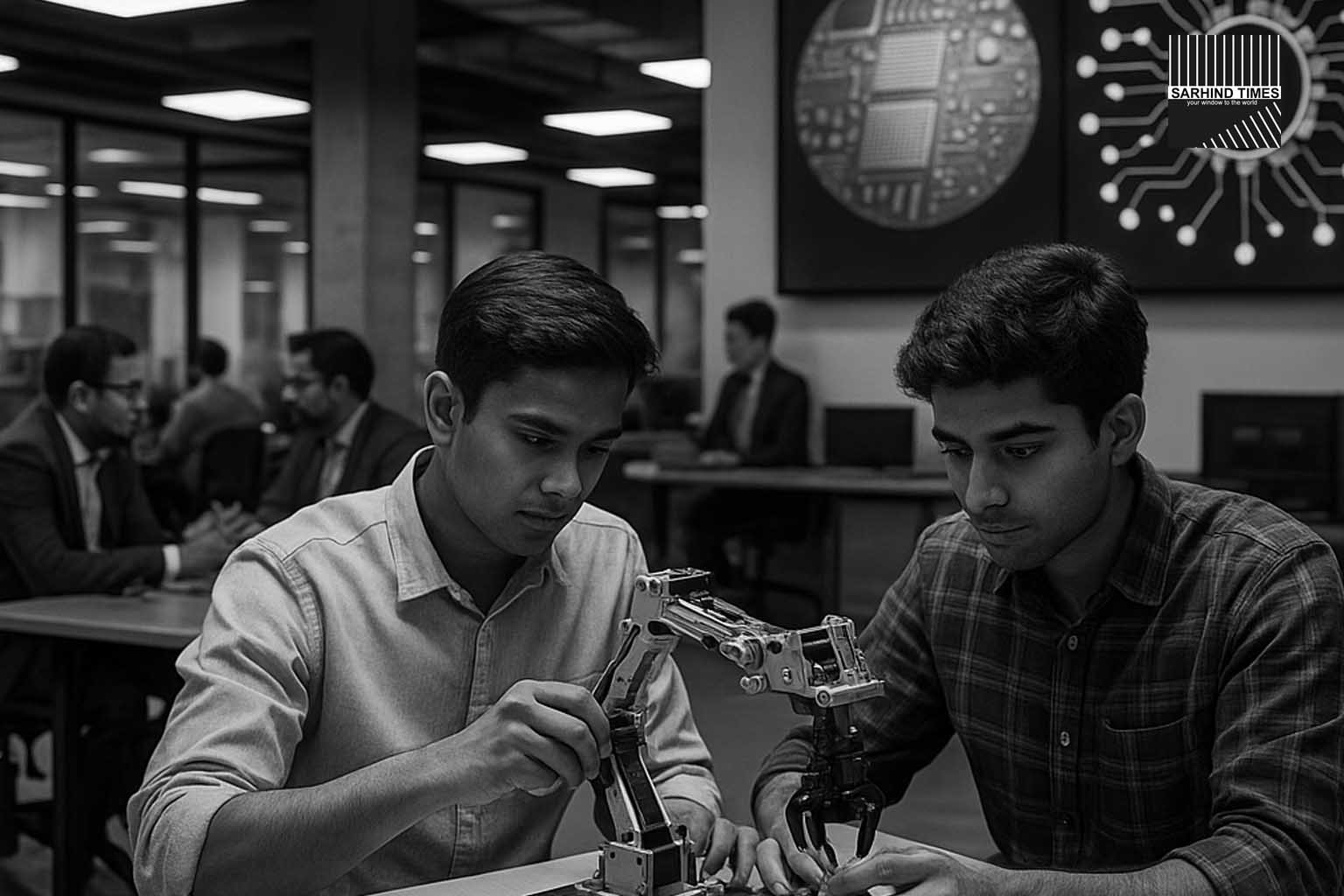
From AI to semiconductors, Indian deep-tech firms are backing bold bets—but scaling remains the real challenge
Dateline: New Delhi | 14 November 2025
Summary: Indian deep-tech startups have crossed a pivotal threshold in funding and ambition. With over US $850 million recently committed by global players and domestic funds to AI, robotics, semiconductors and other frontier technologies, the sector is entering a new scale-up phase. Yet for all the excitement, execution gaps, talent constraints and commercial viability remain significant hurdles.
Setting the scene: what counts as “deep tech” and why it matters
In India parlance, “deep tech” refers to startups built around substantial scientific or engineering innovation rather than incremental app-based change. Think artificial intelligence (AI/ML) with novel models, semiconductor and hardware design, robotics and automation, advanced materials, aerospace, quantum computing and other capital- and talent-intensive technologies.
The reason this matters is twofold. First, these technologies are at the frontier of global competition; countries and corporates are seeking leadership, not just participation. Second, for India, deep-tech offers higher-value creation, export potential, and the opportunity to transition from being a consumer of technology to a developer of it. This shift aligns with national ambitions of self-reliance (Atmanirbhar), manufacturing resurgence, and technological sovereignty.
Recent momentum: funding numbers and ecosystem signals
Recent data show a meaningful uptick in funding for Indian deep-tech startups. By July 2025, Indian deep-tech companies raised approximately US $1.06 billion across 137 equity rounds—about double the amount raised in the same period a year earlier.
Meanwhile, a specific funding vehicle, the India Deep Tech Alliance (IDTA), backed by a consortium of Indian and US investors including global semiconductor and AI players, reported more than US $2 billion in commitments overall. Of that, one tranche alone—over US $850 million—was announced recently as earmarked for Indian AI/semiconductor/robotics ventures.
On the policy front, the Union Budget 2025 allocated substantial sums to research, innovation and deep-tech enablers, reflecting government recognition of this growth vector. Combined with growing VC appetite and more early-stage funds specialising in such technologies, the ecosystem is entering a new phase.
Why now: what has catalysed the shift?
There are multiple drivers converging:
- Global geopolitics and supply-chain realignment: As countries re-think dependence on imports for semiconductors, hardware and advanced tech, India’s large talent pool and large domestic market give it a unique position.
- Domestic policy push: Incentives, manufacturing support schemes, subsidies for semiconductor design and fabrication, and R&D investments from government signal seriousness.
- Startup maturity and talent availability: Earlier waves of consumer internet and SaaS startups have matured. Some entrepreneurial talent is now moving upstream into hardware, robotics and frontier tech. Also, universities and research institutes are supporting more spin-outs.
- Capital availability and investor mindset change: Investors who previously stayed away from hardware or deep-tech (due to high risk, long cycles) are now re-allocating funds thanks to policy clarity, exit-opportunity improvement and global capital flows.
Key sectors gaining traction
Within deep tech in India, certain segments are showing stronger momentum than others:
Semiconductor and chip design: India remains a net importer of chips and is now seeking to build design capability domestically. The ecosystem of chip-design, verification, EDA tools, IP licensing remains nascent but is receiving fresh capital.
AI/ML applied to hardware/embedded systems: Beyond generative AI, the interface of AI with robotics, intelligent automation, edge computing and space technology is getting investor attention.
Robotics, drones and space tech: Startups building drones, satellite imaging platforms, autonomous systems and other hardware-rich solutions are finally getting the spotlight. Early use-cases in defence, surveillance, logistics and agriculture give them relevance.
Domination of early-stage investments – and its risks
Much of the recent funding is in seed and early-stage rounds. This is both encouraging (founders are being backed) and concerning (hardware and deep-tech have long development cycles). One fund cited average ticket sizes of US $2 million to US $10 million in early rounds. Others are explicitly allocating seventy per cent of capital to seed/Series A and thirty per cent to growth-stage. This shows cautious optimism, but also the need for patience.
Opportunities for Indian startup founders
For entrepreneurs in India willing to build frontier-tech companies, this is a golden hour. Specifically:
- Access to fairly large cheque sizes relative to past years, creating runway to build product rather than just survive one pivot.
- Better alignment between policy, industry demand and capital – meaning product-market fit is increasingly viable (not just wishful thinking).
- Opportunity for indigenous innovation – rather than being outsourced development shops, startups can aim for own IP, export orientation and high-skills domains.
Challenges: what must founders, investors and policy makers reckon with?
All the good vibes come tempered with caution. Some of the key issues include:
Longer product cycles: Hardware, semiconductors, robotics don’t typically deliver returns in 12-18 months. Investors need longer time-horizons and founders must be prepared for extended runway.
Talent constraints: While India has many engineers, the depth of experience in frontier tech (analog chip design, high-performance computing, quantum systems) is still limited. Building or attracting those teams is a task.
Capital intensity: Many of these ventures require large upfront investment in infrastructure, prototyping, manufacturing labs, testbeds – making them riskier than software-only ventures.
Market/commercialisation risk: Moving from prototype to product to scale in global markets is hard. Many deep-tech startups struggle to convert technical la-bour into sustainable business models.
Exit ecosystem and valuations: While consumer tech has seen IPOs and acquisitions, deep-tech exits are fewer, especially in India. This can dampen investor appetite unless the path to liquidity is clearer.
Policy and ecosystem role: what needs to be done?
The government, research institutes, universities and industry need to collaborate more effectively. Specific actions include:
- Creating test-beds and prototyping hubs where startups can validate hardware or robotics systems without bearing full infrastructure costs.
- Promoting partnerships between industry and academia to convert research outcomes into startups and products.
- Expanding incentives for domestic manufacturing and export of deep-tech hardware, including semiconductors, sensors, drones and robotics modules.
- Building deep-talent pipelines—both in India and through global collaboration—which include analog design, system integration, quantum computing, AI-hardware convergence.
- Supporting early-stage funds that specialise in deep-tech and can provide patient capital, mentorship and network access—not just money.
Looking ahead: 3-5 year horizon
In the next few years, the following scenarios are plausible:
Optimistic scenario: Indian deep-tech startups successfully scale into global markets, chip-design houses emerge with IP licensed internationally, robotics firms export solutions, and India becomes a meaningful player in hardware/automation exports.
Moderate scenario: The ecosystem grows significantly, but many firms remain early-stage, valuations moderate, some hardware companies fail to scale, and the majority of value-creation remains in software-adjacent domains. Still, this would represent meaningful progress compared to a few years ago.
Pessimistic scenario: The hype overshoots reality—many startups fail to commercialise, capital flows retract, valuations compress, and the deep-tech wave becomes niche rather than transformative.
Implications for investors and content-creators
For investors, the message is to double-check business models, team strength, product-market fit and time-horizons rather than chase the headline numbers alone. For founders and creators (including content-creators like this publication) the rapid growth of deep-tech offers new story-arcs and monetisation paths—from research partnerships and startup narratives to educational courses and consulting services around these technologies.
Conclusion
India’s deep-tech startup ecosystem has crossed an inflection point. The combination of capital, talent and policy is aligning in a way that hasn’t happened before. This is not just a bubble moment—it could be foundational for India’s next tech wave. But it will only matter if the infrastructure, talent, commercialisation and global market access also scale. For all stakeholders—from founders and investors to policy-makers and youth—the opportunity is real. The question is: will India build enduring companies and platforms, or will many remain prototypes and lab-stories?



+ There are no comments
Add yours