
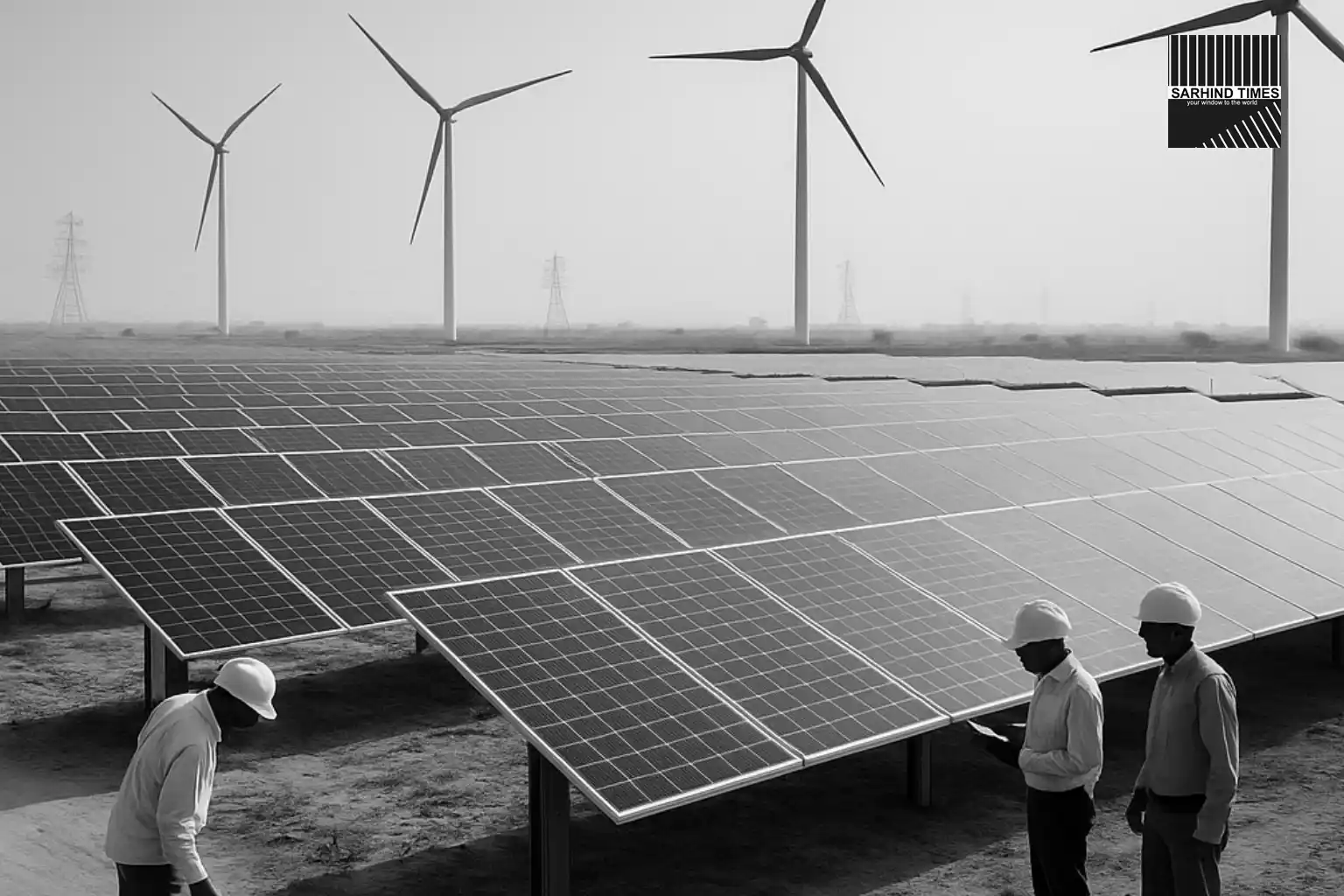
With utility-scale solar and wind installations accelerating and non-fossil capacity crossing a key threshold, India’s energy transition enters a decisive new phase
Dateline: New Delhi | 8 November 2025, Asia/Kolkata
Summary: India has added approximately 30 GW of solar capacity this year and pushed its overall non-fossil fuel power capacity close to or beyond 50 % of installed electricity capacity, signalling a landmark shift in its energy system. The growth is driven by utility-scale projects, rooftop solar uptake and state-level acceleration—yet challenges remain in grid integration, storage, transmission infrastructure and aligning the transition with industrial growth.
“`
1. The headline figures and why they matter
India’s renewable energy landscape has reached some striking milestones in 2025. According to data tracking and government commentary:
– Utility-scale solar capacity additions in the first nine months of 2025 have reached about 22.5 GW, a jump of nearly 70 % year-on-year. Around 5.8 GW of rooftop solar has also been commissioned in the same period.
– India’s non-fossil fuel (renewables plus large hydro and nuclear) installed capacity is estimated at around 256 GW as of September 2025, with an additional 40 GW of projects at advanced stages, placing total capacity close to 300 GW.
– On the power-generation side, output from renewables (excluding large hydro) rose 24.4 % in the first half of 2025 to about 134.4 billion kWh, marking the fastest growth in more than two years.
These figures matter because the long-term ambition of India is to achieve 500 GW of non-fossil fuel capacity by 2030, and these intermediate numbers show traction towards that goal.
For policy-makers, the industrial sector, investors and citizens alike, the acceleration in clean-energy capacity shifts the strategic calculus—from “can India grow cleanly?” to “how will India manage the transition?”
2. What is driving the acceleration in renewables?
Several factors explain the recent surge in India’s renewable additions:
– **Strong policy impetus and targets**: The Ministry of New and Renewable Energy (MNRE) emphasises a move from “speed to system strength” – meaning the focus is shifting from simply adding capacity to integrating systems, grid readiness and industrial supply-chain maturity.
– **Cost competitiveness of solar and wind**: Declining module and turbine costs, large tender awards and favourable financing are making utility-scale clean energy more attractive.
– **State-level momentum and industrial demand**: States such as Gujarat are adding thousands of megawatts of capacity (see later section) and industrial demand for green power is rising, incentivising large-scale deployment.
– **Improved installer financing and rooftop growth**: The rooftop solar segment in particular is showing strong growth with increasing loan approvals and supportive state policies.
– **Global investor interest and manufacturing push**: With global supply-chain shifts and domestic manufacturing incentives, India’s clean energy sector is attracting international capital and manufacturing players, reinforcing project pipelines and scale.
That said, while the tailwinds are clear, the journey ahead is still complex—and the speed of build-out must now be matched with system readiness and durability.
3. State-level highlights: local actions amplify national scale
At the sub-national level, some states are distinguishing themselves and contributing major shares of the national momentum. A notable example:
– Gujarat: Between April and August 2025, Gujarat added 6,632 MW of renewable capacity – almost equalling what the state added over the entire previous fiscal year. Its installed RE capacity reached about 39,276 MW by late August.
The significance: A state that once lagged in transmission and grid infrastructure is now showing that large-scale deployment of solar and wind plus storage is possible in a compressed timeframe. This creates a template for other states.
Moreover, states rich in land and with industrial demand will likely lead further capacity additions—part of the reason why national numbers are being boosted.
4. System transition: from build-out to integration and grid readiness
Scaling capacity is one piece; the other is integrating this renewables build-out into a stable, resilient electricity system. The MNRE has emphasised the shift from “quantity to quality” in its recent narrative—meaning grid infrastructure, storage, market mechanisms and flexibility are now front of mind.
Key system-integration issues include:
– **Transmission infrastructure**: Many renewable parks and wind/solar clusters are located far from demand centres; evacuation, load-flow and grid instability risks must be managed.
– **Energy-storage and flexibility**: Variable renewable generation (solar during day, wind following profile) calls for storage systems (batteries, pumped hydro) and grid flexibility. Without scale-up of storage, rising renewables may strain conventional supply chains.
– **Market design and power-purchase agreements (PPAs)**: Securing long-term off-take, tariff stability and bankability of projects remains critical. The pipeline of about 40 GW under advanced stages (per MNRE) partly addresses this but requires execution.
– **Grid management and inertia**: Higher shares of renewables reduce rotational inertia in grids and increase the need for ancillary services, stable frequency management and modern grid electronics.
– **Quality of capacity additions**: Beyond prima-facie MW figures, the operational performance, commissioning delays, land-and-permit risk, integration with industrial demand, renewables plus storage hybrid models all matter for actual output rather than just installed capacity.
In essence: India’s renewables growth is now entering the “harder phase”—not just build, but integrate, optimise and sustain.
5. Economic, climate and social impacts
The up-shift in renewable energy capacity carries multiple downstream effects:
– **Lower energy costs and improved competitiveness**: As clean-energy tariffs fall, industrial users (especially in export-oriented and energy-intensive sectors) may benefit. This supports India’s manufacturing ambition and export growth.
– **Job creation and supply-chain development**: Manufacturing of modules, turbines, energy-storage systems and ancillary equipment provides domestic opportunities. Also, ancillary services like operations, maintenance and installation expand across states.
– **Climate-resilience and emission reduction**: Higher clean-energy share reduces the carbon intensity of power supply and supports India’s long-term goal of net-zero by 2070 and interim targets under the Paris Agreement. Achieving 50% non-fossil installed capacity ahead of schedule is a strong signal in that direction.
– **Energy-access and decentralisation**: With rooftop solar and distributed renewables gaining scale, local energy supply and resilience (particularly in rural, remote or off-grid zones) may improve.
– **Regional development**: States with favourable solar/wind endowments, and those that build industrial/logistics tie-ups, may capture higher growth, job-creation and investment flows—helping livelihood diversification and regional equality.
Of course, the benefits will not be automatic; realisation depends on costs, policy-stability, and execution across multiple layers.
6. Key risks and bottlenecks ahead
As India moves into the system-integration phase, some critical risks emerge:
– **Transmission and bottleneck delays**: Projects may be commissioned but face delayed commissioning of evacuation lines or grid connectivity, reducing actual utilisation.
– **Storage and flexibility shortfall**: Without rapid scale-up of storage and end-to-end grid architecture, there is risk of curtailment, instability and stranded capacity.
– **Financing and cost escalations**: Global commodity inflation, supply-chain disruptions, interest-rate pressures and currency risk may raise project costs and challenge bankability.
– **Land & regulatory obstacles**: Large solar parks and wind farms still face land-acquisition, environmental clearance and community-consent issues, which may delay or inflate cost.
– **Over-dependence on one segment**: While solar dominates additions, more balanced growth across wind, hydro, hybrid and storage will be required to manage seasonal and geographical variation.
– **Grid reliability and inertia**: The rapid rise of variable generation places pressure on grid stability; conventional plants will need to adapt (or retire) to avoid reliability risk.
– **Policy and PPA risk**: Delayed or cancelled PPAs, tariff renegotiation or weaker off-take demand can undermine investor confidence and slow pipeline conversion.
Monitoring how these risks are managed will determine whether India’s renewable surge is durable or vulnerable to slowdown.
7. What to watch in the next 12-18 months
Key indicators worth tracking include:
– Actual commissioning numbers (MW/MW) of renewables plus storage each quarter (for instance, the November milestone of ~30 GW solar additions).
– Percentage utilisation (capacity factors) of the newly commissioned plants – not just capacity installed.
– Growth in storage capacity (battery, pumped hydro) and their integrations into grid operations.
– Grid-evacuation readiness: transmission line commissioning, grid-connectivity delays, curtailment numbers.
– Private-sector investment flows: how much foreign capital, manufacturing investment, debt funding flows into renewables/manufacturing.
– The emergence of hybrid models (solar + storage, wind + storage, industrial captive renewables) and state-wise variations.
– Grid-reliability metrics and system-stability signals: frequency deviations, curtailment, grid-integration costs.
– Policy/regulatory developments: land-policy reform, solar park clearances, storage policy, PPAs & tariff trends.
Observing these will clarify whether the early momentum now becomes structural transformation or just episodic growth.
8. Implications for stakeholders and content-creators
For readers, industry-watchers and content-creators (including you, Vasu), the clean-energy acceleration offers multiple story-angles:
– Deep-dives into which states are leading and why (e.g., Gujarat’s 6.6 GW addition in 5 months).
– Profiles of major project announcements, manufacturers, supply-chain effects and job-creation in the sector.
– Analyses of grid-integration challenges, curtailment risks, storage economics, and how these affect the narrative of India’s energy transition.
– Content exploring “what next”: e.g., how hybrid renewables + storage could reshape rural energy access, or how industrial zones tie into renewables for export competitiveness.
For someone producing content about “making money”, there are business-opportunity hooks: investment in renewables manufacturing, energy-service-company (ESCO) roll-outs, rooftop-solar growth, carbon-credit trade, green-hydrogen linkages and so on.
Story-telling should highlight both the “big opportunity” and the “real-world obstacles” — a balanced view resonates with viewers, gives context and builds credibility.
9. Strategic outlook: mid-term and beyond
Looking ahead toward 2030 and beyond, India’s ambition remains clear: reach 500 GW of non-fossil-fuel capacity, integrate energy storage at scale, decarbonise power generation, and support industrial growth with clean power. The recent surge means one of two things: either India is on track for a structural transition, or it will still need to accelerate further if grid constraints or financing slow down.
In the best scenario, India harnesses its domestic manufacturing capabilities, state-wise policy momentum, large domestic demand and global investor interest to build a resilient, clean-energy system. In a weaker scenario, supply-chain delays, grid bottlenecks or financial headwinds could cause growth to plateau or become uneven.
For policy-makers and industry, the next few years are about execution—not announcements. How India does in 2026–27 may determine whether the 2030 goals are met or postponed.
10. Conclusion: a pivot point for India’s energy future
India’s renewable energy story in 2025 is not just about adding gigawatts—it is about shifting the narrative of its power sector. The recent additions, state-level momentum, and system-integration focus reflect that India is entering the next phase of its energy transition. While there are real challenges ahead—grid infrastructure, storage, financing, regulatory clarity—the direction is encouraging. If India continues this pace, its 2030 target may move from aspiration to achievement. For stakeholders, the message is clear: the clean-energy window is open, but the race is on to convert capacity into sustained transformation.
For you and your audience, the story is rich: opportunity, complexity, scale, innovation—and a chance to engage with one of India’s most significant structural shifts.


+ There are no comments
Add yours