
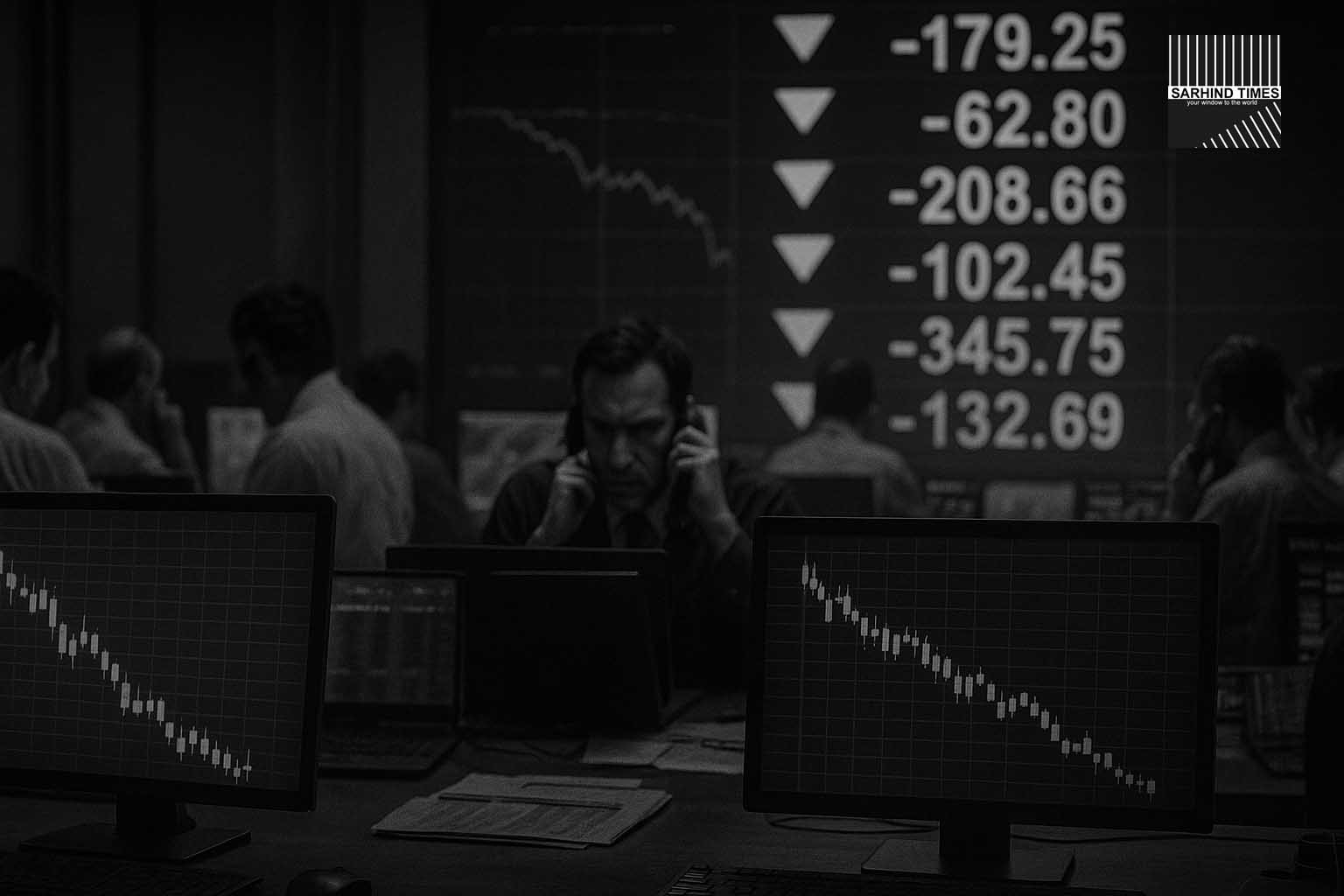
Sensex drops over 1,100 points; Nifty slips below key psychological levels as US tech rout triggers panic across Asian markets
Dateline: Mumbai | 19 November 2025, Asia/Kolkata
Summary: Indian equity markets experienced their sharpest single-day fall in nearly eight months on Tuesday as a steep global correction in technology stocks rattled investor sentiment. The Sensex fell over 1,100 points while the Nifty breached critical support levels. IT, fintech, and semiconductor-linked stocks suffered the deepest cuts, echoing turbulence across US, European and Asian markets. Experts say the volatility may continue unless global cues stabilise.
A brutal day on Dalal Street
Indian markets witnessed a wave of intense selling pressure on Tuesday as the global tech correction — triggered by a selloff in major US technology giants — rippled through Asia’s financial hubs. The Sensex tanked over 1,100 points during intraday trade, closing with one of the steepest declines seen this year. The Nifty mirrored the slide, wiping out gains accumulated over several sessions.
Investors opened trading with trepidation after Wall Street recorded its deepest one-day drop since early 2023. Nasdaq slid sharply as AI-linked valuations cooled, cloud earnings disappointed, and growth estimates were revised downward. This contagion rapidly spread to Asian markets, with Japan’s Nikkei, Hong Kong’s Hang Seng and South Korea’s Kospi all closing in deep red.
India, heavily dependent on global tech sentiment due to its massive IT services and fintech footprint, felt the impact almost immediately.
Sensex and Nifty breach critical levels
At closing bell:
• Sensex ended down over 1,100 points
• Nifty slipped below 19,000 for the first time in weeks
• Bank Nifty fell sharply but remained relatively resilient
• India VIX — the volatility index — surged nearly 11%
Several traders described the mood as “nervous” and “highly reactive to global cues.” The selling was broad-based, stretching across large caps, mid-caps and small caps.
IT stocks at the centre of the storm
The heaviest damage occurred in the IT sector, reflecting the deep red seen in US technology stocks. Major Indian IT firms faced aggressive selling:
• Infosys dropped over 4%
• TCS slid nearly 3%
• Wipro fell 4.5%
• Tech Mahindra declined over 5%
• HCL Tech slipped around 3.5%
Investors reacted strongly to reports of slowing AI project spending by American tech majors, weaker-than-expected cloud growth, and delays in enterprise digitisation budgets. These factors directly impact India’s export-driven IT sector, which earns a majority of its revenue from North American clients.
Fintech, semiconductor and AI-linked stocks also hit hard
Several fintech platforms, semiconductor design firms, chip-based manufacturing plays, and AI solution providers experienced double-digit intraday volatility. Many of these firms had rallied significantly over the past year, fuelled by optimism around India’s digital transformation and semiconductor ambitions.
The correction triggered profit-booking across companies that had seen inflated valuations due to the global AI wave. Analysts say these stocks may remain under pressure as investors reassess earnings projections.
Foreign investors drive heavy selling
Foreign portfolio investors (FPIs) were net sellers for the sixth consecutive session, dumping shares worth thousands of crores amid fears of a global slowdown and tightening financial conditions. Rising US bond yields and a strengthening dollar hurt emerging market sentiment further.
Domestic institutional investors (DIIs) tried to cushion the fall through selective buying, but the magnitude of FPI outflows outweighed local support.
Banking and finance show resilience but not immunity
Banks and broader financial services stocks held relatively stable in morning trade but eventually succumbed to the broader market weakness. While Bank Nifty dropped sharply, analysts noted that Indian lenders remain fundamentally strong and insulated from the tech-heavy volatility seen in US markets.
However, NBFCs, housing finance companies and insurance firms faced moderate selling pressure as risk-off sentiment gripped the market.
Energy, auto and FMCG sectors experience mixed reactions
Traditional sectors fared better compared to high-beta tech stocks. Auto stocks remained largely stable, supported by robust festival season numbers. FMCG stocks attracted defensive buying as investors sought stability in essential consumer businesses.
Energy stocks, particularly in the oil and gas segment, saw mixed movements depending on global crude trends. Power and utilities firms saw limited impact, reflecting the domestic demand-driven nature of the sector.
Mid-cap and small-cap indices suffer sharper declines
Mid-cap and small-cap indices underperformed the benchmarks, a common trend during sharp global corrections. These segments, which had rallied significantly over the past year, saw accelerated profit-booking.
Analysts warn that retail-heavy pockets may see heightened volatility in coming weeks as investors reassess valuations in the face of global uncertainty.
Global triggers behind the meltdown
Three major global developments sparked the chain reaction:
1. US tech earnings disappoint. Several leading American tech companies reported weaker guidance, slower AI adoption timelines, and reduced corporate spending.
2. AI valuations cool. The “AI bubble” that pushed tech stocks to aggressive valuations faced a reality check, with analysts revising growth expectations for some segments.
3. Global risk-off sentiment. Rising US Treasury yields, geopolitical tensions, and concerns around global economic slowdown fueled investor anxiety.
These factors created perfect conditions for a widespread correction across global markets.
Market psychology: Profit-booking and fear collide
Trader sentiment oscillated between panic selling and value hunting. The rapid rise in volatility signals heightened fear among investors, particularly those with exposure to overvalued tech stocks.
Many retail investors used the dip to accumulate quality names, while cautious traders liquidated positions to protect capital. The tug-of-war between fear and long-term optimism defined Tuesday’s choppy trading sessions.
Impact on the Indian rupee
The rupee came under pressure as dollar demand surged amid global concerns. A weaker rupee typically hurts import-heavy sectors but boosts exporters. However, given the tech slump, IT exporters were unable to capitalise on currency depreciation.
Traders said the rupee’s movement would continue to be influenced by global dollar strength and FPI activity.
Investors brace for more volatility
Analysts warn that global markets may remain volatile in the short run. If US tech stocks stabilise, Indian markets could recover quickly due to strong domestic fundamentals. But if the global correction deepens, India may continue to experience spillover effects.
Investors are advised to:
• avoid panic selling
• focus on quality stocks
• maintain diversified portfolios
• avoid speculative high-beta names
• stay updated on global cues
Long-term fundamentals remain strong, say experts
Despite the sell-off, several experts maintain that India remains one of the world’s strongest economic stories. Stable inflation, robust domestic consumption, strong banking sector health, increasing FPI interest in manufacturing, and solid government capex plans are expected to support long-term market growth.
They caution that corrections like these are not only inevitable but necessary to stabilise overheated valuations.
Corporate India reacts to global turbulence
Indian CEOs and CFOs, especially from tech and fintech sectors, acknowledged the impact of global trends on domestic markets. Many emphasised the need for companies to build resilience, diversify revenue streams and strengthen innovation pipelines to withstand global shocks.
Fintech leaders highlighted that temporary market corrections do not change India’s long-term digital transformation trajectory.
Retail investors: Anxiety mixed with opportunity
The sell-off sparked a wave of social media reactions as retail investors shared charts, losses and humour to cope with volatility. Some panicked as portfolios dipped sharply, while others viewed the downturn as a buying opportunity.
Market veterans urged small investors to stay patient and avoid emotionally driven trades.
Sector-wise breakdown: Winners and losers
Biggest losers:
• IT and software services
• Fintech and broking platforms
• Semiconductor-linked stocks
• AI and cloud-service providers
• High-growth startups recently listed
Resilient sectors:
• FMCG
• Autos
• PSU banks
• Utilities
• Healthcare and pharma
The divergence reflects a shift from growth to value stocks, a pattern often seen during global corrections.
What happens next?
Analysts outline three scenarios over the next two weeks:
Scenario 1: Quick stabilisation. If US markets rebound and earnings stabilise, Indian markets may recover quickly.
Scenario 2: Extended consolidation. Markets may move sideways as investors wait for clearer global signals.
Scenario 3: Deeper correction. If the global tech rout intensifies, Nifty and Sensex may see further downside.
Conclusion: A reminder of global interconnectedness
Tuesday’s crash reinforces a powerful lesson — India’s markets, despite strong domestic fundamentals, remain deeply linked to global sentiment. Technology, once the most resilient sector, has become a vulnerability due to its exposure to international trends and valuations.
While investors scramble to interpret headlines, experts remind that volatility is part of market cycles. The long-term story of India’s growth remains intact, but the coming days will test investor patience, discipline and strategy.
The correction may cause short-term pain, but if navigated carefully, it also opens long-term opportunities in fundamentally strong sectors poised for the next growth wave.


+ There are no comments
Add yours