
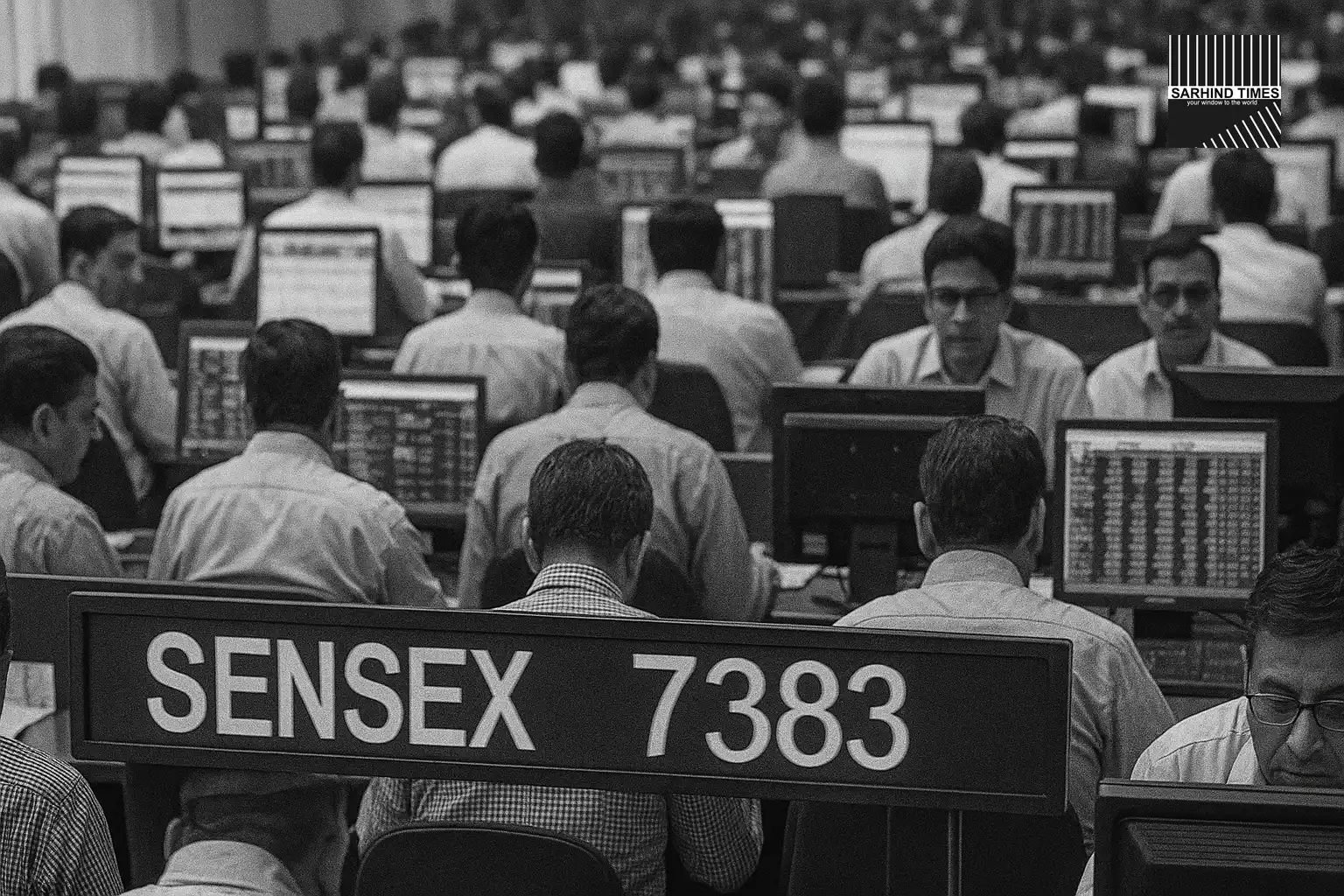
With index gains stalling and investor sentiment cautious, market direction hinges on global cues and domestic earnings
Dateline: New Delhi | 05 November 2025
Summary: India’s equity markets are in a phase of consolidation after a strong October rally, with the Nifty 50 and BSE Sensex hovering near key levels amid weak global cues and investor caution. While earnings surprises in sectors such as PSUs and financials offer pockets of optimism, foreign fund outflows and export concerns continue to weigh on sentiment.
The Recent Market Landscape: Rally Comes with Caution
In October 2025, India’s equity markets enjoyed one of their stronger monthly performances in recent months. However, as November opened, sentiment turned cautious: on 3 November the Nifty 50 edged up only 0.1 % to around 25,747 while the Sensex climbed a mere 0.02 % to 83,956. The backdrop: a rally that many felt had garnered momentum, but one where investors began to realise that the next leg of growth would depend on fresh positive catalysts.
On 4 November, however, that cautious mood sharpened: the Nifty clubbed below 25,600 and the Sensex sank over 500 points, driven by overseas fund withdrawals and dampened global cues from Asian and European markets. The message being: the market’s upward momentum is not paused, but it is taking a deep breath.
Analysts describe the situation succinctly: markets are consolidating. The key questions now include: where will the next major driver come from? Will domestic earnings and reform-momentum suffice to offset external headwinds? How will foreign institutional investor (FII) flows evolve? And can sectors that delivered surprises carry the market ahead?
Sectoral Signals: Where the Strength Lies—and Where It Doesn’t
The finer movement within sectors offers an important window into investor behaviour. On 3 November, 14 of the 16 major sectors logged gains, with small-cap and mid-cap indices rising 0.8 % and 0.4 % respectively. PSU banks stood out, rising 1.5 % on reports of potential increases in foreign investment limits in these entities.
Yet not all sectors were benefitting: private banks and IT stocks slipped about 0.4 % each. That split underlines how selective strength is emerging in the market rather than broad-based optimism.
Some of the notable stock-specific moves on 4 November included: a small-cap company (Sindhu Trade Links) jumping more than 5 % despite a broad market sell-off—highlighting how stock-specific fundamentals still matter even in weak phases. On the flip side, several large‐cap names in power and automobile segments led the weakness on 4 November as the market corrected.
Foreign Capital Movements & Global Context
One of the market’s Achilles heels remains foreign capital flows. Historically India has benefitted from inbound foreign portfolio investment (FPI), especially when global risk-appetite is high. But as global growth concerns, interest-rate anxieties and trade-tensions re-emerge, FPIs have shown signs of caution.
Although recent commentary is less dramatic than earlier in the year, the backdrop remains: any uptick in global inflation, monetary-policy tightening, or slowdown in key trade partners could prompt further outflows. Market participants are monitoring the US Federal Reserve (and other central banks) signals, global supply-chain disruptions and geo-political risks with renewed attention.
Domestic Fundamentals: Earnings, Valuations and Policy Nudges
On the domestic front, the earnings season has delivered mixed results. Some PSU banks and industrial companies have posted surprisingly good numbers, helping to shore up sentiment in those pockets. For example, certain state‐owned lenders beat expectations and drew investor interest.
However, valuations remain under scrutiny. After the rally, many benchmark stocks have already factored in optimism. Analysts are asking whether earnings growth, sector reform, inflows and macro-engine will align to justify further price appreciation—or if a phase of consolidation is more plausible.
Policy nudges matter as well. The government’s intent to allow higher foreign investment limits in public sector banks, for instance, has been priced in to some extent. But market participants are awaiting tangible roll-outs, clearer regulatory announcements and strong policy execution before chasing valuations aggressively. The recent signals of selective strength reflect this wait-and-watch mood.
Risks on the Horizon—What Could Trigger the Next Move?
Several risk factors are converging and could shape market direction in the near term:
- Global growth concerns: A slowdown in major economies, new trade conflicts, or a resurgence of inflation risk could dampen investor sentiment globally and affect India. The narrow window for positive triggers is shrinking.
- Export and earnings pressure: Indian companies with exposure to global demand (especially in IT, metals, autos) may face margin stress if global demand softens. Weakness in these sectors drags on broader indices.
- Credit and corporate-sector stress: While banking reforms are ongoing, any uptick in non-performing assets or lending slowdown could unnerve investors who were betting on balance-sheet improvement as a growth driver.
- Valuation fatigue: Investors may opt to book profits in profitable sectors and stay cautious rather than chase high valuations absent fresh catalysts. This can lead to market consolidation or sideways trading.
- Policy and fiscal execution risk: Infrastructure spending, disinvestment, reform implementation—not to mention state government finances—will matter. Delays or disappointments in policy roll-out can shift sentiment negatively.
Potential Upside Drivers: What Could Reignite the Bull Run?
Amid the caution, market players are eyeing several possible upside catalysts:
- Better-than-expected corporate earnings: Especially from sectors like banking, infrastructure, capital goods and manufacturing, stronger earnings could draw fresh investor interest.
- Higher foreign investment limits and regulatory easements: Clear steps by regulators to raise FPI caps or ease entry in certain sectors would provide fresh capital impetus.
- Improved global growth/ trade scenario: Should global growth projections stabilise, or trade tensions ease, India could benefit from re-routing of supply-chains and stronger export demand.
- Domestic reform acceleration: Infrastructure-capex, disinvestment milestones, privatisation announcements and state-government policy pushes could reframe the narrative from earnings to structural growth.
- Sector rotation and renewed interest in small- & mid-caps: As large-caps consolidate, the next wave of money might move to under-owned segments if fundamentals hold—enhancing breadth of market participation.
What Investors and Stakeholders Should Consider
In this phase, prudent investors, fund managers and corporate observers should pay attention to some key strategic considerations:
- Portfolio discipline: Given the consolidation mode of the market, trimming overly crowded positions and avoiding chasing momentum purely may be wise.
- Focus on fundamentals: Stocks with strong balance-sheets, niche market leadership, fewer global-demand dependencies and potential domestic upside may fare better.
- Sector diversification: With global risk high, diversifying across sectors (rather than concentration) will help manage volatility.
- Time-horizon clarity: Investors should distinguish between short-term trading in volatile sectors and long-term structural bets (manufacturing growth, infrastructure, reforms) that may take time to materialise.
- Monitor flows: Tracking FPI, mutual-fund, retail investor activity and valuations will provide clues on where the margin of safety lies.
Macro Linkages: What This Means for the Indian Economy & Markets
The current phase of market consolidation has implications beyond portfolios. Equity markets are often reflective of broader economic sentiment. When markets pause, it frequently signals a broader wait-and-see phase among business, investors and consumers alike.
If markets remain in consolidation for extended periods without fresh catalysts, it may imply that growth expectations are moderating. That matters for corporate investment decisions, hiring, consumer confidence and capital formation. In the Indian context, where domestic demand has been a key pillar of growth, sustained investor caution could translate into slower business-cycle acceleration.
Conversely, if the markets do bounce back and deliver broad-based gains—particularly in mid-caps, manufacturing, financials and export‐play companies—it may reinforce the narrative of India being among the faster-growing large economies globally, attract more FPI inflows and stimulate higher risk-appetite in related sectors (private equity, venture capital, startups). In that sense, the market’s near-term movements carry outsized significance.
Looking Ahead: Key Dates and Watch-Points
As the markets navigate this phase, a few dates/events will carry outsized weight:
- Earnings announcements for Q2 and subsequent quarters, particularly from banks, infra-companies, manufacturing firms and global-demand-exposed enterprises.
- Policy or regulatory announcements concerning foreign investment, privatisation/disinvestment, and sectoral reforms (such as in banking, defence, manufacturing and infrastructure).
- Global macro-events: central-bank policy outcomes (especially from the US), geo-political developments, and trade-talk breakthroughs or setbacks.
- Domestic indicators of credit, consumption, employment and infrastructure investment that feed into corporate growth narratives.
- Flow data: monthly FPI inflows/outflows, mutual-fund incremental assets, retail investor behaviour—these provide actionable signals of sentiment.
Conclusion: A Moment of Pause, Not Panic
The Indian equity market is at a juncture. After a meaningful rally, markets are reflecting caution, consolidation and selective strength rather than broad exuberance. That is healthy—markets may need a breather before the next leg.
But this phase also carries opportunity. Markets that consolidate and build a broader base often pave the way for more sustainable gains. The key will be how the next catalysts align—whether earnings, policy, global environment or domestic investment pick-up. For investors and companies, adaptability, discipline and timing will matter more than chasing momentum.
In short: the upward trend remains intact, but it is entering the phase where conviction, not speculation, will separate winners and laggards. India’s equity story is underpinned by long-term fundamentals, but the market now demands tangible proof, not only promise. As stakeholders watch, the next move may well define the direction for the remainder of the year and set the tone for 2026.



+ There are no comments
Add yours