
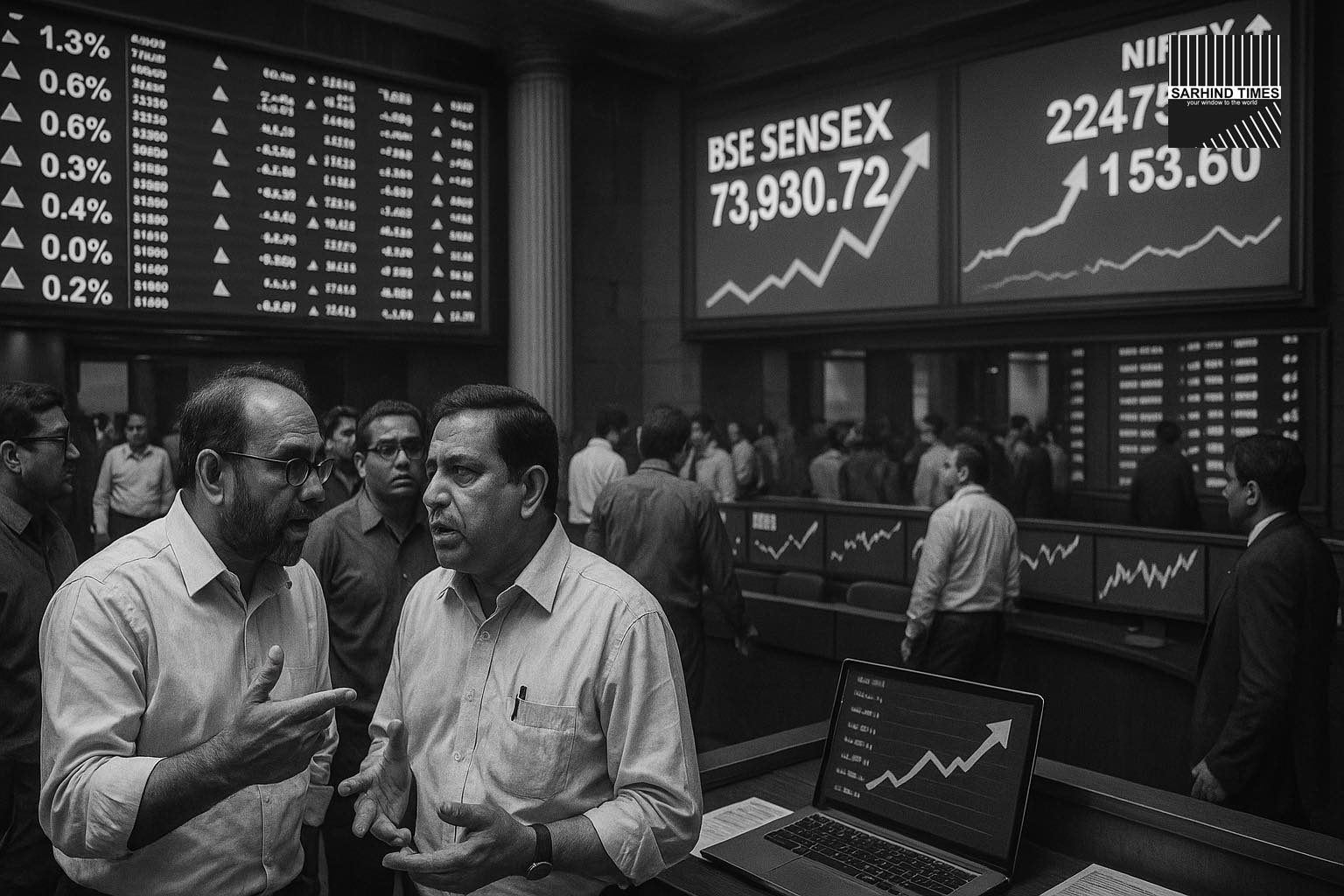
After a strong October across benchmarks, the Nifty 50 and S&P BSE Sensex now face a pivotal consolidation phase as investors eye mid-term opportunities and risks.
Dateline: New Delhi | 2 November 2025
Summary: India’s stock market gained meaningful momentum during October, with benchmark indices responding to lower inflation risks, improved global investor sentiment and strong domestic buying. With November now unfolding, the market enters a consolidation window — supported by technical levels and selective sector strength — even as global uncertainties and valuation concerns temper exuberance.
October Performance: What Drove the Upswing
In late October, the Sensex advanced by more than 500 points on a key day, signalling renewed appetite among equity investors. One report noted the index closing at 84,778.84, up 0.67 per cent on the day, propelled by a combination of lower-than-expected US inflation prints, hopes of global central-bank rate cuts and improved trade-relations dynamics. :contentReference[oaicite:2]{index=2}
For Indian markets specifically, three factors stood out:
- Inflation and global cues: Lower inflation in the US and other major economies raised speculation of upcoming rate cuts, easing pressure on yields. That benign global backdrop benefited equities broadly, including India. :contentReference[oaicite:3]{index=3}
- Domestic flows and sentiment recovery: Domestic institutional investors (DIIs) picked up pace, lending support even as foreign flows remained cautious. In one assessment, India’s equity market year-to-date gains reached around 7–8 per cent, partly due to increased domestic participation. :contentReference[oaicite:4]{index=4}
- Technical breakouts and futures premium: The November futures for Nifty closed at 25,907.10 against the cash index at 25,722.10 — a premium of roughly 185 points — suggesting positive carry and investor commitment to the next month. :contentReference[oaicite:5]{index=5}
Market Mood: Consolidation With Selective Momentum
With the strong October run, many market participants are signalling caution. Analysts at SBI Securities believe the near term will likely see the indices trading in a range, driven by profit-booking pressure, global uncertainty and domestic valuation concerns. :contentReference[oaicite:7]{index=7}
Technically, the Nifty faces immediate resistance near the 26,000–26,100 band, with support around the 25,500–25,600 range. A break above the resistance could open fresh upside, but a drop below support may trigger corrective moves. :contentReference[oaicite:8]{index=8}
Sectoral Outlook: Where the Momentum Is Alive
While broad-market momentum remains healthy, certain sectors stand out in terms of leadership and potential:
- Financials and PSU banks: With interest-rate tailwinds and expected uptick in credit growth, stocks such as Canara Bank and Shriram Finance were recommended by brokers for fresh buying. :contentReference[oaicite:11]{index=11}
- Export-and-domestic cyclical plays: With global demand signs improving and manufacturing push continuing, companies with strong export or domestic-cycle exposure are under spotlight.
- Domestic consumption themes: As inflation cools and rural demand holds up, consumer-discretionary and select mid-cap names with good fundamentals are attracting incremental interest.
Flows, Valuation and Foreign Participation
An important theme in the Indian equity story is the divergence between domestic investor support and foreign investor caution. While DIIs have been net buyers and providing cushioning, foreign institutional investors (FIIs) have been less aggressive. One Reuters analysis noted that foreign investors had withdrawn billions during the year even as domestic buying held up the market. :contentReference[oaicite:12]{index=12}
On valuations, the market is seen as moderately elevated. The premium in futures and active participation in large-cap breakouts suggest near-term optimism, but analysts caution that earnings growth must follow through for the rally to sustain. Macro clarity on inflation, monetary policy and growth will be critical for valuation support.
Macro & Policy Variables to Watch
Several key macro and policy variables will influence the equity market trajectory in November and beyond:
- Inflation trajectory: If domestic or global inflation surprises to the upside, yield pressures may return and weigh on equities.
- Interest-rate decisions: The Reserve Bank of India and global central banks remain in focus; any hawkish tilt or delayed easing could dampen equity sentiment.
- Corporate earnings and guidance: For the rally to evolve into a broad-based up-cycle, quarterly earnings should meet or beat expectations; otherwise, selective strength may persist without broader breadth.
- Global risk environment: Unanticipated shocks — e.g., commodity price shocks, geopolitical events or global growth weakness — may quickly shift risk-appetite and lead to rotation away from risk assets.
- Domestic policy developments: Budget or fiscal announcements, regulatory developments in credit/finance sectors and reforms in infrastructure or manufacturing will influence investor positioning.
Risk Scenarios: What Could Go Wrong?
Even as optimism builds, there are plausible risk scenarios that investors should monitor:
- Profit-booking in large-cap leaders: A sharp pull-back in marquee stocks could affect overall market breadth and lead to short-term correction.
- Over-reliance on domestic flows: With FIIs still cautious, the market remains vulnerable if DIIs reduce buying or if sentiment weakens without foreign support.
- Sector-specific disappointments: If banking/financial stocks under-deliver due to credit stress, or if industrial/cycle sectors fail to pick up, the market may struggle to sustain momentum.
- Valuation vulnerability: With indices trading near resistance and futures reflecting premiums, any erosion of expectation or macro shock could lead to sharper re-rating.
Navigating November: Strategy for Investors
Given the current setup, investors may consider the following strategic posture:
“Maintain exposure to quality large-cap names, rotate into sector-leaders displaying breakout patterns, keep stop-loss discipline, and use dips as opportunities rather than chasing upside without checks.”
Specifically:
- Use consolidation as an opportunity to review portfolio exposures and lock in profits from recent outliers.
- Focus on stocks with strong balance-sheets, visible earnings growth and sectoral tailwinds rather than pure momentum bets.
- Consider thematic plays — eg. financials, manufacturing, cyclical upturns — while being cautious on over-hyped sectors without earnings clarity.
- Keep aside tactical allocation for mid-cap or selective growth names, but avoid excessive leverage or speculative positions given elevated valuations and global risk backdrop.
Outlook Summary
To summarise: Indian equities have built momentum, aided by macro tailwinds and domestic flows, and are positioned for a potential continuation of the move into November. However, the market appears to be entering a phase of consolidation rather than a breakout sprint. Sustained upside will depend on favourable earnings, policy clarity and global cues. For discerning investors, the current environment offers both opportunity and challenge — execution, selection and discipline will matter more than broad enthusiasm.



+ There are no comments
Add yours