
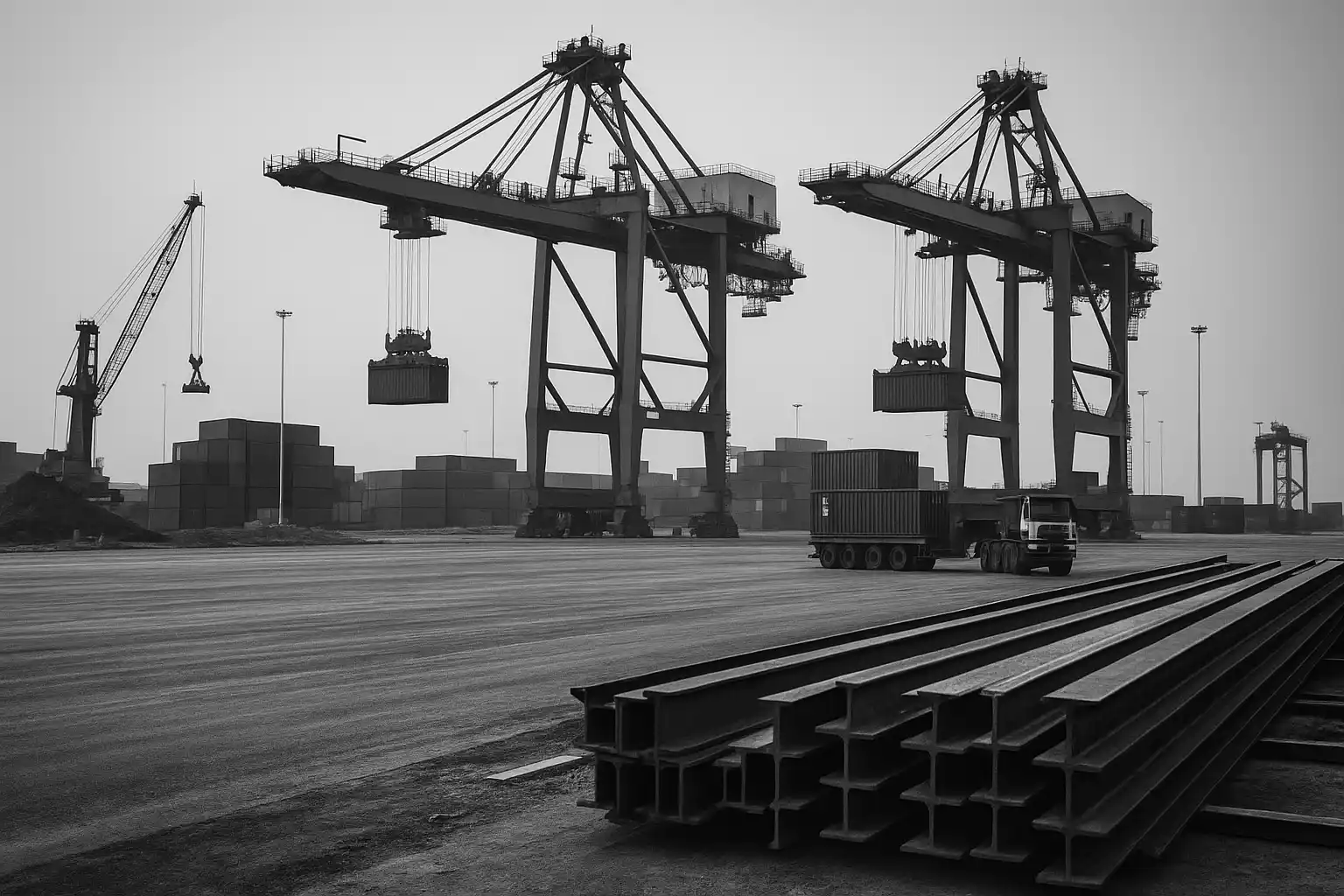
Seven new nex-gen projects cleared as part of the Centre’s drive to attract ₹ several lakh crore and fast-track national development through ports, highways, logistics and PPP reform
Dateline: New Delhi | October 30, 2025
Summary: The Government of India has approved the first batch of seven infrastructure projects under the new “Expedited Clearance & Monitoring System (ECMS)”, signalling the start of a broader infrastructure investment surge across ports, highways, logistics and regional connectivity. The approvals come amid a wider strategy to raise infrastructure investment to 6.5 % of GDP by 2029 and attract large-scale private capital.
Setting the Context: Infrastructure as a Growth Lever
India’s infrastructure sector has long been recognised as a critical engine for growth, job-creation, global competitiveness and regional connectivity. In recent years, the Centre has emphasised “infrastructure as investment” rather than merely “infrastructure as utility”. According to the CRISIL Infrastructure Yearbook 2023, India will spend nearly ₹143 lakh crore (US $1.7 trillion) on infrastructure over seven fiscals through 2030—more than twice what was spent in the previous seven years.
Furthermore, consulting-firm Morgan Stanley projects that India’s infrastructure investment will rise from about 5.3 % of GDP in FY24 to 6.5 % by FY29.
In this light, the recent approvals of seven key projects mark not just incremental steps but the opening of a major investment wave—one that aims to bridge India’s infrastructure-gap, integrate logistics, ports, highways and energy systems, and prepare the nation for “Viksit Bharat @ 2047”.
The timing is significant: global supply-chains are shifting, private-capital is hunting infrastructure yield, and India’s growth narrative is banking heavily on connectivity and manufacturing. The government’s push for faster clearances, PPP viability support and strategic investment signals a convergence of policy, capital and opportunity.
The Approved Projects: What We Know So Far
On October 29, 2025, the government announced that the first batch of seven large infrastructure projects had been approved under its Expedited Clearance & Monitoring System (ECMS). The projects cover sectors such as port-development, inland waterways, logistics parks, highways and power-transmission. While full details of all seven are yet to be disclosed publicly, the announcement represents a shift—approval timelines are being drastically shortened, and projects are now being “performance-rated” on a live-dashboard basis by the government.
Some of the salient features seen in these projects:
- Large-scale private-capital infusions and PPP models, rather than purely public funding.
- Port-led logistics and inland-waterway connectivity being emphasised as a mode of reducing freight cost and improving export competitiveness. For example, a recent press note reported that over ₹1,000 crore has been invested in Inland Waterway infrastructure in the Northeast, with projects nearing completion.
- High-speed expressway and logistic-corridor projects benefiting from policy reforms to support private-sector viability—such as viability gap funding, annuity support, and land-acquisition risk sharing. See government plans for highway builders.
Given the scale and strategic breadth of these projects, analysts believe this could catalyse a multi-trillion-rupee investment wave, with ripple effects across manufacturing, logistics, employment and regional development.
Why These Approvals Matter: Key Impacts
1. Faster implementation and accountability: Historically, India’s infrastructure implementation has been slowed by land-acquisition delays, environmental clearances, multi-agency coordination and funding constraints. The ECMS system aims to reduce these friction points with a 90-day approval window, live dashboards, and performance ratings for implementing agencies. The latest approvals show the pipeline is moving from policy promise to action.
2. Private-capital mobilisation: Attracting private capital is a government priority. The shift from purely public-funded projects to PPP, annuity models and asset-monetisation is evident. Private players see both scale and return opportunities.
3. Logistics-cost reduction and export competitiveness: By building port, highway and waterway infrastructure, India aims to reduce logistics cost (currently higher than many peers) and integrate its manufacturing exports globally. This has implications for “Make in India” and “Atmanirbhar Bharat” agendas.
4. Regional development and job creation: Infrastructure projects are major job-creators (in construction, engineering, transport services). They also spur local economic activity—industrial parks, ancillary services, housing, retail—in and around corridor zones.
5. Strategic resilience and connectivity: Better infrastructure increases resilience to natural disasters (via alternate logistics routes), improves defence connectivity (especially in border areas), and reduces regional disparities in access and growth.
Challenges & Implementation Risks
Despite the positive momentum, several risks remain and will need to be managed actively:
- Execution capacity: Approving projects is vital, but delivery at scale requires competent project-management, timely land acquisition, contractors meeting quality & timelines, and monitoring. India has seen cost overruns and schedule slippages in past mega-projects.
- Funding & financial health: While private capital is showing interest, viability of some sectors (especially toll-roads, freight corridors) can be challenged by demand risk, regulatory uncertainty or macro-shocks. Government support (VGF, grants) will be necessary to de-risk such projects.
- State-Centre coordination: Infrastructure often intersects with state-jurisdictions (land, environment, local utilities). Ensuring smooth co-ordination and avoiding turf delays remains critical.
- Environmental & social safeguards: Large infrastructure can entail displacement, ecological disruption (wildlife corridors, river-beds) and community resistance. Balancing speed with sustainability will be a key governance test.
- Maintenance, operations and lifecycle costs: Building is one phase—maintaining, operating and optimising the infrastructure over decades is another. Lifecycle funding and operations frameworks must be designed upfront.
Analysts note that unless India builds institutional depth (project-management cells, quality assurance agencies, digital monitoring, open dashboards), many of the approvals may suffer the same fate as earlier high-ambition projects that got delayed or under-utilised.
Readiness for Reform: What Has Changed?**
A number of enabling reforms appear to be in place which increase confidence:
- Clearance reforms: ECMS is a direct response to past bottlenecks; by centralising clearance tracking, digitising process, and making agencies accountable, the system signals a new governance paradigm.
- Viability support and PPP models: The government’s outline of additional support for highway builders (e.g., annuity models, eclipse of land-risk) shows that revenue-model risk is being actively addressed.
- Asset monetisation push: India’s National Monetisation Pipeline and strategic disinvestment policy are providing avenues for infrastructure funding via alternate models. Private-investment appetite is elevated.
- Logistics and ports strategy: The Ministry of Ports, Shipping & Waterways and the Ministry of Railways have elevated logistics cost reduction as a key policy target; investments in multimodal connectivity, inland waterways and port modernization signal a systemic approach. For instance, the report that over ₹1,000 crore has been invested in Northeast inland-waterway infrastructure.
These reforms align with global best practice: clear regulatory scaffolding, performance monitoring, private-sector collaboration, and whole-life cost planning. India appears to be moving from “wishful projects” to “deliver-able pipelines”.
Case Study: Maritime Infrastructure Push**
While the seven-project batch is a broad mix, one standout area is maritime infrastructure. The government has recently announced a ₹1.46 lakh-crore (approx US $17 billion) investment plan to develop port-led infrastructure under the “Maritime Amrit Kaal” vision, aiming to position India as a global maritime power.
This involves deep-water ports, logistics parks adjacent to port terminals, coastal shipping push, subsea-cable infrastructure and ship-building. By aligning transport and logistics infrastructure with ports, India is seeking to create integrated value chains that extend from hinterland to global markets.
This complementarity amplifies the significance of the infrastructure wave: it is not just building roads or bridges, but building ecosystem connectivity—enabling manufacturing, export, supply-chain compactness, and maritime anchoring.
Implications for Industry, Region and Investors**
For industry: Enhanced infrastructure means lower logistics cost (often 12-14 % of GDP in India), faster transit times, better reliability—key competitive advantages for manufacturing, agribusiness and services sectors.
For regions/states: States that align with corridor development, land-bank provision, industrial-clusters near infrastructure will benefit more. The investment wave is not uniformly distributed—states that move early may capture growth.
For investors and global capital: The pipeline of deliverable projects with structured funding, PPP models and fast clearance improves the risk-return proposition. Global infrastructure investors (sovereign funds, pension funds, debt funds) are already looking at India as a frontier.
For citizens: Better connectivity, shorter travel times, more access to markets, jobs in construction/maintenance, improved logistics for farm produce, enhanced regional mobility—these large-scale impacts will trickle down.
Outlook: What to Monitor and When**
Key metrics and milestones to watch in the next 12-24 months:
- How many of the seven approved projects achieve ground-breaking or detailed project report (DPR) completion within 6-12 months.
- Capex and private-investment commitments (amounts signed vs. amounts deployed).
- States vs. Centre: which states attract more projects and investment, and how land/clearance issues evolve.
- Impact on GDP, employment, logistics cost, travel-time reduction in select corridors.
- Quality of execution: cost overruns, delays, maintenance budgets and lifecycle outcomes.
If these indicators trend positively, the push could become transformational. If not, the approvals risk being symbolic rather than catalytic.
Balanced View: Risks Alongside Opportunity**
It is worthwhile to temper optimism with realism. Infrastructure is a long-haul game. Approvals are early steps; delivery will take years. Some projects may spill over cost or time; macro-shocks (global recession, commodity price spikes, interest-rate shocks) may test viability. Also, a narrow focus on big projects may overlook maintenance of existing infrastructure, human-resource gaps and inclusion of weaker regions. Conclusion**
India’s infrastructure moment appears to have arrived. The government’s clearance of the first batch of large-scale projects, coupled with policy reforms for clearance, funding, PPP models and logistics connectivity, point to a new phase of capital deployment and growth. The strategic breadth—from ports to highways, inland waterways to logistics parks—suggests this is not just about building things but building networks, capacity and competitiveness.
However, the real test lies ahead. Delivery will depend on execution discipline, funding flow, capacity at state and agency level, private-capital absorption and governance of environmental/social trade-offs. If India can translate approvals into operational assets on time, this phase could reshape the country’s growth trajectory, reduce logistics cost, enhance exports, generate jobs and unlock regional value. If it falters, the risk is of large commitments with limited visible change—a caution many emerging economies know all too well.
In short: the approvals are the start of a journey—how far India travels on it will determine whether this infrastructure wave becomes an anchor of its next growth chapter or a missed opportunity.


+ There are no comments
Add yours