
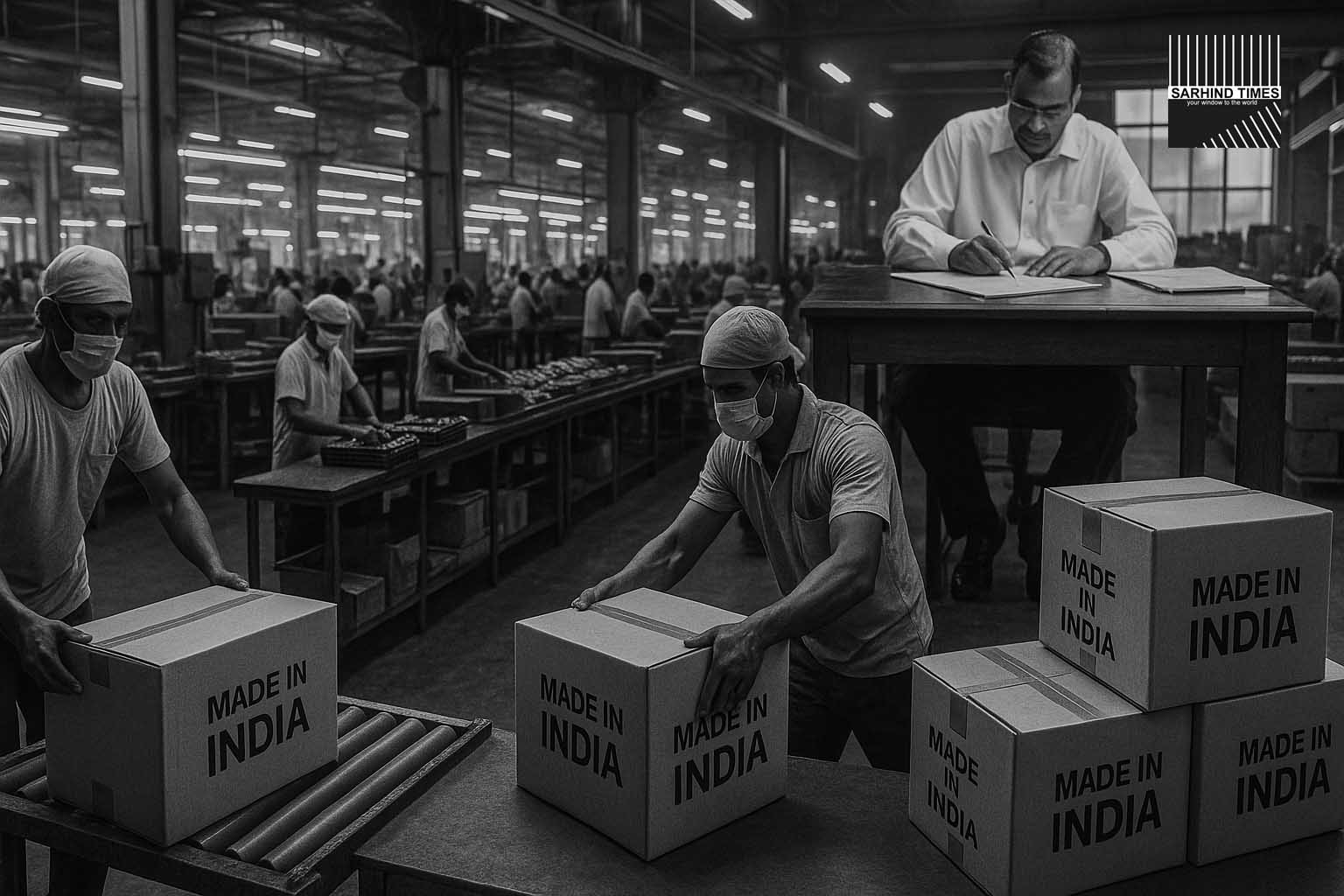
As global headwinds mount, the Government of India has approved a sweeping export-finance package, signalling a shift to trade-led growth and offering fresh impetus to manufacturing, MSMEs and overseas market expansion.
Dateline: New Delhi | 18 November 2025
Summary: The Union Cabinet has approved a ₹4,50,600 crore (around US $54 billion) umbrella package for exporters in the financial year 2026, of which ₹20,000 crore is earmarked specifically as *credit guarantees for bank-loans* to export-oriented units. The move aims to bolster India’s trade resilience, diversify markets, strengthen supply-chains and support domestic manufacturing. The initiative underscores the government’s recognition that export-led growth is likely to be a key engine of economic expansion amid weak global demand and rising competition.
Why the timing of this package matters
In recent months, analysts have flagged that while India remains one of the fastest-growing major economies, its export momentum has lagged, global demand remains subdued and external headwinds (commodity price swings, protectionist trade regimes, supply-chain shifts) are intensifying. Against this backdrop, the Cabinet’s decision to commit a large quantum of finance to export forces is both strategic and urgent.
According to government sources, out of the total package of ₹4,50,600 crore, approximately ₹20,000 crore is to be used as credit-guarantee support for bank loans to exporters, with the remainder supporting trade-facilitation, special-purpose financing vehicles and supply-chain interventions.
The jump in support comes at a moment when India is recalibrating its economic model: moving away from purely domestic-demand-fueled growth and realising that global-linkages, exports, manufacturing scale and comparative advantage matter deeply for job-creation, value-chains and inward investment. By signalling stronger export support, the government is betting on a global turn round and positioning India as a hub of trusted supply-chains for the post-pandemic world.
The components of the scheme — what’s included
The export-support package breaks down broadly into the following buckets:
– **Credit Guarantee for Exporters**: Around ₹20,000 crore allocated to guarantee bank loans for export-oriented units. This effectively lowers lending risk for banks, encourages higher lending volumes to exporters, especially MSMEs and those in emerging sectors.
– **Special Facilities for Manufacturing Exports**: Finance for manufacturers in sectors such as electronics, telecom, auto components, textiles and engineering goods to enhance competitiveness.
– **Market-Diversification Incentives**: Support for exporters targeting newer geographies (Africa, Latin America, ASEAN) as well as value-added products rather than simple commodity exports.
– **Supply-Chain Upgradation**: Funds to integrate domestic suppliers, upgrade packaging, logistics, warehousing, shipping link-ups and export-oriented infrastructure.
– **Risk-Mitigation and Insurance**: Export-credit insurance, currency-hedge support and export-finance refinancing for enterprises facing global demand shock.
– **Trade-Promotion and Branding**: Financial allocations to export-promotion councils, trade-fairs, global branding of “Made in India” and incentives for units going for green/low-carbon certification.
Combined, the package intends to address the full spectrum of export-ecosystem challenges: finance, capacity, markets, competitiveness and risk.
What this means for manufacturing and MSMEs
For the manufacturing sector and small & medium enterprises (MSMEs) aiming to export or scale production, the package signals concrete opportunity:
– Lower cost of finance: With guarantee cover, banks are likely to offer more favourable terms to export-units, especially smaller firms previously excluded or deemed high risk.
– Access to new markets: The diversification focus may allow firms to shift from saturated markets (USA, EU) and access emerging demand areas.
– Scale-up support: Manufacturers can plan scale expansions with greater certainty of finance and government backing, rather than ad-hoc incremental path.
– Competitive edge: Sectors that invest in quality, branding, eco-certification may receive premium support, helping Indian exports upgrade beyond traditional cost-plays.
– Risk-buffer: Support for global-demand volatility or currency risk means exporters may be cushioned from abrupt shocks, improving survival and growth potential.
For India’s broader industrial agenda — aiming at “Make in India”, PLI schemes, supply-chain localisation and export-oriented growth clusters — this export-finance package dovetails with the strategic thinking of re-anchoring manufacturing into global value-chains.
Potential benefits: jobs, growth, trade surplus
The government expects several knock-on benefits:
– Growth: Export-led growth can supplement domestic-demand slowdowns, help industrial output, utilisation of spare capacity and better inventory management.
– Employment: Manufacturing export growth tends to create jobs across value-chain—from production floor to logistics, packaging, design and services. MSMEs, particularly in tier-2/3 towns, stand to gain.
– Trade and current account: Stronger exports reduce reliance on imports, improve trade balance, enhance resilience to external shocks and support rupee stability.
– Investment attraction: With stronger policy backing, foreign firms seeking supply-chain diversification may favour India. This could bring capital, tech, jobs and spill-over into clusters.
– Regional growth: Export-clusters may emerge in non-metro regions, decentralising growth beyond major cities, aligning with government’s inclusive-development aim.
If executed well, the package could deliver high-leverage impact relative to cost, by unlocking latent manufacturing capacity and linking India to growing global demand.
Challenges and fine print: execution matters
The initiative is well-timed — yet serious execution risks must be addressed for the package to translate into outcomes:
– Guarantee scheme complexity: Guarantee-funds often suffer from adverse selection, moral hazard, admin delays, disputes over default claims and bank risk-aversion. Fast and transparent process is key.
– Finance administration: Allocation is large; converting financial commitments into disbursed loans, not just announcements, will test the banking system, export-finance agencies and monitoring units.
– Market diversification is hard: Targeting new geographies requires export-units to adapt to regulatory regimes, trade-barriers, logistics networks and local partnerships—pipeline development will take time.
– Non-finance constraints: Export-success depends also on product-quality, labour-skill, packaging, shipping logistics, port-efficiency, infrastructure and global linkages. If any remains weak, finance alone will not suffice.
– Global demand uncertainty: Even with finance support, if global end-markets slow down further, export-orders may still lag, leaving some firms exposed. Fiscal cushion is helpful but not bullet-proof.
– Monitoring and governance: Large schemes can get diverted unless monitoring, audit, evaluation and sunset-mechanisms are built in. Transparency of guarantee spur, defaults, fraud-prevention are important.
Experts have emphasised that the “last-mile” of converting guarantee into actual business expansion will determine success. A senior trade-policy researcher commented:
> “Financing support is a necessary enabler, but the ecosystem of quality, logistics, market-intelligence and trade-compliance are the harder battles. India must commit not just money but execution velocity.”
Market reaction and investor sentiment
The financial markets and trade community have taken note of the package. Signals include:
– Export-oriented shares (textiles, engineering goods, auto-components) saw early upticks in anticipation of improved finance-terms.
– Analysts say this move strengthens India’s pitch as a global supply-chain alternative and may attract foreign-investment into export clusters.
– Bond markets may interpret the package as a commitment to growth-led fiscal policy rather than pure consolidation—though the cost of guarantee scheme and fiscal impact will also be watched.
– Banks with strong SME/expo-finance books may benefit from guarantee cover, but will need to manage the bank-risk side carefully.
Policy context: from demand cushion to export-acceleration
Historically, India’s growth model relied heavily on domestic demand—housing, consumption, services. That model is now showing tapering returns in matured urban markets. As global headwinds mount, the policy has begun shifting to supply-chain, manufacturing and export-focus. This recent package fits that narrative.
The government’s approach is being guided by global developments: supply-chain reshoring, trade block fragmentation, rising value-chain nationalism and greater importance of production-ecosystems. By loosening finance constraints for exporters and offering brand/up-gradation support, the policy signals India wants to be part of this global shift.
This pivot is also consistent with earlier announcements in the Union Budget 2025-26 which emphasised manufacturing, investment, MSME-growth and export facilitation.
What exporters need to do now**
For exporters looking to benefit from the scheme, the immediate action-points are:
1. Assess their eligibility for guarantee-cover: exporters should engage with banking partners, check scheme criteria and apply for bank-loan guarantees in early FY26.
2. Prepare for scale-up: firms should review production capacity, quality-systems, certifications (ISO, green/eco-cert), logistics and export-markets to align with growth targets.
3. Explore new geographies: beyond traditional USA/EU markets, small firms should evaluate Africa, Latin America, Southeast Asia, CIS markets where first-mover benefits may arise.
4. Strengthen compliance and reporting: to qualify for guarantee and maintain eligibility, exporters must have robust financials, export-track record, governance frameworks and risk-mitigation plans (currency hedging, supply-chain audits).
5. Link with government export ecosystems: export-promotion councils, state export-clusters, trade missions, exhibitions and “Make in India” branding can provide co-benefits alongside finance.
6. Monitor scheme rollout: exporters must keep track of scheme guidelines, bank-terms, periodic thresholds, sectoral caps, and ensure they meet deadlines as FY26 begins.
Looking ahead: benchmarks and indicators to watch**
To evaluate whether the package delivers, key indicators over the next 12-18 months will include:
– Growth rate of India’s merchandise exports (value and volume) year-on-year.
– Share of new markets (Africa, Latin America, ASEAN) in India’s export basket.
– Utilisation rate of guarantee fund: how much of the ₹20,000 crore guarantee envelope is drawn, how many firms receive cover, claim ratios, default incidence.
– Employment growth in export-manufacturing clusters.
– Investment announcements in new export-oriented units, especially in non-metro regions.
– Credit growth to exporters and SMEs in FY26.
– Improvement in logistics/export-readiness metrics: port turnaround, shipping cost reduction, packaging‐and-quality upgrades.
– Financial-stability signals in banks: default/claim exposures, risk management in bank-books tied to export-finance.
If the early data show meaningful uptick, the scheme could become a flagship of India’s next-wave economic strategy; if not, critics may point to “just another subsidy announcement” without execution muscle.
Implications for content-creators, analysts and investors**
If you are involved in creating content, analysing trade or investing in export-oriented sectors, this development warrants strategic attention:
– For analysts: tracking companies with export-exposure, MSMEs in tier-2/3 towns, and logistics/packing firms may reveal early winners of the scheme.
– For content-creators: narratives around “India’s export push”, “global supply-chain shift”, “SME-enabled manufacturing revival” may gain traction. Tied to this finance package are stories of local firms scaling, jobs being created, clusters emerging outside metros.
– For investors: sectors aligned with exports—auto-components, engineering goods, textiles, electronics manufacturing services (EMS), packaging, logistics—may get a policy tailwind. However, execution risk remains and trimming exposure is wise until concrete results emerge.
– For businesses in Gurugram/NCR and other growth corridors: this is a signal that export-clusters may expand beyond traditional zones; manufacturing hubs near Delhi-NCR, industrial estates, logistics corridors may see pipeline benefits.
Conclusion: A bold pivot, but outcome depends on delivery**
The Government of India has sent a clear message: exports will be a central part of the growth strategy for FY26. With a large-scale guarantee and finance package approved, the policy shift is there—but the crucial factor is execution. Money pledged will not automatically translate into orders, jobs or global market traction unless systemic constraints are resolved.
The next few quarters will reveal whether India can convert this financial support into export momentum, shift value-chains, deepen manufacturing-clusters and expand global footprint. If it succeeds, this package might mark the start of India’s next leap in global trade. If it falters, it risks becoming one more box checked without material change.
The takeaway for businesses, investors, analysts and content creators is simple: track the real-world rollout, monitor early winners, remain cautious of execution risk—and stay ready for a trade-led narrative that may define the next phase of India’s economy.



+ There are no comments
Add yours