
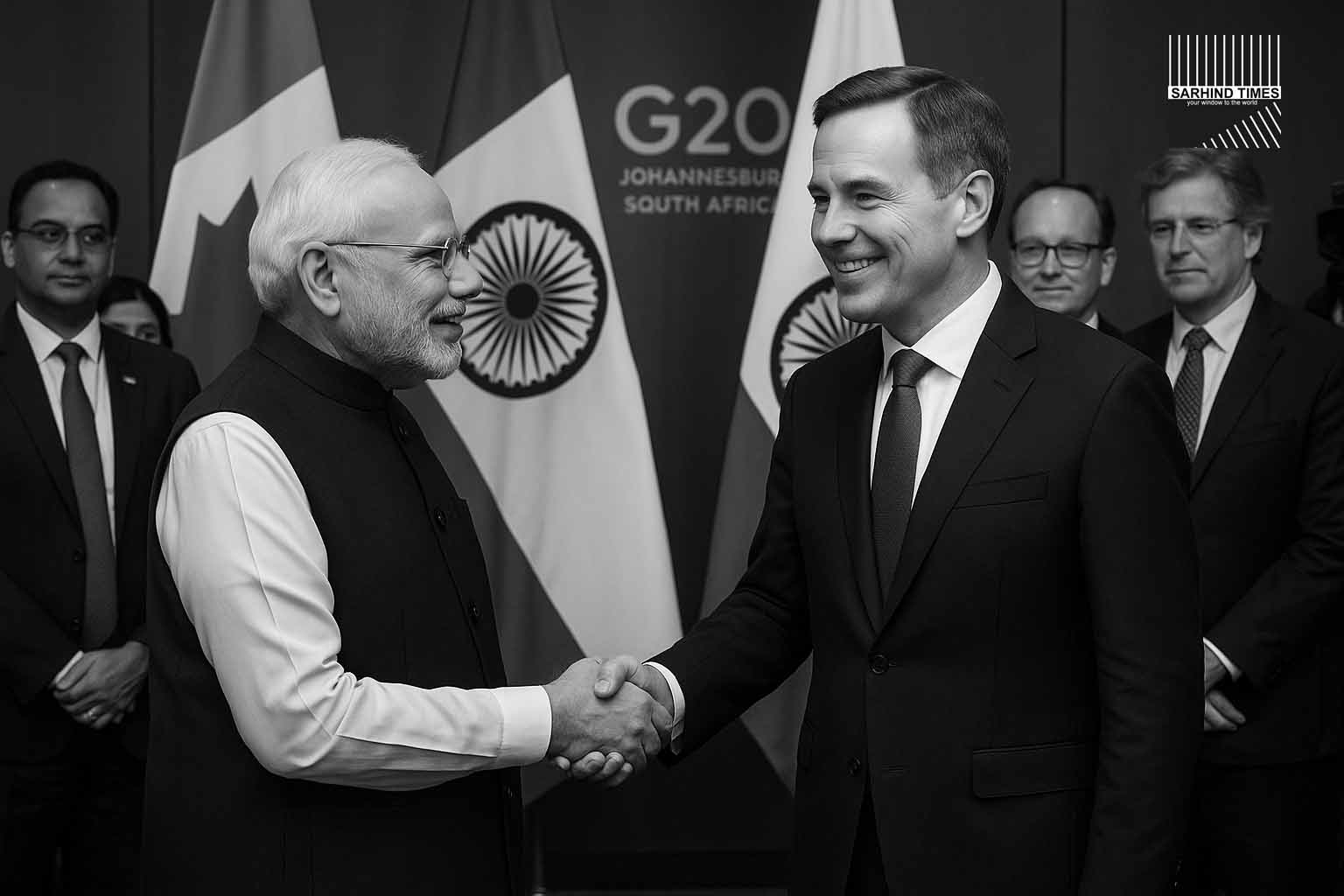
Leaders signal intent to deepen bilateral ties as two-way trade could double to USD 50 billion by 2030
Dateline: New Delhi | 25 November 2025
Summary: In a major diplomatic pivot, India and Canada have agreed to restart comprehensive trade negotiations at the highest level, aiming for a high-ambition trade deal to elevate bilateral commerce and strategic collaboration. The announcement comes after years of a chill in ties and signals India’s increasingly confident global posture.
Re-Engagement After a Diplomatic Freeze
For much of the past two years, India-Canada relations were strained, reflecting diplomatic differences, trade frictions and diverging political narratives. However this week, on the sidelines of the G20 Leaders’ Summit 2025 in Johannesburg, the two nations announced a formal restart of negotiations for a Comprehensive Economic Partnership Agreement (CEPA), with a target to more than double their bilateral trade to USD 50 billion by 2030.
The summit communiqué released by India’s Prime Minister’s Office described the talks as “high-ambition” and part of a broader realignment of India’s trade and strategic partnerships. The announcement follows bilateral engagement between Prime Minister Narendra Modi and Canadian Prime Minister Mark Carney during G20 interactions, where the two reaffirmed their commitment to expanding trade, technology, critical-minerals cooperation and nuclear-energy collaboration.
What’s on the Table: Scope and Strategic Significance
The proposed CEPA is designed to not just boost trade in goods and services but also deepen strategic linkages in areas such as critical minerals, clean energy, nuclear cooperation, and technology exchange. Indian officials emphasise that this deal reflects India’s shift toward “multi-vector partnerships” beyond traditional Western blocs.
On minerals, Canada with its rich deposits of lithium, cobalt and uranium presents an attractive source for India’s ramp-up in battery manufacturing, green hydrogen and nuclear energy. Meanwhile India offers a large manufacturing base, domestic demand and fast-growing technology ecosystem. The deal seeks to align those capabilities.
Why the Timing Matters
This move comes at a time when India is navigating a complex global environment: supply-chain realignments, rising tensions between major powers, and an imperative to secure raw materials and technologies. The revival of talks with Canada signals that India is seeking to diversify partners and mitigate over-dependence on any single bloc.
Moreover, India’s participation in the G20 and its idea of a “Global South” leadership role provide diplomatic momentum. By engaging Canada—which itself is seeking diversification beyond US and China—India strengthens its position as not just a large economy but a strategic partner for democracies globally.
Economic Implications for India
For India’s economy, the revived negotiations offer several opportunities:
- Exports: Indian services (IT, business-process services) stand to gain access to Canadian markets under freer terms.
- FDI and Manufacturing: Access to Canadian capital and joint ventures in manufacturing could boost India’s target of becoming a global manufacturing hub.
- Critical Minerals & Clean Energy: Secure access to Canadian lithium and cobalt supplies could accelerate India’s electric-vehicle and battery ecosystem.
- Technology Transfer & Innovation: Canada’s strengths in R&D, quantum computing and sustainability align with India’s innovation ambitions.
However, some risks are also apparent. Indian exporters may face competition from Canadian producers in agriculture and dairy, and there is domestic concern about job displacement. The government will need to manage trade-adjustment impacts carefully.
Strategic & Geopolitical Dimensions
Trade deals today are rarely just about economics—they are pivot points in geopolitics. In this case:
- India builds a mid-latitude link beyond its Asia-Pacific focus, balancing partnerships in North America and Europe.
- Canada, for its part, seeks to hedge over-dependence on the United States and diversify its trade portfolio in the face of global uncertainties.
- The deal could become part of a broader “like-minded democracies” trade network—following recent trilateral initiatives involving India, Australia and Canada in technology and critical minerals.
Domestic Political Angle: Managing Expectations
The announcement has been welcomed by Indian business communities, but not without qualifiers. Several industry groups note that while ambition is high, the devil will lie in the negotiations and implementation. The agriculture and dairy lobbies in both countries are already alert to potential sensitivities around market access, subsidised imports and regulatory harmonisation.
In India, opposition parties and trade union groups have flagged risks of cheap imports undermining local manufacturing or farm incomes. The government will have to navigate these internal debates, ensuring any deal is perceived as beneficial to Indian labour and industry—not just headline diplomacy.
Next Steps & Timeline
According to official communiqués, the countries have formed a “Trade Track” working group, with lead negotiators appointed and quarterly reviews scheduled. The aim is to conclude the outline of the deal by mid-2026, with a final framework agreement by early 2027.
As part of momentum building, India and Canada plan to hold a joint “Critical Minerals and Clean Energy” conference in Delhi in Q1 2026, followed by “Service & Digital Economy” negotiations in Ottawa. Simultaneously, working groups on tariffs, rules-of-origin and labour standards will meet.
Potential Deal Risks & Challenges</
Despite the promise, several obstacles loom:
- Tariff cuts: Both sides will need to moderate existing agricultural protections to gain market access. Domestic push-back may delay progress.
- Rules-of-origin: Complex supply-chains—particularly for critical-minerals value-chains—will need clear definitions to prevent “China routing” via third countries.
- Labour and environmental standards: Canada is likely to press India on labour rights and environmental enforcement, which may open political debates in India’s federal structure.
- Implementation and monitoring: India will need to bolster trade facilitation, dispute-resolution mechanisms and regulatory coherence—something which has challenged previous agreements.
What To Watch: Indicators of Progress</
In the coming months, key indicators will include:
- Appointment of chief negotiators and timeline publication.
- First round of tariff-reduction offers from both sides.
- Launch of the Early-Harvest Outcome—possibly in IT services or critical-minerals sector.
- Statements by business chambers in both countries reflecting increased confidence.
- Progress in trilateral technology/minerals pipeline involving India-Australia-Canada.
Conclusion</ >
The revival of India-Canada trade negotiations represents much more than a bilateral economic deal. It signals India’s evolving global strategy—moving beyond large-power dependencies, engaging the Global North and South alike, and embedding strategic diplomacy within trade frameworks.
For India, the promise is two-fold: economic expansion and geopolitical agency. But for the promise to translate into reality, the deal will need to deliver inclusive outcomes, manage domestic sensitivities and navigate global headwinds in trade, supply-chains and investment flows. The next 18-24 months will test whether the rhetoric of “high-ambition” ends in signature parchments or transformative action.



+ There are no comments
Add yours