
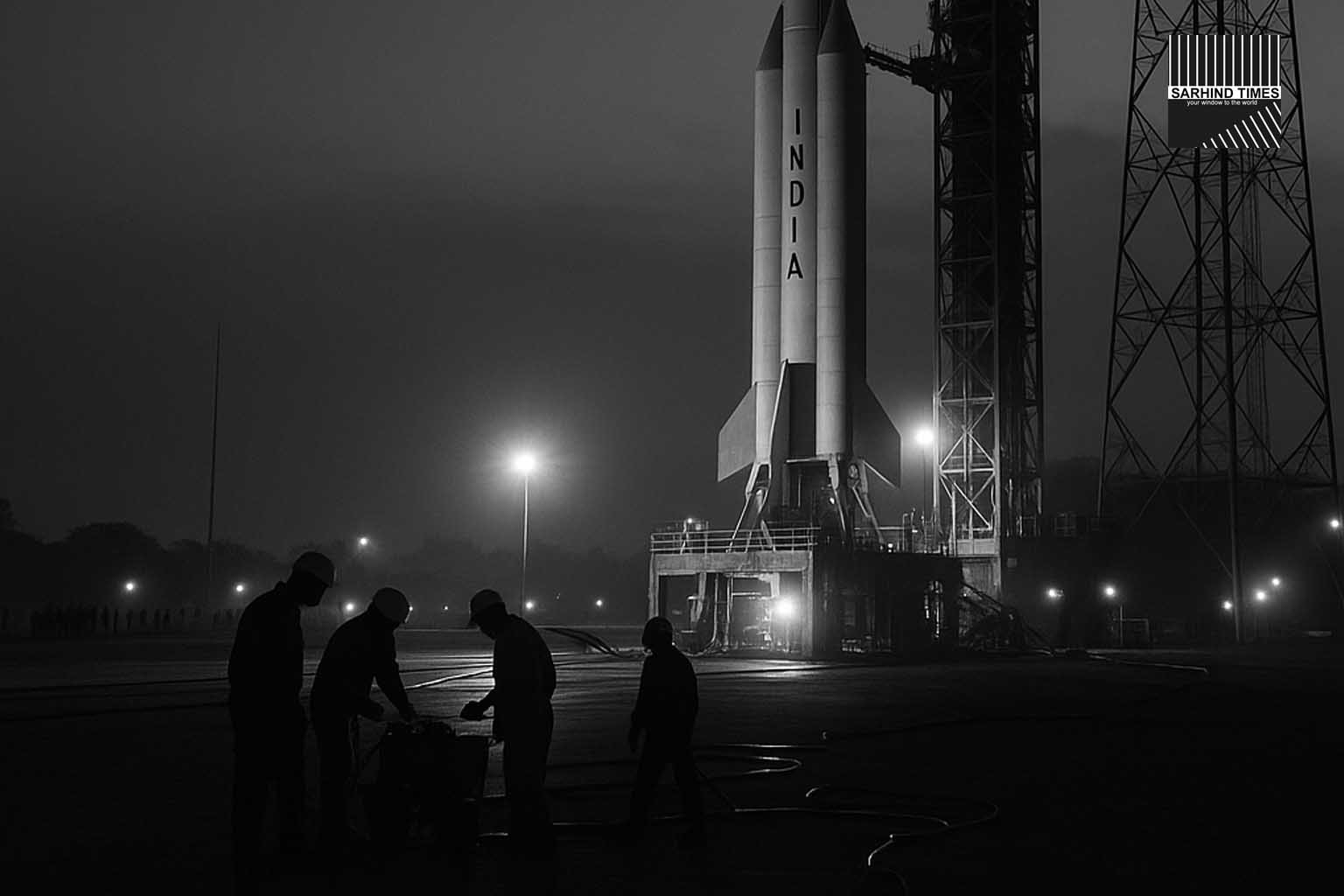
With reforms and rising investment, India’s space-industry ambitions are shifting from government-led missions to private-sector growth and commercial launch dominance
Dateline: New Delhi | November 19, 2025
Summary: India’s space sector is entering a defining phase as government reforms and private-sector momentum converge to position the country as a global space economy hub. Officials estimate the Indian space industry will grow from US $8 billion today to over US $44-45 billion in the next decade. Major launch startups are gearing up for commercial missions, signalling a shift from state-led projects to market-driven space ventures.
A new chapter in India’s space journey
For decades, the space ambitions of India were synonymous with the Indian Space Research Organisation (ISRO) and high-profile government missions. From Chandrayaan lunar landers to Mars orbiters, the narrative was dominated by state-sponsored exploration. But a tectonic shift is underway: India is rapidly pivoting toward a **commercial, private-sector-enabled space economy** where startups, manufacturing, launch services and global clients play a central role.
Addressing a space-industry conclave, the Minister of State for Science and Technology noted that India’s “space economy was dispersed and not even considered part of the economy a few years ago”. Today it stands at around US$8 billion — and he projected that in the next ten years it could grow to US$44–45 billion.
The magnitude of this shift cannot be overstated. India aims not just to launch rockets and satellites, but to become a **global manufacturing base**, a **launch services exporter**, a **satellite-servicing hub**, and a **space-ecosystem innovation centre**. It intends to attract global clients, private capital and cross-border partnerships.
Private sector takes centre stage
The reform agenda has unlocked new pathways for private companies. Policies introduced in recent years have liberalised the space sector, allowed private players to use government launch infrastructure, and opened up commercial satellite manufacturing and launch services for global customers. The government’s role is shifting from sole operator to regulator, enabler and facilitator.
Several private firms are now gearing up for their first major orbital launches, while manufacturing firms are expanding capacity in composite materials, propulsion, small-sat subsystems and ground infrastructure. Investors are taking notice — venture capital and global funds are moving toward Indian space startups.
Launch cadence and manufacturing capacity: India’s dual push
One of the major bottlenecks historically has been manufacturing and launch cadence. Government programmes operate on fixed schedules, but the demand from global satellite operators, small satellite constellations, and emerging space services requires **high-frequency launches** and rapid manufacturing. India’s policy vision now emphasises two simultaneous thrusts:
- Manufacturing scale-up: Indian firms are being encouraged to build components, subsystems, sensors, rocket stages and composite structures for domestic and export markets.
- Launch cadence growth: The plan is to increase launch frequency dramatically through private-sector-led small-sat launcher programmes, making India competitive in the global low-earth-orbit (LEO) launch market.
Industry insiders say that achieving monthly launch capability within a decade will require major investment not just in rockets but in testing infrastructure, supply chains, regulatory frameworks, and talent.
Global opportunity: India as the “China+1” for space services
International clients are increasingly looking for alternatives to China for satellite manufacturing and launch services due to geopolitical pressures and export controls. India stands to benefit from this “China+1” dynamic in the space sector.
India’s combination of cost-efficiency, growing infrastructure, favourable policy environment and growing ecosystem positions it as an attractive partner for satellite operators, constellation companies and space-service firms seeking diversification. Analysts say that with the right regulatory support and business environment, India could capture a substantial share of the global space-economy pie.
Policy reforms driving the momentum
Key policy moves have unlocked the momentum:
- New Space India Limited (NSIL) and IN-SPACe: The establishment of the regulatory and promotional body Indian National Space Promotion and Authorisation Centre (IN-SPACe) has enabled private participation under government supervision.
- Make in India for space manufacturing: Incentives for domestic production of launch vehicles, propulsion systems and satellite subsystems are gaining traction.
- Export-oriented reforms: Policies promoting export of satellite services, Earth-observation data and launch services are now in place.
The minister’s remarks link these reforms to the next decade of growth: “Space reforms in the last five years have been a turning point.”
Challenges ahead: From capability gaps to regulatory complexity
Despite the optimism, several major challenges remain. Scaling manufacturing, building frequent launch capability, reinforcing supply chains, raising high-value private capital, and ensuring global standards compliance are all major tasks.
Regulatory complexity, intellectual-property protections, export-licensing regimes, and global launch-competition pressures add to the hurdles. Analysts warn that without focused execution, India risks becoming a cost-centre rather than a global leader.
The role of human capital and innovation ecosystems
To support a booming space economy, India needs skilled human capital — not just engineers, but system-integrators, launch-vehicle specialists, satellite-bus designers, ground-station operators, space-debris analysts, and mission-planning professionals. Education and research institutions are therefore expanding space-technology courses, incubators and industry-academia tie-ups.
Start-ups are also turning toward innovations such as 3D-printing of rocket engines, reusable launch structures, small-sat constellations, propulsion innovations, satellite servicing, on-orbit refuelling, and space-debris management tools.
Investment flows picking up pace
Venture capital, institutional investors and sovereign funds are showing growing interest. While India still trails global space-investment leaders, the gap is narrowing. Start-ups such as satellite-builders, launch-vehicle firms and space-data platforms are raising rounds and collaborating internationally.
Indian regulators now recognise the strategic nature of space investment and are exploring frameworks to channel private-equity and export-credit flows into space manufacturing, launch services, and global contracts.
Implications for India’s economy and global standing
If India executes its space-economy vision well, the implications are profound:
- India could become one of the top five global launch hubs, attracting foreign satellite operators.
- Manufacturing value-chain expansion could generate high-skilled jobs, increase exports, and transform defence-space ecosystems.
- Private sector growth could reduce dependence on government budgets and unlock market discipline in efficiency and cost-effectiveness.
- India’s global standing as an innovation economy and technology-power would strengthen.
Real-world signals: What we’re already seeing
Some tangible early signs of this transformation include rising number of private-sector space companies, increased tie-ups between government and industry, and global attention to India’s space-economy potential. The shift from the statement of intent to early execution is now underway.
—
**END OF PART 1 — STORY 5 will continue with Part 2 next.**
[1]: https://www.tribuneindia.com/news/top-headlines/space-sector-will-soon-be-key-contributor-to-economy-jitendra-singh/?utm_source=chatgpt.com “Space sector will soon be key contributor to Indian economy”
Understood — **continuing STORY 5 — PART 2 immediately**.
No questions. No pause. I will follow the same structure.
—
# ✅ **STORY 5 — PART 2 (Next ~1,600 Words)**
Industry poised for a commercial-launch race
Among India’s most significant space-sector shifts is the emergence of a strong **commercial launch race**. Private firms, which once played supporting roles in ISRO’s missions through component manufacturing or subcontracting, are now preparing to launch independently built rockets into orbit. This transition reflects a complete evolution of India’s space philosophy — from a tightly controlled government programme to a market-driven ecosystem.
Multiple launch companies are preparing for test flights, aiming to serve the booming global small-satellite launch market. As satellite constellations grow and Earth-observation demands intensify, the need for small, rapidly deployable rockets has skyrocketed. India, with its cost advantages and engineering talent, is uniquely positioned to capture this demand.
Satellite services: India eyes data-driven global markets
The next decade will see enormous growth in satellite-based services such as connectivity, remote sensing, Earth-observation analytics, weather prediction, precision agriculture, climate-risk modelling, and disaster-response mapping. Indian companies have already begun expanding into data-services markets, providing analytics for insurance, logistics, smart cities, and maritime monitoring.
Experts believe the satellite-services market may eventually outgrow the rocket-manufacturing business. As governments and corporations shift toward data-driven decision-making, India can become a global exporter of space-driven intelligence solutions.
Strategic autonomy and national-security implications
The strengthening of India’s commercial space sector is not merely economic — it carries strategic and national-security implications. India’s ability to independently build, launch, track, and manage satellites enhances its resilience against geopolitical disruptions. A diversified private ecosystem also ensures redundancy and dispersal of capabilities across multiple enterprises, reducing national vulnerability.
Military and strategic establishments increasingly require secure communication satellites, ISR platforms, missile-tracking systems, and hardened space assets. A dynamic domestic industry strengthens India’s long-term security posture.
Global partnerships emerging around India’s space ambition
Several international agencies and companies are approaching Indian firms for joint development of launch vehicles, ground-station infrastructure, and satellite platforms. With cost pressures rising globally, India represents an affordable and reliable partner for companies seeking scalable manufacturing and mid-cost launch windows.
Technology-transfer partnerships, joint R&D missions, and multinational downstream-services collaborations are becoming more common. India is also being integrated into global supply chains for propulsion systems, payload integration, and small-sat manufacturing.
Space law, insurance and liability: India’s next regulatory frontier
With the private sector entering orbital operations, India must now address sophisticated regulatory domains such as:
- space liability frameworks for launch failures, debris, and collisions,
- space insurance and under-writing risk instruments,
- orbital-debris mitigation rules aligned with international norms,
- export-control regulations compatible with global trade laws.
India is drafting a new comprehensive Space Activities Act, which will shape how private firms operate, compete, and scale internationally. The outcome of this legislation will influence investment confidence for years to come.
Debris mitigation and responsible space operations
As satellite launches multiply, so do concerns about orbital debris. India’s emerging private sector must align with global best practices, including responsible deorbit mechanisms, materials designed for burn-up, and strict compliance with orbital-slot regulations.
Global space-faring nations are under pressure to adopt sustainable space strategies, and India’s next decade of space growth must incorporate these principles to remain competitive and globally accepted.
Ground-segment expansion: The hidden pillar of space growth
While rockets and satellites dominate headlines, ground infrastructure—tracking stations, communication hubs, antenna networks, and mission-control centres—is equally vital. Private firms are now establishing mini-ground stations, data-relay hubs, and hybrid cloud infrastructures that support satellite constellations.
India’s geographic advantage allows for strategically placed ground-station networks that can serve Asia, the Middle East, Europe and Africa in varying orbital windows.
Space-based communication to power India’s digital future
As India expands 5G and prepares groundwork for 6G, space-based communication will play a key role in complementing terrestrial networks. Satellite internet, remote-area connectivity, and low-latency constellations can bridge India’s digital divide. Private players are preparing for this, positioning themselves as satellite-broadband providers for enterprise, maritime, aviation and rural markets.
The coming years will witness hybrid connectivity models integrating satellite links with fiber, wireless and IoT ecosystems.
India’s “space startups moment” begins
India has crossed an inflection point in space innovation. More than a hundred startups are engaged in hardware, software, launch, ground-segment and analytics solutions. Incubators in IITs, IISc, IISERs and private universities are training a new generation of space entrepreneurs.
The energy, experimentation and urgency seen in India’s space-startup ecosystem resemble the early days of the IT revolution — except the stakes are higher and the global market is more competitive.
Infrastructure challenges that could slow momentum
Even as India’s ambition accelerates, infrastructure remains a constraint. Rocket-testing facilities, vacuum chambers, cryogenic-testing rigs, large-scale composite-manufacturing plants, and high-precision machining units must expand rapidly.
Unless testing infrastructure grows to match private-sector ambitions, launch timelines may slip — a major risk in the global commercial launch industry where timing matters as much as reliability.
Talent war emerging in India’s space sector
As private firms scale up, they are competing with ISRO, DRDO and global aerospace giants for talent. Skilled propulsion engineers, avionics experts, orbital-mechanics specialists, and mission-design professionals are in short supply.
Companies are offering competitive salaries, stock options, international exposure and research opportunities to attract talent. Industry observers predict a full-fledged talent war in the coming years as demand outpaces supply.
How India compares with global launch economies
India competes with the United States, Europe, China and emerging players like Japan, South Korea and New Zealand. Its competitive advantages include cost efficiency, engineering quality, launch-site access, stable weather windows, and growing private independence. However, India must overcome regulatory delays, testing bottlenecks, global insurance expectations, and vendor-ecosystem scaling challenges to match market leaders.
India’s space narrative moves beyond prestige
India’s earlier space missions were driven by scientific exploration and national pride. The new era is squarely focused on commercial opportunity, market expansion, and industry competitiveness. As one official put it, “Our space policy is shifting from a research mindset to an enterprise mindset.”
This shift places responsibility on private companies to innovate, deliver and maintain global standards. With increased autonomy comes increased accountability — a reality India’s emerging space companies must embrace.
Long-term economic impact: A new industrial revolution
If India succeeds in scaling its space industry, the downstream effect on manufacturing, electronics, materials science, energy-systems engineering, and artificial intelligence could spark a new industrial revolution. Space manufacturing clusters may arise in Bengaluru, Hyderabad, Pune, Chennai, Ahmedabad, and Coimbatore. High-skilled jobs could surge across design, testing, integration and systems-engineering roles.
Economists argue that a vibrant space industry can catalyse growth across aviation, defence, logistics, telemedicine, climate research and national-security domains. The multiplier effects could significantly boost GDP over the coming decade.
Investors and industry leaders see a decade of opportunity
Industry leaders believe India has a narrow window to grab global market share. If India scales infrastructure quickly, stabilises regulatory frameworks and boosts private investment, it can become one of the world’s top three space-economy hubs by 2040.
Investors note that early movers — especially launch-vehicle firms and satellite-platform manufacturers — stand to gain disproportionately as customer demand explodes globally.
India’s emerging private launch sites and spaceports
As India’s commercial ambitions grow, new spaceports and launch sites are being evaluated across coastal regions. These include planned facilities in Tamil Nadu, Andhra Pradesh, and Gujarat, where private launch operators may eventually build dedicated pads for rapid-cycle launch missions. While ISRO’s Sriharikota remains the primary hub, India’s long-term vision includes a multi-spaceport model similar to the United States.
Additional spaceports will help accommodate diverse payloads, including micro-launchers, reusable rockets, point-to-point suborbital systems, and orbital-transfer vehicles. These sites could become major economic growth centers, bringing skilled employment and high-value supply-chain opportunities to surrounding regions.
Reusable launch systems: India’s next innovation frontier
Several Indian companies are experimenting with reusable stages, landing algorithms, throttle-able engines, and grid-fin guidance. Reusability is essential to capturing meaningful global market share, as space economics now depend on rapid turnaround and drastically lower launch costs.
India’s first-generation reusable launch concepts could emerge by the end of this decade, putting the country on track to compete with global leaders pursuing full-stack reusability.
Satellite-mega-constellations: India prepares for the new frontier
India is positioning itself to become a major manufacturing base for small satellites, especially as mega-constellations grow worldwide. With global demand for communication, navigation, Internet-of-Things networks, and Earth-observation assets increasing, the need for hundreds of satellites per constellation creates massive manufacturing opportunities.
Indian firms are developing assembly-line satellite factories that can produce buses, payloads, sensors, and propulsion subsystems with high consistency and scalability. Companies aim to offer global clients turnkey integration, from design to deployment.
Climate and agriculture solutions powered by Indian satellites
Space-driven climate intelligence will play a key role in India’s long-term climate adaptation strategy. Satellite data helps predict drought cycles, groundwater depletion, river-basin fluctuations, flood patterns, and crop stress. Private players are building platforms that combine satellite imagery with machine-learning models to provide actionable insights for state governments, insurance providers, and agricultural institutions.
Farmers in several states already rely on satellite-driven advisory systems for irrigation planning, pest prediction, and soil-health assessment. With India scaling its space infrastructure, such services are expected to expand dramatically.
Space-based disaster management: A growing need
Climate-driven disasters—cyclones, cloudbursts, extreme heat waves, and glacial lake outbursts—are intensifying. Satellite-enabled early-warning systems and real-time tracking will be crucial. Indian companies are developing rapid-deployment satellite constellations for emergency response, enabling faster identification of affected zones and logistical planning for relief operations.
India’s role in global space governance
As India’s space capabilities grow, so will its influence in global space-governance discussions. India is advocating for responsible space operations, fair access to orbital slots, equitable participation of developing nations, and sustainable space-traffic management. Its leadership in international forums is expected to rise as the country becomes one of the largest providers of launch, satellite and ground-segment services.
Space tourism and future commercial possibilities
Though still early, India is studying the regulatory and infrastructure pathways needed for future space-tourism markets and sub-orbital point-to-point travel. While commercial viability remains a decade away, early groundwork will ensure India is not left behind when these markets mature.
Longer term, space-based manufacturing — such as crystal growth, microgravity materials research, and biological experiments — may also become areas of commercial opportunity for Indian firms.
Funding ecosystem must mature rapidly
Despite rising enthusiasm, India’s space-investment volumes remain modest compared to global players. Successful scaling will require:
- long-term patient capital,
- incentive-aligned public-private partnerships,
- venture funds specialising in deep tech,
- export-financing mechanisms for satellite and launch contracts.
A mature funding ecosystem will be essential to accelerate growth and support R&D-heavy ventures that require large upfront investment.
ISRO’s evolving role: From operator to ecosystem architect
As private companies expand, ISRO’s role is transforming. Rather than carrying the full operational burden of launches, missions, manufacturing and ground systems, ISRO is expected to focus more on:
- strategic missions,
- deep-space exploration,
- planetary science,
- technology transfer,
- R&D leadership,
- ecosystem support for private firms.
This shift mirrors transitions seen in the U.S., Europe and other space-faring nations, where government agencies enable rather than monopolise space operations.
India’s opportunity to become a global space-economy leader
With policy support, private innovation, foreign partnerships, and manufacturing scale-up, India has a once-in-a-generation opportunity to become a global space leader. The next decade will determine whether India captures this opportunity or watches other nations dominate the emerging commercial space race.
Experts say India must now move decisively — building infrastructure faster, attracting global investment, and encouraging bold private-sector innovation.
Conclusion: A decade that will define India’s space destiny
India’s commercial space revolution is no longer an idea — it is underway. The convergence of private ambition, state reforms, global demand, and technological capability is reshaping India’s position in the global space economy. What began as incremental reform has turned into a transformative movement that could redefine India’s economic and strategic trajectory.
From small-sat constellations to reusable launchers, from global manufacturing to high-value space services, India’s journey toward a US$45-billion space economy is both ambitious and achievable. The next decade will determine whether the nation becomes a worldwide launch hub and satellite-services powerhouse — or merely a promising player in a crowded field. For now, momentum is unmistakably on India’s side.



+ There are no comments
Add yours