
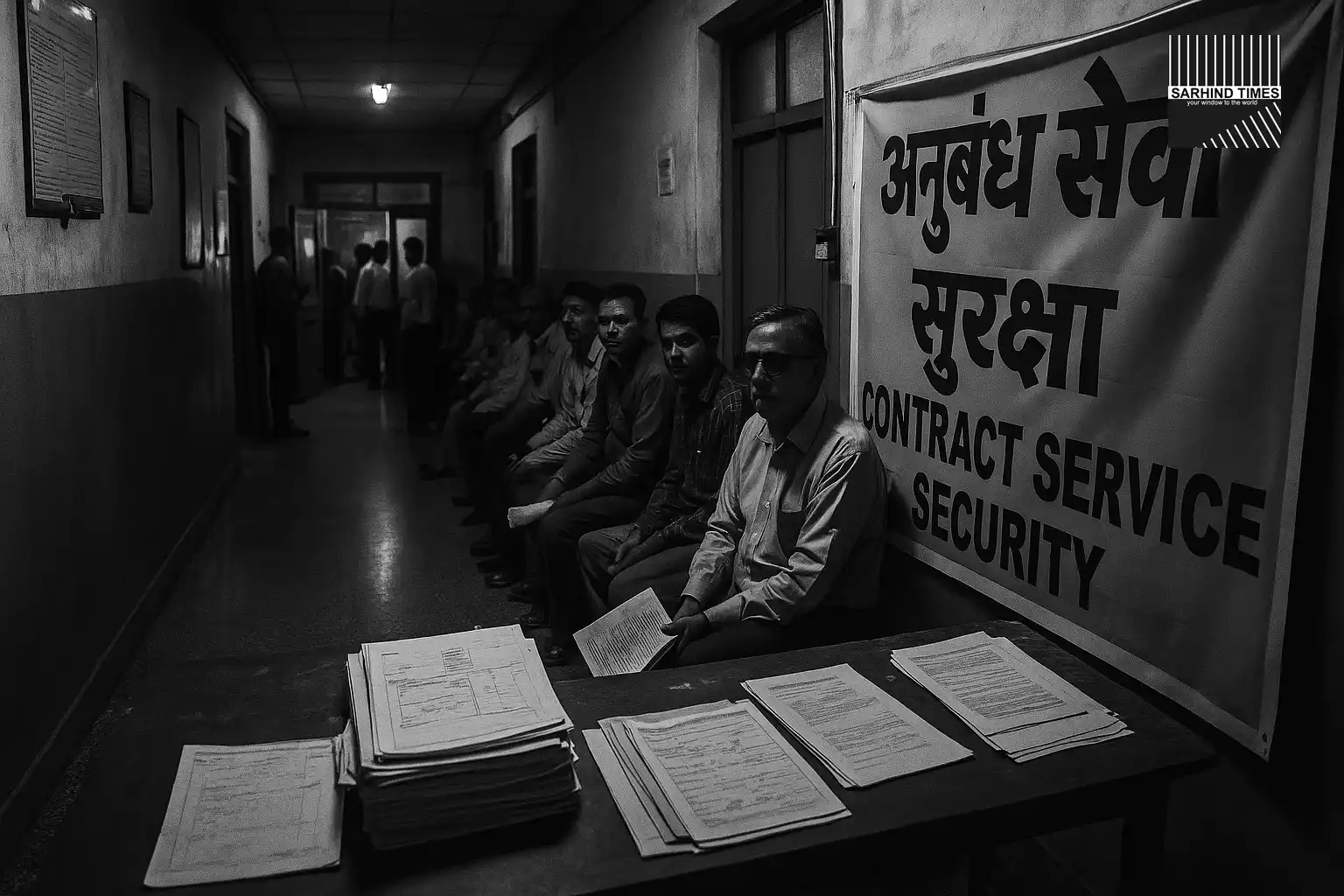
Landmark amendment gives more clarity on tenure-calculation and bolsters job-security prospects for tens of thousands of contract workers in the state
Dateline: Chandigarh | 8 November 2025, Asia/Kolkata
Summary: The Haryana Contractual Employees (Security of Service) Amendment Act, 2025 — a significant amendment to the 2024 Act — came into force retroactively from 31 January 2025. It changes the basis for counting “contractual service” for job-security eligibility, replacing “in a calendar year” with “during a period of one year contractual service.” The reform affects thousands of contract-appointed employees in government bodies across the state and signals a shift towards greater employment stability in Haryana’s public sector.
1. Background: contract labour and employment in Haryana’s public sector
Haryana has long faced structural challenges around government-sector contract employment: large numbers of workers hired on contract, ad-hoc or outsourced bases, often with limited tenure-security and variable access to benefits. To address this, the state legislature enacted the Haryana Contractual Employees (Security of Service) Act, 2024 (referred to as the “2024 Act”), which was designed to provide a statutory framework giving contract employees in government departments, boards, corporations and other state-controlled entities greater protection and a pathway toward “security of service”.
Under the 2024 Act, contractual employees who had completed at least five years of service as of 15 August 2024 were eligible for protection under the Act. One of the core provisions was an Explanation clarifying how “years of engagement” are to be counted — specifically the requirement that a contractual employee must have received remuneration for at least 240 days in a “calendar year”.
However, this triggered immediate concerns. Many contract employees who joined mid-year or whose contract renewal cycles did not align with the calendar year found themselves disadvantaged: their service in the first partial year would not meet the 240-day threshold in a calendar year, effectively excluding them from eligibility.
Thus, while the 2024 Act marked a positive step toward job-security for contract workers, the technical clause on counting days exposed a procedural flaw with real exclusion potential.
2. What the 2025 amendment changes
The 2025 amendment Act sought to correct this technical misalignment. Key changes include:
– The Act substitutes the phrase **“in a calendar year”** with **“during a period of one year contractual service”** in Explanation 2 to clause (ii) of Section 3 of the 2024 Act. This means that instead of being tied to the rigid boundaries of a January–December year, the counting would apply to each contract’s own 12-month period of engagement.
– The amendment came into force from 31 January 2025 (retroactively) which ensures that contract-employees whose service spanned across calendar-year boundaries aren’t penalised simply because they joined in, say, June or July.
– The earlier Ordinance (the Haryana Contractual Employees (Security of Service) Amendment Ordinance, 2025) promulgated in January under Article 213 was formally repealed and subsumed by the Amendment Act, with a savings clause ensuring that actions taken under the Ordinance are preserved as valid.
– The statute applies across all departments, boards, public corporations and authorities under the government of Haryana and covers contract, ad-hoc and outsourcing staff engaged in full-time substantive roles, up to the age of superannuation (60 years) under the principal Act.
From a practical perspective, this change means many contract employees who were previously ineligible due to “calendar year” limitations will now qualify once their 12-month anniversary of contractual engagement is crossed, regardless of which month they joined.
3. Why this matters: implications for contract employees
The implications of the amendment are significant:
– It resolves the “join-mid-year penalty” that many contract workers complained about, thereby aligning the tenure-tracking mechanism with their actual service.
– It helps reduce litigation risk: contract employees who previously raised challenge notices about exclusion now have a clearer statutory basis for eligibility.
– It reinforces the state’s policy intention of transitioning certain categories of contract workers toward more stable employment, signalling to both employees and contractors that contract-service cannot indefinitely remain precarious.
– In terms of career planning, contract workers now have clearer road-maps: each completed year counts toward eligibility rather than waiting for a full calendar year. This alignment may reduce attrition and stabilise workforce morale in departments heavily reliant on contract staff.
– For government departments and policy-makers, the change is also administrative: streamlined tracking of tenure, fewer disputes over eligibility and improved compliance management.
4. The broader labour-market angle and reforms in Haryana
The 2025 amendment forms part of wider labour-law reforms in Haryana. Notable parallels:
– On 8 May 2025 the Government of Haryana issued notifications easing conditions for women to work night shifts (in logistics, warehousing, IT/ITeS) under the Haryana S&E Act and the Factories Act — showing a trend toward more flexible workforce regulation.
– Earlier this year, the Haryana Labour Welfare Board contribution rates were revised effective 1 January 2025, indicating broader institutional reform.
– Enforcement and oversight of contract labour was also refined: the Labour Department withdrew a 1984 notification under the Contract Labour (Regulation & Abolition) Act in April 2025, streamlining regulatory scope.
The contractual employees amendment sits at the intersection of employment stability, state workforce management and reform of temporary labour regimes — a domain that has historically been contentious in Indian states. Labour economists view this shift as part of a larger move toward “recognised contract status” which blurs the old binary between permanent and temporary employment.
5. Stakeholder reactions and emerging issues
Employee groups welcomed the amendment as “much-needed clarification” in counting tenure. Some trade-unions, however, noted that while the change is welcome, several other aspects of the 2024 Act remain opaque — such as the definition of “full-time basis”, the nature of disciplinary procedures, and the process for conversion to permanent status or at least parity of service benefits. One commentary described the Act as “ground-breaking in principle but still work-in-progress in practice.”
Government departments have been asked to update their contract-service registers to reflect the new tenure counting rule, though some implementation delays are being reported in smaller boards and local bodies. Administrative officers say that verifying service records (especially for older contract-workers) remains a challenge.
Legal practitioners caution that eligibility does not guarantee conversion or permanency — the Act provides “security of service” but stops short of mandating permanent appointment. As such, some contract employees may still remain on contract terms, albeit with better tenure protections.
6. Risks, gaps and points to watch
While the amendment addresses a critical procedural issue, several risks remain:
– **Administrative complexity**: Departments must now recalculate service periods for contract employees who joined mid-year — this could pose record-keeping burdens, especially in local bodies.
– **Ambiguity over conversion**: The Act provides security of service but does not automatically convert the contract engagement into a full-regular post; the long-term value depends on departmental policy implementation.
– **Potential for cost burden**: Increased tenure guarantees may raise payroll costs or lead to higher liabilities for future conversions; some departments may resist by increasing reliance on outsourcing or shorter contracts.
– **Selective coverage**: The Act applies only to government establishments in Haryana — private-sector contract employment remains outside its scope; therefore, broader contractual labour reform still lags.
– **Litigation risk**: As the counting mechanism is now changed, employees who were earlier excluded may challenge departmental actions, leading to disputes, claim and arrears.
7. What’s next – implementation and timeline
Key next steps for the state and stakeholders include:
– Departments to issue revised guidelines by 31 March 2026 delineating how service records will be recalculated under the new rule.
– Contract-workers who joined after mid-2023 should check with their employer regarding eligibility status and application process for “security of service”.
– Trade-unions to monitor whether the tenure-counting change improves actual conversions or service-security in practice.
– Government to issue follow-up rules clarifying service benefits, disciplinary mechanisms, service-continuity conditions and interface with promotion/regularisation policy.
– Legal monitoring: lawyers and labour-law scholars will track whether this model is adopted by other states given its significance in terms of contract-worker rights in the Indian public sector.
8. What workers should do now
For contract-appointed staff in Haryana government entities:
– Verify your date of joining and count whether you have completed one year of contractual service (regardless of calendar-year boundaries) after January 2025.
– Request a service-certificate or letter from your employer documenting your contract-engagement duration and remuneration days.
– If you had joined mid-year and were worried about eligibility under the earlier “calendar year” rule, check with union or legal aid whether the amendment now qualifies you.
– Ask your employer or department HR for a copy of the departmental guideline implementing the 2025 amendment, so you know how they will apply it.
– If you still don’t receive clarity or acknowledgment, consider approaching your local labour-commissioner’s office or a legal-aid service specialised in employment-law.
9. Broader significance – what this means for labour policy in India
Haryana’s move may mark a broader evolution in how states deal with contract employment in public institutions. By eliminating a rigidity (calendar-year threshold) and aligning tenure counting more closely with actual service, the amendment reflects a shift towards more inclusive labour-policy thinking. It signals that contract workers are not simply temporary placeholders but increasingly recognised as part of a workforce ecosystem deserving greater security and clarity.
From a policy perspective, this may help reduce the divide between the heap of contract labour and regular staff, inspire other states to follow suit, and raise the standard of workforce management in public services. At a time when national debates on labour codes, gig-economy workers and contract employment are gaining traction, Haryana’s reform stands out for its clarity and practical impact.
10. Conclusion: a measured step, not a silver bullet
The Amendment Act represents a meaningful improvement in Haryana’s labour-law framework — especially for contract employees seeking tenure clarity and service security. It removes a key procedural barrier and provides a stronger legal basis for eligibility under the 2024 Act.
That said, the road ahead will test how well the law translates into practice. Execution, departmental readiness, clarity on conversion/benefits and broader private-sector reform remain open. For the thousands of contractual workers in Haryana, this is a moment of optimism—not an endpoint. As the state continues its broader workforce reforms, this amendment may serve as a reference point for contract-worker rights in India.



+ There are no comments
Add yours