
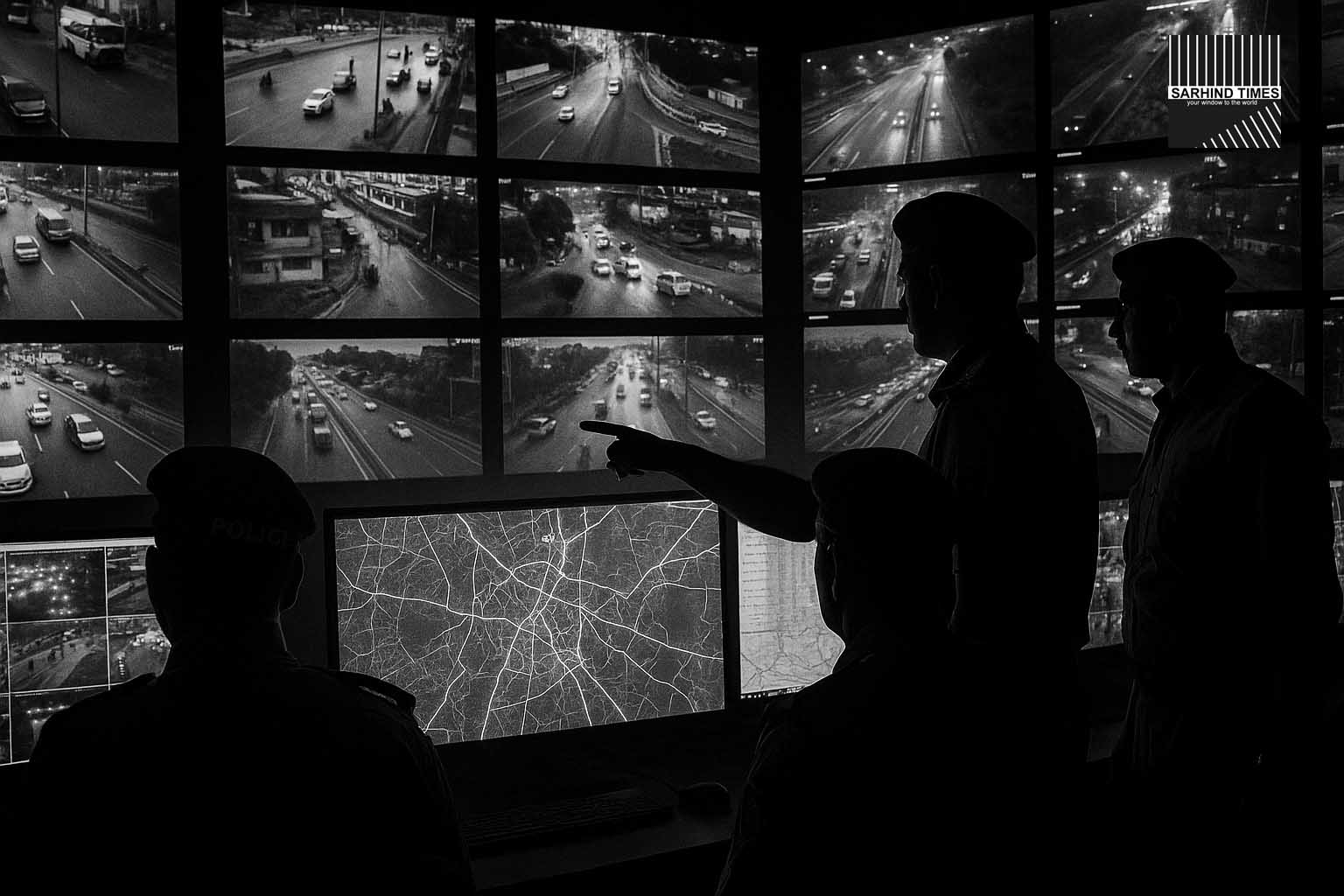
With the National Capital Region (NCR) still vulnerable to cross-border threats, the Haryana Police has unveiled a reinforced anti-terror architecture, emphasising citizen alerts and multi-agency coordination.
Dateline: Gurugram | 18 November 2025
Summary: The state’s Director General of Police, O. P. Singh, has announced a major upgrade to Haryana’s counter-terror setup in the NCR region following the recent bust of a white-collar terror module and explosive seizures. With joint operations involving the Haryana Police, Delhi Police and central intelligence agencies now regularised, the new strategy also highlights a key role for citizens acting as “eyes and ears” of the state in identifying suspicious activity. While the move is welcomed by many, analysts caution that structural challenges around staffing, local intelligence and community trust must also be addressed for it to deliver results.
Why the shift now? The backdrop of NCR security stress
In recent months, the National Capital Region — including parts of Haryana such as Gurugram, Faridabad and Palwal — has faced growing concern around infiltration, extremist funding flows, and terrorism-adjacent criminal networks. The region’s high mobility, dense corporate presence, cross-state urban sprawl and multiple jurisdictional boundaries make it inherently complex to police. The latest incident involving a “white-collar” terror module based in Faridabad has served as the trigger for the more assertive strategy announced by the state police.
O. P. Singh, speaking at a strategic meeting involving Haryana, Delhi and Uttar-Pradesh agencies, made clear that the state is now treating the NCR corridor not merely as an urban growth zone but as a sensitive security zone. He emphasised three points: real-time intelligence sharing, rapid identifier suspension (via helpline 112) by citizens, and joint operational readiness at district and hillock level. The shift signals that the government is aware the security environment around Delhi has elevated — and that Haryana cannot remain a passive periphery to the capital.
The features of the new anti-terror architecture
The upgraded strategy announced by the Haryana Police includes the following key elements:
– **Multi-agency information sharing platform**: Officials disclosed that district-level control rooms will now feed live data into a central NCR command desk that synchronises inputs from Haryana, Delhi, UP and central agencies. This is intended to reduce delays caused by jurisdictional gaps.
– **Citizen-alert system and 112 integration**: A core theme of the announcement was to make citizens active surveillance partners. The DGP stressed that in past cases, key information was known locally but not escalated. He called for prompt reporting of “any suspicious person, object or activity” via the helpline 112. This public-engagement emphasis marks a shift towards collective ownership of security.
– **Rapid identifier suspension and area lockdown strategy**: The police confirmed that they now hold federated access to network-level identifiers and usage data (in coordination with telecom regulators) in suspected zones. This allows faster suspension of mobile numbers or SIM-IDs tied to suspicious profiles, a step previously hampered by red-tape.
– **Focused crack-down on “white-collar terror”**: More than conventional armed groups, the state has identified that many emerging threats revolve around finance, logistics, social-media radicalisation and convergence between organised crime and terror. The term “white-collar terror” was used during the meeting to describe modules blending cyber-crime, money-flow and ideological radicalisation. This reflects a modernisation of the threat landscape.
– **Strengthened patrol and checkpoint presence in NCR corridors**: Gurugram-Faridabad-Palwal stretch will see augmented vehicle inspections, random audits of identity-verification in taxis and ride-hailing, surveillance of delivery/logistics hubs, and greater coordination with district magistrates on local intelligence.
– **Training, cyber-monitoring and rapid-response drills**: Police shifting from reactive mode to proactive. Training modules now include synthetic-media detection, social-media intelligence, AI-based anomaly detection of financial flows and berth readiness for emergency lockdowns.
Implications for the NCR business and residential ecosystem
For Gurugram and its corporate/residential clusters, the new security posture carries practical implications. While security enhancements are welcome given the high-profile infrastructure and international firms in the region, they may increase compliance costs, scrutiny and monitoring in some sectors. Some of the implications:
– **Corporate campuses** may face additional coordination with district administration for security audits, especially those located near logistic hubs or sensitive zones. Compliance with vehicle tracking, driver-verification and entry-exit logging may become more stringent.
– **Residential gated communities**, especially in new sectors or adjacent to highways, may see increased patrols, surprise checks and reminders to residents about vigilant reporting of unidentified visitors or vehicles. One HOA president mentioned: “The police want us to integrate our CCTVs into district control-rooms—so we are hiring tech-vendors now for compliance.”
– **Logistics and supply-chain firms** operating in the corridor will likely encounter more inspection points, especially around goods movement overnight, driver-behaviour checks, vehicle-tracking and identity-verification of staff. While many firms already comply, smaller enterprises may feel the burden of increased administrative coordination.
Corporates have expressed cautious support. One head of security for a large tech campus in Gurugram said: “We welcome anything that reduces risk of knock-on attacks or infiltration. But the cost, timelines and clarity of implementation matter. If this becomes a continuous ‘nag’ rather than an enablement, we will push back.”
Challenges ahead: structural and operational gaps
Announcing stronger strategy is one thing; executing it is another. Analysts and security-watchers point to several key challenge-areas:
– **Human-intelligence (HUMINT) gap**: In a region like Gurugram the proportion of migrant workers, delivery drivers, temporary staff and gig-economy actors is very high. Local intelligence databases may not keep pace with this fluid workforce. Training, language skills, community-outreach remain weak.
– **Inter-agency coordination and data-sharing friction**: Despite formal platforms, data-sharing between state police, central agencies, telecom regulators and metro-police still faces bureaucratic delays and legal/structural bottlenecks. Speed is critical in terror prevention.
– **Privacy and civil-rights safeguards**: Encouraging citizen-reporting and rapid suspension of identifiers raises potential danger of misuse or over-reach. Ensuring safeguards, oversight, redress mechanisms and avoiding profiling of minority communities will be critical.
– **Adapting to evolving threat vectors**: The state’s acknowledgment of white-collar terror signals recognition of change — but implementing detection of cyber-funding, social-media radicalisation or crypto-flows demands specialist capabilities yet to be built in many districts.
– **Resource constraint and enduring commitment**: For any security architecture, continuous funding, training, refresher drills, tech-upgrades and community engagement differentiate success from inertia. Local policing in Gurugram has historically been oriented toward traffic, real-estate regulation and corporate liaison; counter-terror surveillance may demand a different mindset, staffing pattern and resource mix.
A security-analyst noted: “The connectivity, pace and scale of the NCR economy mean that threat-actors can hide in plain sight. The legacy model of policing won’t suffice; you now need a fusion of cyber, human intelligence, behavioural data-modelling and community networks. Whether Haryana can build all that on the fly is the test.”
The accountability and metric challenge**
To avoid mere rhetoric, the police leadership has signalled an intention to publish performance metrics — number of leads generated, number of citizen-reports processed, average response-time after alert, number of identifier suspensions executed, cross-agency joint-operations executed. While specifics weren’t fully disclosed in the press briefing, the promise of transparency is a positive sign.
The police have also indicated they will convene quarterly “security-ecosystem reviews” involving district magistrates, resident-welfare-associations, corporate-security heads and state-intelligence officers — to assess the implementation of the strategy, bottlenecks and areas needing improvement. This inclusive approach reflects awareness that a top-down model alone will not succeed.
How residents and businesses should respond**
Given the heightened security focus, what should local stakeholders in Gurugram and the broader NCR corridor do to adapt?
– **Stay alert and report**: The police message is clear — citizens are part of the safety net. If you observe unusual vehicles, unmarked drivers, abandoned bags, frequent late-night deliveries without OTP-verification, call 112.
– **Upgrade internal protocols**: Businesses reliant on logistics, temporary workforce or multiple access-points should review their access-control systems, guard training, visitor-management logs, CCTV-integration and incident-reporting flows.
– **Community coordination**: Resident welfare associations should engage with local police, attend community-briefings, map neighbourhood vulnerabilities, exchange contacts with adjacent neighbourhoods and establish internal liaison persons with district units. The police have invited HOAs to partnership meetings.
– **Cyber-and-device hygiene**: Given the tilt toward digital-radicalisation and network-based threats, companies and even townships should adopt basic cyber-hygiene: monitoring driver devices, tracking unknown vendor access, logging overnight deliveries, verifying driver identities, restricting unknown third-party vehicle access.
– **Emergency-response readiness**: For critical hubs (IT parks, data-centres, logistics hubs), escalation ladders should be reviewed — who gets alerted when an unknown vehicle loiters, who liaises with district police control room, what is the stand-down timeline. Having these as live drills reinforces readiness.
Looking ahead: the next six to twelve months**
The upgraded anti-terror setup in Haryana’s NCR corridor will be tested over the coming months. Key benchmarks to watch include:
– Whether the number of citizen-reports increases and leads translate into actionable intelligence (not just noise).
– Whether identifier-suspension interventions (SIM-blocks, vehicle-blocks, unknown-vendor access removals) are carried out swiftly and legally, with minimal collateral impact on lawful users.
– Whether cross-agency investigations yield arrests or disruptions of terror-modules rather than only arrests of smaller criminals.
– Whether the state publishes any interim metrics and maintains transparency about response-patterns, false-positive rates and community feedback.
– Whether the model of citizen-integration and community-liaison evolves into sustained trust rather than a temporary campaign.
– Whether infrastructure upgrades (surveillance cameras, LOG-linkages, control-room staffing) keep pace with announcements, especially in fast-changing localities in Gurugram.
Security analysts emphasise that the effectiveness of any anti-terror architecture depends less on large-scale equipment or dramatic subtitles and more on sustained micro-actions — neighbourhood-level trust, fast-response teams, local intelligence networks, proactive driver-screening, logistics-hub audits and citizen-engagement.
Conclusion: A promising shift, but not a guarantee**
Haryana’s decision to re-frame its security approach for the NCR corridor is a welcome move in an era where urban sprawl, cross-border mobility and hybrid threats complicate policing. The emphasis on citizen participation, identifier-control and multi-agency coordination aligns with modern counter-terror thinking.
But declarations only go so far. The real test lies in whether the new system yields a measurable reduction in threat-cycles, disrupts emergent terror-modules, and strengthens community-trust in security institutions. For businesses, residents and local authorities in Gurugram and beyond, the message is: the security context is shifting — adaptation is no longer optional; readiness is.
For your domain — content creation, automation workflows and regional reporting — this means that security narratives in the NCR will evolve: fewer broad “police say” stories, more emphasis on tech-driven threat-analysis, data-sharing between agencies, pan-urban risk flows and community-leadership in vigilance. In a way, what happens in Gurugram and its corridor may become the blueprint for other Indian urban-clusters facing similar threat-and-growth equations.


+ There are no comments
Add yours