
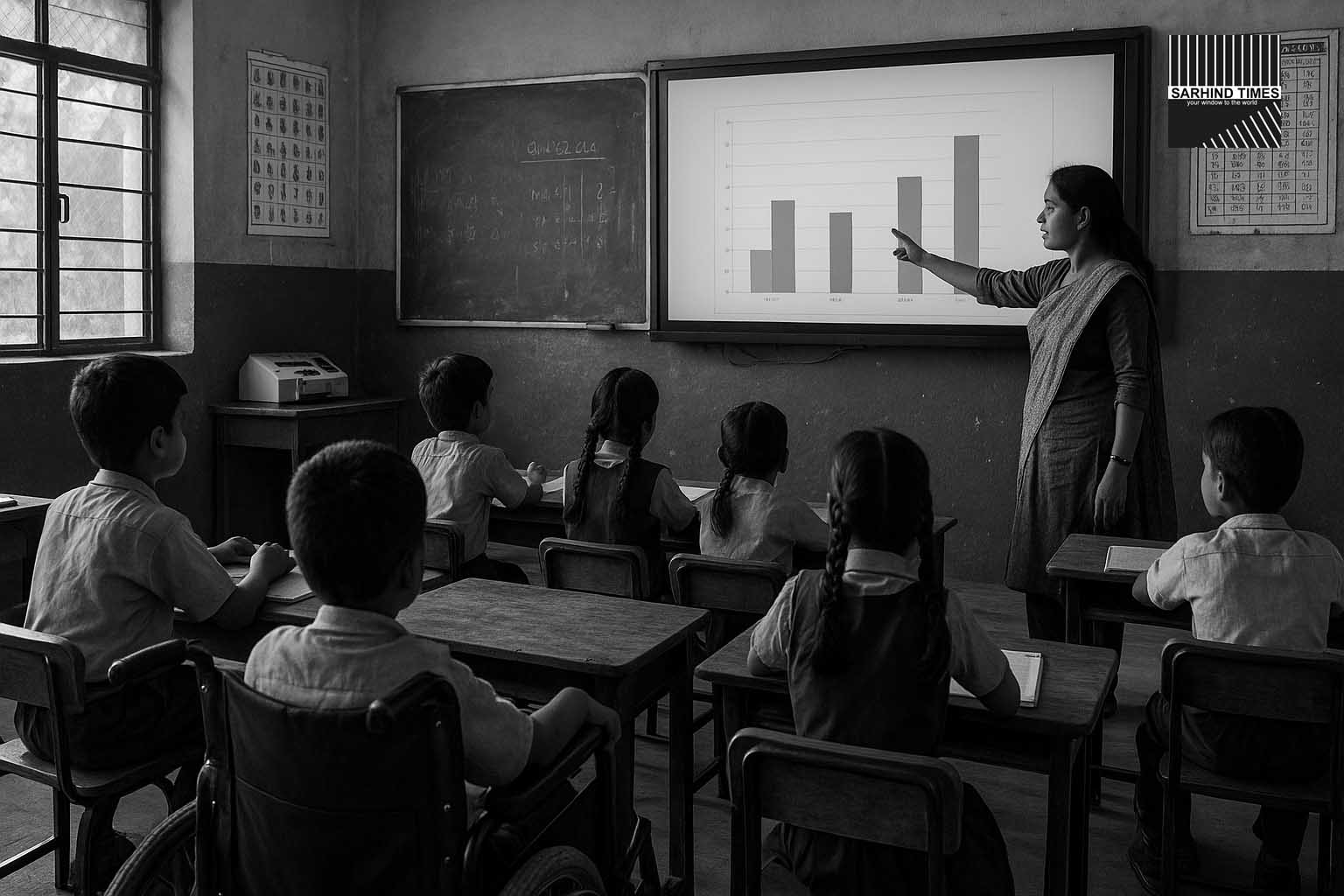
“Haryana State Inclusive Education Guidelines 2025” mandate mainstreaming of students with disabilities across government and private schools — a significant shift in state’s education landscape
Dateline: Gurugram/Chandigarh | 25 November 2025, Asia/Kolkata
Summary: The Haryana School Education Department has officially notified the “Haryana State Inclusive Education Guidelines 2025”, to accelerate the integration of children with special needs into regular classrooms. The guidelines cover both government and private schools from pre-primary up to senior secondary level, and introduce fixed standards for infrastructure, teacher training, Individualized Education Plans (IEPs), assistive technology, and monitoring mechanisms. Implementation in districts such as Gurugram is already under way, but significant operational, resource and capacity challenges remain.
Scope and key features of the new guidelines
The Haryana State Inclusive Education Guidelines 2025 apply to all recognised schools—government, aided and private—across the state. Schools will no longer be permitted to refuse admission to children with special needs (CWSN) on the ground of disability. Registration and admission norms must now integrate these children in mainstream classrooms. Schools must maintain a detailed record of every such learner, with periodic documentation of their assessment, progress and support requirements.
Under the guidelines, each school cluster must establish a resource-room staffed by trained personnel. Teachers will be required to undergo both pre-service and in-service training in inclusive pedagogy, disability awareness, assistive technologies and flexible learning approaches. Physical infrastructure mandates include ramp access, adapted toilets, Braille signage, visual-aids, and accessible digital boards.
Further, each child with special needs will receive an Individualised Education Plan (IEP) that outlines tailored learning goals, remedial support, assistive-tech needs and transition planning. The school will review the IEP at least twice a year, with the option to revise pedagogy or support services. Digital-records of IEPs will be maintained and state-level dashboards will monitor enrollment, progress and dropout indicators. (Information based on “Haryana State Inclusive Education Guidelines, 2025”)
Why Haryana has adopted this policy now
The move follows growing recognition that despite schemes and mandates, children with disabilities remain marginalised in many Indian states—either tracked into separate special schools or left out of mainstream education. In Haryana, data cited by the School Education Department point to over 60,000 CWSN enrolled across government and private schools—yet variable reach of resource-rooms, limited teacher training and infrastructure gaps remained.
By aligning with the National Education Policy 2020 (NEP) and the Right of Persons with Disabilities Act 2016, Haryana signals its intent to close systemic gaps by setting uniform standards across institutions and introducing accountability mechanisms. In districts such as Gurugram, the pace of private school growth, migrant families and inclusive-demand has added urgency to the reform.
What this means on the ground in Gurugram and beyond
In Gurugram district, along with other districts, schools are being audited for current accessibility compliance. The two schools identified in district are undergoing rapid retrofits of infrastructure—ramps at main entrances, accessible toilets, universal design signage, smart-boards with adjustable height and assistive software for visually impaired learners. Teachers in a cluster of 15 government schools have commenced training modules on inclusive pedagogy and use of assistive devices.
Parent groups in Gurugram, particularly from suburbs and townships, have welcomed the move: one parent noted, “My daughter with hearing-impairment used to travel outside Gurugram for special schooling—now she will study alongside her friends in normal school, which matters socially as well.”
Private schools too will now be required to admit children with special needs under the same terms as other students. Some select schools have already begun creating “inclusive classrooms” where CWSN and non-CWSN learn together — with resource-teacher support and peer-aide systems.
Training, pedagogy and assistive-tech: the change-levers
The guidelines place strong emphasis on teacher capacity-building. All newly recruited teachers will receive modules on inclusive teaching during induction; existing teachers must complete mandatory in-service certification within two years. These modules cover differentiated instruction, use of visual and physical aids, collaborative-learning strategies, assistive technology (including screen-reader software, hearing-loop systems, tactile charts) and behavior-management for diverse learners.
Schools will receive grants to procure assistive-tech equipment. The guidelines specify that each cluster of 20 schools should house a resource-room equipped with laptops/tablets with screen-readers, audio-book library, Braille printer, and mobility-aids. Mobile-resource vans will serve remote and underserved blocks.
Further, monitoring dashboards will track teacher training completion rates, resource-room utilisation, IEP completion, and dropout rates of CWSN. District-level officers will be assigned inclusive-education nodal-roles with accountability for implementation timelines.
Infrastructure upgrade and budget implications
Significant investment is required. The School Education Department has estimated an initial rollout cost of ₹ 500 crore over two years for infrastructure retrofit, assistive-tech procurement and resource-room setup. Schools will be given state-aid grants and can apply for central-scheme matching funds under the Samagra Shiksha programme.
For private schools, the guidelines stipulate phased compliance: schools with fewer than 500 students must comply by academic year 2026-27, while larger schools must complete infrastructure upgrades by March 2026. Failure to do so could lead to compliance notices, reduced access to government-aid, or registration renewal delays.
Union and state funds will be used in a 60:40 ratio (state:centre) for infrastructural grants; the state also announced an incentive scheme: schools with exemplary inclusion metrics will be awarded “Inclusive School of Excellence” badges and receive additional funding for extracurricular and sports facilities.
Potential benefits and expected outcomes
If properly implemented, the policy may produce several positive outcomes:
– Increased enrollment of CWSN in regular schools and lower segregation.
– Lower dropout rates and improved learning outcomes for children with disabilities.
– Social inclusion benefits—students with and without disabilities learning together may promote diversity, empathy and peer support.
– Better teacher-capacity and resource-availability, prompting overall enhancement of school quality.
– Private-school sector readiness to accept inclusive mandates may strengthen public-private parity in education access.
Risks, gaps & implementation-challenges
However, the path to successful rollout is far from smooth:
– Roll-out speed: Retrofitting large numbers of schools, especially older ones, to access-standards will take time and may face contractor, material or budget delays.
– Teacher capacity may lag: Existing teachers are already stretched; adding training requirements and inclusion-pedagogy may overburden them unless work-loads are adjusted.
– Assistive-tech supply chains are nascent: Sourcing and maintaining equipment (Braille printers, screen-readers) may face cost and service-issues especially in semi-urban and rural blocks.
– Private-school buy-in: Some private schools may resist additional compliance cost, or defer upgrade timelines; monitoring of private-school adherence is often weaker.
– Equity in outreach: Higher-income urban districts such as Gurugram may see faster implementation; remote and rural districts may lag behind, creating regional disparities.
– Monitoring and enforcement: Dashboards and nodal officers are good on paper—but whether data is accurate, timely and leads to corrective action remains to be seen.
What to watch in the next 12-18 months
Key indicators and signals will determine whether this initiative scales well:
– The proportion of CWSN students enrolled in mainstream (regular) classes vs special schools and their retention rates.
– Completion rates of infrastructure retrofits in schools across districts: percentage of ramps, accessible toilets and resource-rooms installed by March 2026.
– Number of teachers who complete inclusive-pedagogy certification and how many schools report functional resource-rooms.
– Monitoring dashboard data: dropout rate among CWSN, number of IEPs completed/reviewed, utilisation of assistive-tech equipment.
– Private-school compliance statistics: number of schools meeting deadlines, any incentives/penalties invoked.
– Regional variation: District-wise gaps between Gurugram, re-urbanised districts and more remote districts such as Nuh or Palwal.
Conclusion
The Haryana State Inclusive Education Guidelines 2025 mark a significant milestone in the state’s education reform journey. By mandating that children with special needs be included in regular schools, aligning infrastructure upgrades with mainstream norms, and strengthening teacher capabilities, the state is responding to global- and national-standards of inclusive learning.
Yet the success of the policy will pivot on execution rather than intent. Schools, districts and education-authorities must work in concert: ensuring budgets are released, training is delivered, infrastructure is upgraded, and monitoring is real. For Gurugram and other fast-changing districts in Haryana, this represents both an opportunity and a test. If implemented well, the initiative may become a template of how a rapidly growing urban-peri-urban region integrates inclusive education. If not, the gap between policy and practice may widen.
In short: Haryana’s inclusive-education push is bold, timely and necessary—but now comes the harder part: delivery.



+ There are no comments
Add yours