
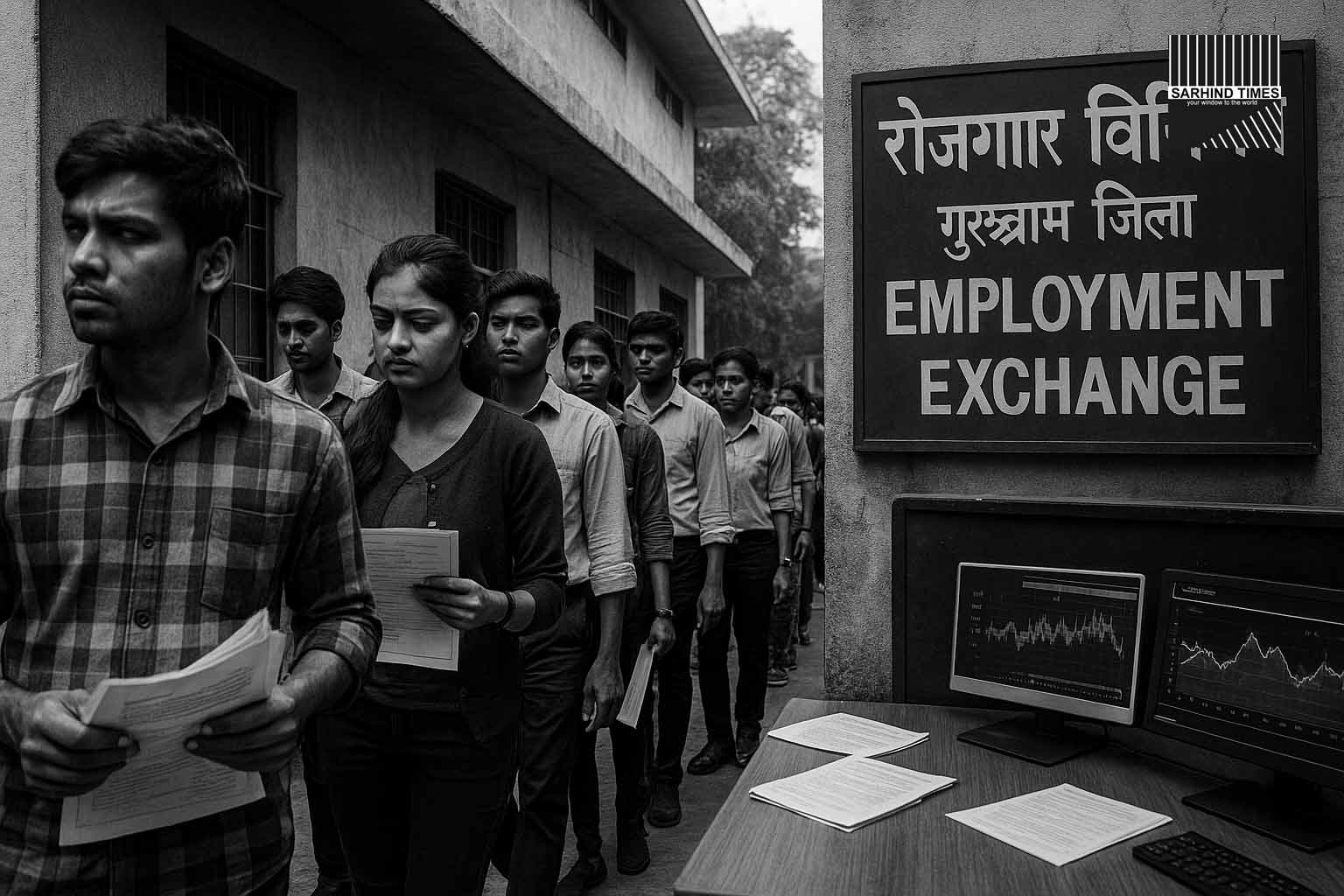
State-level data show labour-market improvement in rural areas while Gurugram’s youth and urban segments face continued employment headwinds
Dateline: Gurugram | 24 November 2025
Summary: The latest labour-force numbers for Haryana indicate a modest reduction in the unemployment rate driven by stronger rural job activity. However, in the more urbanised districts like Gurugram, job-creation pressures persist—especially among young job-seekers and recent graduates. Policy-makers are now highlighting the urgent need for urban employment schemes, skills-development alignment and private-sector absorption to avoid a growing employment gap in the NCR region.
Introduction: Mixed Indicators in Haryana’s Job Market
Haryana’s employment landscape is showing signs of incremental improvement—but the story remains complex. While the overall unemployment rate at the national level held steady around 5.2 % in October, with rural areas in the lead, Haryana’s latest state-level data reflect similar divergence: declining joblessness in the hinterland but persistent strain in urban employment hubs.
In Gurugram district—one of Haryana’s most dynamic labour-markets—young aspirants, recent graduates and migrants continue to report frustration over job access and structural mismatch between demand and supply. This article delves into the latest data from the state, dissects the drivers, outlines stakeholder concerns, and considers strategic implications for India’s job-rich growth narrative.
Statewide Employment Data: What Does Haryana Show?
Though Haryana’s official quarterly unemployment figures are not published with the same frequency or granularity as national numbers, state officials point to several key trends:
- A modest decline in rural joblessness across several districts, attributed to increased agricultural-season activity and micro-enterprise uptake.
- Labour-force participation rising slowly in semi-urban and peri-urban areas—indicating that more people are entering the job-seeking process rather than dropping out.
- Urban districts—especially Gurugram, Faridabad, and Panchkula—witnessing limited formal job growth, as firms remain selective, shift automation-intensive models, or rely on contractual labour.
A state government bulletin noted that “the urban employment ecosystem remains under pressure despite favourable macro-growth” and called for targeted interventions in skill-alignment and private-sector engagement.
Gurugram Focus: Youth, Skills and Urban Job Mismatch
In Gurugram, the situation is emblematic of the broader challenge: a high-growth economy on surface but underlying unresolved employment bottlenecks. Several dynamics are at play:
Youth Concentration: The district attracts large numbers of young job-seekers—from nearby villages, states and migrants—many of whom are educated but struggle to gain roles matching their qualifications or expectations.
High Aspirations vs. Availability: The IT-services, real-estate, retail and hospitality sectors—traditionally key employers—are increasingly emphasising hybrid work, automation, gig models and contractual staffing. This means fewer full-time roles with career-trajectories for aspirants.
Skill-Mismatch: While many youth in Gurugram hold degrees or diplomas, local employers note gaps in practical skills, domain-specific training, and soft-skills. They cite several applicants who clear initial criteria but fail workplace assimilation or lack sector-specific exposure.
Informal Sector Dominance: A sizeable minority of employment in the district remains informal—construction, hospitality, delivery services—with limited job-security, low wages and high entry-barriers for graduates. These roles often fail to absorb youth seeking stable opportunities.
Migration & Commuter Dynamics: Many workers commute into Gurugram from nearby districts and states, increasing labour-supply competition and reducing local absorption odds. Some households report multiple job-seekers competing for single entry-level positions.
National Comparison: Haryana in the Wider Context
According to the latest national data for October and latest quarter:
- The national unemployment rate held at **5.2 %** in October for those aged 15 + years, unchanged from September. :contentReference[oaicite:2]{index=2}
- Rural joblessness fell slightly to 4.4 %, while urban unemployment rose to 7.0 %. :contentReference[oaicite:3]{index=3}
For Haryana, state officials say that the district-wide data reflect similar rural-urban divergence. They note that although the state benefits from proximity to Delhi-NCR, industrial clusters, and service sectors, these advantages have not translated fully into stable employment for large swathes of young aspirants.
Policy Responses: What Is Haryana Doing?**
The Haryana government has flagged employment, skills and youth job-absorption as priority items. Recent initiatives include:
- Setting up job-melas (employment fairs) across districts in partnership with private-sector firms and placement agencies.
- Launching skills-certification programmes targeted at digital skills, logistics, EV-manufacturing, hospitality and retail—sectors identified as growth opportunities in the Gurugram-Manesar belt.
- Targeted encouragement for MSMEs (micro, small and medium enterprises) to expand in peri-urban areas of Gurugram and connect with government subsidies for job creation.
- Encouraging large firms setting up in Gurugram district to reserve a portion of entry-level hiring for local youth, and reporting numbers to the district employment office as part of incentives.
Officials emphasise that although the employment-linked incentive (ELI) scheme announced by the Union government offers national scale support, states must tailor the interventions to local labour-market realities—particularly youth in urban districts.
The Gap: Where Efforts Still Fall Short
Despite the above effort, several barriers remain:
- Depth of Jobs: Many of the roles created are still entry-level, part-time or contractual, which may not provide long-term career stability or reflect the aspirations of degree-holders.
- Location-Bias: While Gurugram has seen private investment, other districts lag behind in diversification of industries and job-creation focus; state data suggest that rural and small-town youth often still lack meaningful opportunities.
- Quality of Training: Skills programmes are increasing in number, but placement rates remain mixed; many youth complete training but struggle to secure jobs without employer linkages.
- Data Transparency: Experts argue that state-level employment data often lack granularity (by age, gender, sector) which limits policy-tailoring and early warning insights.
Implications: Why This Matters for India’s Growth Story
The employment situation in Haryana—and especially in Gurugram—matters for broader reasons:
- Demographic Dividend Risk: With India adding millions of new workers annually, states that fail to absorb youth risk structural unemployment, under-employment and social strain.
- Wage and Consumption Link: Stable employment fosters household income, domestic consumption growth and broader economic momentum. If job creation lags, consumption downturns may follow—even if GDP growth remains high.
- Urban Ecosystem Stress: Cities like Gurugram act as magnet job hubs; failure to create enough quality jobs leads to commuter stress, infrastructure burdens and social inequalities.
- Policy Replication Importance: If Haryana’s model can be scaled—linking skills, placements and job-creation incentives—it may serve as a blueprint for other fast-growing states.
Looking Ahead: Key Indicators to Watch
For Haryana and Gurugram, the following metrics will be critical in the coming months:
- District-level youth (15-29 years) unemployment rates and trends by gender.
- Labour-force participation changes, especially female participation in urban areas.
- Number of full-time versus contractual jobs created in key sectors (IT/ITES, logistics, manufacturing, hospitality).
- Placement rates from state-run skills programmes and private-partnered job-fairs.
- Tracking absorption of new jobs by local versus migrant workforce to ensure resident youth benefit.
Conclusion: Modest Good-News, but Urban Employment Remains a Bottleneck
Haryana’s employment data paint a cautiously optimistic picture: joblessness is edging down in rural zones, labour-force participation is improving, and the state’s proximity to the Delhi-NCR job-market offers a strategic advantage. However, in Gurugram and similar urban clusters, the job-absorption challenge persists. The risk is that without faster growth in quality employment, an avowed growth hub may become a growth-gap zone for youth.
For Haryana to convert its demographic dividend into real economic gains, public policy must align faster with market demand, sectors must absorb local youth meaningfully, and data transparency must improve. The headline unemployment rate—at least in rural India—is stabilising. But the story for urban youth is far from resolved.



+ There are no comments
Add yours