
Chandigarh | October 25 2025 | Sarhind Times Bureau
Chandigarh — In a striking departure from conventional policing imagery, the Haryana Police has rolled out a state-wide behavioural-reform programme titled “Politeness First.” The initiative, announced by Director General of Police Shatrujeet Kapoor, aims to rebuild public trust by embedding courtesy, empathy, and service ethics into daily law-enforcement routines—from street-level traffic stops to station-house interactions.
From power to service: the new policing grammar
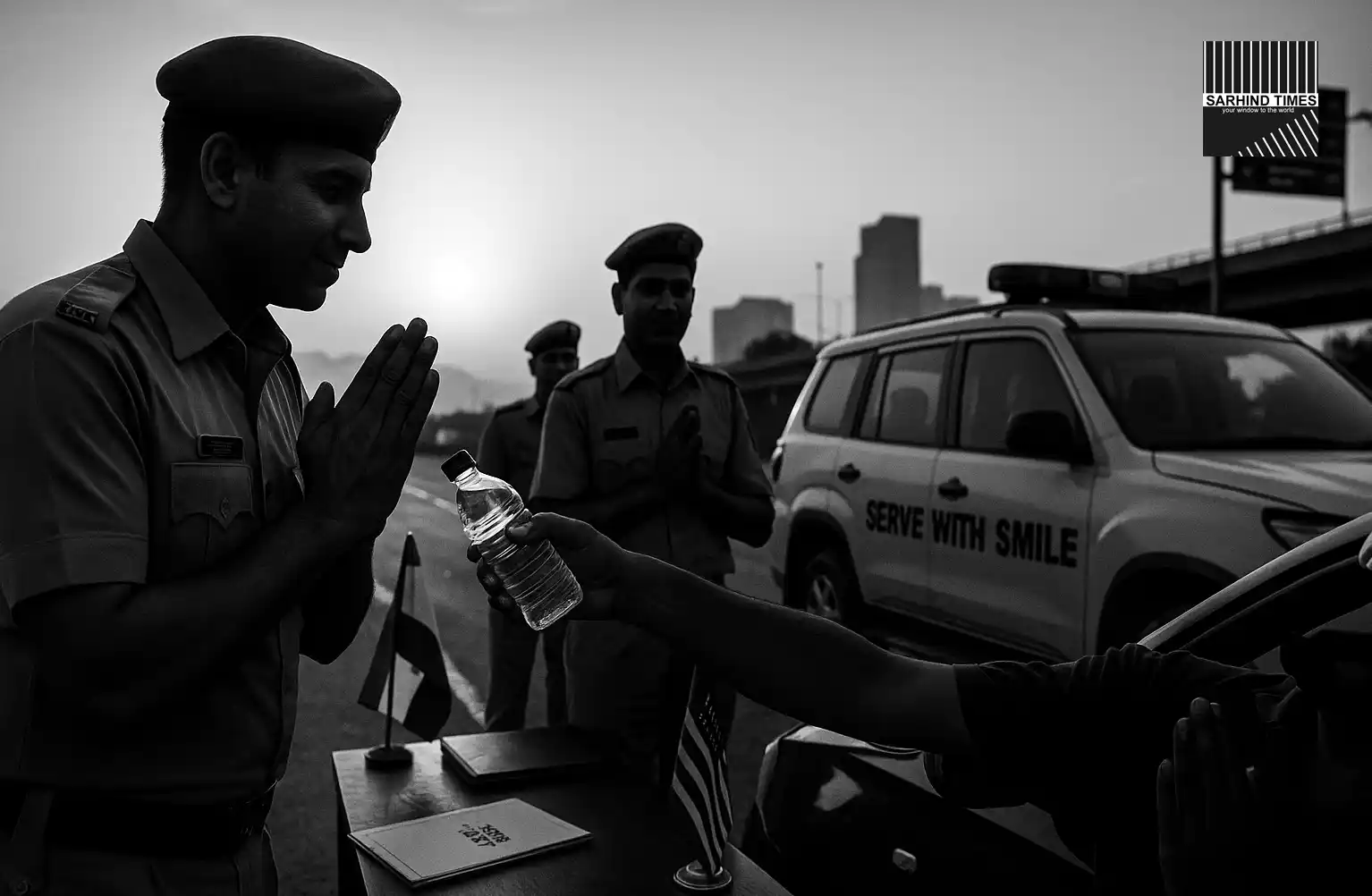
The campaign’s tagline—“Vinay Se Vijay” (“Victory through Humility”)—encapsulates its intent: to replace fear with confidence and confrontation with cooperation. Beginning this week, every police station in Haryana has received visual communication kits, short audio jingles for patrol vehicles, and a handbook titled “100 Ways to Serve with Respect.” The manual emphasises tone of voice, conflict-diffusion tactics, and non-verbal gestures such as greeting citizens with folded hands rather than waving batons.
“Professionalism is not just about arresting offenders—it’s about reassuring the innocent,”
DGP Kapoor told Sarhind Times during an interaction at Police Headquarters. “Politeness doesn’t weaken authority; it strengthens legitimacy.”
The trigger: rising complaints, falling empathy
According to the state Home Department, citizen complaints regarding rude behaviour rose by nearly 17 percent in 2024, even though crime rates declined. Most grievances were filed over verbal hostility during traffic checks or delayed responses at police stations. A survey by the Haryana Governance Research Society found that 68 percent of respondents perceived “attitude” as a bigger deterrent to approaching police than paperwork or distance. It was this paradox—reduced crime but rising distrust—that prompted the DGP’s introspection drive.
The first pilot was launched quietly in Gurugram last June. Traffic inspectors there replaced traditional road barricades with boards saying “Thank You for Following Rules.” Officers who received positive citizen feedback on the state’s HarSampark app were publicly felicitated. Within three months, complaint volumes dropped by 22 percent and traffic-fine recovery improved—a persuasive data point that convinced headquarters to scale the experiment statewide.
Training for tone and temperament
Over 45,000 personnel—from constables to deputy superintendents—will undergo a two-day sensitisation module at district training centres. Sessions are being conducted by behavioural psychologists and retired IPS mentors. Modules include simulated encounters: how to calm an irate driver, assist victims during distress calls, or communicate bad news compassionately. Officers are scored on empathy, composure, and clarity, not merely procedure.
“We’re teaching the art of listening,” said ADGP (Training) Renu Bala. “In policing, silence at the right moment can prevent escalation. That’s what our young officers are learning.”
Rewarding good manners: an incentive model
The campaign introduces a first-of-its-kind ‘Civility Index’—a monthly rating derived from citizen feedback forms, CCTV audit clips, and supervisor reviews. Personnel scoring above 90 percent qualify for the Blue Badge of Courtesy, displayed on their uniforms. The badge has already become a talking point in Rohtak and Faridabad, where citizens reportedly greet badge-holders with a nod of approval.
Additionally, 10 percent weightage for promotions will now depend on behaviour metrics. “Skill without sensitivity is half-training,” observed DGP Kapoor. “Rewarding humility institutionalises it.”
Digital feedback loop: citizens as evaluators
Each police station has been assigned a QR-coded poster linking to a micro-survey where citizens can rate their interaction immediately after visiting. Responses feed into a central dashboard at headquarters. The analytics platform—developed by NIC Haryana—uses natural-language sentiment analysis to classify remarks as appreciative, neutral, or critical. An AI-based alert notifies district SPs when a pattern of complaints crosses a threshold, prompting on-ground mentoring rather than punishment.
Gurugram resident Ruchi Sareen, who recently lodged a lost-documents report, said the difference is palpable: “The officer asked me to sit, offered water, and printed my FIR in ten minutes. I walked out smiling—a first in years.”
From chowki to community
Beyond individual conduct, the campaign seeks to re-embed police units into their neighbourhood ecosystems. Every beat officer must now attend at least one community connect meeting a month—held at local schools, RWAs, or market associations—to listen to grievances and share safety updates. In rural belts, gram chaupal interactions are being revived. Women constables are leading “Sakhi Suraksha Talks”—interactive sessions on harassment awareness and cyber safety in colleges.
ADGP (Law and Order) Ravinder Singh Tomar explained that policing credibility grows not from force but from familiarity. “When people know their beat officer by name, half the suspicion disappears. Civility is the bridge between uniform and society.”
Early outcomes: statistics meet stories
In its first fortnight, the initiative has logged tangible shifts: 5,200 feedback entries, 4,600 rated ‘satisfactory or higher’, and 128 instances where officers went beyond protocol—escorting stranded motorists, delivering accident victims to hospitals, or mediating neighbourhood disputes peacefully. Local newspapers have begun running “Good Cop of the Week” columns, humanising the khaki narrative.
In Hisar, constable Amit Kundu earned headlines for helping a farmer sell produce online after a theft complaint revealed digital illiteracy. In Panchkula, a patrol team repaired a school’s broken gate during a night beat. “These micro-gestures build macro-trust,” says sociologist Dr Ramesh Thakur. “Courtesy converts authority into legitimacy.”
Challenges: old habits, new hurdles
Despite enthusiasm, senior officers admit behavioural change is hard to measure. “Discipline can be commanded; empathy cannot,” remarked a district SP anonymously. Frontline stress, long hours, and public aggression often test patience. The department is therefore introducing peer-support circles—informal debrief sessions where constables discuss emotional burnout and learn stress-management techniques.
Budgetary constraints pose another hurdle. The ₹12-crore rollout covers training, communication material, and analytics software. Sustaining the drive beyond 2026 will require regular funding. Officials hope CSR partnerships will bridge gaps; several corporates have expressed interest in sponsoring “rest-and-refresh kiosks” for highway patrols.
Expert view: policing as social capital
Former IPS officer Kiran Bedi called the initiative “the most significant behavioural pivot in Indian policing since community-police schemes of the 1990s.” She told Sarhind Times, “When officers treat every encounter as service, complaint rates drop and intelligence inputs rise—because people talk more freely.” Criminologist Dr Pankaj Kumar added that emotional-quotient training can cut custodial-violence incidents and litigation costs: “Every harsh word avoided saves hours in inquiry paperwork.”
Technology joins temperament
Parallel to training, Haryana Police is deploying body-worn cameras with automatic voice-tone analyzers that flag raised decibel levels. Supervisors receive weekly civility reports, while citizens can view select footage for transparency. An in-house app, SevaTrack, now tags each FIR with officer ID, processing time, and satisfaction score—creating measurable accountability.
Command centres in Gurugram and Karnal integrate these feeds with emergency-response dashboards. If an officer’s politeness rating dips consistently, they are enrolled for counselling, not punishment—underscoring the reform’s non-punitive ethos.
Voices from within the force
Initial scepticism within ranks has gradually turned to pride. “Earlier we thought politeness meant weakness,” said head constable Sunil Dagar. “Now citizens salute us back. It feels different.” Women personnel note improved cooperation during investigations. “Young girls open up faster when approached respectfully,” said ASI Neha Yadav of Rewari Women Police Station.
The campaign also dovetails with broader reforms: the integration of counselling psychologists at every district control room, annual mental-health check-ups, and digital literacy for citizen-facing staff.
Public reception: a shift in tone
Residents across districts have taken to social media to share positive encounters under the hashtag #PolitenessFirst. Videos of officers helping elderly pedestrians or celebrating birthdays of street children have gone viral, garnering nationwide praise. Even Bollywood actor Randeep Hooda, a Haryana native, tweeted: “Respect earns more obedience than fear. Proud of my state police.”
Community leaders hope the culture shift will ripple beyond policing. “If officials across departments adopt this tone, governance will feel humane again,” said RWA president Anita Verma from Faridabad.
Academic interest and replication prospects
Public-administration scholars from IIPA and IIM Rohtak have requested access to campaign data for longitudinal research on behavioural governance. Meanwhile, neighbouring states like Punjab and Himachal Pradesh are studying the Haryana model for adaptation. The Bureau of Police Research and Development (BPR&D) is preparing a policy brief recommending nationwide replication if metrics remain positive through 2026.
“Soft-skills governance will be India’s next reform frontier,” predicted Prof. Meenakshi Joshi of IIPA. “The Haryana experiment demonstrates that civility is a measurable public good.”
The larger idea: redefining power
At its philosophical core, “Politeness First” reframes the relationship between state and citizen. It asserts that authority derives from service, not subjugation. By institutionalising kindness, the police seeks to humanise bureaucracy itself. As DGP Kapoor put it, “A polite police force is the strongest symbol of a confident democracy.”
The next time a motorist is stopped on Haryana’s highways, they may be greeted not with suspicion but with a smile—and perhaps that single gesture will do more for public safety than any baton ever could.
Hashtags: #HaryanaPolice #PolitenessFirst #PublicTrust #GoodGovernance #CommunityPolicing #LawAndOrder #SarhindTimes



+ There are no comments
Add yours