
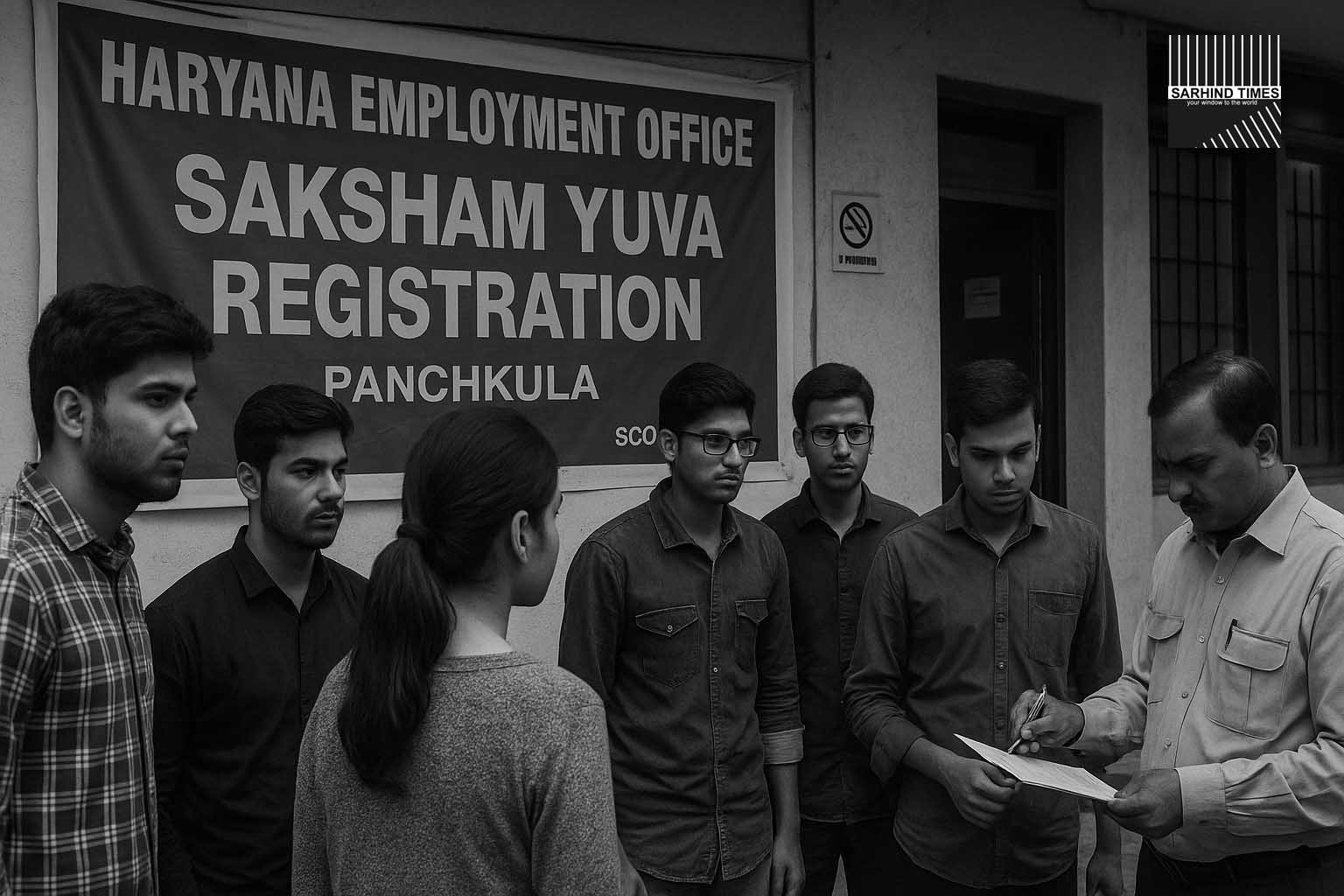
State government introduces enhanced allowance scheme for registered unemployed youth as part of broader focus on job-market support
Dateline: Chandigarh | 17 November 2025
Summary: The state of Haryana has opened applications for its updated youth-allowance programme under the umbrella of the Saksham Yuva Scheme (“Capable Youth Scheme”), offering monthly stipends of up to ₹3,500 for post-graduates who have been registered with the employment exchange for three years or more. The initiative aims to strengthen the link between financial support and active job-search or skill engagement, though analysts warn the success will hinge on screening, targeting and outcomes.
1. What the scheme offers
Under the newly announced allowance structure, eligible youth residents of Haryana will receive monthly financial support based on educational qualification once they satisfy registration and unemployment-criteria in the live employment-exchange register for at least three years. The key stipend levels are:
– ₹1,200/month for 10+2 graduates
– ₹2,000/month for graduates
– ₹3,500/month for post-graduates
The application window is open from 1 November 2025 to 30 November 2025 for initial registration and renewal.
The scheme also allows renewal of registration for those already enrolled under the previous version of the programme. It aims to plug a gap in support for educated youth who are job-searching without regular employment.
2. Eligibility and criteria
The detailed eligibility conditions include:
– Applicant must be a resident of Haryana and registered in the employment-exchange live register.
– Must have 10+2 (regular mode) or graduate/post-graduate qualification from a recognised institution in Haryana/Chandigarh/Delhi.
– Must not be currently employed in any full-time job (public or private).
– Annual family income must not exceed ₹3 lakh (from all sources).
– Age criteria: normally 18–35 years for 10+2, 21–35 for graduates/post-graduates (subject to scheme rules).
Applicants are expected to apply online via the employment-department portal and submit requisite documents (Aadhaar, qualification certificate, employment-registration number, bank account details, proof of residence).
3. Strategic context: why now
Haryana is facing significant youth-unemployment pressures, especially among educated cohorts. While the state has witnessed rapid economic transformation, the transition from education to employment remains uneven. The allowance-scheme signals the government’s intent to provide interim financial support to job-seekers, reduce distress and offset the time gap between qualification and placement.
At the same time, this move complements broader initiatives: increased skill-training efforts, job-fairs, and registration drives under the cultural banner of youth empowerment. By offering a financial cushion, the state hopes to buy time for job-matching infrastructures to mature, while reducing social risk associated with prolonged unemployment.
4. Implementation architecture
The scheme will be administered by the Haryana Employment Department via its digital portal, which also handles the live register, job-fair scheduling, counselling services and training links. Applicants will sign up online, and once verified, the allowance payments are credited monthly into the beneficiary’s bank account through direct-benefit-transfer.
The department has also aligned each district-employment office with monitoring dashboards to track registrations, approval rates, renewal status and drop-outs. A unique aspect: the scheme mandates quarterly check-ins by beneficiaries, wherein they must confirm their job-search status or enrolment in skill-development programmes to remain eligible.
5. Potential benefits and arranged safeguards
The scheme may yield several benefits:
– Provide short-term financial relief to young educated job-seekers, reducing immediate household stress.
– Encourage job-seekers to remain registered and active in the employment-ecosystem rather than dropping out of official records.
– Improve labour-market data via updated registers and periodic check-ins.
– Potentially strengthen the pipeline of trained youth ready for placement initiatives, as the check-in mandate nudges them toward skill-courses or job-fairs.
Safeguards built-in include auditing of registrations, cross-verification with employment records, financial-audit trails for DBT payments, and linkages with counselling and job-readiness modules. The live-register requirement ensures that only active job-seekers qualify, and the income cap ensures targeting toward lower-income households.
6. Critical challenges and concerns
While the scheme is well-intentioned, multiple challenges could reduce its effectiveness:
– **Targeting accuracy**: Ensuring only genuine job-seekers benefit and not idle registrants remains a perennial risk.
– **Financial sustainability**: Given the number of educated youth and potential scale, the fiscal burden may rise beyond initial estimates unless jobs or training absorption improves.
– **Linkage with real employment**: If the allowance simply becomes a substitute for jobs rather than a bridge to work, it may foster dependency or increase idle time.
– **Administrative capacity**: The burden on district employment offices to verify large volumes of applications, maintain live-register accuracy and monitor check-ins could stretch resources.
– **Regional imbalance**: While Haryana has strong urban districts (like Gurugram, Faridabad), rural districts may struggle with job creation, meaning the allowance might not translate into placements in those areas.
Analysts emphasise that the allowance effort is meaningful—but not sufficient in isolation. For long-term outcomes, training, placement and private-sector job-creation must keep pace.
7. Comparisons and precedent
Haryana is not alone in offering education-linked unemployment allowances, but the scale and formal check-in requirement stand out. The earlier version of the Saksham Yuva scheme had similar structure (allowance plus 100 hours of work) but recent enhancements reflect the state’s renewed emphasis. The new stipend levels (₹1,200/2,000/3,500) align with inflation and the evolving job-market context.
Compared to other states, Haryana’s scheme is mid-to-high in allowance quantum, though still modest relative to cost of living in urban districts. The requirement for three-year registration and quarterly check-in offers a governance layer that earlier schemes lacked, potentially improving efficacy.
8. What comes next: monitoring and outcome tracking
The success metrics to watch include:
– Number of approved beneficiaries by district and qualification band.
– Percentage of beneficiaries who transition to jobs (public or private) or skill-courses within six months.
– Drop-out rate from registrations and re-application cycles.
– Fiscal cost versus placement outcomes: cost per job-transition and average time-to-employment.
– Geographic clustering of benefit uptake and any unintended concentration in urban districts rather than rural ones.
The government has indicated that it will publish quarterly dashboards of scheme-metrics and include outcome-tracking in its quarterly employment-report. The first such public dashboard is expected by March 2026.
9. Implications for youth, households and the state economy
For young educated Haryana residents, especially those from lower-income families, this allowance offers a cushion while searching for jobs. It may reduce pressure to accept sub-optimal or exploitative employment out of desperation, allowing better job-match alignment. For households, it may reduce income volatility and ease financial stress during the job-search phase.
For the state economy, the scheme may help maintain a stable human-capital pipeline: rather than seeing educated youth migrate or remain idle, registrations enable tracking, counselling and placement pushes. If aligned properly, this can improve workforce readiness, raise employability and feed into sectors such as manufacturing, services and logistics—which Haryana is targeting aggressively.
10. Final reflection: promise, but work remains
Haryana’s enhanced youth-allowance scheme is a meaningful step—addressing a fundamental gap between education and employment, providing interim relief, and formalising support mechanisms. The challenge ahead lies in linking the allowance to actionable pathways: training, industry engagement, placement, and localised job-creation. Allowing thousands of youth to sit idle on allowances without complementary job traction would risk unintended consequences.
The real test for the state government will be: can this financial bridge become a springboard into employment rather than merely financial support? If yes, the scheme may evolve into a smart labour-market intervention; if not, it may become a well-intentioned but under-performing programme. For now, the youth of Haryana have a lifeline—but converting compensation into opportunity remains the imperative.



+ There are no comments
Add yours