
Gurugram | 4 November 2025
Dateline: Gurugram | 4 November 2025
Summary: The Haryana government has formalised the “Haryana State Inclusive Education Guidelines 2025”, setting out detailed mandates that all government and private schools must admit and retain children with disabilities, provide resource-rooms, prepare Individual Education Plans (IEPs), and ensure barrier-free facilities. The move marks a significant step towards aligning school-education systems in the state with national frameworks of equality and access.
Policy announcement and key mandates
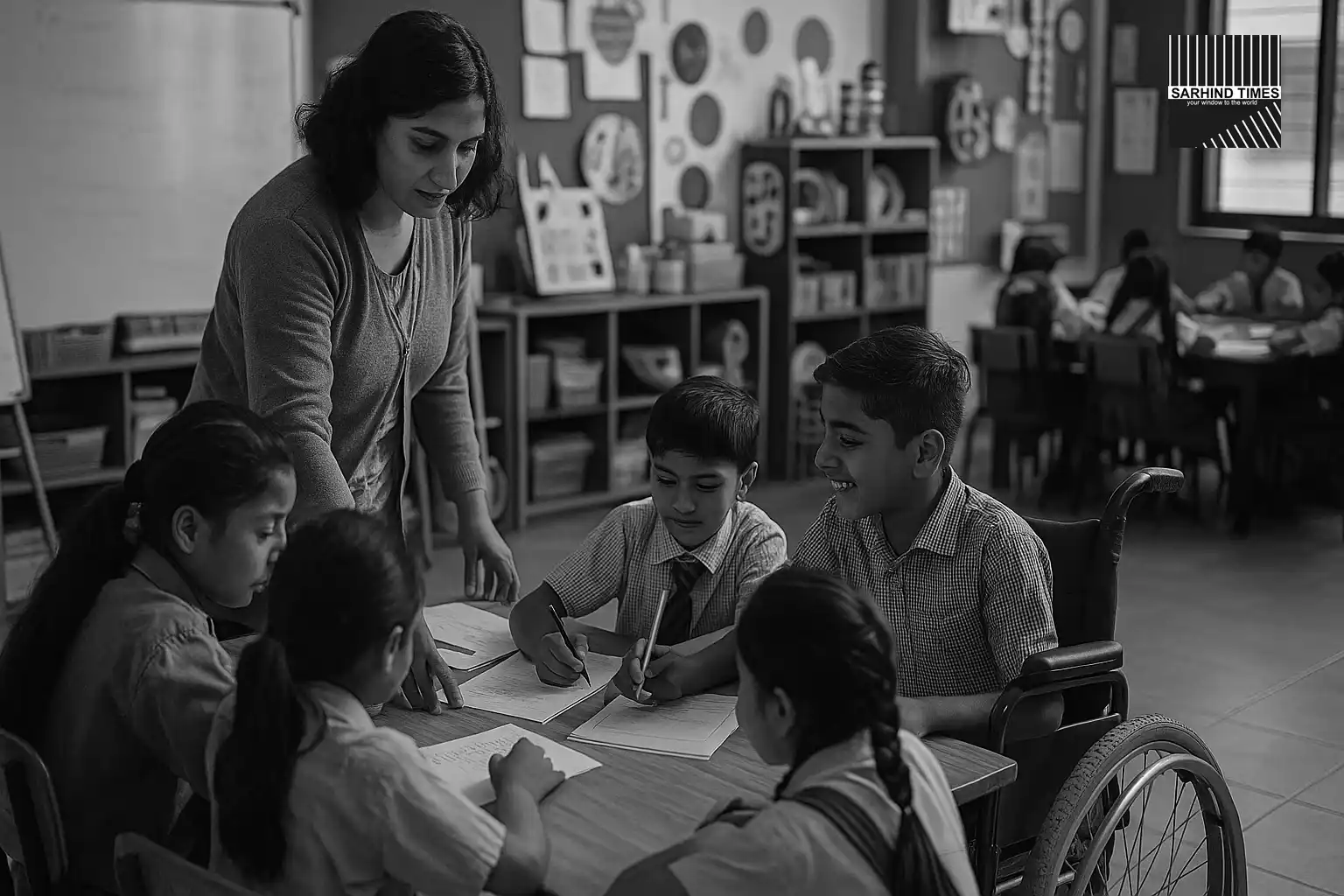
On 17 October 2025, the Department of Elementary Education of Haryana published the full “Haryana State Inclusive Education Guidelines 2025”. These guidelines, developed after extensive stakeholder consultation and following a long-standing directive of the courts, set out a structured framework for ensuring that children with disabilities (CWDs) are integrated into mainstream schools in the state rather than segregated or excluded. The key mandates include:
- All schools—government and private—must admit children with disabilities and admit them into general classrooms alongside their peers, except when the nature of disability necessitates specialised instruction.
- Schools cannot remove a child with special needs without obtaining prior approval from the district Elementary Education Officer (for classes I–VIII) or the District Education Officer (for classes IX–XII).
- Each school with children with disabilities on its rolls must have a resource-room equipped with assistive devices (Braille, hearing aids, software), trained special-educator staff and an accessible layout (ramps, barrier-free pathways, accessible toilets and playgrounds).
- Each such child must be provided with an Individual Education Plan (IEP) within one month of admission, tailored to the child’s learning level, needs and agreed goals. This applies even to children under home-based education.
- Teacher-training modules for B.Ed and D.Ed courses must now include mandatory credits on disability-inclusive pedagogy and classroom strategies. Schools must engage in periodic professional development on inclusive practice
Background: why Haryana moved now
The move follows a 2019 judgment of the Punjab and Haryana High Court in a case involving a child with Down Syndrome whose admission in a private school in Panchkula was terminated mid-year. The court found that earlier circulars did not comprehensively support inclusion of CWDs and directed formulation of “clear, enforceable guidelines” across both government and private schools.
The national legal framework—the Rights of Persons with Disabilities Act 2016—mandates inclusive education and access for children with disabilities. However, in practice many state school systems lacked detailed operational rules, leading to varied implementation. With Haryana now publishing detailed state-level guidelines, it signals a shift from principle to practice.
State education environment and previous developments
Haryana has been active in schooling reforms in recent years: it committed to fully implement the National Education Policy 2020 by 2025 and has rolled out various digital-learning and skill-based upgrades across schools. But concerns remained about equitable access, particularly for children with disabilities and disadvantaged groups.
A recent RTI disclosure revealed that between 2018 and 2025 the number of government high schools in the state fell from 1,207 to 858, while the number of private high schools rose from 1,877 to 2,096. Critics argue this shift might undermine public-school accessibility. The new inclusive-education guidelines can thus be seen as part of the state’s broader effort to shore up the public-school system while ensuring no learner is left behind.
Practical implications for schools and districts
For school managements, the new guidelines bring significant obligations and operational tasks. Among these:
**Admission and retention assurance:** Schools must ensure that no child with disability is denied admission on grounds of disability or perceived ‘lack of resources’. If schools claim inability to accommodate, they must work with district officials to arrange support or referral rather than refusal.
**Infrastructure audit and upgrades:** Schools must audit physical accessibility—ramps, lifts, toilets, corridors, playgrounds—and engage in retro-fitting as needed. Resource-rooms must be created or upgraded with assistive technology, and staffing (special-educators, counsellors) must be enabled. Training programmes must be scheduled for teachers, staff and administrators to meet inclusive-education standards.
**IEP preparation and review:** For each child with disability, the school must draft an IEP with objectives, schedule, tracking indicators and remedial supports. Regular reviews (at least quarterly) are mandated, and parents must be engaged in the process. Special educators must coordinate with mainstream teachers to integrate children into general classrooms with necessary adjustments.
**Monitoring, accountability and penalties:** The guidelines recommend district-level monitoring of compliance via the school-education dashboard, spot audits, and a mechanism for parents/guardians to lodge complaints. Private schools failing to comply may face cancellation of recognition or affiliation in extreme cases.
Reactions: hope and caution
**Civil-society and parent advocates** welcomed the guidelines as long-overdue. Many families of children with disabilities have previously reported exclusionary practices, ad-hoc refusals of admission, lack of resource-supports and inadequate infrastructure. The clear protocol for admission and IEPs is seen as a breakthrough.
**Private-school associations**, however, voiced concerns about the cost of compliance—especially in smaller schools, where installing ramps, purchasing assistive devices, hiring specialised staff and maintaining IEP protocols may impose burdens. Some called for fiscal support or state grants to ease the transition to inclusive models.
**School-administrators** see this as a significant shift in accountability. While many schools have already admitted children with disabilities and operated inclusion programmes, the formalisation of penalties for non-compliance and requirement of IEPs raises the bar. Training existing staff and re-orienting classroom pedagogy will be key to practical implementation.
Analysis: strengths and potential weak spots
**Strengths of the policy:**
- Clear timeline and differentiated mandates covering enrolment, infrastructure, teacher training, resource-rooms, IEPs.
- Combines regulatory enforcement (penalties, private-school recognition) with capacity-building (teacher training modules).
- Aligns state-policy with national law and international benchmarks on inclusive education.
**Potential challenges:**
- Funding and resources: Many schools—especially in rural/remote districts—may struggle to meet infrastructure and staffing requirements without additional state or central grants.
- Monitoring and compliance: Ensuring actual implementation across hundreds of schools remains complex; risk of guidelines remaining “on paper” if district mechanisms are weak.
- Private-school resistance: Without incentives or transition period, some schools may view the mandates as onerous, which could lead to exclusionary practices (or push students to unregulated institutions).
- Data-tracking and reporting: Effective IEP management, monitoring outcomes for children with disabilities, and linking to board/exam-systems will require robust digital-data systems which may currently be under-developed in some districts.
What to watch in the coming months
Key variables to monitor include:
- The number of children with disabilities enrolled in mainstream schools in Haryana for academic session 2025-26 and beyond.
- The creation and functional status of resource-rooms in schools, and whether special educators are in position and trained.
- Instances of refusal or removal of CWDs from schools—whether the complaint mechanism is active and timely.
- Budget allocations in Haryana for inclusive-education infrastructure upgrades, teacher training and assistive devices.
- Outcomes—whether students with disabilities show measurable improvement in enrolment, retention, learning outcomes and integration.
Conclusion
With its new Inclusive Education Guidelines 2025, Haryana has made a bold statement: no child with a disability shall be turned away, excluded or left behind in the state’s schooling system. The success of this policy will depend on the resources committed, the training provided, the implementation depth and the monitoring rigour. Schools, parents, district officials and the state government must now shift from slogans to action. If done well, this could become a model for inclusive-education reform in India’s school system. For children with special needs and their families in Haryana, this moment offers hope and an opportunity for meaningful educational access. How the state leverages it will determine whether inclusion becomes a lived reality, not just a policy line.


+ There are no comments
Add yours