
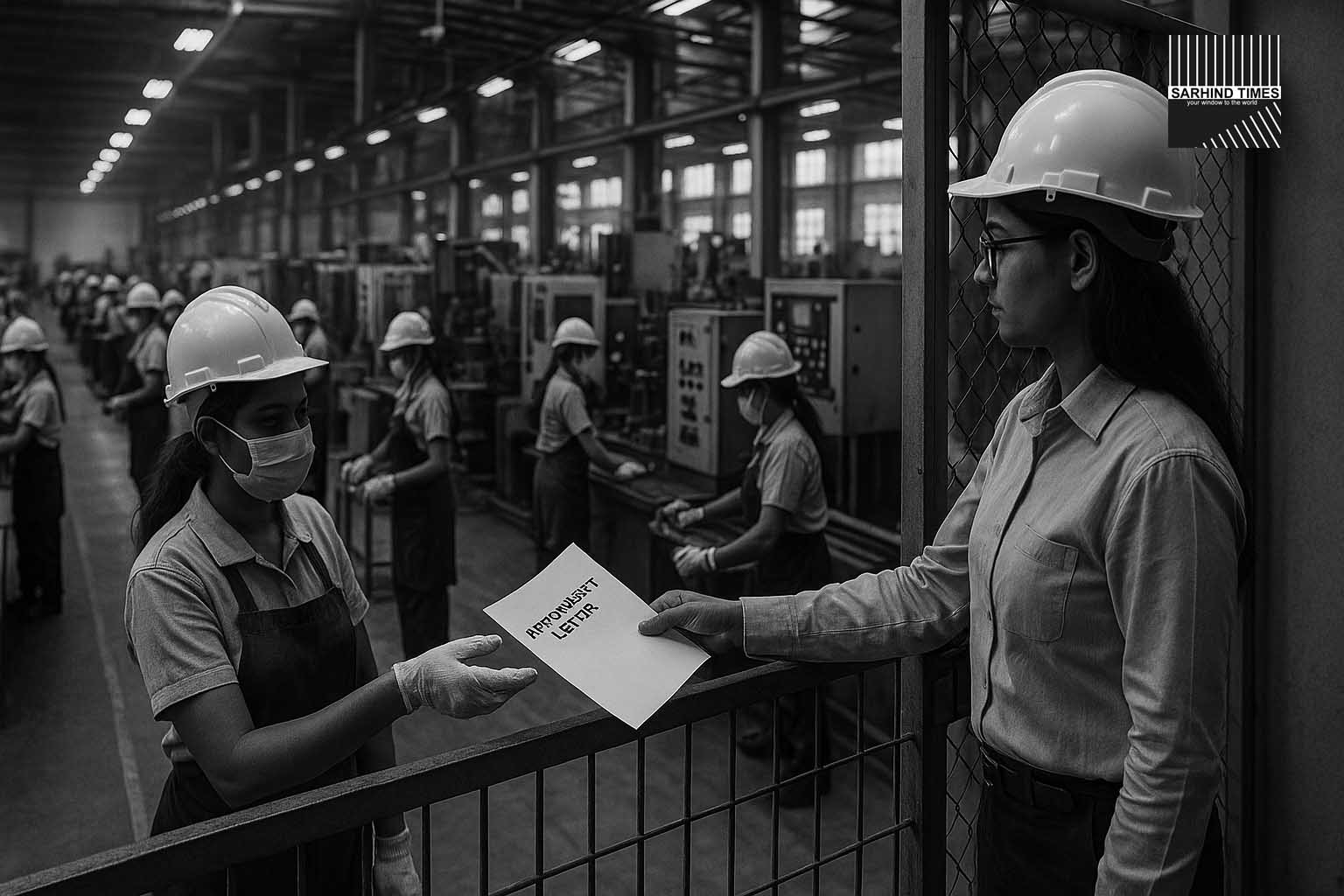
Government moves to expand women’s participation, formalize worker contracts and support ease-of-doing-business in state’s industrial units
Dateline: Chandigarh | November 12, 2025
Summary: The government of Haryana has approved the The Factories (Amendment) Ordinance, 2025, introducing substantial changes to labour regulations under the old The Factories Act, 1948. Key provisions include mandatory appointment letters for workers, regulated overtime rules, and opening all factory processes to women—signalling regulatory modernization and a push for gender-inclusive industrial growth.
The landmark amendment details
Haryana Cabinet, in its meeting on 3 November 2025, cleared the Factories (Amendment) Ordinance, 2025. The changes reflect the state’s intention to bring its industrial-labour laws in line with contemporary practices, technology usage, gender-inclusion demands and ease-of-doing-business goals. According to official announcements, the ordinance will now be placed before the next sitting of the state legislature for ratification and subsequent incorporation into the statutory framework.
Key elements of the amendment include:
- Every factory management must issue a formal **appointment letter** to every worker at the time of joining. This aims to provide clarity of terms, discourage informal work arrangements and strengthen legal protections for employees.
- Women will now be officially permitted to participate in “all types” of factory work, subject to safety compliance and regulated working conditions. The clause marks an end—or partial end—to earlier restrictions on women’s factory work in certain processes and shift patterns.
- Flexible working hours and formally regulated overtime provisions for workers are introduced. The amendment seeks to ensure a more transparent framework for extra work, compensatory rest, and overtime compensation in factories.
- The ordinance includes harmonisation of subordinate factory-rules, safety standards and reporting formats to reduce administrative burden and align with national ease-of-doing-business directives.
The government has described the amendment as one of the “most important industrial-labour reforms” passed in Haryana in recent years, aimed at boosting competitiveness, creating a gender-inclusive workforce, strengthening labour rights and signalling to investors that the state is open for modern industrial expansion.
Why Haryana is making the change now
The timing of the reform is significant. Haryana is part of the National Capital Region (NCR) and hosts many manufacturing, automotive and export-oriented units. Growth in industrial investment, supply-chain pressures, rising demand for formal labour protections and women’s workforce participation all underlie the change. The amendment signals that Haryana wants to ramp up its positioning as a front-runner for industrial modernisation and inclusive growth.
Moreover, national policy signals on labour reform, gender inclusion, formalisation of employment and competitiveness of Indian manufacturing have created momentum. By updating its factory laws, the Haryana government aims to reduce friction in compliance, attract investment and address workforce demographics of young women entering the labour market in neighbouring urban centres.
Implications for workers and women’s participation
For factory workers, particularly those in small and medium units, the appointment-letter requirement adds a new layer of protection: clarity on role, wages, shift patterns and other terms. This could reduce informal arrangements, disputes over rights and misclassification of labour. The regulated overtime provisions bring transparency: workers will know what counts as overtime, when compensatory rest is due and what pay or benefits apply.
For women, this development is especially meaningful. Historically, many factory-processes in Haryana have restricted women’s roles under shift limitations, safety concerns or local custom. Opening “all types” of factory work to women—subject to safety compliance—offers access to wider opportunities, higher wages and career progression in manufacturing, automation, ancillary supply chains and export-oriented units.
However, inclusion in practice will require careful enforcement of safety norms, shift flexibility, childcare and transportation support for female workers in industrial estates. If implemented well, this could pave way for a shift in gender balance in Haryana’s workforce and support broader socio-economic benefits such as higher female employment, empowerment and income diversification.
For industry and investment climate
From the business perspective, the reform sends a positive signal. Transparent employment terms and regulatory clarity reduce business-risk, litigation exposure and labour-relations uncertainty. The appointment-letter requirement—while adding compliance burden—may streamline hiring, audits and workforce management. Gender-inclusive workforces and flexibility in hours may help factories with shift planning, global production-scheduling and export deadlines.
The flexible hours and formal overtime rules may also assist factories in adjusting to global demand swings, seasonal work, export-cycles and just-in-time manufacturing demands. In short, the reform aligns labour law with industrial realities rather than keeping archaic restrictions in place.
Challenges, risks and enforcement open questions
While the amendment is well-intentioned, there are evident challenges:
- **Compliance burden for smaller units:** For micro units, issuing formal appointment letters, tracking overtime and safety compliance may impose cost and administrative burden. Unless the state provides support or simplified processes, some small factories may struggle.
- **Implementation fidelity:** The shift to allow women into all processes is policy-positive—but actual work conditions, safety infrastructure, transport, security and social norms in industrial belts may pose obstacles. Without enforcement and supportive ecosystem (e.g., safe shift transport, accommodation), the door may remain largely symbolic.
- **Monitoring and audit:** Appointment letters, overtime tracking, worker shift logbooks and female-worker participation require monitoring. Without additional inspection or digital / audit frameworks, the law may face the same compliance gaps seen in earlier regimes.
- **Change in power-relations:** In some traditional factory settings, male-dominant workforces and rigid shift structures may resist change. Cultural resistance to women entering certain roles may slow the anticipated gender shift.
- **Impact on informal sector:** Haryana has a sizeable informal manufacturing workforce. The reforms may either push further formalisation or drive cost-sensitive units to informal arrangements. The government must ensure that informal workers are not left behind through displacement or exclusions.
Overall, the success of the reform will depend less on the text of the amendment and more on the mechanisms, digital infrastructure, labour-inspection capacity and engagement of both workers and industry.
Legal and regulatory context
The original Factories Act, 1948 has been the foundational framework for regulation of factories in India—covering safety, health, welfare of workers, hours of work, shift-work, annual leave, and hazardous processes. Many state governments have introduced amendments or rules, but often with incremental change. Haryana’s move stands out because it specifically emphasises formal terms of employment (appointment letters) and opens women’s participation broadly—two areas often cited as bottlenecks in manufacturing economies.
In addition, the reform aligns with national initiatives such as ‘Gender Equal Future’, the National Policy on Skill Development, and central government ease-of-doing-business drives. The timing also coincides with expansion of manufacturing supply-chains in India, global re-shoring interest, and states competing for investment. Haryana wants to position itself as a high-value manufacturing hub with progressive labour laws rather than outdated restrictions.
State-level policymaking: what Haryana signals
Haryana’s decision is significant for several reasons:
- It signals that states within India are willing to bold-step in labour-regulation reforms rather than await national overhaul. That opens the possibility of reform clusters and competition among states for better labour frameworks.
- It places emphasis on gender inclusion as a central feature of industrial strategy—not as an after-thought. Given India’s low female-labour‐force participation in manufacturing relative to potential, Haryana’s targeting may attract renewed policy attention nationally.
- It acknowledges the necessity of formal employment contracts and clarity in worker terms—an acknowledgement of the shift from informal to formal economy targeting by governments globally and domestically.
Haryana thereby strengthens its credentials as a “leading reform state”—which may in turn attract investment, jobs and higher productivity—but it also raises expectations of execution, oversight and worker-benefit delivery.
What to watch for in the coming 12–18 months
The key barometers of success will include:
- The percentage increase in women employed in factory roles previously restricted; how many women move into higher-skill, higher-wage roles as a result.
- The number of factories issuing formal appointment letters and tracking overtime properly; reduction in labour disputes around informal hiring or unpaid overtime.
- The feedback from small and medium industrial units on the compliance cost, ease of implementation and business impact. If smaller units struggle, the cost-benefit calculus may shift.
- Inspection data from the State Labour Department and how many violations of the new norms are recorded (e.g., factories not issuing appointment letters, women excluded from certain work, overtime misuse). The state could set up a digital compliance dashboard to monitor progress.
- Whether this reform stimulates new investment decisions in Haryana’s industrial estates, special economic zones and export-oriented units, especially from women-led enterprises or international firms that emphasise gender equality and modern labour practices.
Wider relevance and replication potential
The Haryana amendment may serve as a template for other states wishing to update factory regulations. If the reform yields clear benefits—higher female employment, better worker terms, lower disputes and stronger investment—we may see a cascade of similar amendments in other manufacturing states across India like Gujarat, Tamil Nadu, Maharashtra, Karnataka or Andhra Pradesh.
From a national-policy vantage, the reform underscores how labour regulation—often viewed as a bottleneck for manufacturing expansion in India—can be revisited pragmatically. Formalisation of worker contracts, transparent appointment letters and gender-inclusive factories are precisely the kinds of building-blocks that global manufacturers often cite as prerequisites in supply-chain decisions. Haryana positioning itself on this axis may yield first-mover advantage.
Conclusion
The Factories (Amendment) Ordinance 2025 passed by Haryana marks a constructive step toward modernising labour-law framework in an industrialised state. The combination of women’s inclusive access, formal employment contracts, business-friendly regulation and compliance clarity presents a compelling reform package. That said, execution will define success. Implementation pathways, inspection mechanisms, support for industry and protections for informal workers will determine whether this is a transformative shift or merely regulatory update. For stakeholders—workers, women job-seekers, factory owners, investors and policymakers—the message is clear: change is underway in Haryana’s manufacturing-labour regime. The question now is how deep, swift and inclusive that change will be.



+ There are no comments
Add yours