
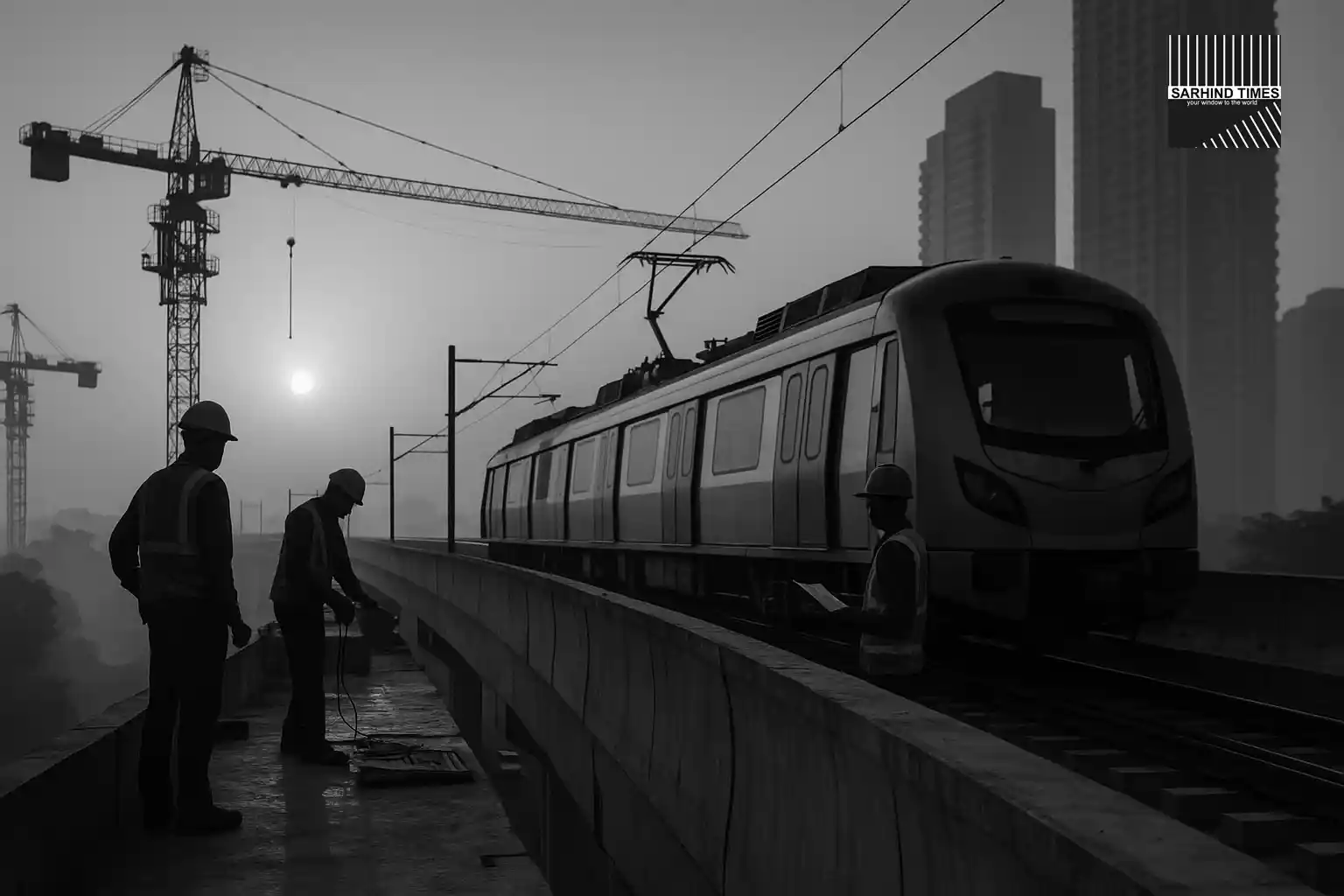
New corridor approved as city gears up for rapid growth and connectivity in Gurgaon region
Dateline: Gurugram | 13 November 2025, Asia/Kolkata
Summary: The urban rail network in Gurugram is set to be significantly upgraded with the launch of a new metro expansion corridor after an eight-year hiatus. The first phase of construction has formally commenced under the aegis of Gurugram Metro Rail Limited (GMRL), connecting key residential and commercial zones and aiming to improve commuting, reduce congestion and support the city’s infrastructural transformation.
Background and context
City of Gurugram has evolved rapidly over the past decade—from an industrial suburban zone to a major urban centre with global workforce, multi-story real estate and high traffic volumes. Transport infrastructure has struggled to keep pace with that growth. For eight years, the metro network in the region remained essentially static, with large swathes of the city inadequately served by high-capacity mass-transit links.
The decision to resume and accelerate the metro expansion reflects recognition by state and municipal authorities that the traffic, pollution and commuting time burdens are unsustainable if kept on the same trajectory. With increasing residential density in sectors such as 81, 92 and along the Dwarka Expressway corridor, reliable rail transit is no longer optional—it is a necessity.
Details of the new corridor
The approved project spans approximately 28.5 kilometres of elevated metro alignment, connecting the Millennium City Centre (MCC) in Gurugram to Cyber City, with a spur from Basai Village to the Dwarka Expressway area. This phase is expected to have 27 elevated stations and one depot, as per GMRL’s plan.
Construction contracts have been awarded and civil works are slated to begin imminently—with a target operational date around end-2028 for the first leg. The budget for this phase is estimated in the region of ₹5,452 crore, making it one of the largest infrastructure commitments in the city’s transit domain in recent years.
Why this matters for commuters and real estate
For daily commuters, the new corridor promises markedly improved connectivity: travel time between older parts of Gurugram and burgeoning employment hubs in Cyber City may drop significantly. This not only improves quality of life but also opens up housing options further from the congested centre, potentially relieving pressure on real-estate prices.
Real estate developers and property investors are already recalibrating. Areas along the metro alignment—especially near the proposed stations—are likely to see increased demand for residential and mixed-use developments. Logistics and office park operators are similarly expected to benefit from improved mobility and attraction of skilled workforce.
Institutional and regulatory factors
The project is being implemented by GMRL in cooperation with the state’s transport department and the urban local body. Key approvals have been issued for land parcels, utility relocation and traffic-management during construction. The fact that this is a public-sector-led expansion (rather than purely private-concession model) ensures stronger regulatory oversight, which experts say reduces delay risk.
That said, challenges remain. Utility shifting, land acquisition on busy corridors, coordination across municipal bodies and maintaining commuter services during construction will all require robust governance. GMRL has indicated that construction will be phased to minimise disruption; early planning includes alternate traffic routing, night-work schedules and noise-mitigation for residential areas.
Challenges and risk-factors
Despite the positive announcement, stakeholders caution about execution risks. These include:
- Delays in civil-works due to monsoon, site constraints or contractor performance.
- Budget escalations if utility diversions prove complex, or if ground conditions are more difficult than projected.
- Ridership assumptions may be optimistic in early years—actually capturing mode-shift from road to rail will require fare, last-mile connectivity and behavioural change.
- Temporary disruption to traffic and local businesses during construction could generate public push-back unless well managed.
What to watch over the coming months
Key milestones include:
- Mobilisation of contractors and awarding of major civil works packages (within next 3–6 months).
- Commencement of piling and elevated-viaduct erection (expected by first half of 2026).
- Interim commuter-service adjustments or changes (station access, traffic diversions) communicated by city-government.
- Monitoring of budget updates, station design releases and stakeholder announcements (developers, land-owners, local residents).
Strategic implications for Gurugram and region
This metro expansion is more than a transport project—it is a strategic lever for the region. It signals that Gurugram is shifting from piecemeal infrastructure fixes to large-scale, modern urban transit systems. It can catalyse densification around transit-nodes (transit-oriented development), reduce road-traffic growth, improve air-quality and strengthen the city’s competitiveness as a business and IT hub.
Conclusion
For a city that has long grown faster than its urban-mobility planning, the renewal of metro expansion after eight years is a welcome—and overdue—step. Execution will determine whether the promise translates into smoother commutes, stronger real-estate corridors and a more liveable city. For residents, developers and transport-planners alike: the countdown begins.



+ There are no comments
Add yours