

Rising smog, stagnant winds, and winter inversion push AQI levels upward again, prompting fresh advisories for schools, parents, and vulnerable groups
Dateline: Gurugram | November 16, 2025
Summary: Gurugram continues to struggle under a thick layer of smog as air quality slipped firmly back into the ‘Very Poor’ category this weekend. With AQI readings rising steadily across multiple monitoring stations, hospitals are reporting increased respiratory complaints and schools are issuing fresh precautionary guidelines. Experts blame stagnant winds, vehicular emissions, construction dust, and regional winter patterns for the renewed spike.
Air Quality Drops Again as Winter Pollution Intensifies
Gurugram, like much of the NCR region, entered the familiar annual phase where air pollution settles into a stable but dangerous pattern. Over the past three days, Air Quality Index (AQI) levels in key locations such as Sector 51, Gwal Pahari, Cyber Hub, Udyog Vihar, and Palam Vihar hovered between the high 280s and 330s—well within the “Very Poor” range.
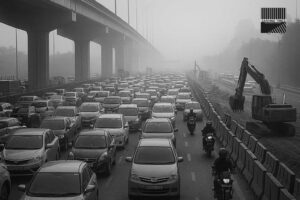
Residents reported visible haze from early morning hours. The skyline, usually sharp around sunrise, appeared blurred under a blanket of lingering smog. Commuters heading out for morning office shifts noticed an acrid smell in the air and reduced visibility on major arterial roads. Many reported mild irritation in eyes and throat while cycling or walking outdoors.
Schools Issue Precautionary Guidelines
Several schools in the city sent fresh advisories to parents, recommending that children with asthma, allergies, or respiratory difficulties avoid early morning outdoor activities. A few institutions shifted their morning assemblies indoors, while some temporarily suspended sports practice sessions.
Parents expressed concerns about sending young children out during peak pollution hours. With winter exams approaching and attendance being crucial, many are resorting to air purifiers at home and N95 masks during school commute.
Hospitals Report Spike in Respiratory Cases
Major healthcare facilities along Golf Course Road, Sohna Road, and MG Road observed an uptick in patients reporting breathing discomfort, chest tightness, wheezing, coughing, and seasonal allergies. Pediatricians noted that children under 10 were among the most affected, especially those prone to bronchitis or asthma.
Pulmonologists warn that stagnant air combined with particulate matter creates a trapped layer of pollutants at lower altitudes, making it harder for vulnerable people to breathe. Cross-ventilation at home offers limited relief because outside air remains heavily contaminated.
The Meteorological Angle: Why Pollution Is Rising Again
Meteorologists explained that light winds and temperature inversion contributed to the persistent smog. During winter nights, cold air sinks close to the ground while warmer air forms a layer above, trapping pollutants within a lower atmospheric pocket.
This layer prevents emissions from dispersing and allows particulate matter to accumulate until a stronger wind pattern arrives. The absence of rain and the continuation of dry conditions have further allowed dust and vehicle-related pollutants to linger.
Vehicular Emissions Remain the Biggest Contributor
Gurugram’s heavily motorized landscape—with thousands of daily commuters traveling between Gurugram, Delhi, and Noida—plays a significant role in the deterioration of air quality. Despite the metro expansion and rapid fleet electrification efforts, the dependency on personal vehicles remains high.
Traffic flows along stretches like Sohna Road, NH-48, Udyog Vihar, Cyber City, and the Southern Peripheral Road produce a consistent plume of pollutants. Early morning congestion, in particular, results in concentrated emissions during peak hours.
Construction Activity Adds to Dust Levels
Even with enforcement drives, construction sites across Gurugram often struggle to maintain strict dust-control norms. Water sprinkling, covering of loose materials, and proper fencing remain inconsistent across smaller sites.
With multiple real estate projects underway across sectors 58–71, 89–95, and along the Dwarka Expressway, dust contributes significantly to rising particulate matter. Residents around these clusters frequently report dust settling on balconies and cars within hours of cleaning.
Citizens Voice Frustration Over Recurring Crisis
The return of “Very Poor” air has fueled widespread frustration. Resident groups argue that the situation repeats annually with almost predictable patterns, yet policy responses remain slow and often reactive.
Many citizens expressed disappointment over the delayed implementation of long-promised measures such as large-scale mechanized street sweeping, dust vacuum systems, stricter freight timing restrictions, and green buffers around dense urban clusters.
Businesses See Rising Health-Related Absenteeism
Large corporate offices in Cyber City and Udyog Vihar reported slight but noticeable absenteeism, especially among employees with health vulnerabilities. Several companies have already shifted to flexible work-from-home options for teams that don’t require physical presence.
Cafes, gyms, walking clubs, and outdoor fitness groups have also experienced lower participation. Owners of health-focused businesses note that early winter pollution affects footfall more than any other seasonal factor.
Green Spaces Shrinking, Magnifying the Impact
Environmental groups highlight that Gurugram’s green cover has not expanded at a pace matching its construction boom. While some plantations have been carried out in Aravalli-adjacent zones, several internal sectors still lack sufficient green buffers.
Reduced tree density means fewer natural sinks to trap particulate matter. As the city grows vertically and horizontally, ground-level dust and emissions remain largely unchecked.
Government Measures and Enforcement Actions
Agencies have stepped up enforcement against uncovered construction materials, unauthorized burning of waste, and violation of dust-control norms. Mobile enforcement teams continue to issue penalties to violators.
Water sprinkling tankers have been deployed in some high-dust zones. Mechanized sweeping machines are operating along major roads like Golf Course Extension Road and parts of Sohna Road. However, the effectiveness of these measures remains mixed.
Health Experts Urge Caution
Doctors urge residents to adopt strict preventive steps during this period:
- Use N95 or KN95 masks outdoors
- Avoid early morning jogs or outdoor exercise
- Keep windows closed during peak pollution hours
- Use indoor air purifiers where possible
- Stay hydrated and use saline nasal sprays
- Monitor children, elderly, and asthma-prone individuals closely
Health professionals also emphasize seeking immediate medical attention if symptoms like breathlessness, chest heaviness, or persistent cough arise.
Residents Call for Long-Term Urban Solutions
Citizen groups are urging the government to focus on structural, long-term reforms instead of seasonal firefighting. Their suggestions include:
- Accelerating electric bus rollout across Gurugram
- Expanding green corridors and plantation drives
- Implementing stricter construction regulation compliance
- Enhancing last-mile connectivity to reduce vehicle usage
- Strengthening Aravalli conservation efforts
- Boosting industrial emissions monitoring
Winter Outlook: More Challenges Ahead
Meteorologists warn that unless strong north-westerly winds or scattered rain occur, the smog will likely persist through the coming weeks. The early winter season typically brings prolonged periods of low wind speed, making pollutant dispersion difficult.
Pollution spikes are expected to fluctuate depending on construction activity, traffic density, and regional wind patterns. Residents are advised to remain alert to daily AQI updates.
The Road Ahead for Gurugram
Gurugram remains at the center of NCR’s fast-evolving urban landscape. Yet the city continues to face the seasonal burden of toxic air that impacts public health, productivity, and overall quality of life. As it sets ambitious targets for infrastructure, digital transformation, and global investment, addressing air quality will be integral to building a sustainable urban future.
For now, as smog blankets the skyline once again, Gurugram’s millions are left hoping that this winter will not repeat the worst episodes of past years—while preparing themselves for a long season of caution.


+ There are no comments
Add yours