
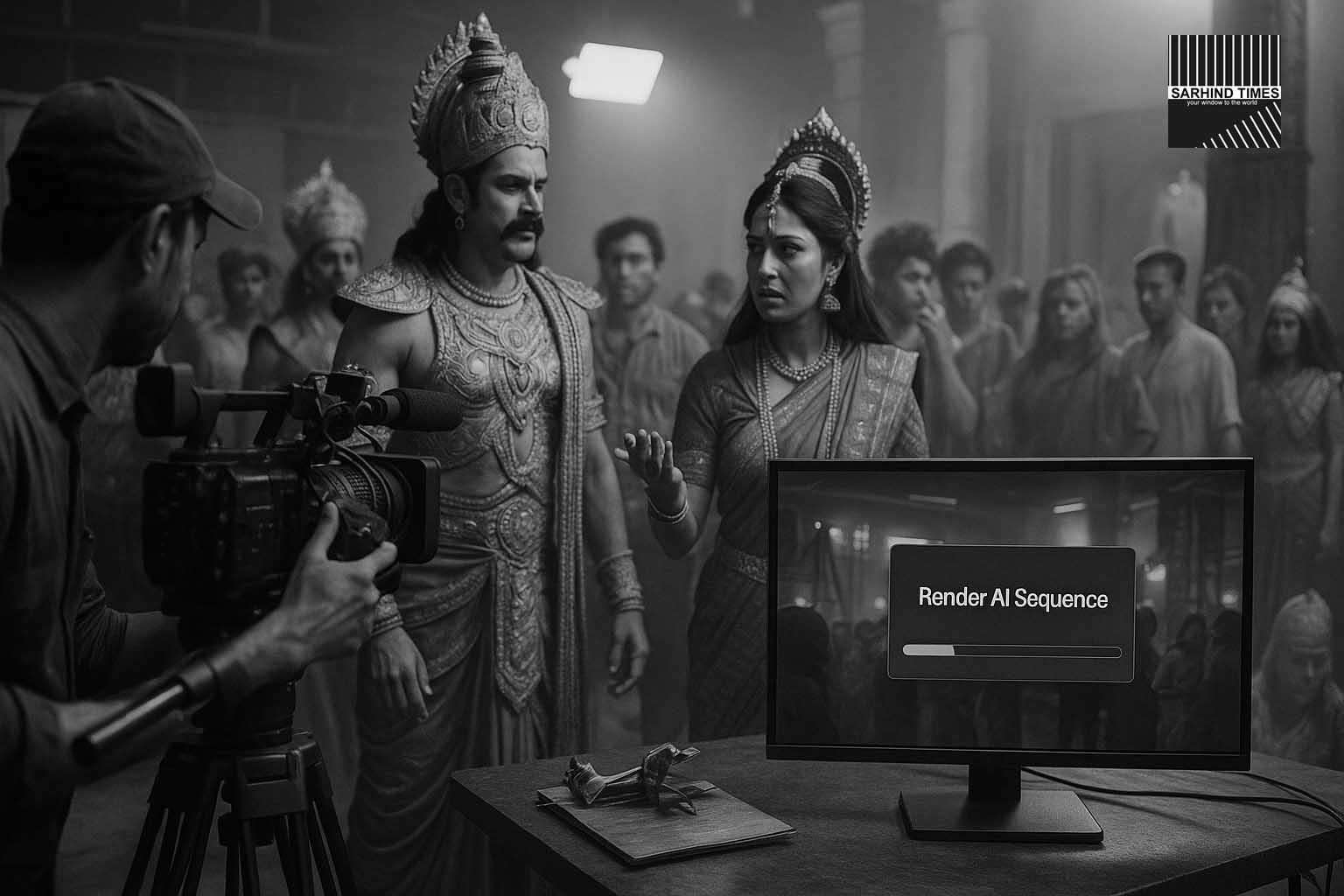
Despite its epic roots and high-budget rollout, the new series is trending for all the wrong reasons: modern glitches, apparent AI-rendered errors and an online backlash that may challenge how AI is used in creative storytelling in India.
Dateline: Mumbai / New Delhi | 14 November 2025
Summary: The latest OTT offering in India — Mahabharat – Ek Dharmayudh — has generated intense social-media buzz following viewers’ discovery of unexpected modern-day anachronisms (including a “missing wireless charger” on a mythological set). The show’s extensive use of AI-powered visuals and animation has prompted sharp commentary from both audiences and industry observers regarding the balance between technological innovation, production quality and creative integrity.
Setting the scene: myth meets machine-learning in Indian OTT
India’s streaming ecosystem has become one of the most dynamic globally — with series budgets, production values and competition rising rapidly. Within this context, the new series Mahabharat – Ek Dharmayudh aimed to revisit India’s most storied epic, the Mahabharata, through a fresh lens, leveraging AI tools for heavy visual-effects, set-extensions and post-production workflows.
However, shortly after release, audiences spotted multiple glitches that sparked memes and debate: a scene where a myth-era character appears to possess a modern smartphone charger lying on a table, visible behind the rendered backdrop; another where anachronistic lighting rigs briefly flicker like studio LEDs; and sequences where AI-generated crowd-scenes show repeating character models and uncanny-valley animation. These errors have led to a viral meme-fest and broader industry commentary on the use of AI in content creation.
Why the backlash matters: credibility, trust and creative value
At stake are deeper questions about how Indian entertainment balances ambition with craft. For traditional epics like Mahabharata, cultural and mythological authenticity is vital to audiences. When visual anomalies or technological shortcuts become visible, the immersive experience breaks down—and trust erodes.
For creators, heavy reliance on AI tools may accelerate workflows, reduce costs and enable scale, but may also introduce new kinds of risk: unnoticed artefacts, loss of human detail, over-automation of creative decisions, and eventual audience fatigue. The case of Mahabharat – Ek Dharmayudh acts as both a cautionary tale and an inflection point for how the industry handles AI.
Production and rollout: what we know so far
While full production details are still being released, the series reportedly involved extensive CGI, AI-enabled crowd-duplication, and virtual-set extensions to simulate large battle scenes. The production team also aggregated generative-AI tools for background elements, crowd movement and colour-grading. However, the tight timeline and heavy reliance on machine-rendered assets appear to have contributed to visible artefacts.
When the series premiered on the major platform, social-media reactions were swift. Memes appeared within hours of release, highlighting the “wireless charger” moment and variations thereof. The meme spread not just in India but internationally, demonstrating the global reach of India’s streaming content — for better or worse.
Industry reactions: mixed signals of innovation and concern
Optimistic voices in the production and streaming business argue that India must adopt AI tools to remain competitive globally. With rising budgets, streaming platforms and COVID-era disruption, new production models that blend AI, cost-efficiency and speed are increasingly necessary.
Critics and creators are more cautious. They emphasise that technology cannot replace craft. One editor pointed out that “even the best VFX pipeline needs human eyes – when you scale with AI you must assume some mistakes will leak and the audience will notice.” Others highlighted concerns about ethics, labour displacement and over-standardisation of creative output.
Implications for streaming platforms and content strategy
The episode raises several strategic implications for OTT platforms in India and globally:
- Brand risk: High-budget series which attract global attention must meet quality expectations. Visible errors damage reputation and may reduce subscriber retention.
- Cost vs quality trade-off: AI promises cost-savings, but if errors cost audience trust, the value proposition weakens. Platforms will need to invest in robust QA, human-oversight and possibly slower but higher-quality production.
- Audience behaviour: Social-media-driven feedback loops amplify mistakes quickly. Indian series now launch into a global feedback-machine; production teams must factor viral risk into planning and post-production timelines.
- IP and talent dynamics: As AI tools become more accessible, traditional visual-effects studios may face disruption. Indian VFX talent must up-skill; platforms may topple into a battle between speed-first vs craft-first models.
What creators should watch: how to optimise AI use in entertainment
To harness AI without sacrifice, creators and producers may consider the following best-practice steps:
- Hybrid pipelines: Use AI for repetitive tasks (crowd-duplication, background extensions) but maintain human oversight for key frames, character interaction, lighting continuity and cultural detail.
- Quality-control gates: Introduce mid-production review points where live audience panels, meme-testing sessions or internal QA can catch anachronisms before release.
- Production buffers: Factoring extra time for post-AI cleanup and manual corrections reduces risk of visible artefacts. Speed is not a substitute for polish.
- Transparent marketing: If AI-tools are used heavily, platforms may communicate novelty but also set expectations around potential limitations—a transparency that may convert risk into brand differentiator.
Long-term view: India’s streaming evolution and global positioning
India’s entertainment industry is riding a powerful global-content wave. From Bollywood theatrical releases to Indian original OTT series, the demand is far beyond domestic. But competing in this domain means meeting global-production standards—both creative and technical.
If India can develop a well-balanced ecosystem where AI tools amplify creative capacity rather than replace it, then the future is bright: more ambitious stories, larger scale, global audiences. But if machine-driven shortcuts become visible, the industry risks credibility losses, both domestically and abroad.
Conclusion: lessons from the meme-fest
The series Mahabharat – Ek Dharmayudh has become a conversation-starter — not because of its mythological majesty or narrative innovation, but due to a visible glitch-driven meme chain. That may seem trivial, but it signals a deeper fault-line: when storytelling strives to scale via AI, the smallest slip becomes a viral focal point.
For India’s creative community, the message is clear: innovation without integrity may backfire. The ambition to remake epics with AI-power is commendable—but the execution must match the expectation. The next wave of entertainment in India will be built on the convergence of technology and craft—but only if the seams are invisible, not visible to millions of memes.



+ There are no comments
Add yours