
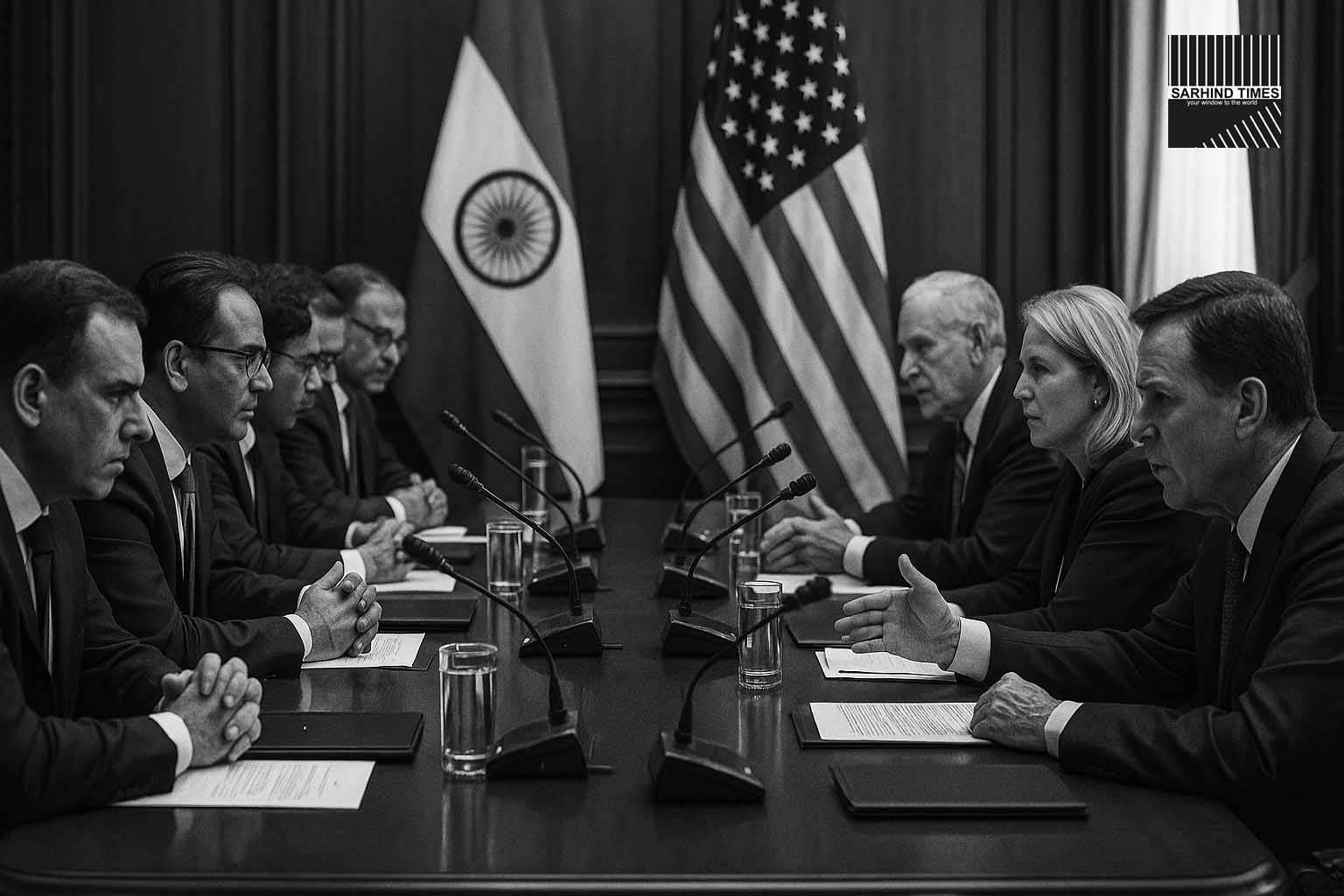
New Delhi pushes for balanced market access, tariff stability, and technology cooperation while resisting pressure for unilateral concessions
Dateline: New Delhi | November 19, 2025
Summary: India and the United States have entered the decisive phase of a long-pending bilateral trade agreement, with senior officials indicating that a breakthrough is “within reach”. Yet New Delhi has made it clear that the final deal must remain fair, reciprocal, and aligned with national economic priorities. As talks intensify, both nations confront competing interests, political pressures, and a shifting global trade landscape that makes this agreement strategically critical.
A breakthrough that has been years in the making
Talks between India and the United States for a structured bilateral trade agreement have surged forward after months of quiet diplomacy and high-level intervention from both capitals. Senior Indian officials confirmed that negotiators have resolved “more than 70 percent” of the contentious issues that previously stalled progress — including tariff disagreements, digital-trade norms, agricultural access, intellectual property concerns, and data-governance frameworks.
Yet the final stretch may be the toughest. Multiple rounds of consultations were held between India’s Commerce Ministry and the Office of the US Trade Representative (USTR), with both sides acknowledging that despite their strong strategic partnership, their economic priorities remain divergent. The US has been pressing for deeper market access in sectors such as medical devices, agriculture, e-commerce, financial services, and energy. India has rejected any approach that appears extractive, unilateral, or misaligned with domestic industry sensitivities.
The tone of the negotiations in recent weeks has shifted markedly from defensive posturing to cautious optimism. According to a senior official in New Delhi, “We are closer than ever before, but not at any cost. India will not sign a deal that undermines our manufacturing goals, our farmers, or our digital-sovereignty framework.”
This shift in tone comes amid a larger geopolitical recalibration, where both nations increasingly see each other as essential economic and strategic partners. The United States is seeking resilient supply chains, diversified sourcing of critical goods, and deeper access to large emerging markets. India aims to expand its export share, attract high-value investment, secure technology partnerships, and strengthen its position as a global manufacturing alternative.
Why this deal matters now: A transformed global landscape
The urgency behind the India–US trade agreement is not merely transactional — it is structural and strategic. The global economy has undergone significant shifts in the past three years, with disruptions in supply chains, rising protectionism, and intensified geopolitical competition among major economies. In this climate, the India–US partnership has emerged as one of the few mutually beneficial alignments capable of stabilising and advancing global commerce.
For the US, deepening trade ties with India is seen as a necessary hedge against over-reliance on East Asian manufacturing and a key strategy to build “democratic supply chains.” Washington increasingly views India as an indispensable technological, economic, and geopolitical counterweight in the Indo-Pacific region.
For India, the global reordering has created a rare window of opportunity. As multinational companies seek alternatives through the “China+1” and “friendshoring” models, New Delhi wants to position itself as the next major destination for manufacturing expansion. But to seize this opportunity, India needs more predictable market access, reduced tariff volatility, technology partnerships, and smoother integration with global value chains — factors that a well-structured bilateral deal with the US can unlock.
The core sticking points: What remains unresolved
While negotiators have made notable progress, several disagreements remain sensitive and politically charged. Among the most challenging issues are:
- Agricultural access
The US has pushed for broader market access for specific American agricultural products, including almonds, pecans, certain dairy items, and animal feed ingredients. India has resisted steep tariff cuts, arguing that such concessions could undermine domestic farmers and rural economies. - Digital trade, data flows, and e-commerce regulation
Washington has advocated greater freedom for cross-border data flows and reduced restrictions on digital-platform operations. India maintains that data sovereignty and consumer protection frameworks must remain intact. New Delhi is especially wary of proposals that could affect its ability to regulate large foreign tech platforms. - Tariff predictability and industrial policy alignment
The US wants stable tariff structures to protect its exporters from sudden hikes, while India insists on retaining flexibility to support domestic manufacturing ambitions under initiatives such as Atmanirbhar Bharat and Make in India. - Medical devices and pharmaceuticals pricing
American manufacturers are seeking market access with more transparent price-control mechanisms, whereas India argues that affordability is essential for public health. - Intellectual property (IP) norms
The two countries remain divided over patent standards, compulsory licensing, and generic drug production rights. India, as a global leader in affordable pharmaceuticals, fears that adopting stringent IP rules may dilute access and hike costs.
India’s negotiating position: Fairness above speed
Commerce Minister Piyush Goyal reiterated that India is committed to closing a balanced deal but will never accept “pressured timelines or one-sided commitments.” He added that the bilateral partnership is moving towards “trust-based economic cooperation,” but trust must be earned through mutual respect for national priorities.
Indian negotiators have pushed for:
- Reciprocal concessions rather than unilateral commitments
- Sector-specific safeguards for sensitive industries
- Recognition of India’s development needs
- Flexibility in digital-trade policy frameworks
- Stable access for Indian pharmaceuticals, textiles, and IT services
India has also made it clear that tariff reductions must reflect economic realities. “We cannot dismantle our defensive tariff framework simply because the US expects expedited access,” said a senior government source. “Tariffs are not barriers — they are policy tools to level the playing field.”
US priorities: Access, predictability, and strategic alignment
The US side, led by the USTR, is focused on creating a fair and predictable trade environment for American exporters and investors. Washington seeks:
- Lower tariffs on agricultural goods and manufactured products
- Stable rules for digital commerce
- Market access for high-value sectors such as energy and medical devices
- Stronger IP protections
- Reduced regulatory bottlenecks for US companies in India
However, the American side has signaled greater willingness to accommodate India’s sensitivities compared to earlier years. Diplomats suggest that rising geopolitical cooperation, especially in semiconductors, defense manufacturing, and clean-energy supply chains, has improved the tone of negotiations.
Political pressures in both capitals
Trade negotiations are not occurring in a vacuum. Both governments are navigating internal political pressures:
- In Washington, lawmakers are under pressure to protect American farmers and industries from foreign competition. Any trade deal perceived as undermining domestic producers may face congressional resistance.
- In New Delhi, the government must avoid appearing as though it is yielding to foreign pressure ahead of key state elections. Protecting farmers, small manufacturers, and digital sovereignty remains a political imperative.
These political realities explain why, despite the strategic necessity of the agreement, both sides are moving cautiously.
Strategic sectors shaping the contours of the agreement
While tariffs and agriculture dominate headlines, the deeper substance of the India–US trade deal is concentrated in a handful of strategic sectors that will define the next decade of bilateral economic cooperation. These include electronics manufacturing, semiconductors, clean energy, defense supply chains, and digital technologies — all areas where both nations see opportunity and mutual leverage.
1. Semiconductors and electronics manufacturing
Semiconductors have become central to the global technology race. With US companies seeking alternate production hubs beyond East Asia, India is trying to position itself as a serious contender. The US, in turn, wants resilient, democratic-aligned supply chains that reduce risk from geopolitical instability.
Negotiators have therefore explored frameworks for:
- Joint semiconductor manufacturing facilities with US firms providing technology and India offering incentives, infrastructure, and skilled workforce.
- Increased export opportunities for US chipmaking equipment to India.
- Coordinated R&D investment in India’s newly emerging semiconductor ecosystem.
The trade deal is expected to outline specific commitments in this space. India is reportedly pushing for broader access to advanced manufacturing tools, while the US wants tariff clarity for equipment and components. Both sides view this as a foundation for long-term strategic collaboration.
2. Clean energy and critical minerals
Another pillar of the agreement is the clean-energy transition. Both countries want rapid progress in renewables, but success depends on stable supply chains for critical minerals such as lithium, cobalt, nickel, and rare earth elements — almost all of which are currently dominated by China.
India has sought partnerships enabling:
- Technology transfer for battery manufacturing and storage systems.
- Joint exploration projects in friendly countries rich in minerals.
- Preferential access to US mineral-processing capabilities.
The US has asked for stronger market access for American clean-energy companies and predictable import duties. In principle, both sides agree that strengthening clean-energy supply chains is a strategic necessity, not just an economic opportunity.
3. Digital-trade rules and data governance
This is arguably the most complex section of the trade agreement. The US wants freer cross-border data flows, fewer restrictions on digital-commerce operations, and predictable rules for multinational technology platforms. India maintains that digital sovereignty is non-negotiable.
India’s core position includes:
- Critical data must remain under Indian jurisdiction.
- Large digital intermediaries must follow Indian law without exemption.
- India reserves the right to enforce competition rules on foreign tech giants.
- Any trade agreement must not undermine India’s upcoming Digital India Act.
Insiders say negotiators are exploring a creative middle-path such as sector-specific agreements or phased commitments. But this remains one of the most delicate themes of the entire negotiation.
4. Defense-industrial cooperation
Though not directly part of the trade agreement, defense supply chains form a crucial backdrop. The US wants India to increase purchases of certain advanced platforms, while India is focused on joint manufacturing, technology transfer, and co-development of systems.
Commerce officials argue that trade and defense are linked. Stronger supply chains and clearer rules can support both ecosystems. India has emphasized the need to reduce import dependency by building domestic defense capabilities with US partnership — something Washington is increasingly open to.
5. Services exports and professional mobility
India’s strength in IT, software services, engineering, and professional services has made mobility a critical concern. Any restrictions on visas, work permits, or on-site project access can disrupt India’s biggest export engine.
Indian negotiators have therefore included demands for:
- Smoother mobility for IT professionals and skilled workers.
- Reduced uncertainty in visa processing timelines.
- Tech partnership corridors allowing easier collaboration.
The US has not made formal commitments on mobility within the trade deal, but discussions are ongoing. Both nations recognize that talent movement fuels innovation, investment, and bilateral tech cooperation.
Why New Delhi is pushing back on one-sided concessions
India’s assertive stance marks a departure from earlier eras where developing nations often accepted asymmetrical trade deals to secure geopolitical ties. Today, New Delhi enjoys stronger economic confidence, rising global relevance, and more leverage in negotiations.
India’s position rests on three pillars:
1. Domestic industry protection
Whether it is agriculture, dairy, pharmaceuticals, or MSMEs, India believes that premature tariff cuts can crush domestic competitiveness. Developing economies need space to grow — not a level playing field, but a fair one.
2. Strategic autonomy
New Delhi’s foreign-policy doctrine emphasizes autonomy. Conceding too much in a trade deal would contradict this evolving philosophy. India wants partnerships but on equal footing.
3. Long-term manufacturing goals
India’s industrial policy — from electronics to energy — is structured around incentives, tariff tools, and targeted protections. Any trade agreement must reinforce, not derail, these goals. The government does not want a short-term diplomatic victory at the cost of long-term manufacturing capacity.
What both sides have already agreed on
Despite disagreements, negotiators have reached alignment on several themes:
- Tariff reductions on select industrial goods.
- Customs facilitation measures to reduce delays.
- Mutual recognition of certain quality and certification standards.
- Cooperation in clean energy, semiconductors, and critical minerals.
- Predictability frameworks for pharmaceuticals and medical devices.
- Expansion of agricultural quotas for non-sensitive categories.
- Joint working groups for technology and AI governance.
A senior Indian diplomat described the progress as “significant but not final,” noting that both sides are moving with unusual urgency because they recognize how global trade realignments create new openings.
Corporate reactions: Hope mixed with caution
India’s industry bodies, including CII, FICCI, and ASSOCHAM, have welcomed the progress but urged clarity. Manufacturers in electronics, auto components, textiles, and pharmaceuticals see the deal as a gateway to greater market access. Exporters believe that tariff stability and smooth certification norms will boost competitiveness.
Technology start-ups remain cautious. They fear that a digital-trade commitment could benefit large foreign platforms at the expense of Indian players. However, Indian SaaS and digital-payment firms are optimistic, seeing the US as a strong growth market.
Farmers’ groups remain skeptical. Any hint of agricultural concessions often triggers political reaction. The government is therefore expected to tread carefully on farm-related access.
Washington’s recalibration: India is no longer just another partner
The US has quietly shifted its approach to India in the past few years. Rather than treating New Delhi as a developing-economy market to be coaxed into concessions, Washington increasingly sees India as a strategic necessity.
Three forces drive this shift:
- China’s dominance in manufacturing and critical technologies.
- Global supply-chain reconfiguration requiring trusted allies.
- India’s growing geopolitical weight in the Indo-Pacific.
This recalibration has softened the tone of US negotiators, making space for compromises earlier considered unlikely.
Where things stand today: “Close but not closed”
Both sides acknowledge that the deal is in its final phase. Technical teams continue to meet virtually, while senior officials on both sides remain in direct communication. The next minister-level meeting is expected within days.
An Indian official summed it up bluntly: “We are close. But the last 20 percent takes 80 percent of the effort.”
The final hurdles: Why the last phase is the hardest
Negotiators on both sides agree that the closing phase of any trade agreement is where the deepest political and economic contradictions surface. The India–US deal is no exception. Despite enormous progress, several sensitive issues still require careful wording, calibrated concessions, or phased implementation. Officials privately admit that each unresolved item carries domestic political implications.
For example, reducing tariffs on specific American agricultural products may provoke pushback from Indian farm unions. Relaxing data-flow restrictions could trigger criticism from civil-society leaders and Indian tech start-ups. Similarly, offering expanded access to Indian pharmaceutical products in the US may draw scrutiny from American lobby groups.
In essence, the deal must navigate multiple layers of political economy. Both countries know that a poorly balanced agreement can become contentious after signature. Therefore, negotiators are focused not just on closing the deal but closing it sustainably.
What a “balanced” deal might look like
Experts say a balanced trade agreement between India and the US would likely include:
- Limited but meaningful tariff cuts on selective goods.
- Predictability frameworks instead of sweeping regulatory changes.
- Sector-specific commitments for semiconductors and clean energy rather than broad concessions.
- Phased openings for agriculture and digital services.
- Joint working groups to address evolving areas like AI, cybersecurity, and technology transfers.
- Safeguard clauses aligned with India’s development priorities.
In short, the deal will not resemble traditional free-trade agreements that eliminate tariffs across most sectors. Instead, it will resemble a modern, strategic, sector-focused agreement built around trust, predictability, and common interests.
What could derail the agreement?
While optimism has increased, risks remain. Several scenarios could disrupt momentum:
- Domestic political resistance in either country could make concession-based components politically unviable.
- Lobby pressures from agriculture, pharmaceuticals, or technology sectors could harden negotiation lines.
- Geopolitical spikes — for instance, tensions in the Indo-Pacific — could shift focus away from economic cooperation.
- Global recessionary pressures might cause one side to adopt more protectionist stances.
- Mismatch in expectations about digital governance and data protection could derail consensus.
Officials stress that both sides are working to avoid such pitfalls, aware that stakes are high and global observers are watching closely.
Impact on India’s economy: Opportunities and adjustments
If the agreement is signed, the impact on the Indian economy will be multifaceted. Short-term effects may include increased foreign investor interest, improved export sentiment, and a boost to sectors like textiles, pharmaceuticals, auto components, and IT services.
But the deeper benefits lie in long-term structural shifts:
- India’s integration into global value chains will accelerate.
- Manufacturing ecosystems — especially electronics — may mature faster.
- Technology transfer in clean energy and semiconductor production could scale upward.
- Regulatory predictability will attract global businesses hesitant about India’s compliance environment.
However, domestic industries must prepare for more competition, particularly in select categories where American exporters enjoy advantages. Indian manufacturers may need to introduce higher-quality standards and innovate faster.
Impact on the US economy: Access to a fast-growing market
For the US, the trade agreement offers access to one of the world’s fastest-growing consumer markets. American firms in agriculture, energy, healthcare, defense, fintech, and technology expect to benefit from lighter barriers and clearer rules.
Experts argue that the US stands to gain:
- A major export market with rising disposable income.
- A reliable partner for diversifying supply chains.
- Investment pathways in India’s growing sectors.
- Strategic leverage to balance China’s influence in global trade.
This alignment of economic and strategic goals is what makes the partnership increasingly compelling.
Voices from the strategic community
Strategists in both countries emphasize that the agreement carries implications far beyond economics. For some, it is a milestone in shaping the Indo-Pacific’s economic architecture. Others view it as a test case for trust-building among major democracies.
One senior policy analyst described the agreement as “a blueprint for a new era of cooperative trade, where like-minded countries balance domestic interests with global responsibilities.”
Another noted: “If India and the US cannot craft a balanced and fair agreement, it sends the wrong signal to the world — that even strategic partners cannot negotiate trust-based economic frameworks.”
The road ahead: What happens next?
The next few days are crucial. Another high-level ministerial discussion is expected, followed by a potential announcement of an “agreement in principle.” If both sides approve the final draft, the deal could be formally unveiled during a bilateral summit or state visit.
The remaining timeline may involve:
- Final consolidation of drafted chapters.
- Mutual legal review of commitments.
- Internal consultations with industry stakeholders.
- Cabinet-level vetting in both capitals.
- Public communication of benefits and safeguards.
If all goes well, implementation could begin in phases over the next 12–18 months.
Conclusion: A defining moment for India–US economic ties
As the world recalibrates in response to geopolitical tensions, technological disruptions, and the quest for resilient supply chains, India and the United States stand at a pivotal crossroads. Their long-pending trade agreement represents more than a commercial negotiation — it is a strategic statement about the future of democratic economic cooperation.
India has made it clear that it will not accept a hurried, one-sided agreement. The US has shown willingness to accommodate India’s developmental priorities. Both sides recognize that an equitable deal could become a cornerstone of Indo-Pacific economic stability.
Whether the agreement is sealed in days or weeks, one reality is unmistakable: the India–US partnership is entering a new phase — one defined by confidence, clarity, and the understanding that global leadership in the 21st century requires collaboration, not coercion.



+ There are no comments
Add yours