
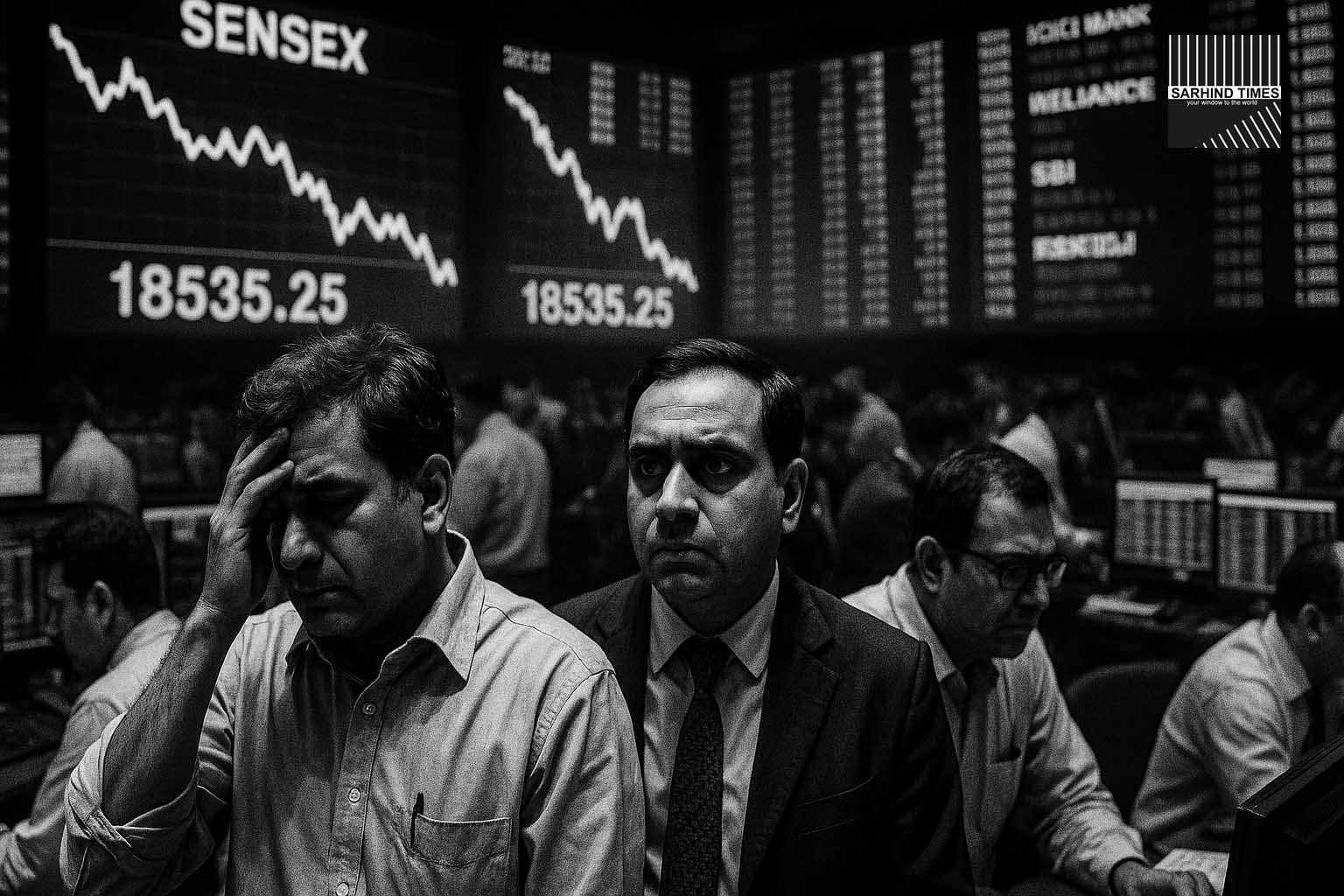
While domestic fund flows remain strong, the broader risk-off sentiment triggered by global tech corrections and delayed U.S. rate cuts is testing India’s bullish narrative.
Dateline: Mumbai / New Delhi | 18 November 2025
Summary: India’s equity markets, long supported by strong domestic investor interest, are now grappling with elevated volatility as global cues turn unfavourable. A sharp pull-back in major AI/tech stocks overseas, coupled with waning expectations of a U.S. rate cut, has spooked foreign investors and triggered outflows. Yet domestic institutional investors are stepping in, creating a complex tug-of-war. The coming weeks may determine whether India’s relative resilience becomes a strength—or whether the external shock reveals deeper fragilities.
Global tech sells trigger shock-waves
Global ambience of risk-off entered markets in early November as major technology-linked stocks plunged. In the U.S., a sell-off in AI-heavy names spread from Silicon Valley to global exchanges.Analysts attribute the weakness to inflated valuations, slower-than-expected monetisation of emerging technology platforms and rising concern over interest-rate cycles. In India, firms tied to AI infrastructure and data centres were among the first to feel the impact. The trigger is two-fold: first, the expectation of a U.S. interest-rate cut in December has been sharply downgraded—from roughly 70 % probability to near 40 %. Second, high valuations of tech companies built on future growth (AI, cloud) are being challenged by more conservative investor sentiment. As one strategist put it: “It’s a speed bump, not a wall… but we’re not out of the woods.” For India-centric tech and export-oriented sectors, this means headwinds. The global demand impulse that helped fuel last year’s rally is now in question; margin sensitivities, input-cost pressures and currency dynamics are coming back into investor focus.
The Indian market context: divergence between external flows and internal support
India presents an interesting dichotomy: while external sentiment has turned conservative, domestic channels remain active and supportive—at least for now.
On one hand, Foreign Institutional Investors (FIIs) have increased net selling. Institutional flow data shows FIIs sold ₹17,351.98 crore on one session, while purchases were only ₹12,383.76 crore—a net outward movement. In the month through November 14, FIIs are estimated to have net sold around ₹18,620.66 crore.
On the other hand, Domestic Institutional Investors (DIIs) have stepped in aggressively—buying around ₹24,572.09 crore in one day, and have cumulative inflows of ₹50,352.13 crore over the same window. The differential between DII inflows and FII outflows stands near ₹69,000 crore.
This dynamic suggests that while global risk sentiment has turned, structural domestic conviction remains. It implies that Indian markets may have an element of insulation—provided external shocks don’t escalate further.
Sectoral shifts: gaining and losing themes
Not all sectors are moving in tandem. The correction phase has triggered rotation and re-pricing.
– The IT sector has come under pressure. The Nifty IT Index dropped over 1 % in a session, led by system-integrators, cloud-software providers and infrastructure names. The reasons: weaker global demand, margin pressure, and valuation-reset fears tied to AI hype.
– Conversely, banking and public-sector banks have seen relative strength. The Nifty PSU Bank Index gained about 1.17 % in a recent session, supported by hopes of upcoming monetary easing and improving asset-quality.
– Other defensive sectors—pharma, FMCG—also gained modest traction as investors sought refuge from the tech-driven volatility.
The message: the era of broad-based momentum may be pausing; investors are recalibrating bets toward sectors with clearer earnings and less dependency on global risk appetite.
Valuation spotlight: what’s changing?
Global valuations across many tech names had stretched far beyond fundamentals, especially those reliant on future-growth narratives such as AI/data-centres. In many cases, valuations assumed exponential growth over five-to-ten years—a risk environment that is now being reassessed.
In India, the broader market’s valuations remain moderate compared with previous peaks; the narrower tech segment is where the strain is most visible. As one analyst noted: India may be “a relative safe haven” simply because it has fewer frothy valuations tied purely to AI hype.
That said, the recalibration is not without risk. If global tech remains under pressure, even Indian exporters and platforms may be impacted via demand-channels, margin erosion or currency/interest-rate linkages.
Monetary policy, interest-rates and currency interplay
< unfolding story in markets is the interplay between U.S. monetary-policy signals, global risk sentiment and emerging-market flows—and India is part of that narrative. The weakening probability of a U.S. rate cut in December (now near 40 %) means global “carry-trade” flows may reverse. Emerging-market equities, which had benefitted from lower rates and higher risk-appetite, may now face headwinds. For India, this is relevant in several ways: – A stronger U.S. dollar makes rupee-based earnings comparatively weaker, and heightens inflation/import-cost risks. – Interest-rate expectations feed into valuations: higher discount-rates reduce the present value of future earnings—a key risk for growth-oriented firms. – With global flows under pressure, India may become more dependent on domestic liquidity—which introduces concentration risk and structural asymmetries in market support.
Near-term chart levels and trade setup
For traders and short-term investors, the technical landscape offers clues about where things may head next.
According to trade-set-up notes ahead of the session on 17 November, the Nifty 50 has closed above the important 26,000 mark and immediate upside points are 26,100 followed by 26,300, provided the index sustains this zone.Support levels are around 25,900-25,800. A break below could open a test of 25,700-25,500.
From a flow-perspective, monitoring FII net flows, DII buying intensity, India VIX (volatility index) movements and scheduled global cues (Fed commentary, U.S. employment, China data) will be critical.
What does this mean for Indian investors and stakeholders?
The convergence of global uncertainty and domestic resilience creates a delicate balancing act. Some practical implications:
– **For retail investors**: Volatility is elevated—positions in high-valuation growth names (especially those tied to AI/infrastructure) should be scrutinised for fundamentals, earnings delivery and margin resilience. Diversification and risk-control become more relevant.
– **For long-term investors**: The current market pull-back may represent an opportunity—especially in sectors with strong secular themes (defence, domestic consumption, infrastructure) rather than global-growth dependent names. As one large Indian broker suggested: “Go niche-tech over large-cap IT, stay invested for 3-5 years.”
– **For corporates and businesses**: The environment underscores the importance of balance-sheet strength, margin clarity, global-demand diversification and currency risk management. Exporters and global tech-service firms need to factor in slower overseas spending.
– **For policymakers and regulators**: The divergence between foreign and domestic flows emphasises the need for structural depth in Indian markets. Over-reliance on domestic buying may create liquidity-traps, synthetic buoyancy and unexpected reversals when flows shift. Further, currency strength/stability, inflation control and macro-policy clarity will matter more than ever in attracting foreign capital.
– **For global investors**: India’s equity market may appear relatively insulated from the global tech collapse—but this does not mean immunity. Indirect channels (global demand, commodity/input costs, risk-off sentiment) still connect the Indian market to the global cycle. Institutional investors will watch for earnings surprises and corporate commentary tied to global headwinds.
Key risk-factors to monitor
Several risks may tip this phase into a deeper correction rather than a benign pause:
– A sharper than expected global tech draw-down, leading to cascading sell-offs beyond the tech sector into domestic cyclical names.
– A surprise hawkish move from the U.S. Federal Reserve (or a delay in rate cuts) that further tightens global risk appetite and escalates carry-trade reversals.
– Deterioration of macro data in India (inflation, growth miss, corporates downgrading guidance) that undermines domestic institutional conviction.
– Currency depreciation and capital outflows if foreign investors lose confidence in India’s growth-oriented sectors.
– Market structure risk: heavy reliance on domestic institutions may create liquidity bottlenecks if they pause buying or reverse direction.
Monitoring these risk-levers closely will be essential over the coming weeks.
Why this pull-back might actually be constructive
While headlines may focus on volatility and risk, there is an argument that this phase could serve as a healthy recalibration rather than a crash:
– Markets that run too far too fast—with inflated growth expectations—often require a correction to reset valuations and rebuild sustainable growth narratives. The global AI-tech euphoria may have reached that inflection.
– India’s broader market still has structural growth drivers—consumption, urbanisation, infrastructure build-out, defence spending, digital adoption—that are less directly exposed to global tech swings. This provides longer-term ballast.
– The current divergence between FII outflows and DII inflows suggests that domestic confidence remains intact; if managed well, this could reduce dependence on fickle global flows.
– Tactical corrections provide entry points for value investors. Sectors that were overlooked during the tech-frenzy may get fresh attention.
In short, the market may be in a phase of consolidation rather than collapse—provided policymakers, companies and investors use the pause to re-align rather than panic.
Looking ahead: what to watch for until end-2025
Several key triggers will shape how this episode unfolds:
– Clarification from the U.S. Federal Reserve on rate-cut timing—any shift toward more hawkish tone will ripple through emerging markets.
– Earnings commentary from large Indian companies, especially those with export or global-tech orientation. Any signs of margin deterioration, deal-slowdown or currency stress could trigger re-pricing.
– Flow data: continued FII selling juxtaposed with strong DII buying will test how long domestic institutions can offset external headwinds without concentration risk.
– Sector-rotation signals: whether money moves from tech toward value/defensives, and how quickly that shift becomes permanent.
– Technicals: break-down below key support bands (such as Nifty 25,700-25,500) could open a deeper corrective phase. On the upside, holding above 26,000-26,300 would support confidence.
– Macro surprises: India’s inflation trajectory, rupee stability, GDP growth prints, and global demand for Indian exports will all matter more in this volatility phase.
– Sentiment: whether retail participation pulls back. If retail investors who joined the rally now exit fearing global risk, that could accelerate corrections. Conversely, if they stay put, consolidation may be shallow.
Conclusion: Calm before the next move?
< Indian equity market finds itself at a junction: global headwinds—particularly fixation on tech valuations and monetary-policy uncertainty—are pressing it from the outside; domestic structural strength and institutional support are anchoring it from the inside. Which force wins will determine how risk calibrates going into 2026. If domestic buying continues and global risk remains contained, India could emerge as one of the less-damaged markets in this volatility wave. But if external shocks deepen or spill over into broader sectors, the market may confront a more serious correction phase. For investors, the path ahead calls for increased vigilance—not panic, but realism. Growth names must now justify their valuations, tech-linked bets need scrutiny, and sector-rotation may become the dominant theme. For companies and policymakers, clarity, resilience and structural depth—not just high-growth narratives—will be the differentiator. The question isn’t whether the market will fall—it’s whether it will re-base. And during a re-base phase, discipline, diversification and structural assessment matter more than chasing momentum.
In the weeks to come, this volatility may feel uncomfortable—but it could also be a useful reset before the next leg of India’s equity story. The key will be staying informed, staying selective, and treating this not as a panic moment, but as a readiness moment.



+ There are no comments
Add yours