
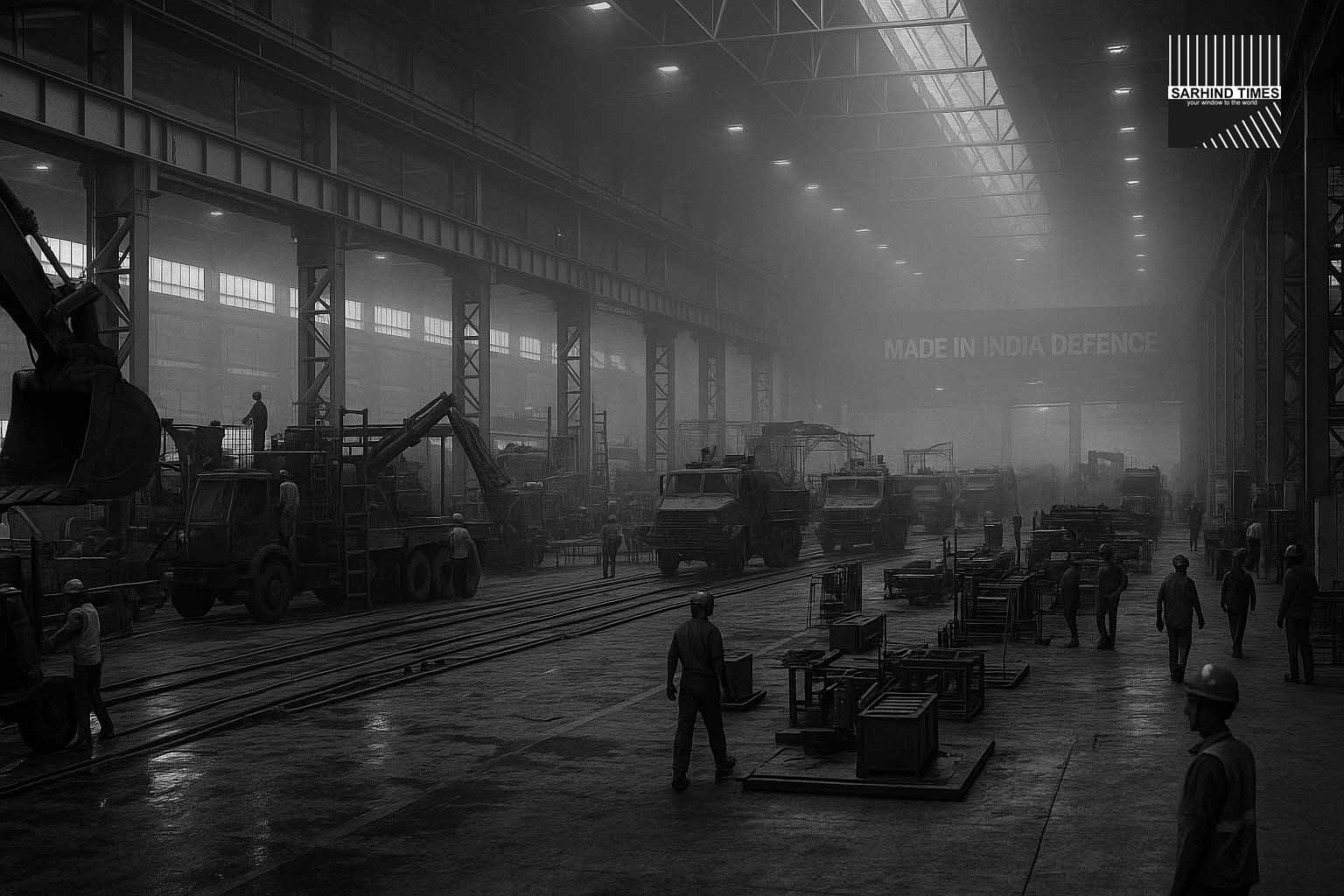
Government’s self-reliance push accelerates industrial build-out, but execution and export scale remain key challenges
Dateline: New Delhi | November 16, 2025
Summary: India’s defence manufacturing sector has reached a new milestone, with production touching ₹1.51 lakh crore in FY 2024-25 and exports rising significantly. The government is betting heavily on building the infrastructure — manufacturing parks, test facilities, private-industry involvement — to sustain this growth. But as infrastructure expands, questions linger about scale, supply-chains, export markets and integration with global defence ecosystems.
A Major Milestone for the Sector
The Ministry of Defence announced that in the fiscal year 2024-25, India’s defence production crossed the ₹1.51 lakh crore mark, with public-sector defence producers contributing over 70 % of that output. This marks the fastest growth in recent years and signals a turning point in India’s ambition to become self-reliant in military manufacturing.
Defence exports also reached new highs, registering figures in the thousands of crores, a testament to rising global competitiveness of “Made in India” hardware.
Infrastructure and Ecosystem Build-out Underpins the Jump
Behind the headline numbers lies a massive infrastructure effort—manufacturing plants, private-sector integration, test benches, auxiliary supply-chains, export logistics and dedicated defence corridors. Key developments include:
- Defence manufacturing clusters such as the Uttar Pradesh Defence Industrial Corridor, which has attracted major land-allotments and MoUs for major units.
- New state-of-the-art test-facilities and integration-centres being inaugurated or planned for missile systems, armoured vehicles and advanced electronics.
- Significant private-sector involvement, both domestic and foreign collaboration, building capacity for large-scale production of high-value systems.
These infrastructure moves are aimed at converting intent into capability—large factories, dedicated real-estate, supply-chain anchor tenants and export-oriented units.
The Export Push and Global Integration
While domestic production has surged, exports remain a major strategic element in the infrastructure build-out. The government has set medium-term export targets that require both manufacturing scale and robust supply lines.
Export infrastructure—ports, logistics, trade-agreements, offset-arrangements—is being woven into the manufacturing fabric. Defence manufacturing corridors are expected to double as export hubs, not just domestic supply points.
Private Sector Role: From Supporting Cast to Core Player
One of the distinguishing features of the infrastructure surge is the expanding private sector footprint. Historically dominated by large state-owned entities, the defence ecosystem is now inviting private capital, JV-models and foreign partnerships.
Private firms are setting up production lines for missiles, ammunition, launchers and subsystems. Infrastructure investment is moving from single vendors to cluster models—where workshops, suppliers, test labs and logistic hubs co-exist in a defined zone.
Supply-Chain and Ancillary Infrastructure: The Next Frontier
A manufacturing plant alone does not ensure competitiveness. The usable infrastructure now extends to ancillary units—composites, electronics, precision machining, foundries, test benches, calibration labs, logistics parks and export-oriented customs corridors.
Many of the new defence corridors and clusters emphasise this full stack: land for large factories, roads, utilities, testing facilities and export docks. The push also includes vendor development programs to ensure local sourcing of critical components.
Regional Infrastructure Impacts: Jobs, Skill, Urbanisation
The infrastructure expansion has substantial regional implications. States hosting manufacturing clusters are seeing land-use conversion, new employment hubs, industrial townships and an ecosystem of suppliers. These developments are likely to fuel local economies, increase skill levels and create industrial corridors beyond metro regions.
For example, aerospace component manufacturing is poised to double its market by 2030—another infrastructure stimulus for regional economies.
Implementation Challenges: Execution Bottlenecks Remain
Even with the surge, significant challenges lie ahead. Building infrastructure is one thing; making it efficiently operative is another. Key constraints include:
- Supply-chain bottlenecks—domestic suppliers for advanced electronics, composites and sensors remain limited.
- Skilled manpower—manufacturing of defence hardware needs engineers, precision operators, and test-lab engineers, many of whom are in short supply.
- Regulatory and approval delays—land allotments, environmental clearances and export-licensing slow the ramp-up.
- Global integration—accessing world-class technologies and partnerships often involves export controls, geopolitics and tech-transfer constraints.
Analysts warn that unless these execution issues are addressed, the infrastructure build-out may under-deliver relative to its promise.
What Infrastructure Means for India’s Strategic Posture
The infrastructure push is not simply industrial—it has direct strategic implications. A domestic manufacturing base for defence reduces import dependence, shortens procurement lead times, strengthens deterrence and gives India greater freedom to act.
As India’s geopolitical environment grows more complex—border disputes, maritime challenges, technology-led warfare—the ability to produce, test, deploy and sustain systems rapidly becomes a force-multiplier. Infrastructure investment here equates to strategic insurance.
Outlook: Infrastructure Expansion with Eyes on Delivery
The roadmap ahead hinges on three tracks: ramp-up of manufacturing lines, export deployment and global market penetration, and maturity of supply-chains and workforce. If the infrastructure architecture aligns with execution, India could become a major global defence supplier by the end of the decade.
On the flip side, if bottlenecks persist, costs rise and export markets don’t expand, the infrastructure build-out may partly lose momentum or yield sub-optimal returns.
Conclusion: Building the Backbone of a Defence-Industrial Nation
The milestone of ₹1.51 lakh crore of production is impressive—but it is just the visible tip of a much larger infrastructure transformation underway in India’s defence manufacturing ecosystem. Factories, corridors, test-beds, export logistics, vendor clusters—all are being built simultaneously. The infrastructure challenge has shifted; scaling it, sustaining it and integrating it globally will determine whether this becomes a leap rather than just a step.
For India, the infrastructure narrative now matters as much as the production figure. Success will be measured not just by how much is produced—but by how efficiently, reliably and globally competitive it becomes. The next few years will define whether ‘defence-manufacturing India’ is a slogan or a sustained reality.



+ There are no comments
Add yours