
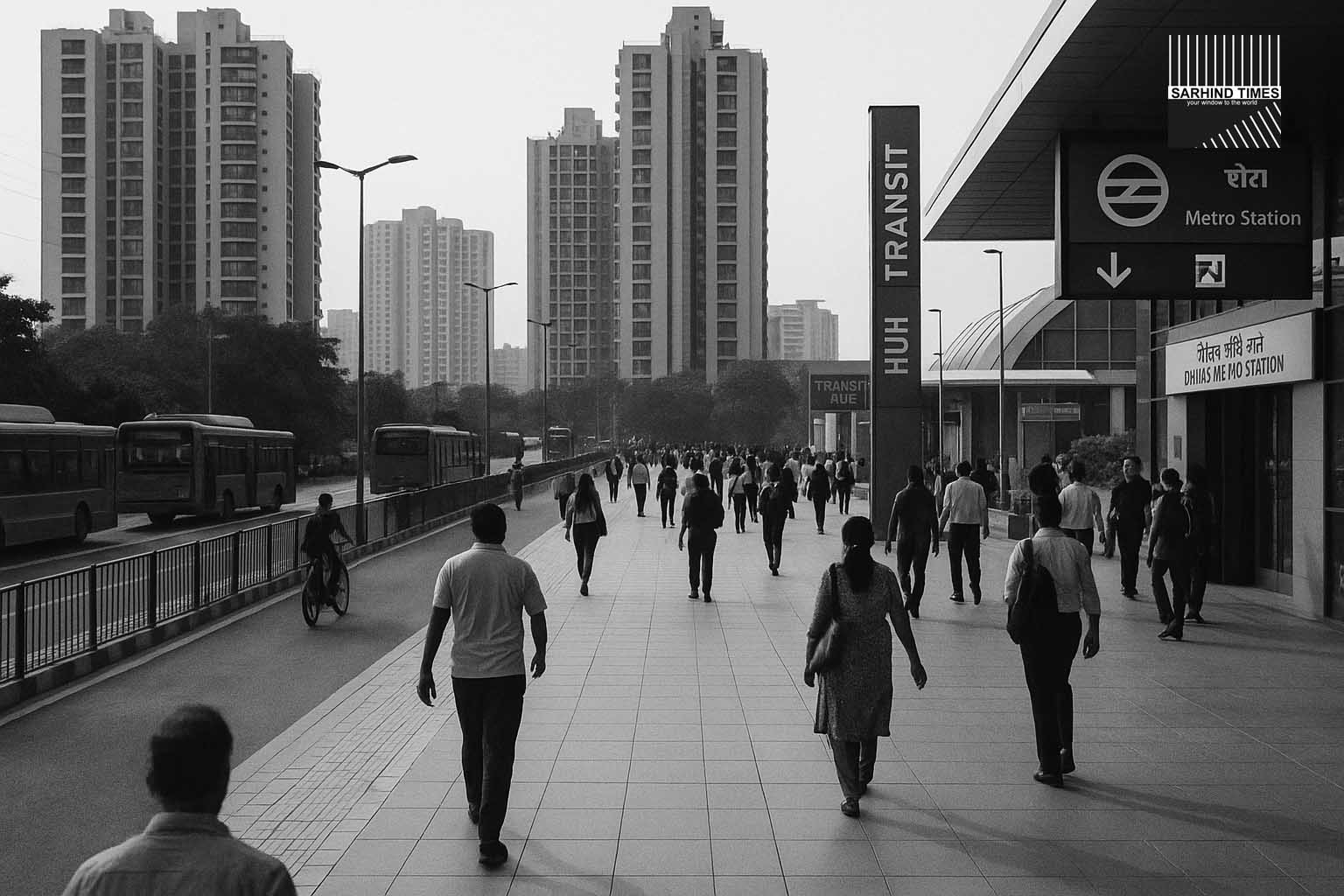
New policy aims to reposition the capital’s mobility model around pedestrian access and high-quality public transit
Dateline: New Delhi | 14 November 2025
Summary: The government of the National Capital Territory of New Delhi has announced a sweeping transport policy, the Delhi Transport Policy 2025, which places walkability, first-mile/last-mile integration and transit-oriented development (TOD) at its core. The keystone measure: ensuring every citizen is within 500 metres of a bus or metro station. The initiative signals a major shift away from car-centric urban growth toward a denser, cleaner, more equitable mobility paradigm—but implementation challenges remain formidable.
1. Why a transport policy reboot now?
New Delhi’s transport system is at an inflection point. The capital faces chronic traffic congestion, rising pollution, sprawling suburbs, and a commuter culture heavily skewed toward private-vehicles. Despite investments in metro expansions and bus fleets, the city’s mobility model remains largely radial and car-dependent.
At the same time, global urban-mobility trends emphasise dense, mixed-use corridors, walkable neighbourhoods, and transit-first planning. For Delhi, aligning with these trends is not just about easing congestion—it’s about climate commitments, inclusive urban growth and de-risking future infrastructure costs. The new policy marks the capital’s strategic pivot.
2. Core features of the Delhi Transport Policy 2025
The policy outlines several pivotal measures—among them:
- 500-metre access target: Every residential location in the NCT is to be within 500 metres (roughly a 5-10 minute walk) of a primary public-transport node—bus, metro, or the upcoming regional rail. The goal: shift pattern of mobility from private-vehicle > public-transit.
- Transit-oriented development (TOD) zones: Around major stations, the policy mandates denser mixed-use development, pedestrian-first design, limited parking, and improved feeder-bus/cycle connectivity.
- Feeder-and-first-mile connectivity: Emphasis on feeder buses, shared mobility, cycle-lanes, pedestrian malls and redesign of bus stops and sidewalk networks to ensure safe, efficient access to major transit nodes.
- Reallocation of road-space: The policy threatens reduction of kerbside private-vehicle parking around transit zones, dedicated bus/cycle lanes, expanded pedestrian paths and stricter enforcement of private-vehicle restrictions in selected corridors.
- Mobility demand-management incentives: The policy contemplates differential pricing for parking, congestion charges in core zones, incentives for low-emission vehicles, and support for shared-mobility services.
- Governance and data-driven delivery: A “Mobility Observatory” will be set up to monitor usage, pedestrian flows, transit uptake, and parking densities. Regular public reporting and target-based funding for municipal wards are envisaged.
3. Strategic logic: what this shift means
This policy is not about small tweaks—it implies a systemic change in how Delhi builds, moves and lives. The strategic logic includes:
Less private-vehicle dependency: Unless mobility patterns change, Delhi risks ever-worsening congestion, pollution and lost productivity. A 500-metre transit access goal directly challenges the car-centric model.
Equity and inclusion: Walkable access and strong transit favour all income groups—not just car-owners. It particularly benefits women, older citizens, persons with disabilities and lower-income commuters who rely on public transit.
Climate and environment: Travel-demand shifts, fewer private-vehicles, better use of public transit and active mobility (walking/cycling) reduce carbon emissions, local air-pollution and fuel dependency.
Land-use and economic uplift: Transit-oriented nodes tend to attract real-estate investment, densify development, and improve land efficiency. The policy opens opportunities for mixed-use hubs, last-mile retail, and intensified activity around station precincts.
4. Implementation roadmap and timelines
The policy articulates a phased rollout:
- Short-term (next 12-18 months): Conduct an “access-audit” of all neighbourhoods against the 500-metre target, redesign feeder-bus routes in pilot wards, launch pedestrian-corridor upgrades around 10 multi-modal hubs, update municipal zoning for TOD around stations.
- Medium-term (3-5 years): Redevelop major transit precincts into TOD zones, expand cycle-lanes to 500 km +, integrate feeder-and-micro-mobility solutions, implement parking pricing in 30 % of wards, enforce reduced parking minimums in new developments.
- Long-term (5-10 years): Full rollout of core policy—majority of households within 500 metres of transit, parking-free “station belts”, integrated mobility cards across bus/metro/last-mile, large-scale regeneration of under-utilised transit-adjacent land. Municipal & state funding lines will be aligned via the Mobility Observatory data-system.
5. Immediate reactions and stakeholder views
Urban-planning community: Praised the 500-metre standard as bold and internationally aligned; but flagged that land-use inertia, enforcement, inter-ministerial coordination and retrofit costs will pose major challenges.
Real-estate developers: Broadly positive: densification around stations creates opportunity for commercial/residential premium. However, developers remarked that changing zoning, parking norms, and infrastructure upgrades will require incremental cost and may delay approvals.
Transport-operators and municipal bodies: Expressed cautious optimism—but highlighted need for feeder-bus fleet scale-up, dedicated cycle-lane infrastructure funding and coordination among agencies (transport, urban-planning, municipal). They emphasised that metrics and monitoring (via Mobility Observatory) must be operationalised fast.
Citizen groups and accessibility advocates: Welcomed the inclusive mobility focus but stressed that 500-metre rule must ensure accessibility for persons with disabilities, safe walking paths, lighting, way-finding, and safe crossings—physical quality matters, not just distance measure.
6. Key risks and obstacles
Despite strong vision, risks loom large:
- Infrastructure deficit: Many existing neighbourhoods do not have safe sidewalks, lighting, continuous walking paths or dedicated cycle-lanes. Catch-up retrofits may be expensive and slow.
- Coordination challenge: The policy spans multiple agencies—Transport Department, Delhi Metro Rail Corporation, Municipal Corporation of Delhi, Delhi Development Authority, planning, traffic police. Without clear institutional ownership, delivery may stall.
- Behavioural inertia: Citizens used to private-vehicles may not switch unless transit frequency, reliability and comfort improve significantly. Distance alone doesn’t guarantee mode-shift—time, cost, quality matter.
- Parking and enforcement: Reducing parking around transit nodes and restricting private-vehicle access will require political will, enforcement muscle and viable alternatives for those displaced. Without that, parking reform may backfire.
- Funding and maintenance: Sidewalks, feeders, cycle-lanes, smart-shelters all cost money and require upkeep. The policy’s success depends not only on initial investment but sustained maintenance and operational budgets.
- Transit-node capacity: Expanding access only makes sense if transit frequency and capacity are sufficient. If buses and metro services remain underserved, the 500-metre rule may create false promise.
7. Economic and social impacts
If implemented well, the benefits could be multi-fold:
Reduced travel-time and cost: With more local public-transit access, households could switch from private-vehicles, reduce fuel and maintenance cost, and cut time lost in congestion. Over time, improved mobility translates to productivity gains and lower household transport burdens.
Inclusive access: Low-income and disadvantaged groups tend to live further from transit. By narrowing access gaps, the policy can support social mobility, job access, and more equitable urban participation. Women and older citizens may benefit from safer, closer access to mobility.
Land-value uplift: Areas near transit nodes may see increased demand, higher rents/premiums, and densification. Transit-oriented development can spur mixed-use growth instead of sprawl. Real-estate sectors may shift focus toward station-precinct developments.
8. What to watch: indicators and milestones
In the coming 12–24 months, some key indicators will reveal how fast the policy moves from paper to pavement:
- Publication of the “access-audit map”: percentage of neighbourhoods within 500 metres of transit stations, baseline data.
- Number of feeder-bus route redesigns rolled out, cycle-lane kilometres added, and sidewalk upgrades completed in pilot wards.
- Percentage of new residential or commercial projects incorporating TOD norms and reduced parking minima.
- Transit-mode-share trend: increase in bus/metro ridership in targeted areas, reduction in private-vehicle usage.
- Private-vehicle parking bays removed or converted near station zones, enforcement data on parking restrictions.
9. Strategic implications for Delhi’s growth trajectory
Shifting to a transit-first city has longer-term implications for Delhi’s urban form. Instead of ring-roads, fly-overs and expressways, the policy signals densification around nodes, mixed-use growth and fewer long-haul commutes. For the real-estate ecosystem, the policy may steer investment toward station-adjacent parcels and away from far-flung peripheral sprawl.
From a governance standpoint, the policy places mobility at the core of urban planning—not an after-thought. It represents an attempt by Delhi’s leadership to knit together transport, land-use and infrastructure into a coherent mobility ecosystem, rather than disjointed add-ons.
10. Conclusion: an ambitious reset with execution hurdles
The Delhi Transport Policy 2025 sets an ambitious and timely agenda. The 500-metre access target is bold and internationally aligned—if delivered, it could reshape the capital’s mobility landscape, reduce emissions, improve livability and anchor more equitable transport access.
However, the scale of change required is massive. It demands thousands of sidewalk upgrades, feeder-bus redesigns, station-precinct reinvention, and major coordination among agencies. Behavioural shifts, enforcement of parking reform and sustained funding remain the largest unknowns. The coming years will test whether Delhi can turn vision into value, and whether the walk-to-station promise becomes reality rather than policy aspiration.



+ There are no comments
Add yours