
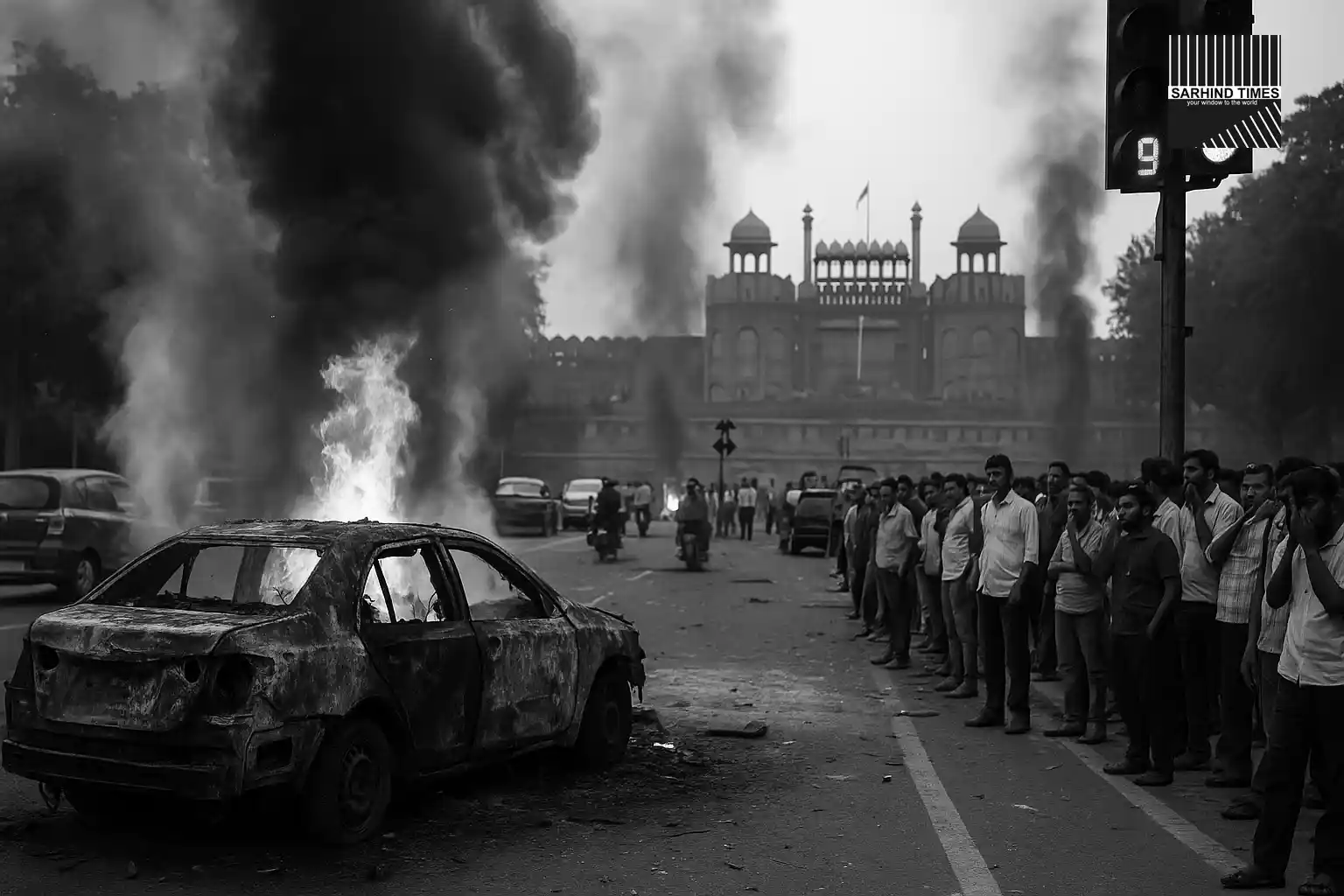
In a high-stakes probe, authorities treat the car blast outside the historic landmark as a terrorism incident with cross-border implications
Dateline: New Delhi | 13 November 2025, Asia/Kolkata
Summary: A deadly car explosion near the Red Fort Metro station has been officially classified as a terror attack by Indian authorities. Investigators point to a vehicle-borne explosive device, detained suspects, and potential links to a terror cell operating across Delhi and Jammu & Kashmir.
The incident and immediate fallout
On the evening of 10 November 2025, a white Hyundai i20 travelling along Netaji Subhash Marg near the Red Fort Metro station in Delhi exploded at approximately 6:52 pm IST. The blast ripped through the vehicle and triggered a secondary fire that engulfed adjacent vehicles, shattered windows in nearby buildings and sent shock-waves through the capital’s old city core. Witnesses described the moment as a sudden fireball, followed by screams, debris and chaos.
Initial government figures confirmed at least eight people were killed and more than twenty wounded in the explosion. Within 48 hours the toll was revised upward and the incident prompted a nationwide security review.
Responding swiftly, the Union Cabinet declared the incident a “terrorist attack by anti-national forces” and ordered the case to be handled under the anti-terror legislation Unlawful Activities (Prevention) Act (UAPA). The National Investigation Agency (NIA) was pulled into the investigation, marking a major escalation in the response.
Vehicle trace, explosive forensic leads
Investigators quickly zeroed in on the vehicle used in the attack. CCTV footage showed the car entering a parking zone adjacent to the Red Fort at about 3:19 pm, then sitting idle for over three hours before moving and exploding at the traffic light. Forensics revealed traces of ammonium-nitrate based explosive which, when combined with high-speed incendiary fire, caused extensive blast damage — including ruptured eardrums and internal organ damage among the victims.
Linking the vehicle to a Faridabad-based car dealer, the probe identified a chain of sales and transfers that travelled from Jammu & Kashmir to the National Capital Region. Authorities detained several individuals connected to this chain and seized additional vehicles of interest.
Terror cell and cross-border angle
In ongoing raids in Jammu & Kashmir and the NCR region, police recovered large caches of weapons and bomb-making materials — including gel sticks, detonators and circuit boards. Two medical doctors from Kashmir working in Faridabad have been detained, raising concerns over an entrenched terror network utilising professionals to facilitate planning and logistics.
Sources within the investigation say the vehicle-bomb may have been intended for a higher-profile target, possibly for 26 January (Republic Day) but was triggered prematurely after the module became exposed. A senior intelligence official described the module as “suicide-fidayeen style” and “white-collar supported”, blending academic cover with militant planning.
Political and national security implications
Prime Minister Narendra Modi and Home Minister Amit Shah jointly convened a high-level review under the Cabinet Committee on Security. The incident revived tensions between India and Pakistan and prompted heightened alerts at borders, airports and major religious sites.
Some opposition voices and activists questioned how the attack could happen in one of the country’s most secure zones at a peak time. They called for accountability for local security lapses, especially in vehicle parking validation in old city zones. Opposition leaders emphasised long-term implications for urban counter-terror operations and freight/vehicle-monitoring infrastructure.
Urban security and vehicle-based threats
The attack underscores the evolving nature of urban terrorist threat-vectors in India’s metropolises. Instead of large car-bomb truck attacks, this used a compact passenger vehicle — parked, moved and detonated at a busy signal near a major cultural landmark. Urban security experts say this model is harder to detect because an everyday vehicle blends in until moments before detonation.
To counter such risks, agencies are upgrading CCTV analytics, vehicle-entry logs and biometric-based parking systems. Traffic authorities across NCR announced tighter protocols: dealers must now verify second-hand sales, vehicle transfers must link to verified I-cards and number-plates, and overnight parking near sensitive zones will be banned pending review.
Forensic findings paint grim picture
Post-mortem reports revealed victims suffered extensive internal trauma consistent with high-intensity blast waves: lungs collapsed, eardrums ruptured, skull fractures evident. Forensic experts described the injuries as unusually severe for a car-blast, indicating high-yield explosives likely combined with incendiary component. The blast radius extended beyond the car itself; errant shards from nearby vehicles acted as secondary shrapnel.
The blast also caused structural damage to several nearby buildings and sparked immediate fire-response by seven fire-tenders. The fire service brought the blaze under control within 37 minutes, but the damage to infrastructure and public psychology is expected to linger.
Impact on Delhi-NCR and national alert levels
In the hours after the explosion, Delhi Police declared a city-wide high alert. Metro stations, heritage sites, large markets and religious venues were placed under enhanced protection. Traffic in old Delhi was rerouted and security check-points were reinforced with explosives-sensing equipment and K9 units.
Neighbouring states including Uttar Pradesh, Haryana and Punjab elevated threat status and deployed rapid-response squads to high-use public gathering points — especially workplaces, malls and transport hubs. Travel advisories were issued abroad; the United States, United Kingdom and EU missions in India asked their nationals to avoid crowded old city zones until further notice.
Reactions at home and abroad
Internationally, more than a dozen countries issued expressions of condolence and solidarity with India, including France, Japan, Iran and Argentina. The EU delegation in Delhi affirmed support for Indian investigations and offered counter-terror cooperation. U.S. officials said they were “closely monitoring” the situation and ready to assist if needed.
Domestically, opposition leader Rahul Gandhi described the incident as “extremely heartbreaking and deeply concerning”. The chief minister of Delhi called for a full review of parking access around heritage zones and questioned whether warning indicators had been ignored. Civil-society groups urged the government to accelerate reforms in vehicle-entry verification and parking-zone screening.
Lessons and future security policy shifts
Security analysts highlight several take-aways:
- The shift from large-scale truck bombs to smaller vehicle platforms means that detection and prevention must evolve beyond sheer size and checkpoints to include behavioural analytics, ownership trail verification and transfer-history monitoring.
- A reform of second-hand vehicle market practices is imperative. The directive now requiring dealers to verify buyer identity is part of this reform. This has implications for nationwide vehicle registration and resale regulation.
- The choice of a heritage landmark as target signals an intention to strike at national psyche as much as physical infrastructure. The messaging — using a monument and crowded route — magnifies terror-impact beyond the blast itself.
- Coordination between agencies across states (Haryana, Delhi, UP) and with Jammu & Kashmir security units will be emphasised going forward. Intelligence-fusion centres are being scaled up to detect “white-collar terror” involving professionals, academics and logistics support roles.
What happens next in the investigation?
The NIA is leading the investigation and has already detained multiple suspects. Over the next few days the focus will include:
- Forensic chain-of-custody of the car, explosive remnants and data-logs from parking lots and traffic cameras;
- A complete audit of vehicle-entry and parking record for the old city zone around the Red Fort, including owner, driver, origin of vehicle, waxed number-plate changes;
- Tracing the procurement chain of explosives recovered in Faridabad and Kashmir, including suppliers, transit and storage nodes;
- A human-intelligence push to identify the broader terror module — whether local sleeper cells or trans-national linkages with Pakistan-based groups; officials have flagged Jaish‑e‑Mohammed and Ansar Ghazwat‑ul‑Hind as likely upstream sponsors.
Given the nature of the strike and the location, authorities are treating the incident as a **signal attack**: one intended to maximise psychological impact ahead of larger dates such as Republic Day. The fact it triggered vehicle-verification reforms nationally is testament to its strategic impact.
Wider implications for India-Pakistan relationship
The Indian government’s language and public statements indicate that it views this attack not only as domestic terror but as part of a broader cross-border chain. With India and Pakistan already at elevated tensions after recent incidents in Kashmir, the blast could serve as a catalyst for renewed escalation.
While official channels continue to urge restraint, military formations on both sides remain on alert. Analysts say a retaliatory terrorist strike could force India’s hand, potentially leading to cross-border operations or diplomatic escalation. Pakistan has not yet responded formally to India’s assertion of external involvement.
Public mood and heritage impact
The Red Fort area, a UNESCO World Heritage Site and a symbol of India’s independence legacy, will carry the psychological scars of the blast. Tourists, locals and vendors witnessed the attack close-up, leading to increased fear around crowded lanes, old city markets and transport hubs.
Security experts warn that heritage sites with large footfall must be protected not just by physical perimeter but by integrated monitoring of vehicles, unsolicited parking, and dynamic crowd-flow analytics. The “soft holy” status of the Red Fort zone offers high propaganda value to attackers.
How resilient is India’s urban counter-terror architecture?
India’s urban security architecture, based on layered physical security, intelligence fusion and traffic-monitoring, has been tested. This incident reveals vulnerabilities: modern terror modules using civilian-blend vehicles, occupying busy heritage roadways, exploiting parking inertia. Urban experts say that pre-emptive intelligence and adaptive vehicle-entry controls will need to be scaled.
India’s metropolitan police forces, along with the central government’s National Crime Records Bureau and intelligence agencies, have already begun deep-dives into “vehicle-borne IEDs, lower-volume explosive arrays, academic-cover professionals” as future threat vectors. The blast may become a turning point in urban counter-terror doctrine.
Conclusion: a structural wake-up call
The car explosion near the Red Fort is more than a criminal incident — it is a symbol of evolving terror tactics, urban vulnerability and geopolitical stakes. For India’s security ecosystem it is a wake-up call: from old-school vehicle checking to real-time ownership vetting; from standalone policing to national intelligence fusion; from physical perimeter to behavioural analytics.
How India responds — prosecuting the module, reforming vehicle-entry systems and deterring trans-national sponsorship — will define its urban counter-terror posture. With the next major national date just over two months away (26 January) and national morale at stake, authorities know the stakes are high.



+ There are no comments
Add yours