
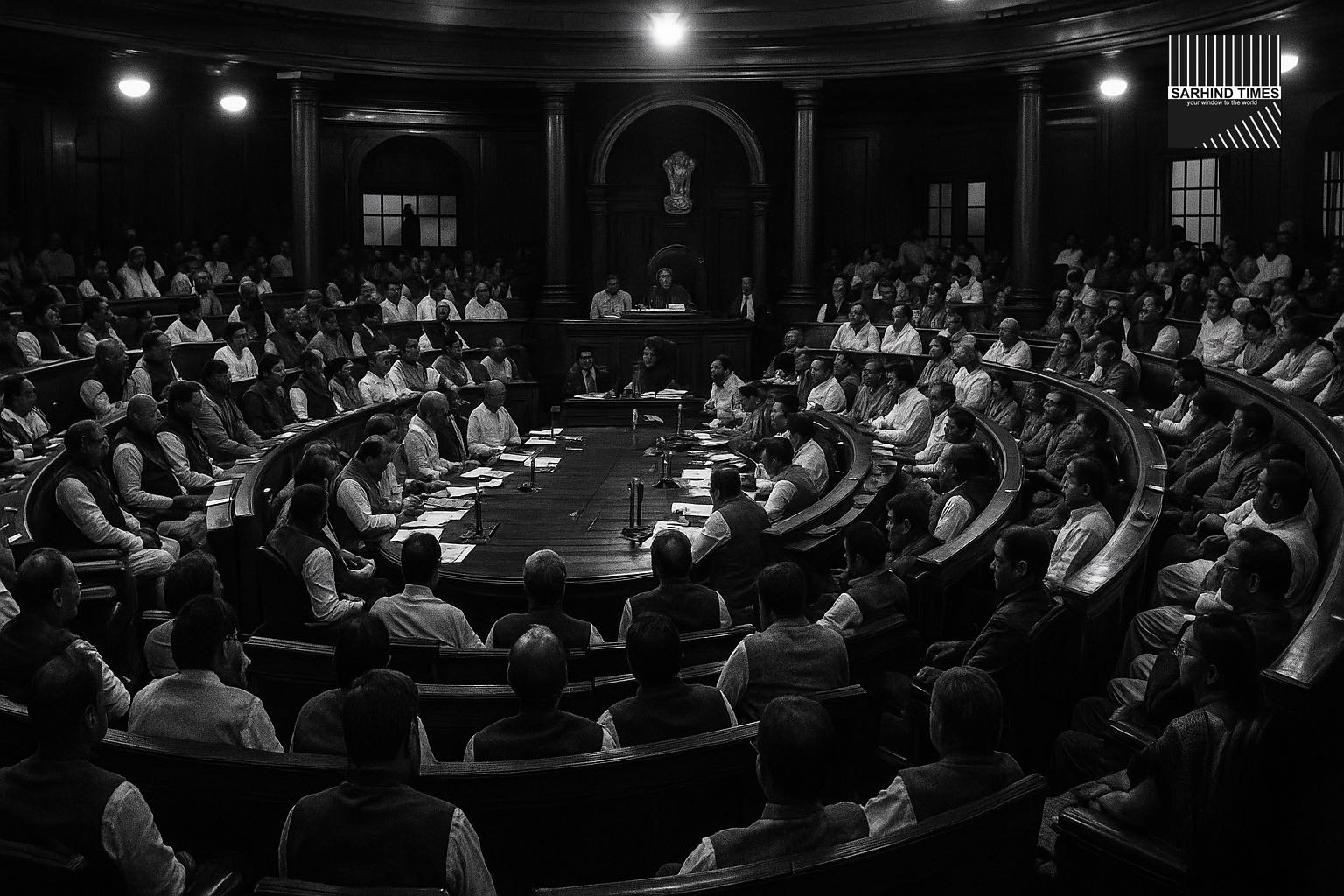
Constitution (One Hundred and Thirtieth Amendment) Bill, 2025 proposes that any minister or chief minister detained on serious charges may be removed — a shake-up in accountability norms
Dateline: New Delhi | 09 November 2025
Summary: The Constitution (One Hundred and Thirtieth Amendment) Bill, 2025 has been tabled in India’s Parliament with the objective of enabling removal of the Prime Minister, a Chief Minister or any Minister—central or state—if they are arrested and detained in custody for serious offences. The Bill signals the government’s push toward tightening political accountability and aims to address longstanding public concerns over criminalisation of politics and ministerial immunity.
The genesis of the Bill
For decades in India, the issue of criminal charges against political office-holders has posed a challenge to democratic accountability. Ministers and Chief Ministers have often retained office even after arrests or prosecutions, leading to public frustration and questions around fairness and transparency. The new Bill, introduced in the lower house of Parliament on 20 August 2025, seeks to provide a constitutional mechanism that addresses this gap.
According to the parliamentary bill-track record, the Constitution (One Hundred and Thirtieth Amendment) Bill, 2025 was introduced in the Lok Sabha on 20 August 2025.
The move is rooted in decades of debate over political ethics, public-trust erosion and the slow pace of judicial resolution of high-profile cases. By linking detention for serious offences with ministerial removal, the government signals a more proactive accountability framework, albeit one kicking off with further legislative and constitutional work ahead.
Key provisions of the Bill
The Bill proposes that if the Prime Minister, a Chief Minister, or any Union or state Minister is arrested and remains in lawful custody in respect of a “serious criminal offence”, they shall cease to hold office. It would apply to Union and state governments, and for Union Territories. Let’s unpack the central features:
- Arrest + Custody Trigger: The Bill is triggered when the office-holder is arrested and detained in custody on account of a serious offence. Mere filing of a charge-sheet or complaint alone is not sufficient; the operative trigger is detention in custody.
- Coverage includes Prime Minister and Chief Minister: The Bill explicitly names the Prime Minister, Chief Ministers, as well as ministers at Union and state level. This is wider than previous attempts which often excluded the top executive.
- Application to Union Territories: The Bill extends coverage to Union Territories (UTs) with legislative assemblies, meaning that ministers in such territories are also subject to the rule.
- Amendment of Constitution required: Given the fundamental nature of ministerial tenure, the Bill proposes to amend the Constitution thereby altering the rules of office for ministers.
- Definition of “Serious Offence”: Although the Bill uses the term “serious criminal offence”, it leaves room for a Parliamentary or regulatory definition, thereby driving future rule-making.
The political and legal context
This Bill comes at a time when public discourse around the criminalisation of politics has intensified. In India, data shows that a non-trivial number of legislators and ministers face criminal charges—including for offences such as extortion, assault, fraud, and organised crime. The delay in prosecuting and the fact that many continue to serve erodes public trust.
<pFurthermore, recent reforms in ethics, ministerial disclosures and censure motions have exposed gaps in accountability frameworks. This Bill is therefore a legislative leap—attempting to ensure that ministers who are detained automatically lose the mandate to occupy office until cleared. If implemented and enforced effectively, it could reshape executive behaviour, discourage egregious conduct and strengthen institutional credibility.
Implications for governance and accountability
From a governance perspective, this Bill carries far-reaching implications:
- Better deterrence: The possibility of removal for ministers upon detention may raise the cost of serious offences by office-holders and disincentivise misuse of power.
- Public trust reinvigoration: For citizens frustrated by delayed justice or unchecked office-holders under investigation, the Bill signals that rule-of-law may catch up with those in power.
- Executive-legislative interplay: The Bill may reduce pressure on legislative councils and committees to hold ministers accountable since the removal trigger is automatic. This shifts oversight from ad-hoc to structural.
However, several caveats and challenges remain. The enforcement mechanism will matter greatly: who certifies arrest and detention, how the “serious offence” threshold is framed, whether interim suspension is automatic or by notice, what happens if the arrest is later found invalid, etc. Legal challenges are likely, possibly to the Supreme Court, especially around ministerial immunity or constitutional protection of executive office.
Analysis: What could this mean for Indian politics
For political parties, the Bill may force earlier internal vetting of ministerial appointments and could influence candidate selection. Ministers may think twice before engaging in conduct that risks arrest. For opposition parties, this creates new leverage: any arrest of a minister instantly raises questions of legitimacy and vacancy in government structures. For bureaucrats, it means a shifted chain of responsibility: if a minister is removed automatically, an acting caretaker may take over, which adds complexity to administrative continuity.
The Bill may also impact coalition governments and state politics where ministerial portfolios are a key bargaining chip. If arrest leads to automatic removal, parties will be more cautious in distributing portfolios and in monitoring allied party ministers. Further, the urgency of proving or disproving charges becomes higher, putting pressure on investigative systems and courts.
Legal and constitutional challenges ahead
There are several legal questions that loom:
- Will the “serious offence” definition pass constitutional muster, given potential vagueness or executive discretion?
- Is the automatic removal compatible with separation of powers and the right to fair trial and presumption of innocence?
- If detainment ends but charges persist, does the minister automatically get reinstated, or is a new process triggered?
- What about ministers arrested abroad, or on foreign litigation? Is the Bill jurisdictionally coherent?
- Would this amendment inadvertently deter talented leaders from roles if the risk of harsh legal actions is high?
Stakeholder reactions
The Bill has generated varied responses. Supporters applaud the push for accountability and cleaner politics; critics caution against rushed legislative drafting, potential misuse or targeting, and dilution of fundamental rights. Legal experts emphasise that while the goal is positive, the framing and safeguards will determine whether it strengthens democracy or creates new vulnerabilities.
Law-firm partners and constitutional scholars note that this is among the most significant ministerial-accountability reforms in decades; but they also stress the risk of litigation and roadmap delays. Some opposition parties have already sought to debate the implications of automatic removal and whether such a rule creates instability in government posts whenever arrest occurs, even for lesser crimes or politically motivated detentions.
Next steps and implementation timeline
The Bill is currently under consideration in Parliament and will need to pass both houses and receive presidential assent before becoming law. Given its constitutional nature, a two-thirds majority may be required for passage. Following enactment, the rules for “serious offence” classification, ministerial removal procedures and transitional provisions will require enabling legislation and possibly amendments to existing laws like the Ministers (Conditions of Service) Act or State equivalent statutes.
Additionally, administrative systems will need to adjust: Cabinet secretariats, state councils of ministers, governor’s offices will all have to build protocols for immediate removal and replacement of detained ministers. Databases may track ministerial arrest-custody status; early-warning systems might be introduced.
Potential ripple effects
Beyond immediate ministerial accountability, this Bill may set precedent for further reforms: early resignations, impeachment-style proceedings, clearer ministerial portfolios, strengthened oversight, more rigorous vetting of candidates, and increased pressure on political parties to maintain “clean” benches. It may also shift the balance of power in states and unions: if ministers retain portfolios only while free from detention, parties may place more emphasis on parliamentary performance rather than fear of legal action.
Conclusion
The Constitution (One Hundred and Thirtieth Amendment) Bill, 2025 represents a bold move in India’s evolving governance landscape. By linking ministerial tenure with arrest and detention for serious offences, it seeks to fill a longstanding accountability gap. Yet, the effectiveness of the reform will depend less on intention and more on execution—on clear definitions, fair processes, legal resilience and administrative follow-through.
For India’s democracy, the stakes are high: If done well, the reform could enhance trust, reinforce respect for rule-of-law and reduce political impunity. If done poorly, it risks institutional conflict, ambiguity and unintended consequences. The next chapters of debate, refinement and enactment will tell whether this is truly an accountability innovation or simply a headline.”



+ There are no comments
Add yours