
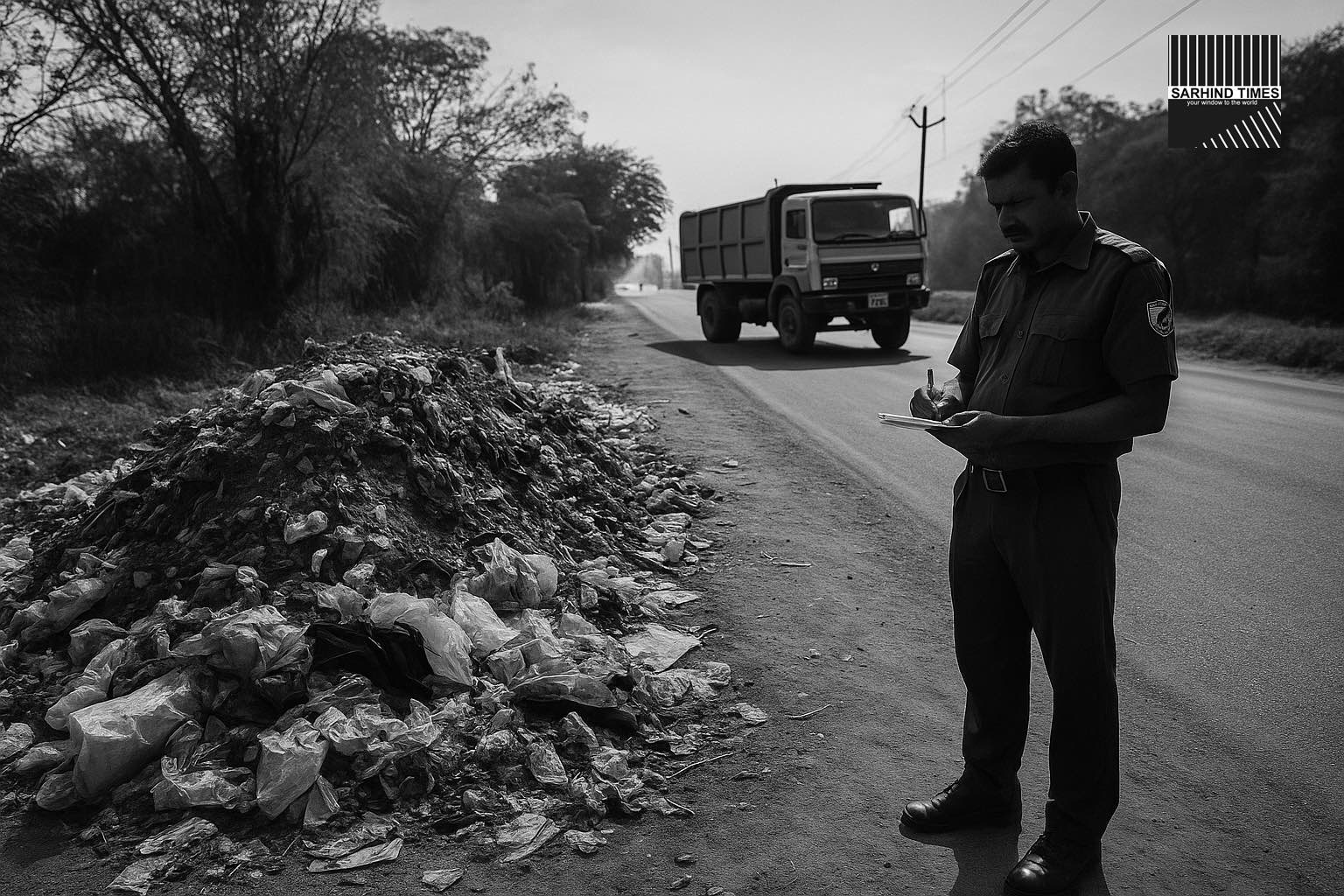
Following a directive from the National Green Tribunal, Haryana’s municipal bodies will now impose stricter penalties for unauthorised dumping, targeting urban areas including Gurugram.
Dateline: Gurugram | November 7 2025
Summary: The Government of Haryana has directed all municipal corporations to enforce fines ranging from ₹5,000 to ₹50,000 for illegal solid-waste dumping in line with a National Green Tribunal order. Compliance will be monitored monthly, and enforcement officers appointed across local bodies such as Municipal Corporation of Gurugram (MCG). The move is aimed at tackling increasing environmental degradation and bolstering urban cleanliness in the state’s fast-growing city zones.
Background: Escalating Waste Challenges in Haryana’s Urban Areas
The rapid pace of urbanisation in Haryana — and particularly in the Gurugram corridor — has brought with it a sharp increase in municipal solid-waste generation, informal disposal practices and unregulated dumping of debris, construction refuse and mixed household waste. According to municipal observations, edges of residential sectors, roadside land-fills, peripheries of industrial parks and wetlands have increasingly become refuge-points for unauthorised waste dumping.
The challenge has been compounded by seasonal factors: as winter approaches, burning of dumped waste adds to air-pollution woes, and untreated leachate seepage from heaps into storm-water drains and wet-zones raises water-quality and sanitation concerns. The Haryana State Pollution Control Board (HSPCB) and municipal bodies cite the need for stronger deterrents to discourage the “dump-and-burn” culture that undermines urban environmental health.
The National Green Tribunal Directive—What Changed
The directive comes on the heels of the National Green Tribunal’s earlier ruling in the case of Prakash Yadav vs State of Haryana & Others. In that order, the tribunal flagged extensive dumping of solid waste along roadsides, rivers, wetlands and government lands across the state, and observed that the practice was leading to serious air-quality and water-pollution consequences. The tribunal directed immediate preventive and punitive action by municipal and state agencies.
In response, the Directorate of Urban Local Bodies (DULB) of Haryana has circulated a formal order to all municipal corporations, municipal councils and nagar panchayats. Key measures laid out include:
- Appointment of enforcement officers mandated for each municipal zone with powers to issue challans and lodge prosecution.
- Monthly compliance and action-reporting evidence, to be submitted to the DULB by November 24 2025.
- Specification of penalty slabs: individuals face fines from ₹5,000 (first offence) and ₹10,000 (repeat); bulk waste-generators or concessionaires face ₹25,000 to ₹50,000.
- Extension of environmental-compensation powers to HSPCB officers, where non-payment will be treated as land-revenue arrears.
- Public-awareness campaigns to be run in tandem, with special focus on sectors prone to dumping and burning during smog-season.
Implications for Gurugram and Its Municipal Corporation
Gurugram, one of the fastest-growing urban zones in India, is named explicitly as part of the enforcement push. The Municipal Corporation of Gurugram (MCG) is required to issue at least 10,000 challans during November targeting open dumping and open burning in the lead-up to the winter-smog season. Residential-sector housing societies, industrial parks and informal settlements are in focus.
MCG officials note that certain peripheral sectors — especially near river-beds, leftover construction plots and non-residential zones — have been hotspots for illegal dumping. With the new penalties in place, the corporation plans to deploy special teams, increase mobile-patrols during early-morning hours, and integrate GPS-tagged complaints to track and act against habitual dumpers.
Why the Timing Matters: Pollution Risks and Winter Challenges
The timing is strategic: as northern India moves into the colder months, two major environmental risks converge — stagnant atmospheric conditions favouring accumulation of fine particulate-matter (PM2.5, PM10) and increased incidence of waste-burning by local generators and households. The combination of waste-burning plus vehicle/industrial emissions exacerbates smog episodes in Gurugram and the wider Delhi-NCR region.
By enforcing stricter waste-dumping penalties now, the state government seeks to pre-empt a seasonal surge in smog events and align with the federal directives on air-quality control. It also signals to citizens and corporations that environmental oversight is no longer fringe but central to urban governance in Haryana.
Expected Benefits and Urban Cleanliness Outcomes
The policy is expected to deliver multiple benefits:
- Reduction in unauthorised dumping, leading to cleaner public spaces, less blocking of drains, fewer fire-incidents from burning waste and improved storm-water flow.
- Improved air-quality on early mornings in Gurugram sectors as open-burning declines and debris piles decrease.
- Enhanced citizen participation and neighbour-reporting through awareness drives, creating a culture of accountability.
- Streamlining of data and reporting via monthly compliance means state agencies can monitor progress in near real-time and deploy resources accordingly.
In sectors where waste had formed large unmonitored mounds, the new deterrent is likely to spur quicker clearance and discourage fresh dumping. For industrial park management and residential societies in Gurugram, the message is clear: waste-management protocols must be tightened or face financial penalties.
Challenges to Implementation
While the policy framework is robust, several challenges remain:
- Resource constraints for municipal bodies: Enforcement-Officer posts need to be filled quickly, trained and equipped; routine patrols in sprawling Gurugram zones may stretch existing staff.
- Resistance from large waste-generators: industrial clusters and informal recycling hubs may attempt to circumvent formal processes; tracking and attribution of illegal dumping may be complex.
- Infrastructure for authorised disposal: Dumping often occurs because of lack of convenient authorised disposal or high charges; unless alternatives are in place, enforcement may push dumping to more remote zones.
- Public-awareness lag: many residents or smaller societies may still be unaware of the new penalty structures; communication and outreach efforts must be amplified.
Linking to Broader Environmental Governance
The move in Haryana falls within a broader trend of stricter environmental governance in Indian cities. As studies and commentary point out, urban India is increasingly impacted by climate waves, pollution risks and infrastructure stress — making municipal-level enforcement essential. For example, analysis ahead of COP30 highlights India’s growing exposure to weather extremes and the need for governance mechanisms that address both mitigation and adaptation.
In that context, waste-management policy is not just a cleanliness or civic issue — it intersects with water-pollution control, air-quality management, urban health outcomes and disaster-resilience frameworks. By elevating waste-dumping fines, Haryana is signalling that environmental regulation in urban zones will be actively enforced rather than mostly advisory.
Next Steps & Monitoring Framework
The state government has laid out the following monitoring roadmap:
- All municipal bodies to submit compliance and action records (including number of challans issued, funds collected, sites cleared) to DULB by November 24, 2025.
- HSPCB to publish monthly summary reports of enforcement data, including zones identified, repeat offenders, disposal-sites cleaned, and amounts of environmental compensation recovered.
- Gurugram’s MCG to deploy mobile complaint-apps where citizens can capture illegal dumping instances, upload geotagged images, and trigger enforcement officers.
- Public-awareness campaigns in high-density housing societies, with periodic audits by resident-welfare associations (RWAs) for illegal dumping and open-burning.
Citizen Role and Expectations
Residents of Gurugram and other urban localities have a role to play. Tips for citizens:
- Report illegal dumping immediately via municipal complaint apps, providing date, time, photo and location to trigger enforcement.
- Ensure household waste is handed over to authorised collection agencies; do not resort to dumping outside sector boundaries or near vacant plots.
- Avoid open-burning of waste — this is increasingly being monitored and fined under winter-smog control rules.
- Participate in local resident-welfare and cleanliness drives; an informed community increases compliance and peer pressure on violators.
Conclusion
Haryana’s decision to implement heavier penalties for illegal waste-dumping comes at a critical juncture for its fast-urbanising cities. In Gurugram, where infrastructure, population density and industrial growth intersect, the enforcement push marks a shift from regulatory talk to action. Whether this will translate into cleaner streets, fewer pollution-incidents and improved urban health depends on implementation, data transparency and citizen cooperation.
In the larger narrative of India’s urban-environmental transition, municipal enforcement matters more than ever. As India engages with global climate agenda and domestic environmental stress-points, states like Haryana that embed regulation, monitoring and community-engagement stand a better chance of managing the challenges of urbanisation with climate resilience and civic dignity.



+ There are no comments
Add yours